They look similar because the script almost never changes. An older generation announces that the young are rude, shallow, and probably doomed. The young roll their eyes and keep dancing, driving, or scrolling.
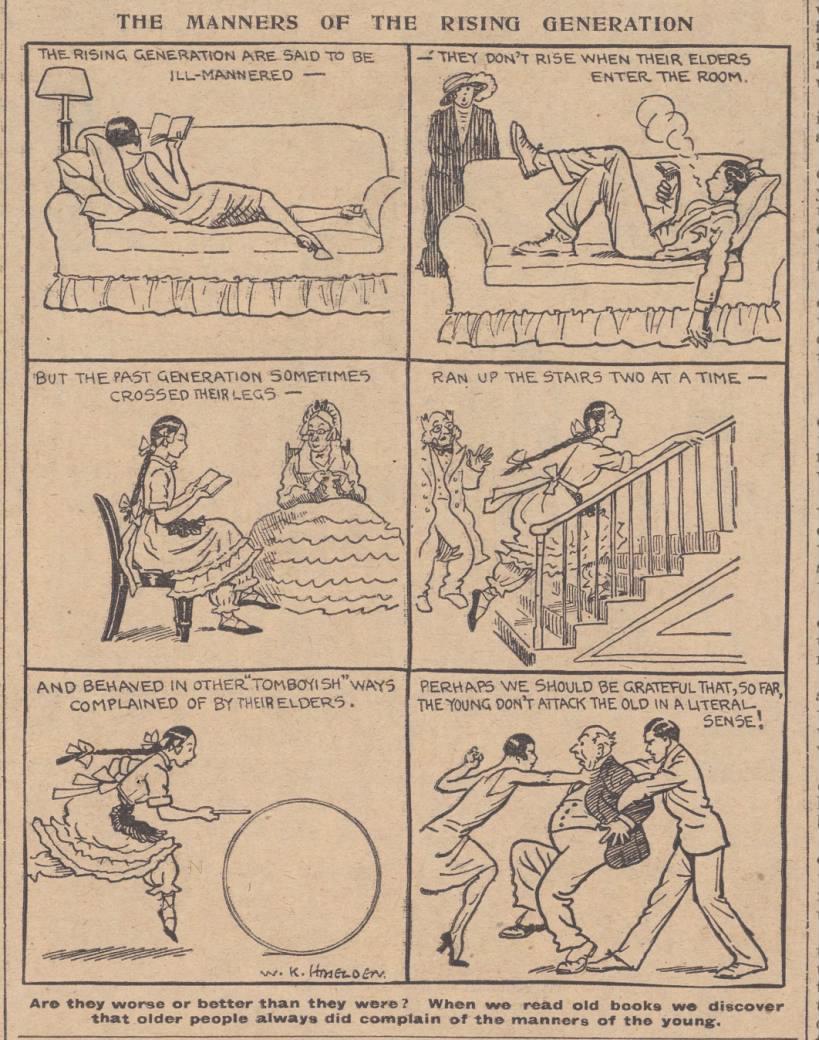
On April 12, 1926, readers opened their newspapers to yet another complaint about “the manners of the rising generation.” The details varied by country and paper, but the theme was the same: short skirts, slang, backtalk, and a worrying lack of respect. A century later, people on Reddit are reading that headline and hearing an echo of every modern rant about smartphones, pronouns, and kids “these days.”
So what actually happened in 1926, and how does it compare to today’s moral panics about youth manners and civility? They look similar because both are reactions to rapid social change, but they grow out of different worlds and use different tools to police behavior.
“Manners of the rising generation” in 1926 was a moral panic about flappers, jazz, and postwar youth independence. Today’s complaints about rude youth focus on phones, social media, and changing norms of respect.
Moral panics about youth manners tend to appear after big shocks, like wars or technological revolutions, when older people feel their authority slipping.
Origins: Why 1926 adults panicked about youth manners
Picture a tram in London or New York in 1926. A middle-aged man in a stiff collar stands, clutching the strap. Nearby, a teenage girl in a cloche hat and short skirt sits, legs crossed, reading a magazine. She does not leap up to offer her seat. She might even be chewing gum.
For a lot of older passengers, that tiny scene was proof that the world had gone wrong.
The complaint about “the manners of the rising generation” did not come out of nowhere. It sat on top of three fresh shocks.
First, the First World War. Between 1914 and 1918, tens of millions of young men fought, and millions died. In Europe, an entire cohort of older brothers and fathers vanished. Authority figures were missing, and the survivors were often disillusioned. Prewar sermons about duty and obedience sounded hollow next to trenches and gas attacks.
Second, the 1918–1919 influenza pandemic. It killed more people worldwide than the war. Death felt random and close. That pushed a lot of young people toward a “live now” attitude that older moralists read as selfishness and bad manners.
Third, the roaring economy of the mid‑1920s. In the United States, Britain, and parts of Europe, wages rose for some, consumer goods got cheaper, and teenagers started to have pocket money. They bought gramophone records, cinema tickets, cosmetics, and cigarettes. They went out without chaperones. They talked back.
Newspapers and magazines, desperate for readers, framed all this as a generational crisis. Articles with titles like “The Manners of the Rising Generation” complained about:
• Girls smoking in public
• Boys not removing their hats indoors
• Young people using slang instead of “proper” English
• Couples petting in cars or dark cinema balconies
• Children interrupting adults in conversation
Behind the etiquette gripes was fear. If young people no longer accepted old rules about how to sit, speak, and dress, what else might they reject? Church? Marriage? Class hierarchy?
So what? The 1926 panic about manners grew out of war, disease, and new money, so it was really about lost authority and a world that no longer looked like the one older people thought they had built.
Origins today: Why phones and pronouns trigger the same nerves
Fast‑forward a hundred years. Swap the tram for a subway car. The older man is still standing, but now everyone is sitting, heads bent over glowing screens. No one meets his eye. No one offers a seat. Somewhere, a columnist is writing that this proves the death of manners.
Today’s moral panic about youth manners also has a triple origin story.
First, digital technology. Smartphones and social media rewired how people communicate in less than twenty years. Older adults who grew up with landlines and face‑to‑face chats often read constant texting, earbuds, and online slang as disrespectful or antisocial.
Second, economic shocks. The 2008 financial crisis, the long grind of wage stagnation, and rising inequality left many older people anxious and nostalgic for a time when “hard work and respect” seemed to promise stability. Complaints about rude youth often carry a subtext: the old deal is gone, and no one is following the rules.
Third, cultural shifts around identity and power. Movements around race, gender, and sexuality have pushed younger generations to question old hierarchies. That shows up in language, from pronouns to calling teachers by first names at some schools. For people raised on stricter titles and roles, that can feel like a collapse of respect.
Modern articles and talk shows complain about:
• Kids glued to phones at the dinner table
• Students challenging teachers in class
• Casual profanity in public
• Online “call‑outs” of older public figures
• Declining use of “sir” and “ma’am” in some regions
The topics changed, but the anxiety is familiar. If the young do not follow the old scripts for politeness, what else might they refuse to obey? Workplace hierarchies? Traditional family roles? National narratives?
So what? Today’s panic about rude, screen‑addicted youth grows from rapid digital change and shifting power dynamics, so it mirrors 1926 by turning broad social anxiety into a story about bad manners.
Methods in 1926: How adults tried to fix ‘bad manners’
In 1926, the main weapons in the manners war were print, pulpits, and parents.
Newspapers ran editorials scolding the “rising generation.” Middle‑class magazines printed etiquette columns telling girls how to sit, speak, and smoke (or not smoke) in public. Advice writers like Emily Post in the United States published bestsellers on proper behavior. Her 1922 book “Etiquette in Society, in Business, in Politics, and at Home” sold widely through the 1920s.
Churches weighed in. Sermons railed against jazz, short skirts, and “necking” in parked cars. In some towns, ministers and civic leaders organized “clean dance” campaigns, trying to ban certain steps or close dance halls early.
Parents and schools tried direct control. Curfews tightened. Daughters were forbidden to bob their hair. Sons were told to stop using American slang picked up from movies. Teachers punished students for speaking out of turn or using casual speech.
Governments rarely legislated manners directly, but they did police the spaces where youth culture flourished. In the United States, Prohibition laws targeted speakeasies, which were also youth hangouts. In Britain, local councils regulated cinemas and dance halls, sometimes under the banner of protecting public morals.
Mass media, especially film, both fed and framed the panic. Movies showed glamorous flappers and cheeky young men. Then newspapers printed worried letters about how those same films were corrupting manners. The cycle sold tickets and papers.
So what? In 1926, adults tried to control youth manners through etiquette manuals, sermons, and local regulation, which turned private generational tension into a very public culture war.
Methods today: From viral outrage to school policies
Today, the tools are different, but the aim is similar: to shame, regulate, or retrain the young into what older people consider proper behavior.
Instead of print editorials, we get viral posts and think‑pieces. A teenager refuses to give up a subway seat, someone films it, and millions weigh in. A clip of students talking back to a teacher circulates on TikTok or X, framed as proof that “kids have no respect anymore.”
Talk radio, cable news, and podcasts amplify the theme. Hosts complain about “participation trophy culture,” “woke” language, or students demanding trigger warnings. The language is new, but the structure is the same as 1926 letters to the editor: a single incident becomes a symbol of generational decline.
Schools respond with policies. Some ban phones in classrooms. Others introduce “character education” or “social‑emotional learning” programs that explicitly teach empathy, eye contact, and respectful speech. Dress codes, especially for girls, are still battlegrounds, just as hemlines were in the 1920s.
Parents try to set rules about screen time, table manners, and how to address adults. At the same time, parenting styles have shifted. Many middle‑class families encourage children to express opinions and question authority, which older observers sometimes misread as pure rudeness.
Governments occasionally step in around the edges. Some cities pass ordinances against “disorderly conduct” or public profanity. Debates over “civility” in universities or public hearings often revolve around how bluntly younger activists can speak to older officials.
Social media also gives young people their own megaphone. Teens can mock out‑of‑touch adults, share their side of a viral incident, or create new norms within online communities. That feedback loop did not exist in 1926.
So what? Today’s methods for policing youth manners run through digital outrage and institutional rules, which makes the conflict faster, louder, and more visible on all sides.
Outcomes in 1926: What actually changed about manners
Did the 1926 moral panic work? Yes and no.
Some old rules collapsed. By the end of the 1920s, it was normal in many cities for young women to go out unchaperoned, to smoke in public, and to wear shorter dresses. Young men and women called each other by first names, went on dates without a formal “calling” ritual, and kissed in cars.
New etiquette emerged instead of no etiquette. Emily Post updated her books to accept some modern habits. She still insisted on saying “please” and “thank you,” but she allowed that a woman could smoke at a dinner party if she did so with “discretion.”
Respect shifted from automatic to conditional. In many middle‑class families, children were still expected to obey, but they also expected more warmth and explanation from parents. Teachers began to deal with students who had seen the world during the war or in factories, not just sheltered children.
Class lines blurred a bit. Working‑class youth copied the manners and style of movie stars. Some middle‑class kids picked up slang and dance steps from Black jazz musicians or immigrant neighborhoods. That mixing horrified traditionalists, but it stuck.
At the same time, new forms of politeness developed around technology. People learned how loudly to speak on telephones, how to behave in cinemas, how to act on buses. Those rules were not the same as Victorian drawing‑room etiquette, but they were still rules.
So what? The 1926 panic did not stop change, but it helped shape a new, looser code of manners that fit an urban, consumer, postwar world.
Outcomes today: What is really happening to manners?
Modern surveys give a mixed picture. Many adults say manners are worse. They point to road rage, online abuse, and people checking phones mid‑conversation.
Yet in some ways, manners have expanded. There is more attention to inclusive language, to asking consent, to not making racist or sexist jokes in public. A 1926 dinner party might have had perfect table manners and open bigotry. Today, a teenager who forgets to say “sir” might still be more careful about slurs and harassment than his great‑grandfather was.
Digital life created new etiquette. There are unwritten rules about when to leave someone on “read,” how quickly to respond to group chats, when it is acceptable to film someone, and how to credit creators. Violating those norms can get you socially punished, even if older adults do not recognize those rules as manners.
Respect is more negotiated. Many young people believe respect should be mutual, not automatic. They may refuse to defer to adults who they see as bigoted or hypocritical. That can look like rudeness to someone raised on “respect your elders no matter what.”
On the flip side, online anonymity makes it easier to be cruel without immediate consequences. Comment sections and gaming chats can be vicious. That is a real change from 1926, when most insults had to be delivered face‑to‑face.
So what? Today’s outcomes look less like the death of manners and more like a messy transition to new norms, where some courtesies weaken, others strengthen, and digital life adds a whole extra layer.
Legacy: Why the 1926 panic still feels familiar
The phrase “manners of the rising generation” could be dropped into a modern op‑ed with barely a tweak. That is the legacy of 1926: it set a pattern for how we talk about youth and decline.
Every few decades, a new technology or social shift arrives. In the 1920s it was cars, jazz, and cinema. In the 1950s it was rock and roll and television. In the 1980s it was video games and MTV. Today it is smartphones and social media. Each time, older generations reach for the same language of rudeness and decay.
Historians who look back at 1920s moral panics see a useful warning. Many of the behaviors that horrified adults then now look tame or even respectable. The flapper who smoked in public became the grandmother who tutted at miniskirts in the 1960s.
The 1926 debate also shows how manners are tied to power. Politeness rules often protect the comfort of those already in charge. When young people, women, or minorities push back, they get labeled rude. That was true when jazz‑loving teenagers ignored their elders, and it is true when students today confront politicians on live TV.
At the same time, the past reminds us that manners are not fake. They are real social tools. A shared sense of how to treat strangers can make crowded cities and online spaces bearable. The question is whose comfort those rules protect, and who gets to rewrite them.
So what? The 1926 panic about the “manners of the rising generation” matters today because it shows that every era thinks its youth are the rudest yet, while quietly building the next version of normal.
Frequently Asked Questions
What did people mean by “manners of the rising generation” in 1926?
In 1926, complaints about the “manners of the rising generation” referred to worries that young people were less respectful and more self‑indulgent than before. Adults pointed to flappers’ clothes, public smoking, slang, casual dating, and a perceived lack of deference to parents, teachers, and elders as signs that traditional etiquette and authority were breaking down after World War I.
Were 1920s flappers really considered rude or immoral?
Yes, many older observers in the 1920s saw flappers as rude and immoral. Short skirts, bobbed hair, dancing to jazz, smoking and drinking in public, and going out unchaperoned broke Victorian and Edwardian rules of female behavior. To flappers, these habits expressed freedom. To critics, they looked like bad manners and a threat to social order.
How is today’s concern about rude youth similar to the 1920s?
Today’s concern about rude youth is similar to the 1920s in that it appears after major social and technological change and focuses on visible habits. In the 1920s, adults attacked jazz, cars, and cinema. Today they target smartphones, social media, and casual speech. In both cases, older generations interpret new behavior as disrespectful and fear it signals deeper moral decline.
Are manners actually getting worse over time?
Evidence is mixed. Many people feel manners are getting worse, especially around phones and public behavior. Yet other forms of politeness have expanded, such as attention to inclusive language and consent. History suggests manners do not simply decline. They change with technology and social values, dropping some rules and adding others as each generation renegotiates what respect looks like.