On a spring day in April 1926, a reader opened a magazine and saw something instantly familiar and slightly embarrassing: a cartoon titled “Those Victorian Objects of Decoration.”
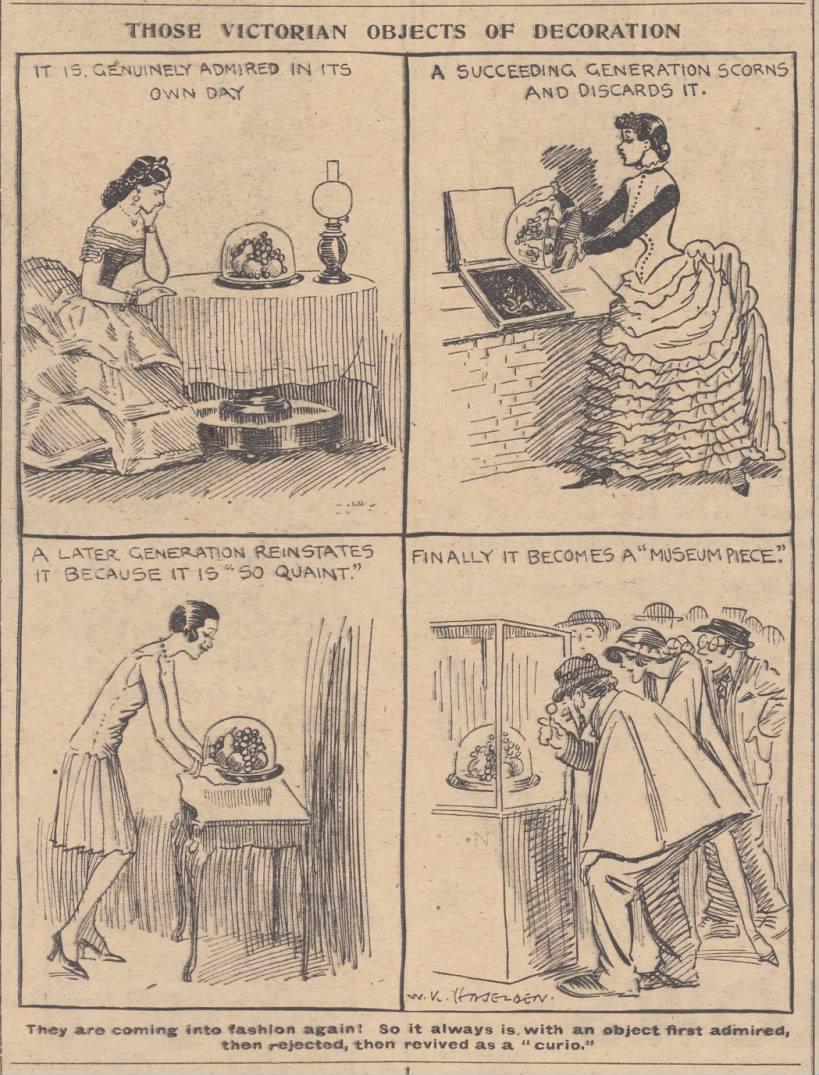
The drawing, which circulated in newspapers and magazines around that time, showed a suffocating Victorian parlor. Every surface was crowded with vases, china dogs, framed mottoes, stuffed birds under glass, and knick‑knacks that looked like they had multiplied in the night. The joke was simple. This is what your parents’ or grandparents’ house looked like. And now it looked ridiculous.
By 1926, “Victorian objects of decoration” had become shorthand for clutter, bad taste, and an older generation’s obsession with stuff. The mockery said as much about the 1920s as it did about the 1880s. To understand why people were laughing, you have to understand why Victorians filled their homes the way they did, and why their children were suddenly desperate to clear the mantels.
What follows is the story of how the Victorians turned objects into moral lessons and status symbols, how their children turned those same objects into punchlines, and how that fight over bric‑a‑brac helped shape what we now call “good taste.”
Why did Victorians fill their homes with so much stuff?
Victorian decoration was not random clutter. It was a system.
From roughly the 1840s to the 1890s, middle‑class families in Britain and across the English‑speaking world treated the home as a stage on which to perform respectability. Industrialization had created new wealth and new insecurity. A clerk or shopkeeper might earn enough to buy a house, but not enough to feel secure in his class position. Objects helped fill that gap.
Cheap mass production made it possible. Staffordshire potteries churned out figurines and dogs. Birmingham factories produced brass ornaments. Printed cottons, lace curtains, and machine‑made carpets poured out of mills. For the first time, a clerk’s wife could buy things that looked vaguely like what aristocrats had owned a generation earlier.
Victorian decoration followed a loose logic. Walls were crowded with framed prints and family photos. Mantels carried clocks, vases, and figurines. Tables were draped in cloths and topped with lamps, photograph albums, and what magazines politely called “ornaments.”
The objects were not just pretty. They were supposed to be improving. A framed motto might read “Home Sweet Home” or “God Bless Our Home.” A figurine might show a shepherdess, a classical figure, or a famous writer. Shellwork, pressed flowers, and wax fruit showed that the women of the house were industrious and refined.
One crisp definition historians use: Victorian bric‑a‑brac was mass‑produced ornament that middle‑class families used to signal morality, refinement, and social aspiration. It was a visual language of virtue, even if it looks like chaos to modern eyes.
There was also a gender story. The Victorian middle‑class man was supposed to battle in the public world of work. The woman was supposed to rule the private world of the home. Decoration became part of her job description. Advice books told women that arranging objects correctly would create a moral refuge from the harsh outside world.
So the clutter was not accidental. It was the material expression of Victorian values: industriousness, sentiment, piety, and a deep anxiety about class. That is the world the 1926 cartoon was skewering.
So what? Because once you see that Victorian clutter was a moral and social project, the later mockery of it becomes a rebellion against more than just bad lamps. It was a rebellion against a whole way of living.
What exactly were “Victorian objects of decoration”?
When people in 1926 talked about “Victorian objects of decoration,” they meant a specific set of things that had filled late 19th‑century parlors and drawing rooms.
Some of the most common:
1. Bric‑a‑brac and mantel clutter.
China dogs, Staffordshire figurines, small vases, glass domes with wax flowers or stuffed birds, seashell arrangements, and souvenir miniatures from seaside resorts. The mantelpiece was prime real estate, and it was rarely left with any bare space.
2. Framed mottoes and sentimental prints.
Cheap color prints of religious scenes, sentimental children, or moral stories. Embroidered mottoes framed under glass. Portraits of Queen Victoria or famous statesmen. The wall was a gallery of values.
3. Heavy textiles and covers.
Tablecloths with fringes. Antimacassars (small lace or crocheted cloths) on chair backs to protect from hair oil. Layered curtains and valances. The effect was softness and abundance, but also dust traps.
4. Curios and souvenirs.
Shells, minerals, foreign coins, Japanese fans, and other “curiosities” arranged in cabinets. These showed that the family was educated, traveled, or at least interested in the wider world, even if the objects came from a local shop.
5. Clocks and lamps.
Ornate mantel clocks, sometimes with gilded figures, and oil or gas lamps with decorated shades. These were practical but also decorative centerpieces.
One snippet‑ready summary: “Victorian objects of decoration” were the mass‑produced ornaments, textiles, and framed mottoes that filled 19th‑century middle‑class homes, turning rooms into dense displays of sentiment and status.
By the 1920s, many of these items were still sitting in people’s houses, especially in Britain and older American towns. They were inherited, not chosen. That made them ripe for satire.
So what? Because once you know what those objects were, you can see how the 1920s generation used them as props in a cultural argument about taste, modernity, and what a home should say about its occupants.
Why did the 1920s generation start mocking Victorian decor?
By 1926, the world that had produced all that bric‑a‑brac was gone.
Queen Victoria had died in 1901. Her son Edward VII reigned until 1910. The First World War then smashed the old order. Millions died. Aristocratic fortunes collapsed. Women worked in factories and offices. The old moral certainties that Victorian mottoes had preached looked hollow after the trenches of the Somme.
In art and design, the change was just as sharp. Art Nouveau had already softened some of the heaviness around 1900. Then came Art Deco and modernism. Clean lines, geometric patterns, and stripped‑down forms were in fashion. Architects like Le Corbusier and designers like the Bauhaus group argued that “ornament is crime” or at least a waste of material and effort.
Magazines and department stores pushed the new look. Rooms were shown with bare floors, simple furniture, and a few carefully chosen objects. The word “clutter” became an insult. “Period rooms” full of Victorian stuff were used as cautionary tales.
In that context, a cartoon titled “Those Victorian Objects of Decoration” was more than a joke about ugly vases. It was a generational eye‑roll. The children and grandchildren of Victorians were saying: look what we grew up with. Look what we have to clear out.
There was also a class angle. Some of the new taste‑makers were from old elites who had always sneered at middle‑class excess. Others were from the same middle class but now armed with design education and a sense of superiority. To them, the crowded mantelpiece was proof that their parents had been duped by mass production.
Writers in the 1920s often used the word “Victorian” as a slur. It meant stuffy, prudish, sentimental, and cluttered. When they said “Victorian objects of decoration,” they were not just naming a style. They were condemning a whole attitude to life.
So what? Because the mockery of Victorian decor in the 1920s shows how design became a weapon in a wider fight over modernity, memory, and who got to define “good taste.”
The turning point: from heirlooms to junk
There was a specific moment, roughly between 1900 and 1930, when Victorian objects shifted from treasured possessions to embarrassing junk.
Before 1900, even modest ornaments were often kept for life. They were gifts from weddings, tokens of affection, or souvenirs of trips. Throwing them away felt wrong. They were part of the family story.
After 1900, several forces pushed people to reconsider.
1. Changing housing.
Urban apartments and smaller suburban houses had less room for display. The classic Victorian parlor, used mainly for receiving guests, gave way to the more informal “living room.” There simply was not space for twenty figurines and three ferns.
2. New domestic technology.
Vacuum cleaners, better lighting, and new ideas about hygiene made dust more visible and more offensive. All those objects were dust magnets. Advice columns started to link clutter with dirt and disease.
3. The trauma of war.
The First World War forced many families to move, downsize, or sell possessions. Young officers saw the world, stayed in modern hotels, and came home with different expectations. The war also gave people a sense that the old world was gone. Keeping every object from 1880 suddenly felt less like continuity and more like being stuck.
4. The rise of professional taste.
Interior decorators and design writers carved out a profession. They had a financial interest in telling people that their current possessions were out of date. They offered to curate, simplify, and modernize.
By the mid‑1920s, the tipping point had been reached. Newspapers ran cartoons mocking “Aunt Emily’s antimacassars” and “Grandma’s what‑nots” (the corner shelves loaded with ornaments). Auctions were full of Victorian furniture and bric‑a‑brac sold cheaply.
One crisp causal claim: As housing shrank, hygiene standards rose, and modern design ideals spread, Victorian decorative objects lost their moral aura and became symbols of clutter and bad taste.
So what? Because that shift from heirloom to junk is how entire eras of material culture vanish from everyday life, leaving only a few survivors in museums and antique shops and a lot of baffled descendants asking what all that stuff was for.
How did families actually get rid of all that Victorian stuff?
The cartoon in 1926 captured something many readers were living through: the quiet, sometimes painful process of clearing out Victorian homes.
For many families, this happened when an older relative died. The children or grandchildren would walk through rooms packed with objects and have to decide what to keep, what to sell, and what to throw away. The sentimental value that had attached to each vase or framed motto did not always transfer to the next generation.
Estate sales became a regular feature of local life. Advertisements from the 1920s list “Victorian suite,” “ornamental china,” and “assorted bric‑a‑brac” as if these were almost interchangeable. Dealers bought lots cheaply and resold the few items that still had fashion value.
Some objects survived by being rebranded as “antiques.” High‑quality Victorian furniture in dark woods might be kept, sometimes stripped or painted. A few types of ceramics and glassware were collected for their craftsmanship. But the everyday mottoes, wax fruit, and mass‑produced figurines largely went out with the trash.
There was also a psychological side. For some younger people, getting rid of Victorian objects felt like shedding an old identity. A woman who cut her hair into a bob and wore a shorter skirt did not want to drink tea under a framed text about “A Woman’s Place.” A man who worked in a modern office did not want to sit every evening in a room that looked like 1885.
Not everyone was happy about this. Some older people saw the new bare rooms as cold and impersonal. They missed the sense of coziness and memory that came with a crowded mantelpiece. Letters and memoirs from the time sometimes mention arguments over “all that old stuff” and whether it should be kept.
So what? Because the clearing out of Victorian decoration was not just a design trend. It was a family drama, where objects became proxies for arguments about memory, loyalty, and how much of the past to carry into the future.
From joke to nostalgia: the legacy of Victorian decoration
By the mid‑20th century, the sharp mockery of 1926 had softened into something else: nostalgia.
After the Second World War, another generation looked back at the late 19th century as a more stable, if stuffy, time. The term “Victoriana” emerged to describe surviving objects from the era. Antique shops and collectors began to hunt for items that the 1920s had thrown away.
Television and film used Victorian clutter as a visual shorthand. Want to show a respectable 1890s household? Fill the set with doilies, ferns, and framed mottoes. Want to show a suffocating, old‑fashioned home that a young heroine longs to escape? Same objects, different mood.
Historians of design started to take Victorian decoration seriously. They pointed out that the same industrial processes that produced cheap bric‑a‑brac also produced the goods that raised living standards. They noted that what later generations mocked as “clutter” had once been a way for ordinary people to participate in visual culture.
Today, there is a small but steady market for Victorian objects of decoration. Some people collect Staffordshire dogs or framed mottoes precisely because they are so out of step with modern minimalism. Others inherit a single piece, like a glass dome or a china figurine, and keep it as a fragment of family history.
At the same time, the basic pattern has repeated. Late 20th‑century “country” decor, 1980s chintz, and early 2000s shabby chic have all gone through their own cycles of mass adoption, mockery, and partial revival. What Victorians did with vases, later generations did with throw pillows and word art.
So what? Because the fate of Victorian objects of decoration shows how taste is not fixed. It is a moving argument between generations, and the objects on our shelves are the evidence.
Why “Those Victorian Objects of Decoration” still matter
That 1926 cartoon, resurfacing a century later on Reddit’s r/100yearsago, hits a nerve because the basic situation has not changed.
We still inherit rooms full of objects we did not choose. We still argue about clutter versus minimalism. We still use design to signal who we are and which generation we belong to. The only difference is the style of the objects.
Victorian ornaments tell us how a rising middle class used cheap goods to build a sense of self. The 1920s mockery of those ornaments tells us how their children tried to invent a new self, stripped of what they saw as sentimentality and pretension. Both moves are understandable. Both left a lot of physical stuff in their wake.
When people today ask, “What were those Victorian objects of decoration?” they are really asking two things. What were these odd, fussy things my ancestors owned? And how did taste change so much that something once cherished became a joke?
The answer is that taste is history written in porcelain, brass, and framed mottoes. Those Victorian objects of decoration were not just clutter. They were the material script of an age that believed objects could make you better. The 1926 cartoon was the beginning of the rewrite.
So what? Because the next time you roll your eyes at someone else’s decor, remember that a hundred years from now, your own “good taste” may be the punchline in someone’s cartoon.
Frequently Asked Questions
What were Victorian objects of decoration?
Victorian objects of decoration were the mass‑produced ornaments, textiles, and framed mottoes that filled 19th‑century middle‑class homes. They included china figurines, mantel clocks, embroidered mottoes, heavy curtains, antimacassars, and curios in glass domes. Families used them to signal respectability, sentiment, and social aspiration.
Why did Victorians have so much clutter in their homes?
Victorians filled their homes because industrial mass production made ornaments cheap and because decoration was tied to morality and status. A crowded parlor showed that the family was industrious, pious, and refined. Women were expected to manage the home, and arranging objects was part of their role. What looks like clutter now was once seen as a carefully built display of virtue and comfort.
Why did people in the 1920s mock Victorian decor?
By the 1920s, tastes had shifted toward simpler, more modern interiors influenced by Art Deco and modernism. The First World War, smaller homes, new hygiene standards, and professional interior design all pushed against heavy ornament. “Victorian” became shorthand for stuffy and old‑fashioned, so cartoons like “Those Victorian Objects of Decoration” mocked the crowded parlors of parents and grandparents as symbols of bad taste and an outdated way of life.
What happened to all the Victorian bric‑a‑brac?
Between about 1900 and 1930, much Victorian bric‑a‑brac was cleared out during estate sales, moves, and redecorations. Everyday items like wax fruit, mottoes, and cheap figurines were often thrown away or sold cheaply. Some higher‑quality pieces survived as antiques, and a later wave of collectors in the mid‑20th century began to seek out “Victoriana.” Today, surviving pieces are found in museums, antique shops, and family heirloom collections.