Picture a woman in 1926, standing at a department store counter in Chicago. She is buying face cream labeled “Anti-Wrinkle” and a new cloche hat that hides her hairline. The clerk asks for her age to fill in a store credit form. She smiles, hesitates, and knocks five years off the number.
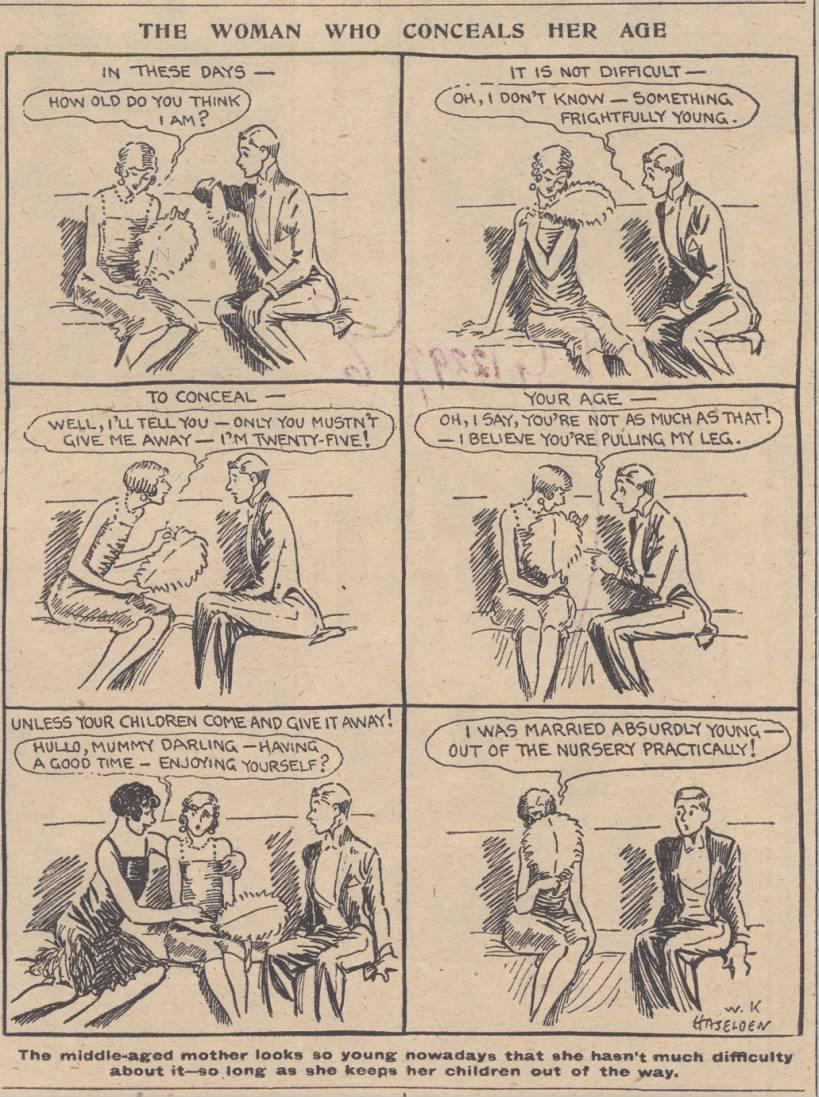
By the mid-1920s, this was a familiar joke. Newspapers and magazines ran cartoons about “the woman who conceals her age,” usually a bob-haired flapper lying through her lipstick. But behind the gag was a serious social story: why, in a decade obsessed with youth, did women feel pushed to hide how old they were?
The 1926 headline “The Woman Who Conceals Her Age” was not just a throwaway gag. It captured a cultural anxiety about aging, femininity, and respectability at a moment when women’s lives were changing fast. To understand that phrase, you have to see how the 1920s rewired ideas about beauty, work, and time itself.
What was “the woman who conceals her age” in the 1920s?
In 1920s media, “the woman who conceals her age” was a stock character. She was the middle-aged or older woman who lied about her years, dyed her hair, used cosmetics, and adopted youthful fashions to pass as younger.
Cartoons showed her tugging at her corset, hiding gray hair under a fashionable hat, or dodging questions about her birth year. Advice columns mocked her, beauty ads targeted her, and short stories used her as a warning or a punchline.
So when a 1926 paper ran a piece titled “The Woman Who Conceals Her Age,” readers knew the type. They expected a mix of scolding and sympathy: jokes about vanity, plus hints that society had backed her into a corner.
In plain terms, “the woman who conceals her age” was a cultural figure that embodied the pressure on women to stay young in order to be considered attractive, employable, and respectable. She was less a specific person and more a mirror of 1920s gender expectations.
That matters because it shows how early the modern age of anti-aging anxiety arrived. Long before Instagram filters, the 1920s were already treating a woman’s age as a problem to be managed and disguised.
What set it off: why age suddenly became a problem in the 1920s
Women had lied about their age long before 1926. What changed in the 1920s was the intensity and visibility of the pressure to stay young.
First, there was the new cult of youth. After the First World War, the “modern girl” or flapper became a global symbol. Short skirts, bobbed hair, slim figure, carefree attitude. Magazines and movies sold youth as the ideal, not just for teenagers but for everyone.
Second, the beauty industry exploded. Between about 1910 and 1930, American spending on cosmetics and beauty treatments soared. Companies like Pond’s, Palmolive, and Cutex ran national ad campaigns. Many of those ads were blunt: “Don’t let wrinkles steal your charm” or “Keep him guessing your age.”
Those ads did two things at once. They created anxiety about aging, then sold a solution. The message was simple: a good woman, a modern woman, did not “let herself go.”
Third, women were entering public life in new ways. The 19th Amendment in 1920 gave women the vote. More women worked in offices, shops, and factories. They were visible in workplaces, in politics, in city streets. Age suddenly mattered for hiring, promotion, and marriage prospects in a more public way.
Older women especially felt squeezed. They had grown up in the Victorian or Edwardian world of long skirts and domestic ideals, then woke up in a decade that worshipped youth and slimness. Many tried to adapt: bobbing hair, using lipstick, wearing shorter skirts. Others were mocked for trying.
Finally, there was simple arithmetic. Birth registration had become more standardized in the early 20th century, but many people born in the 19th century did not have clear records. That left room for “flexible” ages, especially for women who wanted to shave off a few years on forms or in social settings.
So the 1920s created a perfect storm: a youth-obsessed culture, a booming beauty business, new public roles for women, and still-loose documentation. That storm turned a private fib about age into a public cultural type.
This matters because it shows that the “age problem” was not just about vanity. It was built into new markets, new media, and new roles that rewarded youth and punished visible aging.
The turning point: from private fib to public joke
By 1926, the woman who concealed her age had moved from private behavior to public spectacle. You can see the turning point in three places: newspapers, movies, and etiquette debates.
Newspapers and magazines ran humor columns about women lying on census forms or at the marriage license office. Cartoons showed clerks rolling their eyes as a clearly middle-aged woman claimed to be 29. These jokes only work once readers share a common idea: women are expected to hide their age, and everyone pretends to believe them.
Hollywood helped. Silent films in the 1920s often played with age and appearance. Comedies featured older actresses playing “mutton dressed as lamb,” chasing younger men or competing with flappers. The audience was invited to laugh at the gap between the character’s claimed age and her visible body.
At the same time, etiquette writers were arguing about whether it was rude to ask a woman’s age. Some columnists insisted it was improper. Others mocked that taboo as silly. The very fact that people were debating the question showed how sensitive it had become.
There were also more formal moments when age suddenly mattered. Pension applications, immigration forms, and driver’s licenses (still new in the 1920s) all asked for birth dates. Women who had once been able to fudge their age socially now met a growing wall of paperwork.
So by the mid-1920s, the woman who concealed her age was no longer just a private person shaving off a few years. She was a public joke, a debated etiquette problem, and a figure used to sell creams and cosmetics.
That shift matters because once a behavior becomes a stock joke, it also becomes a social pressure. Women were not only expected to stay young, they were warned that trying too hard would make them ridiculous.
Who drove this obsession: advertisers, reformers, and real women
No single person invented “the woman who conceals her age.” She emerged from the collision of several groups with very different agendas.
Advertisers and beauty companies were key. Firms like Pond’s Cold Cream and Palmolive Soap paid for full-page ads in national magazines. Their copywriters often wrote short “stories” about women whose husbands or bosses praised them for looking younger than their years. The villain in those mini-dramas was usually age itself.
Some of the most aggressive campaigns were aimed at women in their thirties and forties. They warned that “first lines” and “faded charm” would cost them affection or opportunity. The not-so-subtle message: if your age shows, you have failed.
Magazine editors and advice columnists also kept the topic alive. Women’s magazines like Ladies’ Home Journal, Good Housekeeping, and Vogue ran pieces on “growing old gracefully” right next to ads promising to erase years. They told readers not to lie about age, then endorsed products that made lying easier.
On the other side were reformers and early feminists who saw the trap. Writers such as Charlotte Perkins Gilman and, in Britain, Rebecca West criticized the way women’s value was tied to youth and looks. They argued that a society that forced women to conceal their age was one that feared female experience and authority.
Yet even some outspoken women played along. Actresses, for instance, had strong incentives to shave years off their public biographies. Studios often rewrote birth dates for stars. A performer who admitted to being over thirty risked being typecast as a mother instead of a romantic lead.
And then there were the millions of ordinary women who did the actual concealing. Census takers noticed that women’s ages on forms often did not match baptismal records. Some marriage licenses show brides “aging backwards” between first and second marriages. These were quiet acts of self-defense in a world that punished visible aging.
This matters because it shows that the age-hiding obsession was not just top-down propaganda. It was a feedback loop between advertisers, media, moralists, and women making tactical choices in a biased system.
What it changed: work, marriage, and the business of aging
The 1920s fixation on women concealing their age had real consequences. It shaped how women thought about work, marriage, and their own bodies.
In the workplace, age became a gatekeeper. Employers in offices and shops often preferred younger women, who were seen as more modern and cheaper. Older women who wanted to keep jobs had incentives to “pass” as younger through dress and grooming. Appearance became part of employability.
In marriage and dating, the age gap between men and women was treated differently. Men could be “distinguished” as they aged. Women were “faded.” Advice columns warned women that after a certain age, their marriage prospects declined sharply. No wonder some chose to shave a few years off when meeting new suitors.
The beauty and fashion industries reorganized themselves around age anxiety. Anti-wrinkle creams, hair dyes, and “rejuvenating” treatments became big business. Department stores opened beauty salons. Newspapers carried ads for “reducing salons” that promised to restore a youthful figure.
This period also helped normalize the idea that a woman’s official age and her “social age” might differ. Jokes about women being “29 again” started appearing in print in the early 20th century and spread in the 1920s. That joke still circulates today.
On a deeper level, the figure of the age-concealing woman helped fix the idea that women’s value was tied to how well they could resist time. Male aging might be about career and achievement. Female aging was about appearance and loss.
That matters because it laid the groundwork for a modern anti-aging culture. The assumptions that beauty has an expiration date, that women must fight the clock, and that lying about age is both expected and mockable, all took clearer shape in this era.
Why it still matters: from 1926 jokes to today’s age anxiety
When people today see a 1926 clipping titled “The Woman Who Conceals Her Age,” it can seem quaint. The fashions are old. The language is dated. The anxiety is not.
Modern social media is full of age filters, anti-aging serums, and jokes about never admitting your real age. Celebrities face scrutiny when they “age naturally” and suspicion when they do not. Job seekers quietly delete early jobs from their résumés to avoid looking “too old.”
The 1920s were one of the first decades when mass media, consumer capitalism, and changing gender roles collided to make women’s age a public problem. That collision set patterns we still live with: the double standard for aging, the commercialization of insecurity, and the expectation that women manage their appearance as part of their identity.
Looking back at “the woman who conceals her age” also reminds us that the behavior often mocked as vanity was usually a survival strategy. Women were responding rationally to a world that punished them for visible aging in ways men did not face.
So when a 1926 newspaper joked about the woman who would not tell her age, it was not just teasing one type of person. It was helping to build a culture where a woman’s years were both her business and everyone else’s, something to be hidden, guessed at, and judged.
That legacy still shapes how we talk about age, who is allowed to be visibly older in public life, and why a simple question like “How old are you?” can still feel loaded for many women.
Frequently Asked Questions
Why did women hide their age in the 1920s?
Women in the 1920s hid their age because youth was heavily rewarded in work, marriage, and social life. A booming beauty industry and media culture tied women’s value to looking young, so many shaved years off their age or used cosmetics and fashion to appear younger.
When did jokes about women lying about their age start?
Jokes about women lying about their age appeared in newspapers and magazines by the late 19th century, but they became especially common in the 1920s. That decade’s focus on flappers and youth made the “woman who conceals her age” a stock comic figure.
How did the beauty industry affect women’s views on aging?
The early 20th-century beauty industry ran aggressive ad campaigns that framed wrinkles, gray hair, and weight gain as problems that would cost women love and opportunity. By selling creams, dyes, and treatments, companies taught women to see aging as something to fight and hide.
Is the 1920s attitude toward women’s age still present today?
Yes. Modern culture still often treats women’s aging as a problem to be solved, with anti-aging products, cosmetic procedures, and social pressure to look younger. The double standard where men can age “gracefully” while women are judged more harshly has roots in the early 20th century.