She is frozen mid-laugh, a cigarette between her fingers, a highball glass sweating on the table. Hair set, eyeliner sharp, dress fitted but not scandalous. The Reddit caption asks: “Would you have a drink with her? 1960s.”
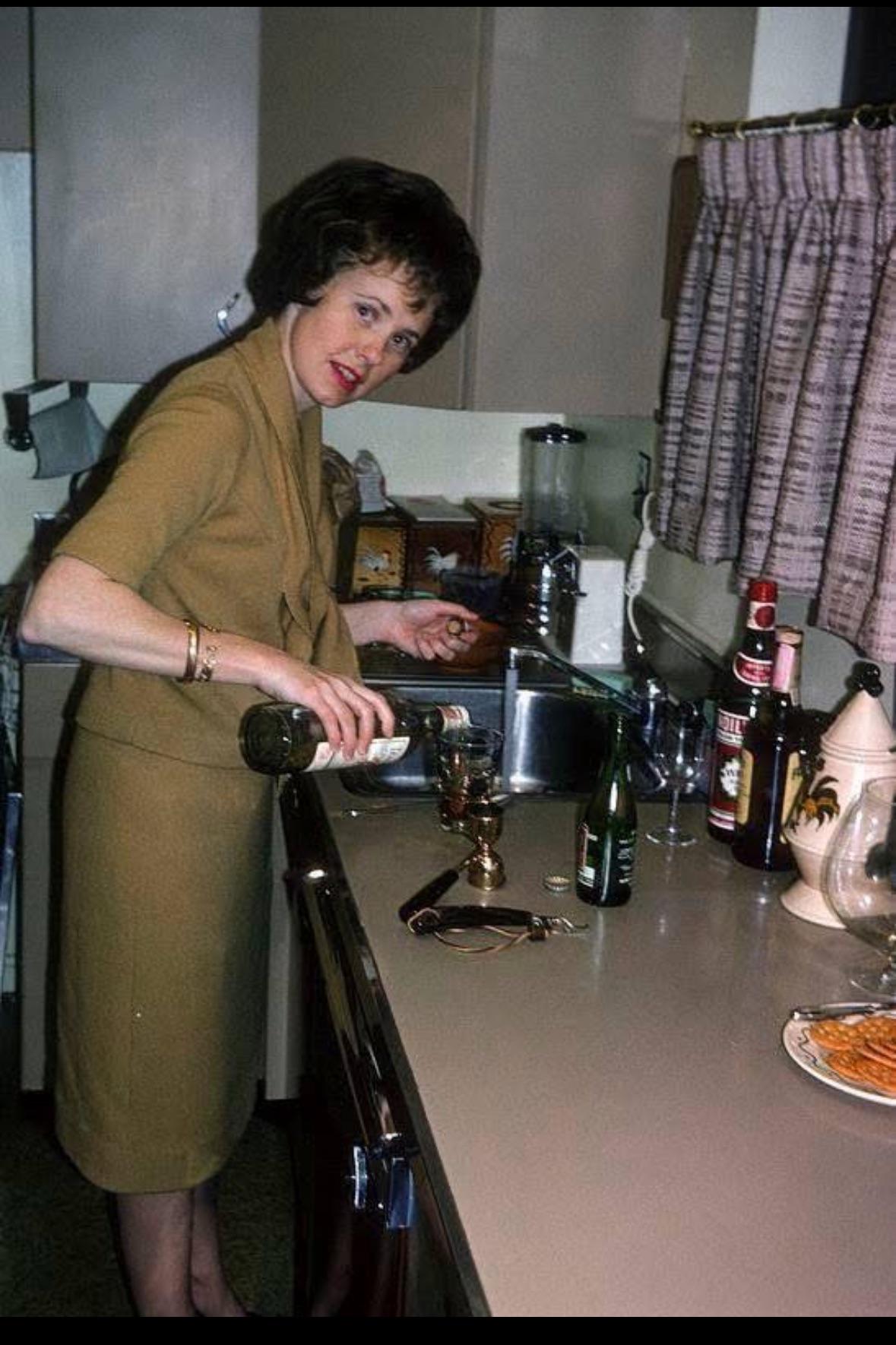
People scroll past, hit upvote, and imagine an easy answer. Of course. Or no way. But in the actual 1960s, that simple question carried rules, risks, and unspoken codes. Who could drink where, with whom, and under what assumptions was not just personal taste. It was law, custom, and class.
This is a counterfactual history built on real constraints. What would it have meant to “have a drink with her” in the 1960s in three different settings: a working-class bar, a middle-class cocktail lounge, and a campus or bohemian scene? And what does each scenario tell us about gender, power, and the quiet revolutions happening at the time?
Dating in the 1960s was shaped by strict gender expectations, limited legal rights for women, and a rapidly changing youth culture. Asking a woman for a drink was never just about the drink. It was a negotiation with all of that.
How did a bar date work for ordinary people in the 1960s?
Start with the most grounded version. She is not a movie star or a Greenwich Village poet. She is a secretary in Cleveland in 1964, or a shop worker in Leeds in 1966, or a telephone operator in Sydney in 1962. You see her in a photo on Reddit and imagine sliding onto the barstool next to her.
In most Western countries in the early 1960s, that barstool was already coded. Many bars were male spaces. In the United States, “ladies’ entrances” and “ladies’ bars” were still a thing in some cities into the 1950s, and the hangover of that segregation lingered. In Britain, some pubs informally discouraged women from drinking at the bar counter at all. A woman alone in a bar could be read as “looking for business,” not looking for conversation.
So if you “had a drink with her,” the most realistic setup is that you already knew her. She was a co-worker, a neighbor, your friend’s cousin. You did not just cold-approach a random woman in a bar in most respectable circles without risking being seen as rude or predatory.
Economics shaped the script. In 1960, the median annual income for a full-time male worker in the U.S. was about $5,400. For women it was roughly $3,200, and many women were not in the workforce at all. Men were expected to pay. A beer might be 25–35 cents, a cocktail 60–75 cents. Cheap by 2020s standards, but not trivial if you were young and on a modest wage.
The gender script was clear. He asked. He paid. He walked her home. She was expected to be polite but cautious. “Nice girls” did not drink too much, did not go home with a man after a first drink, and did not go to certain bars at all. Her reputation was a form of currency, and the cost of misjudgment fell far more heavily on her than on him.
Legally, she had fewer protections. Sexual harassment law did not exist in the way we know it. Marital rape was not recognized in most jurisdictions. Birth control access was limited. The U.S. Supreme Court decision in Griswold v. Connecticut, which legalized contraception for married couples, came only in 1965. For single women, access was patchier and often depended on a sympathetic doctor.
So when Reddit users in 2020s comment sections imagine an easy, flirty drink with a 1960s woman, they are importing modern assumptions about consent, contraception, and social freedom that she did not have. For her, saying yes to a drink with a man, especially one she barely knew, carried higher stakes.
So what? Because the ordinary bar date in the 1960s was constrained by gendered expectations and legal realities, any imagined “drink with her” that ignores those constraints turns a real woman into a fantasy prop instead of a person navigating risk.
What if she was in a smart cocktail lounge or hotel bar?
Now shift the scene. Instead of a smoky neighborhood bar, picture a mid-range hotel lounge in 1963. Low lighting. A piano player. Martinis in stemmed glasses. She might be a stewardess on an overnight layover, a young professional in a suit, or a married woman out with friends.
Here, the rules were different, but still strict. In many American cities, women could not legally be refused service at bars by this point, but informal discrimination persisted. In New York, the famous case was McSorley’s Old Ale House, which barred women until 1970. Even where the law allowed women, management often policed who “belonged.”
Hotel bars and cocktail lounges sat on a fault line between respectability and vice. They were known pickup spots. Business travelers, salesmen, flight crews, and single women who could afford the drinks all mixed there. A woman alone at a hotel bar in 1962 might be read as independent, adventurous, or suspect, depending on who was doing the reading.
Class mattered. A woman in a well-cut dress with a good handbag, ordering a gin and tonic, signaled a different story than a woman in cheaper clothes drinking alone at a corner bar. The 1960s were the decade when the “single girl” as a consumer figure emerged, especially in big cities. Magazines like Cosmopolitan in the later 1960s sold the idea of the young, working woman with her own apartment, her own money, and her own social life.
In this setting, you might plausibly approach a woman you did not know, but there were still scripts. A man might offer to buy her a drink. She could accept or decline. Accepting did not automatically mean she was agreeing to anything beyond conversation, but many men assumed it did. Women developed their own defensive tactics: meeting in groups, having a “story,” watching their drinks, arranging a pre-planned exit.
Internationally, the picture varied. In parts of Southern Europe, unaccompanied women in bars were rare and heavily judged. In Scandinavia, women’s public drinking was somewhat more normalized, though still gendered. In Japan, the bar world was structured around hostess clubs and male corporate drinking, with women often working in the bar rather than drinking as customers.
By the late 1960s, the sexual revolution began to shift expectations, at least among the young and urban. The combination of the birth control pill, changing divorce laws, and a growing youth culture chipped away at the idea that a woman’s reputation was permanently ruined by being seen as “too forward.” But the change was uneven. A woman in 1968 San Francisco might feel freer than a woman in 1968 small-town Kansas, even if they dressed similarly.
So what? Because cocktail lounges and hotel bars sat on the edge of respectability, a drink there could be a small act of independence for a woman, and a test of how far the new gender norms could stretch before they snapped back.
What if she was part of the youth or bohemian scene?
There is another way to read that Reddit photo. Maybe she is not a secretary or a suburban wife. Maybe she is a college student in 1967, or a folk singer in 1963, or a young woman in a civil rights or antiwar group. The drink in her hand might be part of a very different world.
On American campuses, the rules were still tight at the start of the decade. Many colleges imposed curfews on women, banned alcohol in dorms, and enforced “parietals” that restricted visiting hours between men’s and women’s rooms. A woman might be allowed to drink only in certain off-campus bars, and even then under watchful eyes.
By the mid to late 1960s, student protest movements were attacking those rules as part of a broader fight against authority. The Free Speech Movement at Berkeley in 1964, antiwar protests from 1965 onward, and the rise of second-wave feminism all fed into a culture that questioned why women were treated as children who needed protection.
In bohemian districts like New York’s Greenwich Village, London’s Soho, or San Francisco’s North Beach, mixed-gender drinking was normal. Coffeehouses, jazz clubs, and cheap bars were social hubs. A woman could plausibly sit alone with a drink and a book without being assumed to be a sex worker. She might be a writer, an art student, a political organizer.
Yet even in these supposedly liberated spaces, the power imbalance persisted. Many women from that scene later recalled that the “free love” rhetoric often meant freedom for men to expect sex, and pressure on women to go along or be labeled uptight. Alcohol and drugs blurred lines. Consent was rarely discussed in the way it is today.
Economics again shaped who was there. A college-educated woman in the U.S. in 1965 was still unusual; women were about 38 percent of college students. Those who did attend were often tracked into teaching, nursing, or secretarial work. A woman who rejected that path to hang out in bars with artists or activists was making a conscious break with expectations.
In this world, “having a drink with her” might mean arguing about Vietnam, listening to Bob Dylan on a jukebox, or planning a sit-in. It might also mean navigating a male-dominated counterculture that talked about liberation while leaving most domestic and emotional labor to women.
So what? Because the youth and bohemian scenes of the 1960s experimented with new gender roles, a drink with a woman there could be both more equal and more exploitative, revealing the gap between the era’s rhetoric of freedom and its lived reality.
Which 1960s drink scenario is most plausible, and why?
So if you freeze that Reddit image and ask, “What would this have really been like?”, which scenario fits best?
We do not know the actual woman in the photo, her country, or her class. But statistically, the most likely story in the 1960s West is the first one: she is an ordinary working- or lower-middle-class woman, out in a familiar place, with people she already knows. Random men did not usually walk up to a lone woman at a bar and start chatting, unless they were willing to risk being seen as crude or she was in a venue coded as a pickup spot.
The cocktail lounge scenario is also plausible, especially if she looks well-dressed and the glassware hints at a more formal setting. In that case, a stranger approaching her would be more common, but still filtered through class and respectability. The bohemian or student scene is likelier if the photo shows more casual dress, posters on the wall, or a mixed-gender group with a certain scruffy look.
What is least plausible is the modern fantasy: a completely frictionless, low-stakes drink, with both parties assuming shared norms about consent, contraception, and gender equality. In the 1960s, those norms were contested, uneven, and often absent.
Counterfactual history works best when it respects constraints. You can imagine yourself into that barstool next to her, but you have to bring 1960s law, economics, and culture with you. You would be expected to pay. She would be expected to protect her reputation. Both of you would be operating under rules that many Reddit readers have never had to think about.
So what? Because asking which 1960s drink scenario is most plausible forces us to see the gap between nostalgic images and the actual limits on women’s freedom, and it reminds us that casual social interactions rest on legal and cultural foundations that can change.
Why this still matters when we look at old photos
That Reddit thread is part of a larger habit: projecting modern fantasies onto old images. A woman in a 1960s bar becomes a blank screen for comments about her looks, her “vibe,” or whether someone today would date her.
In reality, she lived in a world where a drink was never just a drink. It was shaped by wage gaps, by the absence of legal contraception for many, by social rules about female respectability, and by emerging but incomplete liberation movements.
Three clean claims help anchor the picture. First, in the 1960s, women’s public drinking was still heavily policed by custom, even where the law allowed it. Second, dating scripts assumed male financial responsibility and female sexual caution, which raised the stakes of accepting a drink. Third, the sexual revolution and youth culture loosened those scripts for some women, but did not erase the underlying power imbalance.
So when you look at that frozen frame and think, “Would I have a drink with her?”, a better question might be: “What would it have cost her to say yes?”
So what? Because reading 1960s photos with their real social rules in mind turns nostalgia into history, and gives the woman in the picture her context back instead of flattening her into a fantasy.
Frequently Asked Questions
What were dating norms like in the 1960s?
Dating in the 1960s followed strict gender roles. Men were expected to ask women out, pay for dates, and initiate physical contact. Women were expected to be cautious about their reputations, avoid being alone with men too soon, and limit drinking and sexual behavior. These norms varied by class, region, and subculture, but the basic script of male initiative and female restraint was widespread.
Could women drink alone in bars in the 1960s?
Legally, in many Western countries, women could drink in bars by the 1960s, though some establishments still excluded them. Socially, a woman alone in a bar was often judged harshly. In many places she risked being seen as sexually available or as a sex worker. Women were more accepted in bars if they were with a date, with female friends, or in specific venues like hotel lounges or student bars.
How did the sexual revolution change dating in the 1960s?
The sexual revolution, especially from the mid-1960s onward, relaxed some norms around premarital sex, cohabitation, and public affection, particularly among young, urban, and college-educated people. The birth control pill, changing divorce laws, and youth counterculture all contributed. However, the change was uneven. Many communities kept older standards, and even in “liberated” circles, women often faced double standards and pressure to conform to male expectations.
Were 1960s bars really male-only spaces?
Not all, but many bars in the early 1960s still functioned as male-dominated spaces. Some had formal or informal policies discouraging women at the bar counter. Others steered women into separate rooms or “ladies’ bars.” Over the decade, especially in larger cities, mixed-gender drinking became more common, but the idea that respectable women did not hang around bars alone remained strong in many areas.