In the desert outside modern Nazca, Peru, a farmer still climbs down a stone spiral that was dug around 500 CE. Wind whistles through the funnel, cool air drops into a dark tunnel, and clear water slides past his feet, pulled along by nothing more than gravity and a clever use of air pressure. Tourists fly overhead to see the Nazca Lines. He walks past them to reach the thing that has actually kept people alive for 1,500 years.
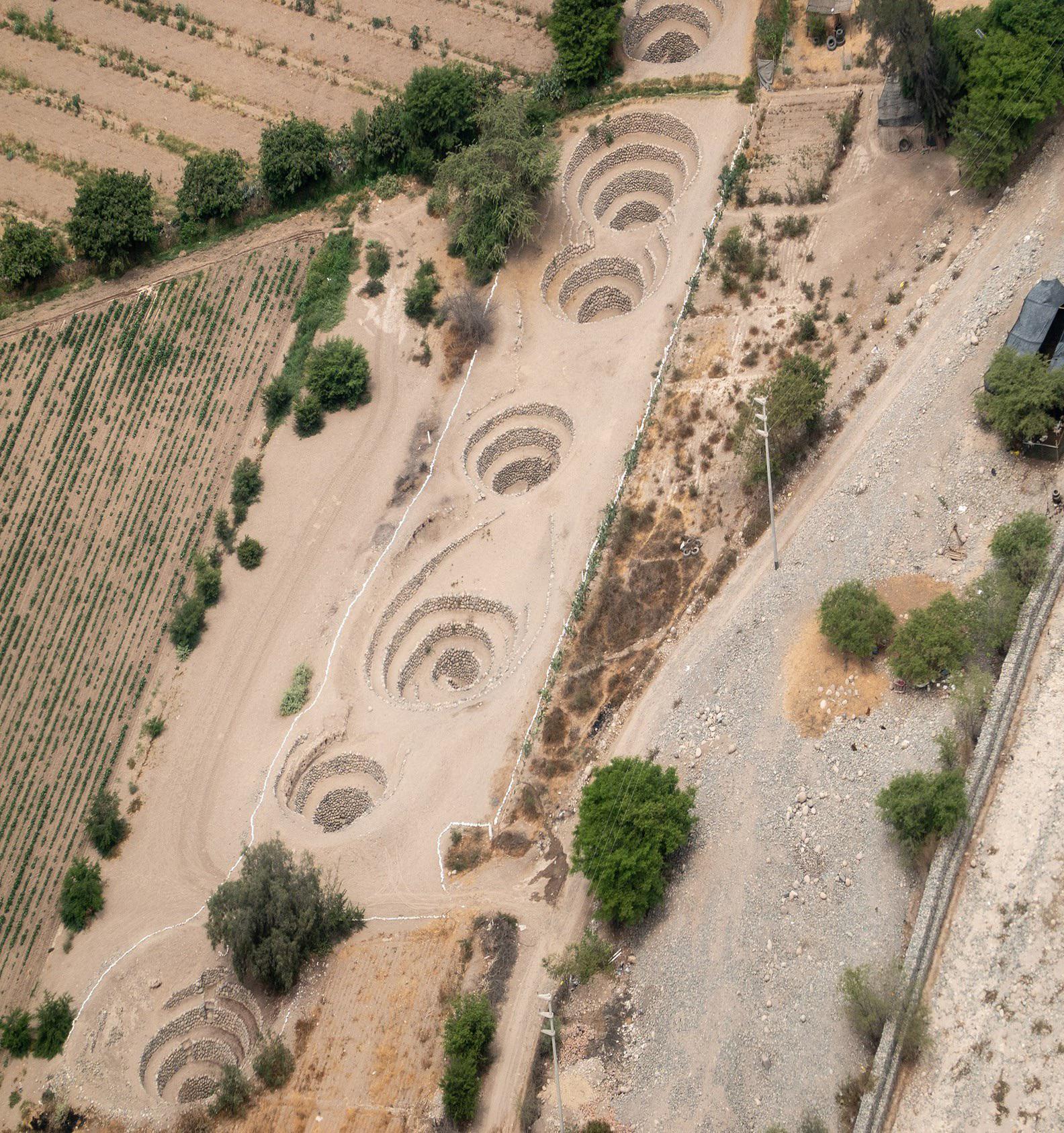
Those spirals are the ojos of the Nazca puquios, an underground water system that tunneled into the water table, lined it with cobbles, and carried water for miles under one of the driest skies on earth. The Nazca built at least forty of these systems. Dozens still work.
The Nazca puquios were wind-powered underground aqueducts that moved groundwater across the desert without pumps or metal. They used spiral shafts to drive air into tunnels, keeping water flowing and cool. They were a low-tech but sophisticated answer to a hard problem: how to live where rain barely reaches 25 millimeters a year.
So here is the counterfactual: what if this technology had spread? What if the logic of puquios had jumped valleys, cultures, and even continents? What would that have changed, and what would have stayed exactly the same?
What if the Inca had adopted Nazca-style puquios?
By the time the Inca Empire rose in the 1400s, the Nazca culture was long gone. Their puquios, though, were still there, quietly moving water under the desert. The Inca were obsessive builders of roads, terraces, and canals. They were not shy about borrowing good ideas from conquered peoples.
In the real world, the Inca mastered water in their own way. They built terraced hillsides with stone-lined channels, ritual fountains at places like Tipón, and long canals that moved glacial meltwater and springs along the Andes. They understood gravity-fed irrigation and hydraulic pressure. What they did not copy, as far as we can tell, is the Nazca habit of driving water underground for long distances using spiral vents and wind.
Could they have? Technically, yes. Puquios do not require iron tools, cement, or advanced math. They require three things the Inca already had: organized labor, stoneworking skill, and the ability to plan on a regional scale. Digging 10 to 15 meters down to an aquifer and tunneling horizontally is dangerous, but the Inca already dug deep foundations and mined stone. The spiral ojos are just carefully laid dry-stone ramps.
The bigger question is whether the Andes gave them a reason to bother. Nazca’s coastal desert is brutally dry, with long, flat stretches of alluvial fan where groundwater sits in accessible aquifers. That is perfect puquio country. Much of the Inca heartland, by contrast, is steep, broken, and fed by seasonal rains and snowmelt. Water problems there are about managing too much in the wet season and not enough in the dry, not about a total absence of rain.
Still, there are Andean pockets where puquio-style systems could have changed the map. The coastal valleys north and south of Lima, the Atacama fringe in what is now southern Peru and northern Chile, and some high plateau zones with shallow aquifers all fit the Nazca pattern: flat enough to tunnel, dry enough to make evaporation a serious enemy.
If the Inca had recognized what the Nazca had done and scaled it up, several things follow.
First, they could have made more of their desert frontiers genuinely productive. Puquios do not create water out of nothing, but they let you tap groundwater steadily and move it without losing it to the sun. That means more stable oases, more reliable maize and cotton harvests on the coast, and denser populations in places that were otherwise marginal.
Second, it would have fit neatly into the Inca political model. The state liked to move people around, resettling loyal colonists in newly conquered areas and tying them together with roads and storehouses. A chain of puquio-fed settlements along the driest stretches of the Pacific coast would have been a perfect way to lock down trade routes and resource zones, especially for coastal products like dried fish and salt that fed the highlands.
Third, it might have changed how the Spanish conquest played out in a small but real way. When the Spanish arrived in the 1530s, they targeted existing centers of population and production. If more of the coastal desert had been stitched together by reliable water systems and irrigated fields, there would have been more towns, more food, and more reason for the invaders to invest in those corridors. That could have shifted some colonial emphasis from the highland silver mines toward coastal agriculture earlier.
None of this saves the Inca from smallpox or steel. But an empire with a denser, more resilient coastal population and more irrigated acreage is harder to starve and easier to reconstitute in fragments. In a world where the Inca adopt puquios widely, you get a slightly tougher, more water-secure empire meeting the Spaniards in 1532, which nudges, if not overturns, the story of conquest.
So what? If the Inca had scaled up Nazca-style puquios, the Andean coast could have supported more people, more food, and more state power, making both the late pre-Hispanic empire and the early colonial economy look a little less fragile and a little more desert-proof.
What if puquio technology had jumped north to Mesoamerica?
The Nazca puquios were a local solution to a local problem, but they were not the only ancient answer to desert water. In what is now Mexico and the American Southwest, farmers carved canals off rivers, dug cisterns, and built terraces to catch runoff. The Hohokam in Arizona, for instance, built hundreds of kilometers of open canals to irrigate the Sonoran Desert.
So imagine a world where the idea of underground aqueducts with spiral vents somehow makes the leap from southern Peru to Mesoamerica centuries before the Spanish. No airplanes, no telegraphs, just the slow relay of ideas along trade routes that already existed.
We know that long-distance exchange did link the Andes and Mesoamerica in a very loose way. Spondylus shells from Ecuador show up in Mexican sites. Copper metallurgy probably moved north from South America into West Mexico around the first millennium CE. So the idea of a southern hydraulic trick drifting north is not impossible, just unlikely.
If it did, the most likely carriers would not be Nazca themselves, who were relatively local, but later Andean traders or coastal groups who inherited or reused puquios and then talked about them. A Mesoamerican engineer hearing about “stone tunnels that bring water under the desert, with spirals that pull the wind” would not have a blueprint, but they would have a concept.
Would it help? In some places, yes. Parts of northern Mexico and the American Southwest have shallow aquifers under arid ground, much like Nazca. Farmers there already fought evaporation and flash floods. An underground system that protected water from the sun and moderated flow would have been attractive, especially in drought-prone centuries like the late first millennium CE.
In central Mexico, where the Classic and Postclassic states rose and fell, the story is different. Teotihuacan, Tenochtitlan, and their neighbors were more worried about managing lakes, chinampas, and seasonal rains than about coaxing groundwater out of a bone-dry plain. Their water engineering focused on dams, causeways, and raised fields. Puquios would have been a niche trick, not a core technology.
But in the northern frontier zones, where Mesoamerican farmers pushed into drier lands and met more mobile peoples, puquios could have been a quiet advantage. Underground aqueducts are hard to see and harder to sabotage than open canals. A community that can keep its water hidden and cool during a drought has more staying power than one that depends on exposed ditches.
Over centuries, that might have meant more stable farming communities in parts of northern Mexico and the Southwest, less abandonment of marginal lands during dry spells, and a slightly different balance between sedentary farmers and mobile raiders. You do not suddenly get skyscraper cities in the Sonoran Desert, but you might get more medium-sized towns hanging on through bad decades.
There is a catch. Puquios are labor intensive to build and maintain. You have to keep tunnels clear, ojos stable, and intakes clean. That fits best with societies that can mobilize large work parties and plan for the long term. Some Mesoamerican polities could do that. Others, especially in frontier zones, were more fragmented. The technology would have spread unevenly.
So what? If puquio-style underground aqueducts had reached Mesoamerica, they would have given certain drought-prone regions a modest edge in water security, supporting more persistent farming communities on the desert fringes and slightly reshaping where people could afford to stay put.
What if puquio logic had reached the Old World before modern times?
Here the counterfactual brushes up against a real cousin of the puquio: the qanat. Across Iran, Central Asia, and parts of North Africa, ancient engineers dug sloping tunnels from upland aquifers, vented them with vertical shafts, and carried water for kilometers under hot ground. Qanats are documented by the first millennium BCE. They are older than the Nazca puquios by many centuries.
The resemblance is not perfect. Qanats typically use straight vertical shafts, not spiral ramps, and there is no clear evidence that they were designed to harness wind in the same way. But the core idea is the same: protect water from evaporation by moving it underground along a gentle gradient from source to field.
So the Old World did not need Nazca engineers to invent underground aqueducts. They already had them. What the Nazca added was a particular twist: the spiral ojo that can act as a wind scoop, aerating and slightly pressurizing the tunnel. That detail is what Rosa Lasaponara’s team, using satellite imaging in 2016, argued had been misunderstood for years. Archaeologists had treated the ojos as maintenance shafts. The airflow patterns suggest they are more than that.
What if that specific trick had been known in, say, Sasanian Iran, Abbasid Iraq, or Roman North Africa? In windy deserts, a spiral shaft that encourages air circulation could help keep water fresher and reduce sediment buildup. It might even nudge flow along in low-gradient sections. In a world where every liter counts, that is not trivial.
Yet even here, we have to respect constraints. The main limit on qanats and puquios is not air pressure. It is geology and labor. You need a sloping aquifer, soft but stable ground, and a huge workforce willing to dig and maintain tunnels. Ancient empires already pushed those limits hard. Many qanat systems were overextended, leading to collapse when maintenance failed.
The Nazca spiral would not change the basic math. It might make some segments more efficient or easier to clean, but it would not turn the Sahara green or keep Mesopotamian cities from salting their fields. The big water problems in the Old World were about deforestation, soil salinization, and river management, not just evaporation from canals.
Where the puquio logic could have had a more visible Old World impact is in the Mediterranean’s drier fringes, such as parts of Spain and North Africa under Roman and later Islamic rule. There, a mix of qanats, cisterns, and surface canals already existed. A spiral-vented, wind-aware design might have been one more tool in the kit, especially on windy plateaus where keeping water cool and oxygenated mattered.
But it would have been an incremental improvement, not a revolution. The Old World already had underground water technology. The Nazca did not invent the idea of hidden aqueducts. They arrived at a similar solution from a different direction, then gave it a distinctive architectural flourish.
So what? If Old World engineers had borrowed the Nazca spiral vent, some qanat systems might have run a bit cleaner and cooler, but the big patterns of settlement and empire in Eurasian deserts would look much the same.
Which puquio what-if is most plausible, and why does it matter?
Of the three scenarios, the most plausible is the first: an Andean world where the Inca recognize and expand Nazca-style puquios along the Pacific coast.
That scenario does not require intercontinental contact or heroic long-distance idea transfer. It just asks whether later Andean states noticed a working technology in their own backyard and chose to copy it. We know they did this with other things. The Inca adopted terrace styles, textile patterns, and religious symbols from conquered peoples. Puquios would have fit that pattern.
The second scenario, a jump to Mesoamerica, runs into distance and cultural boundaries. While there were faint trade links between the Andes and Mexico, they were thin and slow. Transferring a complex, context-dependent technology like puquios through that chain is possible in theory but unlikely in practice.
The third scenario, an Old World borrowing, is the least impactful because the core idea already existed there as qanats. The Nazca spiral is clever, but it is a refinement, not a missing piece.
Thinking through these what-ifs does something useful. It reminds us that the Nazca puquios were not a quirky side project next to the famous Lines. They were a serious piece of water engineering that solved a hard problem in a specific place. They show that ancient people without metal, without wheels, and without writing could still read geology, airflow, and hydraulics well enough to build systems that last for 1,500 years.
They also push back against a common misconception: that big, visible monuments are the main measure of a civilization’s sophistication. The Nazca Lines grab the headlines. The puquios kept people alive through droughts. If the technology had spread more widely, it might have changed where cities grew, how empires fed themselves, and which communities survived bad centuries.
Even in our own time, when we can pump aquifers dry with diesel engines, the puquios have a quiet relevance. They are a reminder that sustainable water systems can be built with stone, gravity, and wind, not just with concrete and electricity. In a warming world where evaporation is again the enemy, the Nazca’s buried answer in the desert feels less like a curiosity and more like a question: what else have we overlooked because it was underground and not carved large enough to see from the sky?
So what? Weighing these counterfactuals shows that the Nazca puquios were not just local oddities but a form of desert engineering that could have nudged the development of Andean and other dryland societies, and they still offer a quietly radical model for how to move and protect water without modern machines.
Frequently Asked Questions
What are Nazca puquios and how did they work?
Nazca puquios are ancient underground aqueduct systems built around 500 CE near Nazca, Peru. Engineers dug horizontal tunnels into the water table, lined them with river cobbles, and sloped them gently so water could flow by gravity. Spiral stone openings called ojos funneled wind into the tunnels, helping move and oxygenate the water while protecting it from evaporation.
Did the Inca use or copy the Nazca puquios?
There is no solid evidence that the Inca copied Nazca-style puquios on a large scale, although they did inherit and use some existing systems. The Inca were skilled water engineers in their own right, building terraces and canals across the Andes, but their main projects focused on surface water and springs rather than long underground desert aqueducts with spiral vents.
Are Nazca puquios related to Old World qanats?
Nazca puquios and Old World qanats are similar in concept: both are underground channels that tap aquifers and move water long distances under arid ground. Qanats, used in places like Iran and North Africa, predate the Nazca systems by many centuries. There is no evidence of direct contact, so most scholars see them as independent inventions shaped by similar environmental problems.
Do Nazca puquios still work today and can you visit them?
Yes. Dozens of puquio systems around Nazca still function and supply water to local communities. The best known are the Cantalloc Aqueducts, about 4 kilometers outside the city of Nazca in Peru. Visitors can walk right up to the spiral ojos and see the underground water channels in use.