Picture a French knight in 1356, trotting toward a rebel castle with a siege ladder on his shoulder. He rounds the last hill, ready for the usual: a dry ditch, some thorny brush, maybe a half-rotten palisade.
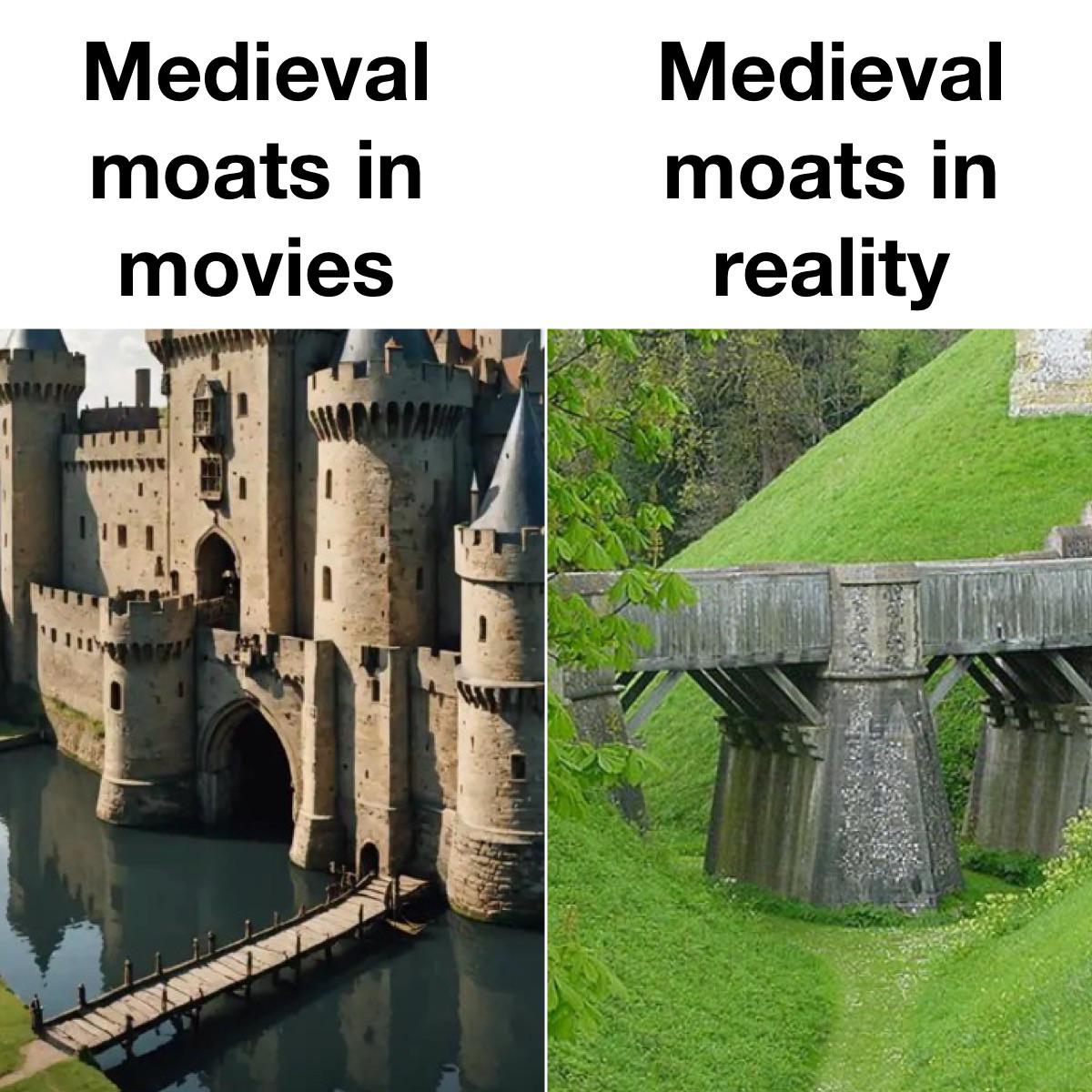
Instead he pulls up short. In front of the walls is not a ditch. It is a 20-meter-wide sheet of water, three meters deep, fed by a diverted river. No easy fill. No quick bridge. No ladders. His commander swears. This is going to take weeks.
That scene almost never happened in medieval Europe. The Reddit joke is right: most moats really were just ditches, sometimes damp, often dry. The Hollywood image of every castle ringed by a deep, gleaming lake full of crocodiles is mostly fantasy.
So what if it had not been? What if European lords had actually built the kind of water-filled, engineered moats people imagine today? To answer that, you have to start with what moats really were, then push the technology and the budgets as far as they could realistically go.
What were real medieval moats actually like?
A medieval moat was usually a ditch. Sometimes wet, often dry, almost always muddy. It was a cheap, labor-heavy way to make life harder for attackers, not an impenetrable lake.
Castles like Bodiam in England or Caerphilly in Wales did have impressive water defenses, but they were the exception, not the rule. Many fortifications, especially hilltop castles, could not support big water moats at all. You cannot keep a wide, deep moat full if you are perched on a rocky ridge with no reliable water source.
Most lords had three constraints: money, manpower, and water. Digging a ditch was cheap. Filling it with water in a controlled way was not. You needed a river or spring at the right height, or a serious earthwork system of dams and channels. You also needed maintenance. A stagnant moat turned into a foul, disease-prone swamp, clogged with silt and trash.
So medieval engineers used moats as part of a layered defense. A dry ditch forced ladders to be longer and siege towers to be higher. It funneled attackers into killing zones. It made mining under the walls harder. The ditch did not stop an army, it slowed and exposed it.
In short, a moat was a shaped obstacle, not a medieval force field. That gap between meme and reality is what makes the counterfactual interesting: if lords had paid the price for real, deep, water moats, they would have been choosing a very different kind of war and politics.
So what? Understanding the real ditch-based moat explains why the fantasy version would have required major changes in money, engineering, and strategy.
Scenario 1: Europe goes all-in on deep, water-filled moats
Imagine that around 1150–1200, European rulers start copying the best water castles they know and pushing them further. Think of places like Caerphilly (built in the late 13th century with huge artificial lakes) but multiplied across the map.
Technically, this is possible. Medieval engineers could already divert rivers, build dams, and manage water levels for mills and fishponds. The Cistercians were moving water around their monasteries with serious skill. The Dutch were reclaiming land and playing chess with the sea by the late Middle Ages.
So in this scenario, kings and big lords decide that a deep, wide, water moat is worth the cost. They pour labor into digging basins, raising embankments, and cutting feeder channels. They accept that they will lose some farmland to water. They treat the moat as both defense and infrastructure: fishpond, mill pond, maybe even transport route.
The result is a castle that looks more like a fortified island. A 15–30 meter wide moat, 2–4 meters deep, with controlled inlets and sluices. Not every site can do this, but rich lowland regions in France, Flanders, England, and parts of Germany can.
What changes on the battlefield? Siege ladders and towers lose a lot of value. You cannot roll a tower across water. You need boats, floating bridges, or to drain the moat. That means more time, more engineering, and more exposure to arrows and stones.
Attackers lean harder on artillery even earlier. Trebuchets are already important by the 13th century, but if every serious castle has a real water barrier, the incentive to smash walls from a distance grows. By the 14th century, when gunpowder artillery appears in Europe, the pressure to build bigger, heavier guns increases. A moat that stops ladders pushes siege warfare toward bombardment and trench work.
Defenders, in turn, double down on water tricks. They can raise water levels to flood siege works, or drop them to trap attackers in mud. They can use the moat as a sewage outlet and disease weapon. They can hide palisades or stakes under the surface.
Economically, this Europe is more stratified. Only the wealthiest can afford a true water fortress. Lesser nobles make do with dry ditches and earthworks, which look even more vulnerable by comparison. The gap between a royal castle and a minor lord’s tower house widens.
Politically, strongholds become harder to crack quickly. A king who wants to crush a rebellious vassal faces longer sieges and higher costs. That slows centralization. On the other hand, a rebel locked in a water castle is also stuck. His fields might be flooded for the moat. His supply lines are limited. Siege warfare becomes a long, grinding contest of logistics rather than quick storming assaults.
So what? A Europe of real water moats would push siege warfare toward heavy artillery and engineering sooner, widen the gap between rich and poor lords, and make political conflicts slower and more expensive.
Scenario 2: Moats become regional water-management systems
Now push the idea further. Not just castles with moats, but moats integrated into regional water control. Think less “ring of water around a single keep” and more “network of defensive canals.”
This is not fantasy. Parts of Europe already did something like this. The Low Countries used flooded polders and dikes as defensive tools. In later centuries, the Dutch Water Line literally planned to drown sections of land to stop invaders. In Italy, cities like Milan and Venice used canals both for trade and defense.
In this scenario, starting in the 13th century, more regions copy that logic. A French king in the Loire valley or an English king in the Thames basin decides that moats, canals, and fishponds are one system. Castles, abbeys, and towns are linked by channels that can be opened or closed in war.
Castles no longer sit in isolated moats. They anchor nodes in a watery grid. In peacetime, the channels feed mills, irrigate fields, and move goods. In wartime, sluices are opened to flood low ground, turning roads into marshes and siege camps into quagmires.
Militarily, this favors defenders who know their terrain and control the gates and dams. An invading army cannot simply march on a city. It has to navigate a maze of embanked roads and flooded fields. Cavalry loses much of its shock value in knee-deep water. Supply trains bog down.
Economically, this is expensive but productive. The same works that make war harder also raise agricultural yields and power more mills. Lords and towns that invest in water control get richer in peacetime and harder to conquer in war.
Politically, control of water infrastructure becomes power. Whoever holds the main sluices and dams can threaten to flood or starve a region. Kings might centralize authority faster by claiming control over rivers and canals. Towns that manage their own water systems gain leverage in negotiations.
There is a social downside. Peasants bear the brunt of construction and maintenance. When a lord decides to flood fields for defense, it is not his table that goes empty. In bad years, resentment grows. Water politics feed revolts.
Technologically, this pushes Europe toward more systematic hydraulic engineering earlier. You might see standardized sluice designs, better surveying, and more written treatises on water management by the 14th century instead of later.
So what? Turning moats into regional water systems would blur the line between civil infrastructure and defense, making water control a central tool of both economic growth and military strategy.
Scenario 3: The age of gunpowder meets the super-moat
By the 15th century, gunpowder artillery is reshaping fortification. High medieval walls crack under cannon fire. In our timeline, Italian engineers respond with the trace italienne: low, thick, angled bastions, wide ditches, and layered outworks.
Now imagine that this revolution hits a Europe already full of serious water moats. What happens when you combine bastion forts with engineered lakes?
In reality, some early modern forts did use water cleverly. Places like Neuf-Brisach or parts of the Dutch defenses used flooded ditches and controlled inundations. In our counterfactual, that logic is more widespread and starts earlier.
Fort designers in the late 15th and early 16th centuries treat water as a standard element. A new royal fortress is not just a star-shaped wall with a dry ditch. It is a star rising from a managed basin. The ditch is deep and wet. The surrounding lowlands can be flooded to musket depth.
For attackers, this is a nightmare. Artillery needs stable platforms. Soft, wet ground makes it hard to emplace heavy guns close to the walls. You can still bombard from further away, but accuracy and effect drop. To get closer, you have to build causeways and batteries under fire, or drain parts of the moat, which takes time and engineering skill.
Siege warfare becomes even more technical. Armies need specialist water engineers as much as gunners. Trench lines must account for groundwater and flooding. Sappers might try to cut or block feeder channels. Defenders might release stored water at key moments to wash out works.
Strategically, states that master this style of fortification become very hard to invade. Think of France or the Habsburg lands ringed with water-bastion fortresses. Wars drag on. Field battles still matter, but taking key strongholds becomes a multi-month operation, even for well-funded monarchs.
There is a cost. These complexes are extremely expensive. Only large, centralized states can build and maintain them. Smaller polities either submit, ally, or get bypassed. The military revolution of the 16th and 17th centuries, which already favored big states, would tilt even further in that direction.
Naval power also shifts. If coastal and riverine fortresses use water moats and bastions together, amphibious assaults become harder. Control of sea lanes matters, but getting from ship to shore under fire is more dangerous. Maritime empires might invest even more in siege fleets and engineers.
So what? Combining real water moats with bastion fortifications would make early modern strongholds tougher, sieges longer, and the advantage of big, centralized states even more pronounced.
Which moat-heavy world is most plausible, and what really changes?
Of these scenarios, the first two are the most realistic within medieval constraints. Europe could have had more deep, water-filled moats and more regional water defenses. The third scenario, with super-moated bastion forts everywhere, is technically possible but limited by cost. Only a handful of rich states could afford it.
The biggest constraint is geography. You cannot put a big water moat on a dry hilltop or in porous limestone country without insane effort. Many of the most important medieval strongholds were on high ground for a reason. They traded water moats for natural slopes and rock.
Economics is the second brake. A serious moat is not just a hole with water. It is an engineered system that must be dug, lined, fed, and maintained. For a medieval lord whose income depends on harvests and tolls, tying up labor and land in a moat is a big decision. Only in rich, flat, well-watered regions does it make consistent sense.
Given those limits, a plausible alternate Europe would have:
• More real water moats in lowland France, England, Flanders, and parts of Germany.
• More use of controlled flooding and canals as regional defenses, especially in river basins.
• Earlier and wider use of water as a factor in fortification design once gunpowder arrives.
What would not change is the basic arc: gunpowder artillery still erodes the value of tall medieval walls. Engineers still respond with lower, thicker, angled works. Siege warfare still gets slower and more technical. States that can fund big fortresses and big armies still pull ahead.
The main difference is degree and geography. Some regions would be even harder to conquer. Some sieges would last longer. Water engineers would have higher status. But moats, even real ones, are never magic. They buy time, not invincibility.
So what? The meme gets one thing right: the gap between fantasy moats and real ditches is big, and even in a world that paid for Hollywood-style moats, water would change the tempo and cost of war, not make castles unbeatable.
Today, when people joke that “most moats were just ditches,” they are reacting to that gap between pop culture and archaeology. The counterfactual helps clarify why. Deep, water-filled moats required the right terrain, serious engineering, and steady maintenance. Medieval Europe had the skill, but not always the incentives or the surplus to make them standard.
The fantasy of the perfect moat is really a fantasy of perfect security. The history, and the what-if, both say the same thing: even a lake around your walls just buys you time. After that, it is still about money, logistics, and who can wait the longest outside in the mud.
Frequently Asked Questions
Were most medieval moats actually filled with water?
No. Most medieval moats were dry or only seasonally wet ditches. Truly deep, wide, water-filled moats existed, but they were expensive and limited to sites with reliable water sources and wealthy patrons.
Why did many castles have dry moats instead of water moats?
Dry moats were cheaper and easier to build. A ditch still forced attackers to use longer ladders, made siege towers harder to deploy, and complicated mining. Keeping a water moat full and healthy required suitable terrain, diverted water, and constant maintenance.
Could medieval engineers have built the big water moats we see in movies?
Yes, in many lowland areas. Medieval engineers could divert rivers, build dams, and manage water levels. The main limits were cost, labor, and geography. That is why impressive water castles exist, but they are not the norm.
How would warfare change if most castles had real water moats?
Storming walls with ladders and towers would be harder, so attackers would rely more on artillery and engineering. Sieges would take longer and cost more. Powerful states and rich lords, who could fund serious water defenses, would gain an edge over poorer rivals.