On 15 April 1926, a reader unfolding a British or American magazine might have met a very confident idea: that you could measure “the average man” with a tape measure, a questionnaire, and a few skulls, then rank him against “savages.”
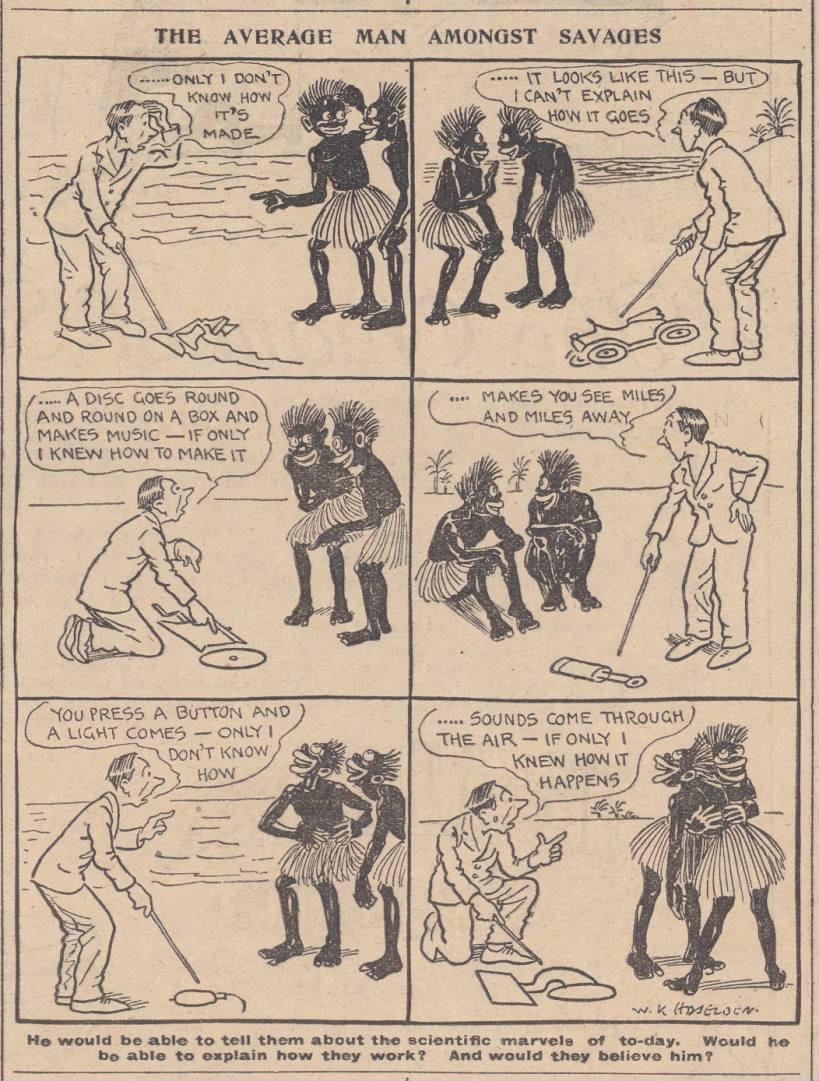
Charts, profiles, and tidy categories promised to explain why Europeans ran empires and why colonized peoples supposedly sat at the bottom of a human ladder. That language, “the average man amongst savages,” was not a fringe insult. It was mainstream science, journalism, and policy talk.
By the end of the 1920s, that way of thinking would start to crack, but in April 1926 it was still respectable. To understand the phrase is to walk into the world of scientific racism, eugenics, and empire at their peak.
What was “The Average Man Amongst Savages” in 1926?
In the 1920s, “the average man amongst savages” was shorthand for a whole bundle of ideas: that humanity could be divided into ranked races, that “civilized” Europeans sat at the top, and that “primitive” peoples represented earlier stages of human evolution.
Writers used “average man” to sound objective and statistical. They claimed to describe a typical member of a group, stripped of individual quirks. “Savages” was the era’s casual term for non-European, non-industrial societies, especially in Africa, the Pacific, and parts of Asia and the Americas.
So when a 1926 article or lecture talked about “the average man amongst savages,” it usually meant something like this: if you took a random person from a colonized group and measured his skull, his reaction times, his “moral sense,” and his “intelligence,” you would find him closer to a European child or a European criminal than to a respectable white adult.
That was the claim. It rested on a mix of anthropology, psychology, and eugenics, all filtered through colonial prejudice.
In plain terms: “The average man amongst savages” was a scientific-sounding way to say that colonized peoples were inherently inferior and stuck at an earlier stage of human development.
This matters because the phrase was not just rhetoric. It gave a veneer of science to racial hierarchies that shaped laws, borders, and lives across the 20th century.
What set it off? The roots in Victorian science and empire
The 1926 mindset did not appear overnight. It grew out of 19th-century science, empire, and anxiety.
First came the measuring craze. In the mid-1800s, figures like Paul Broca in France and Samuel George Morton in the United States collected skulls and brain weights. They claimed to find that Europeans had larger brains than Africans or Indigenous Americans. From this they leaped to conclusions about intelligence and character.
Then came social evolution. After Charles Darwin published On the Origin of Species in 1859, other thinkers extended evolutionary ideas to human societies. Herbert Spencer popularized the phrase “survival of the fittest” and argued that societies evolved from “savage” to “civilized.”
Anthropologists such as Edward Burnett Tylor and Lewis Henry Morgan drew up neat ladders of cultural evolution. At the bottom were hunter-gatherers, then pastoralists, then agriculturalists, with industrial Europe at the top. They treated contemporary Indigenous societies as living fossils, snapshots of Europe’s own distant past.
Empire made these ideas feel obvious. By 1900, European powers controlled huge territories in Africa and Asia. Many Europeans looked at the map and concluded that conquest proved superiority. Science was then used to explain and justify what power had already done.
At the same time, industrialization and urbanization created anxiety at home. Elites worried about “degeneration” among the poor, the “feeble-minded,” and immigrants. Eugenics, the idea that you could improve the human stock by encouraging some people to reproduce and discouraging others, grew out of this fear. Francis Galton, Darwin’s cousin, coined the term “eugenics” in the 1880s and pushed for a science of hereditary quality.
By the early 20th century, these strands had fused. You had a racial ladder, a belief in measurable hereditary traits, and a global empire full of people to classify. “The average man amongst savages” was the product of that fusion.
This origin story matters because it shows that the 1926 language was not a scientific discovery. It was the scientific dressing on older hierarchies and imperial power.
The turning point: When the “average savage” met data
By the 1920s, the confidence behind phrases like “the average man amongst savages” was already starting to wobble, even if most readers did not see it yet.
Psychologists had been busy during World War I. The U.S. Army used mass IQ tests on more than a million recruits. Early reports claimed that Black Americans and recent immigrants scored lower than native-born whites of Northern European descent. Eugenicists seized on these numbers as proof of innate racial differences.
But the data did not behave as neatly as the racial story required. Scores rose when people had more schooling or more familiarity with English. Soldiers from poor rural backgrounds, including many white Americans, scored badly too. The tests seemed to measure education and culture as much as any inborn “intelligence.”
Anthropologists were also pushing back. In 1911, Franz Boas published a study on the children of immigrants in the United States. He found that the skull shapes of children born in America differed from their parents’ skulls, which implied that environment and nutrition affected physical traits previously treated as fixed racial markers.
Fieldwork further complicated the tidy ladder from “savage” to “civilized.” Researchers who actually lived with Indigenous communities found complex legal systems, sophisticated ecological knowledge, and elaborate art. The idea that these societies were frozen at some childlike stage of development began to look thin.
Even within eugenics, there were cracks. Some scientists distinguished between “positive eugenics” (encouraging the fit to have more children) and harsh coercive policies. Others worried that environment and social conditions mattered too much for simple hereditary explanations.
Still, in 1926, the old language dominated popular writing. A magazine article could talk breezily about “the average man amongst savages” while the specialist literature was already arguing over how much of that average was heredity and how much was history.
This turning point matters because it shows that the collapse of scientific racism did not come from moral outrage alone. It came from data that refused to line up with the racial ladder story.
Who drove it? The scientists and writers behind the idea
No single person coined the exact phrase “the average man amongst savages,” but several figures helped build the intellectual scaffolding that made it sound reasonable in 1926.
Francis Galton, working in late Victorian Britain, pushed the idea that human mental traits were strongly hereditary and that you could rank individuals and groups on a scale of ability. He popularized statistical tools like correlation and regression to the mean. His work framed the idea that there was such a thing as an “average” racial type that could be measured.
Anthropologists like Edward Tylor and James Frazer, writing from their armchairs with travelers’ reports, described “primitive” societies as early stages of a universal human path. They rarely met the people they wrote about, but their books shaped how educated Europeans thought about “savages.”
In the early 20th century, psychologists such as Henry H. Goddard and Lewis Terman adapted IQ testing for American schools and institutions. Goddard used the label “feeble-minded” freely and argued that such people were a hereditary menace. Terman suggested that IQ differences between racial groups reflected innate differences, not just schooling or poverty.
Popular writers translated this into plain language. Travel writers, colonial administrators, and journalists described encounters with “natives” in terms that reinforced the hierarchy. They compared colonized adults to European children, praised “loyal” tribes, and warned about “degenerate” ones. A 1926 reader encountering “the average man amongst savages” was hearing an echo of hundreds of such pieces.
On the other side, critics were already at work. Franz Boas and his students, including Margaret Mead and Ruth Benedict, argued that culture shaped behavior and that no race had a monopoly on intelligence or morality. W. E. B. Du Bois dissected how racism, not biology, shaped Black life in America. Anti-colonial thinkers from India to the Caribbean wrote against the idea that they were stuck at an earlier evolutionary stage.
The people behind the phrase matter because they show how authority works. A mix of statisticians, anthropologists, and popular writers gave racism a scientific accent, while a smaller group of critics started the long process of dismantling it.
What did it change? From words to laws and lives
Calling someone “the average man amongst savages” might sound like an insult today. In 1926, it was more than an insult. It was a policy argument.
If you believed that colonized peoples were inherently less intelligent and less moral, then empire looked like guardianship. British officials in Africa or India could tell themselves they were ruling children who would one day, perhaps, be ready for self-government. Until then, white rule was “for their own good.”
In settler colonies like Australia, Canada, and the United States, the same logic justified taking land and children. Indigenous people were framed as unable to manage property or raise children in a “civilized” way. That helped legitimize forced removals, residential schools, and restrictions on movement and marriage.
At home, ideas about averages and hereditary fitness fed into eugenic laws. In the United States, several states passed compulsory sterilization laws for people labeled “feeble-minded” or “unfit.” The 1927 Supreme Court case Buck v. Bell upheld Virginia’s sterilization law. Justice Oliver Wendell Holmes Jr. wrote the infamous line, “Three generations of imbeciles are enough.” Behind that sentence was the same belief in measurable hereditary inferiority that shaped talk of “average savages.”
Immigration policy also absorbed these ideas. The U.S. Immigration Act of 1924 set quotas that favored Northern and Western Europeans and sharply limited arrivals from Southern and Eastern Europe and Asia. Lawmakers cited IQ test results and racial theories to argue that some groups would lower the national stock.
Internationally, racial hierarchy shaped the League of Nations’ mandate system, which handed former German and Ottoman colonies to Britain, France, and others on the theory that “advanced nations” should guide “backward peoples.”
These consequences matter because they show that phrases about “average men” and “savages” were not just offensive language. They helped build a world of unequal citizenship, coerced sterilization, and delayed independence for millions.
Why it still matters: Echoes in modern science and culture
Today, almost no scientist would publish a paper talking about “the average man amongst savages.” The language has changed. The assumptions have not entirely vanished.
Modern genetics has demolished the old racial ladder. Human genetic variation does not sort neatly into the old racial boxes. There is more genetic variation within so-called races than between them. Traits like intelligence turn out to be influenced by many genes and by environment, education, nutrition, and social conditions.
Yet the temptation to sort people into ranked groups persists. Debates over IQ differences between populations still flare up. Some commentators reach for genetic explanations before fully accounting for poverty, schooling, discrimination, and health. The old idea that you can read destiny from averages lingers.
In everyday culture, the language of “civilized” and “backward” societies still pops up in discussions of development, corruption, or violence. Travel writing and documentaries sometimes recycle the trope of the Western observer explaining “primitive” customs, even when they mean well.
Remembering phrases like “the average man amongst savages” helps explain why these patterns feel familiar. It reminds us that scientific authority has been used before to justify ranking whole peoples, and that such rankings shaped real policies.
It also matters for how we read the past. When we see a 1926 article or cartoon using that phrase, we are looking at a snapshot of a world where racial hierarchy felt like common sense to many educated people. Understanding that context does not excuse it, but it helps explain how ordinary readers could nod along.
The legacy of 1920s scientific racism is not just a cautionary tale about bad science. It is a reminder that numbers, averages, and charts can be used to dress up prejudice. The question is not only what the data say, but who is asking the questions and what they already believe about “average” people.
That is why a casual phrase from April 1926 is worth unpacking a century later. It marks a moment when science, empire, and everyday prejudice met on the printed page, and it shows how long their shadow can be.
Frequently Asked Questions
What did people mean by “the average man amongst savages” in 1926?
In the 1920s, writers used “the average man amongst savages” to describe what they believed was a typical member of a non-European, colonized society. They assumed such people were at a lower evolutionary and intellectual level than Europeans, treating them as living examples of an earlier stage of human development. It was a scientific-sounding way to justify racial hierarchies and colonial rule.
Was scientific racism mainstream in the 1920s?
Yes. In the 1920s, many scientists, psychologists, and anthropologists accepted some form of racial hierarchy. Skull measurements, IQ tests, and cultural evolution theories were used to argue that Europeans were more advanced than other groups. There were critics, especially around Franz Boas and anti-colonial thinkers, but their views were still fighting for space against a dominant racial model.
How did ideas about “average” racial differences affect laws and policy?
Beliefs about average racial inferiority shaped colonial governance, immigration restrictions, and eugenic policies. They were used to justify European rule over colonies, to argue for immigration quotas favoring certain Europeans, and to support sterilization laws targeting people labeled “feeble-minded” or “unfit.” The language of averages helped make discrimination look like rational policy.
Why study phrases like “the average man amongst savages” today?
Studying this phrase reveals how scientific authority and casual prejudice reinforced each other in the early 20th century. It helps explain the roots of modern debates about race, intelligence, and culture, and it warns that statistics and averages can be misused to support old hierarchies. Understanding this history sharpens our ability to question similar arguments when they appear in new forms.