The man in the photo is pausing, not resting. One hand on a block of ice hooked over his shoulder, the other steadying the load, he stares into the camera on a Houston street around 1920. His shirt is damp. The ice is already sweating in the Texas heat.
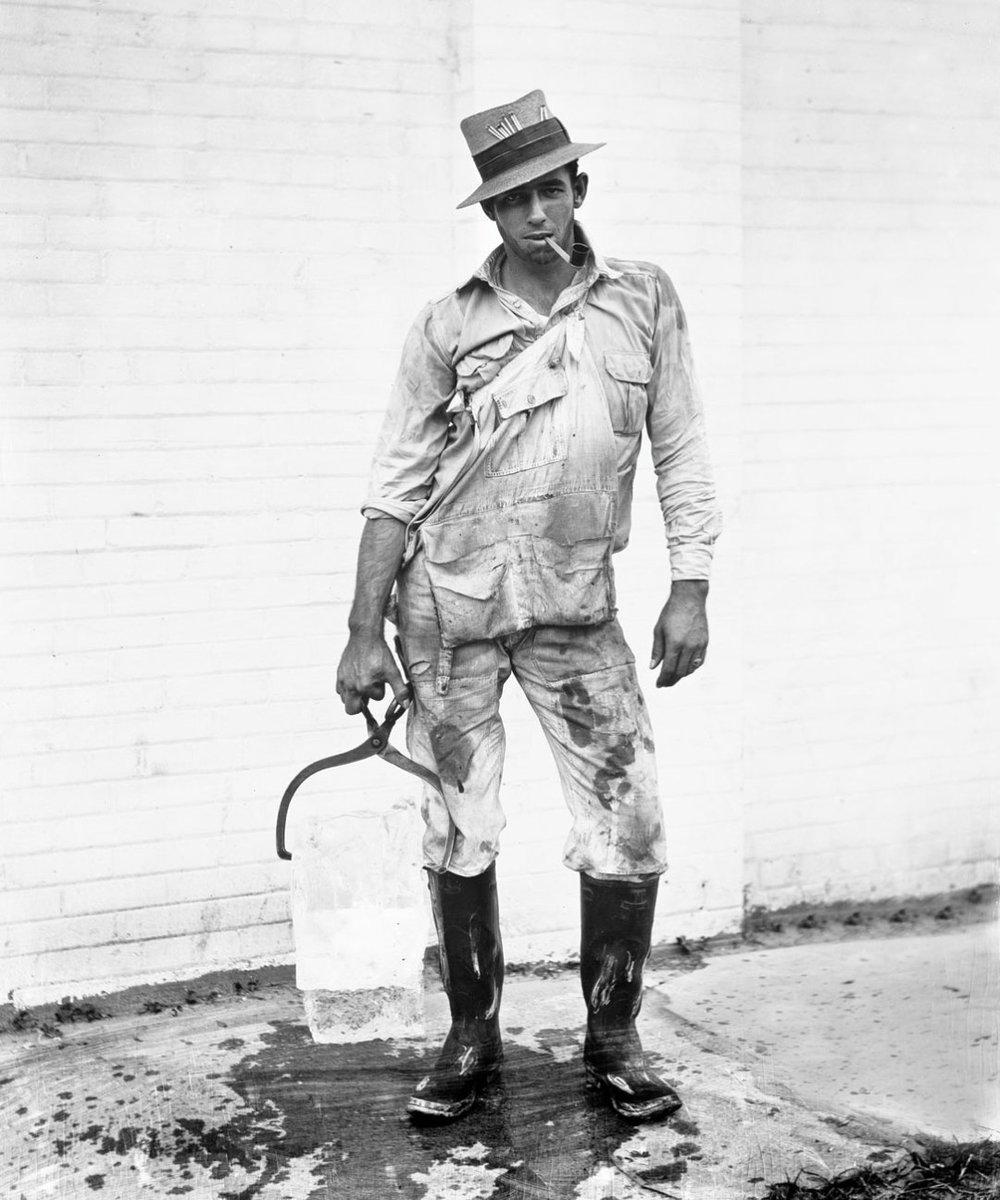
Reddit saw a nostalgic snapshot. What that image really shows is a disappearing job, a city trying to stay cool before air conditioning, and a country on the edge of a technological flip. By the time this man was old, his entire trade would be gone.
Ice delivery in 1920s Houston was more than a quaint service. It was a daily lifeline that shaped how people ate, how cities grew, and who did the hardest work. Here are five things that photo quietly captures.
1. The Ice Man Was the Refrigerator Before Refrigerators
What you are seeing first is simple: this man is a human refrigerator. Before electric fridges spread, families kept food in an “icebox” and relied on men like him to keep it cold.
An icebox was a wooden cabinet lined with metal and insulation. A block of ice went in the top compartment, and cold air sank down to keep milk, meat, and leftovers from spoiling. In 1920, fewer than 10 percent of American homes had electric refrigerators. In working-class neighborhoods in Houston, that number was even lower.
So the ice man was not a luxury. He was part of the basic food system. The American Ice & Fuel Company, which operated in Texas cities including Houston in the early 20th century, ran plants that froze huge blocks of ice. Their delivery crews made daily rounds, much like postal workers, except their cargo melted if they were late.
Families put little cardboard signs in their windows with numbers like 25, 50, 75, or 100. The number on top told the ice man how many pounds they wanted that day. He would glance up, swing a block off the wagon or truck with his ice tongs, hoist it on his shoulder, and carry it straight into the kitchen.
Refrigeration changed how people ate because it changed how long food could last. Before reliable home cooling, most families shopped daily or every other day. With an icebox and regular ice delivery, they could buy meat in larger quantities, keep leftovers safely, and store milk for children for more than a day.
So what? That sweaty man in the photo is the missing link between the old world of daily markets and the modern world of weekly grocery runs and leftovers, and his work made 20th century eating habits possible before electricity caught up.
2. Ice Delivery Was Brutal, Skilled Labor
To modern eyes, the job can look simple: pick up ice, drop off ice. In reality, it was a punishing mix of strength, speed, and technique that chewed up bodies.
A standard commercial ice block weighed around 300 pounds. For home delivery, workers used ice saws to cut that into smaller blocks, often 25 or 50 pounds each. The man in the Houston photo is using ice tongs and a shoulder pad, the basic tools of his trade. The pad kept the ice from burning his skin and gave him a little cushioning. The tongs had to be set just right. Too loose and the ice slipped. Too tight and the block cracked.
In the 1910s and 1920s, ice routes in big cities could involve 100 or more stops a day. In summer, demand spiked. In Houston’s humid heat, that meant hours of hauling heavy, melting blocks up stairs, into narrow kitchens, and sometimes to boarding houses or restaurants with multiple floors.
One Houston Chronicle ad from the early 1920s for the Houston Ice & Brewing Company boasted of “prompt and regular delivery.” That promise rested on men like this one, who had to move fast enough that the ice did not vanish in the wagon before reaching customers.
In northern cities, some ice men became minor neighborhood celebrities, especially to children who hoped for slivers of ice on hot days. In Houston, where summer temperatures regularly pushed past 90 degrees, the ice man was even more visible. He was the person you watched for on the street when the butter started to soften and the milk smelled off.
The work had a cost. Medical reports from the era mention hernias, back injuries, and arthritis among ice workers. Many started young and burned out early. The man in the photo looks lean, not bulky. That is the body of someone who hauls weight all day, every day, not someone posing for a fitness magazine.
So what? The image of the ice man reminds us that early 20th century “modern life” ran on human muscle, and that comfort for middle-class households depended on the hard, often invisible labor of delivery workers whose bodies paid the price.
3. Houston’s Heat Made Ice a Matter of Survival
Houston in 1920 was already a hot, humid city of more than 130,000 people. Air conditioning was still a lab curiosity. Ice was how the city coped.
Mechanical ice plants had been operating in Texas since the late 19th century. By the 1910s, companies like Houston Ice & Brewing and Southern Ice & Fuel were running large facilities that froze water in big tanks, then cut it into blocks. Railroads brought ice to smaller towns. In a Gulf Coast climate, this was not just about comfort. It was about health.
Milk spoiled quickly in the heat. Meat went bad fast enough to cause food poisoning. Before pasteurization and modern packaging, keeping food cold was one of the simplest ways to avoid sickness. Public health officials in hot cities quietly relied on the ice trade to keep disease down.
Houston’s heat also shaped how people used ice beyond the kitchen. Bars and soda fountains packed it around beer kegs and soft drink bottles. Hospitals used it to cool patients with fevers. In some neighborhoods, people bought small chips just to suck on during the worst afternoons.
One concrete example of how central ice was to city life comes from the summer of 1918, when a coal shortage hit parts of the United States. Coal powered many ice plants. Newspapers reported worries about ice shortages in Southern cities and the effect on food supplies and hospitals. Houston was not immune to those fears. When ice production faltered, the city felt it.
So what? The Houston ice man in the photo is not just a quaint figure. In a pre-air-conditioning city, he is part of the basic survival system that kept food edible and people cooler in a climate that could easily make them sick.
4. The Ice Trade Sat at the Edge of a Technological Revolution
The most striking thing about the photo, if you know the timeline, is that this man is working in a doomed industry. He is standing in the shadow of the electric refrigerator.
Commercial refrigeration had been around since the late 19th century, especially for breweries and meatpacking plants. Home refrigerators, though, were rare and expensive. In 1913, Fred W. Wolf introduced a domestic refrigerator unit in the United States, but it was clunky and aimed at the wealthy. By the mid-1920s, companies like General Electric and Frigidaire were pushing electric refrigerators harder, but adoption was still slow.
In 1920, when this Houston photo was taken, the ice man could probably not imagine that within a generation, his job would vanish. Yet the numbers tell the story. In 1921, there were only tens of thousands of electric refrigerators in American homes. By 1937, there were more than 6 million. By the early 1940s, in many cities, the ice man’s daily rounds had shrunk to a trickle.
Houston followed that pattern. As the city electrified and incomes rose, more households bought refrigerators. Ice companies tried to adapt. Some shifted from home delivery to supplying restaurants, industrial users, or cold storage warehouses. Others went under.
There is a quiet irony in the photo. The same industrial progress that allowed Houston to have large ice plants, trucks, and a growing urban economy also created the technology that made the ice man obsolete. Refrigerators did not just make life easier. They wiped out a whole category of work.
So what? The ice man in the Houston street is a snapshot of a job in its last strong decade, and his story shows how quickly a new technology can erase an entire trade that once felt permanent.
5. Race, Class, and Who Carried the Ice
Even without seeing his face clearly, that Houston ice man is almost certainly working-class, and his job sits at the intersection of race and class in the Jim Crow South.
In early 20th century Houston, as in many Southern cities, heavy manual labor was often done by Black and Mexican American workers, while white workers were more likely to hold the better paid driving or supervisory roles. Photographs from the era in Texas and Louisiana show Black ice men carrying blocks into homes, sometimes directed by white foremen or wagon drivers.
The record for this specific photo is thin, so we cannot say with certainty what this man’s background was. But we do know that in 1920 Houston, Black residents made up a significant minority of the population and were largely confined to low-wage, physically demanding work. Ice delivery fit that pattern: long hours, heavy lifting, modest pay, and little job security.
Class lines showed up on the customer side too. Middle-class families could afford regular ice delivery and a decent icebox. Poorer families might buy smaller quantities less often, or share an icebox between households. In some cases, they bought ice by the chunk from corner stores rather than paying for home delivery.
One telling example comes from New Orleans, another Gulf Coast city, where Black ice workers went on strike in 1902 over wages and conditions. Their employers tried to break the strike by hiring white workers and using police pressure. That fight, reported in regional newspapers, revealed how dependent cities were on this labor and how little power the workers had.
Houston had its own labor tensions, including streetcar strikes and dockworker disputes in the early 1900s. While specific ice worker strikes in Houston are less well documented, the pattern across the South suggests similar dynamics: essential work done by marginalized people, with limited leverage.
So what? The man in the Houston ice photo is not just a generic worker. He sits inside a racial and class system where the hardest physical jobs kept cities running while leaving the workers themselves near the bottom of the social order.
The Reddit photo of the ice delivery man in 1920s Houston feels like a simple time capsule: a guy, a block of ice, an old street. Look closer and you see a whole world. A city fighting the heat. A food system balanced on melting blocks. A laborer whose job combined skill and strain. A technology on the verge of wiping his trade away.
Today, refrigerators and air conditioners hum quietly in Houston apartments and houses. Few people think about how cold air reaches them. That is the legacy of the ice man: his work was so effective that once machines took over, the human story disappeared from view.
That single photograph brings him back, shoulder bent under the weight of a city’s comfort, caught for a second before he moves on to the next doorbell and the next melting block.
Frequently Asked Questions
How did ice delivery work in the 1920s?
In the 1920s, families used iceboxes instead of electric refrigerators. Ice companies froze large blocks in factories, then delivery men used wagons or trucks to bring smaller blocks to homes. Customers put signs in their windows showing how many pounds they wanted, and the ice man carried the block inside with tongs and a shoulder pad.
When did ice delivery stop in American cities?
Ice delivery began to decline in the late 1920s as electric refrigerators became cheaper and more reliable. The Great Depression slowed adoption, but by the late 1930s and early 1940s, many urban households had refrigerators. In most big cities, regular home ice delivery largely disappeared by the 1950s, surviving longer only in some rural or poorer areas.
Why was ice so important before refrigerators?
Before refrigerators, ice was the main way to keep food from spoiling, especially in hot climates. Ice in an icebox kept milk, meat, and leftovers cold for longer, which reduced food poisoning and allowed families to shop less often. In cities like Houston, ice was also used in hospitals, bars, and soda fountains to cool drinks and patients.
Who usually worked as ice delivery men?
Ice delivery was tough, low-paid physical work. In many American cities, especially in the South, Black and immigrant men often did the heaviest hauling, while white workers were more likely to drive wagons or supervise. The job required strength and skill and often led to back and joint problems after years on the route.