They look similar because in most popular images, the Hanging Gardens of Babylon and the palaces of Mesopotamian kings are all turned into the same thing: lush green terraces rising over a brown river city. But when you strip away the modern artwork and go back to the sources, you find two different stories competing for the same wonder.
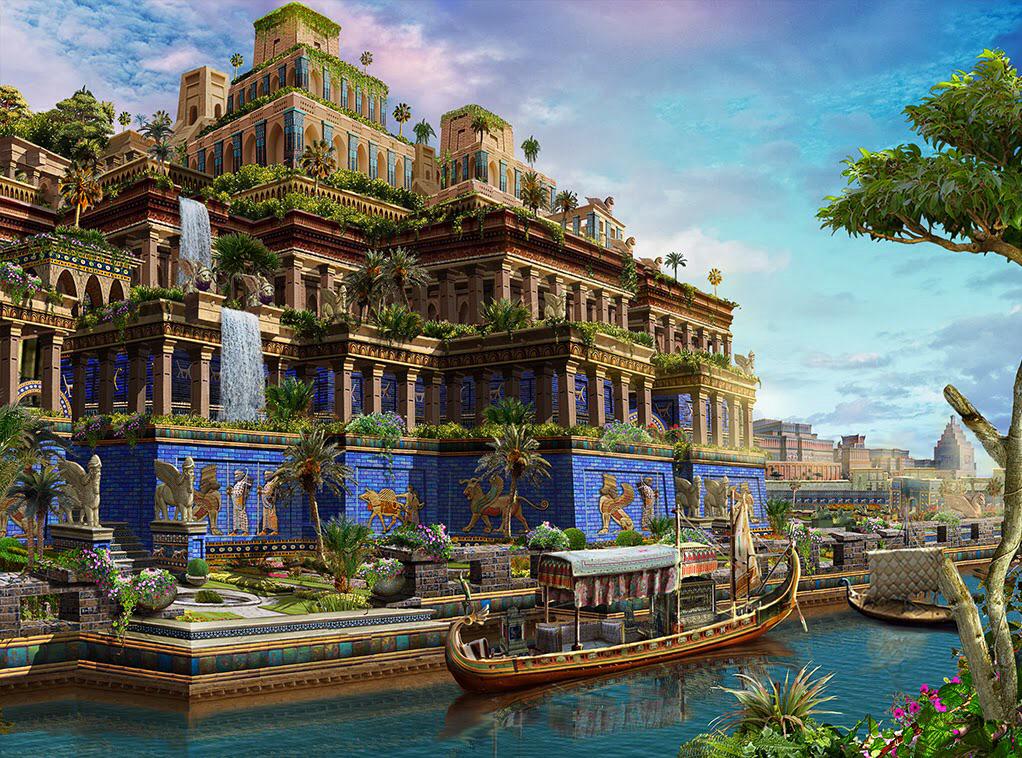
Ancient writers swore the Hanging Gardens were real. Archaeologists have spent more than a century trying to find them in Babylon, and have not. A smaller group argues we have been digging in the wrong city, and that the famous gardens belonged not to Babylon at all, but to Assyrian Nineveh.
The Hanging Gardens of Babylon were a legendary terraced garden said to have been built by a Mesopotamian king, irrigated by ingenious machinery, and counted among the Seven Wonders of the ancient world. Whether they existed, and where, is still debated.
To make sense of the debate, you have to compare two candidates on the same terms: their origins, the methods used to build and water them, what they achieved, and the legacy they left behind.
Origins: Babylon’s love story vs Nineveh’s power project
Start with the story everyone knows. In later Greek and Roman texts, the Hanging Gardens of Babylon are usually tied to Nebuchadnezzar II, the Babylonian king who ruled from 605 to 562 BCE.
Writers like Diodorus Siculus and Strabo say Nebuchadnezzar built the gardens for a queen from a mountainous land, often identified as Amytis of Media. She missed the green hills of home, so he raised an artificial mountain of terraces by the Euphrates and covered it with trees and flowers. It is a neat story: a warlord with a sentimental streak.
There is a problem. Nebuchadnezzar left a lot of inscriptions bragging about his building projects in Babylon: temples, walls, palaces. He never mentions a wonder of the world–scale garden. For a king who boasted about everything, that silence is loud.
On the other side of Mesopotamia, in Nineveh, the Assyrian king Sennacherib ruled from 704 to 681 BCE, a generation before Nebuchadnezzar’s time. His inscriptions do talk about gardens. He calls his capital a “palace without rival” and describes planting fruit trees, exotic plants, and constructing an elaborate water system to feed them.
Sennacherib also boasts of engineering a new kind of water-raising screw and building massive aqueducts to bring water from distant mountains to Nineveh. The language sounds less like a romantic gift and more like a statement of imperial power: I can move rivers and remake the earth.
So you get two origin stories. In the Babylon version, the gardens are a royal love letter. In the Nineveh version, they are a piece of high-pressure imperial propaganda.
That difference matters because it shapes where historians look for evidence. If Nebuchadnezzar really built a wonder for a queen, it should show up in Babylonian records. If the wonder was actually Sennacherib’s prestige project, the trail runs through Assyrian texts and ruins instead.
Methods: how do you make a mountain of plants in a desert city?
Ancient descriptions of the Hanging Gardens agree on a few technical points. The garden was terraced, like a stepped pyramid. It used stone or brick vaults filled with soil. And it had some kind of mechanical irrigation that lifted water from the river or canal level up to the top terraces.
Diodorus Siculus, writing in the 1st century BCE, describes a square garden, each side about 120 meters long, with arches and vaults, thick walls, and layers of reeds, asphalt, and bricks under the soil to keep water from seeping through. He says screws and other devices raised water from below.
In Babylon, archaeologists have found large palace complexes, thick walls, and evidence of gardens, but nothing that clearly matches this description. The city sat right on the Euphrates, so irrigation was not a fantasy. But the specific terraced mountain described by Greek authors has not appeared in the ground.
Some scholars argue we may have missed it because later building and river shifts destroyed the evidence. Others point out that Babylonian building habits used mudbrick more than stone, which does not survive as dramatically as Assyrian stonework. The record is patchy enough that absence of proof is not quite proof of absence.
In Nineveh, the picture is different. Excavations at Sennacherib’s capital have uncovered the remains of a vast water system. There are canals cut through hills, a famous stone aqueduct at Jerwan carrying water over a valley, and inscriptions that describe water being brought from about 50 kilometers away.
One inscription even mentions a screw-like device used to raise water, centuries before Archimedes is credited with inventing the screw pump. That has led some modern historians, especially Stephanie Dalley, to argue that the Hanging Gardens were in Nineveh, powered by this Assyrian engineering.
Both cities had the basic tools: bricks, labor, knowledge of irrigation. Only Nineveh, though, leaves us a clear paper trail of long-distance water engineering and experimental lifting devices tied directly to a royal garden project.
So what? Because if you are trying to match ancient descriptions to real-world methods, Nineveh’s engineering record fits the technical side of the legend more neatly than anything we can currently document in Babylon.
Outcomes: what did these gardens actually do for their cities?
Whether in Babylon or Nineveh, a terraced garden in Mesopotamia was not just about shade and flowers. It was a political statement written in plants and stone.
If the traditional story is right and Nebuchadnezzar built the gardens in Babylon, they would have been part of his broader project to make the city the showpiece of his empire. He already rebuilt the great ziggurat, Etemenanki, and the Ishtar Gate with its blue-glazed bricks and dragon reliefs. A man-made mountain of greenery by the river would have told visiting envoys: this is the center of the world, rich enough to waste water on ornament.
In that reading, the outcome is soft power. The gardens would have impressed foreign rulers, soothed a homesick queen, and projected an image of Babylon as a place where human skill could tame the harsh climate.
In Nineveh, Sennacherib’s garden project had a sharper edge. The waterworks that fed his parks and orchards were built by forced labor from conquered peoples. His inscriptions brag about cutting through mountains and controlling rivers. The gardens were the pleasant surface of a system built on conquest and engineering terror.
Here the outcome is twofold. On the practical side, the canals and aqueducts improved agriculture around Nineveh and made the city less vulnerable to drought. On the symbolic side, the royal gardens were a curated display of the empire’s reach. Exotic trees and plants from different lands were transplanted into one controlled space, a living map of Assyrian domination.
There is also a quieter outcome that both versions share. Terraced gardens in a hot, dry environment create microclimates. Shade, moisture, and plant cover cool the air and stabilize soil. Even if the Hanging Gardens never matched the later romantic pictures, any large irrigated garden would have changed how people experienced urban life in these cities.
So what? Because whether you put the wonder in Babylon or Nineveh, the gardens were not just decoration. They were tools of statecraft and environmental engineering that reshaped how power and comfort were displayed in ancient Mesopotamian capitals.
Legacy: a Babylonian wonder with an Assyrian footprint
Here is the odd part. Every schoolchild learns about the Hanging Gardens of Babylon, not the Hanging Gardens of Nineveh. Yet the strongest archaeological and textual evidence for a wonder-like garden complex points to Assyria.
Greek writers who compiled the list of the Seven Wonders in the Hellenistic period knew Babylon’s name better than Nineveh’s. By then, Nineveh had been destroyed for centuries. Babylon, on the other hand, was still a reference point in stories and travel accounts.
So the legend stuck to the more famous city. When later authors heard about ancient Mesopotamian gardens with artificial mountains and clever irrigation, they attached the story to Babylon and Nebuchadnezzar, the king who already loomed large in Jewish and Greek memory.
Modern historians are split. Some argue the gardens were in Babylon and we simply have not found them. Others, following Dalley and a few earlier hints, argue that Greek and Roman writers misattributed an Assyrian wonder to a Babylonian king.
There is also a third possibility: that the Hanging Gardens are a composite legend. Greek visitors and storytellers might have merged memories of several large gardens and waterworks across Mesopotamia into one dramatic image. A bit of Babylon, a bit of Nineveh, some exaggeration, and a catchy name.
Either way, the legend’s afterlife has been powerful. Medieval and early modern writers repeated the story. Nineteenth- and twentieth-century artists painted the gardens as vertical forests. The phrase “Hanging Gardens of Babylon” became shorthand for lush, improbable luxury.
So what? Because the legacy we remember, a Babylonian wonder, may be built on an Assyrian footprint. The way the story shifted tells us as much about how later cultures remembered Mesopotamia as it does about what was actually built there.
So did the Hanging Gardens really exist, and where?
Put the pieces side by side and a pattern emerges.
On the Babylon side you have: strong later literary tradition tying the gardens to Nebuchadnezzar and Babylon, a city famous in the ancient Mediterranean, and a plausible setting on the Euphrates. Against that, you have the silence of Babylonian inscriptions and the lack, so far, of a clear archaeological match.
On the Nineveh side you have: inscriptions from Sennacherib describing grand gardens and experimental water-raising devices, physical remains of aqueducts and canals feeding the city, and reliefs that show terraced palace gardens with trees and water features. Against that, you have the fact that ancient Greek and Roman writers almost always call the wonder Babylonian, not Assyrian.
Historians who lean toward the Nineveh theory argue that Greek authors confused cities and kings in a region that was already partly ruined by their time. They point out that the technical details in Greek descriptions fit Sennacherib’s projects better than anything we can document in Babylon.
Historians who stick with Babylon respond that absence of evidence is not evidence of absence, that our excavations in Babylon are incomplete and complicated by later destruction, and that Greek writers were not completely clueless about Mesopotamian geography.
So did the Hanging Gardens exist? Most scholars today think there were large, engineered royal gardens in Mesopotamia that inspired the legend. Whether there was one single wonder that exactly matches the later descriptions is less certain.
As for location, the debate is still alive. Babylon remains the traditional answer. Nineveh has become the most serious alternative, backed by Assyrian texts and ruins. A minority view holds that the “Hanging Gardens of Babylon” are a mythic composite rather than a single site waiting to be found.
So what? Because the question forces us to confront how ancient wonders are built twice: once in brick and water, and again in memory. The Hanging Gardens sit right at that fault line, where archaeology, royal propaganda, and later storytelling blur into each other.
Why the Hanging Gardens debate still matters
The argument over the Hanging Gardens is not just about pinning a wonder to a GPS coordinate. It touches on deeper questions about how we read the ancient world.
First, it shows how heavily we rely on a small set of Greek and Roman authors to tell us about places they barely knew. When their stories clash with local inscriptions and archaeology, we have to decide who gets the benefit of the doubt.
Second, it reminds us that ancient kings used architecture and environmental control as propaganda. Whether in Babylon or Nineveh, bending water and greenery to your will was a way to say: I control not just people, but nature itself.
Third, the debate shows how modern expectations shape what we look for. We imagine the Hanging Gardens as a vertical jungle. Archaeology might reveal something more modest but still impressive: a series of irrigated terraces, a palace garden with imported trees, a cool, shaded space in a hot city.
Finally, the story has become part of how we think about cities and nature. The phrase “hanging gardens” gets borrowed for rooftop parks and vertical farms. People reach back to a half-legendary Mesopotamian wonder to describe modern attempts to green dense urban spaces.
So what? Because chasing the Hanging Gardens forces us to admit how much of ancient history is built from fragments and guesswork, and yet how those fragments still shape the stories we tell about power, environment, and what it means to build something worthy of wonder.
Frequently Asked Questions
Did the Hanging Gardens of Babylon really exist?
Most historians think there were large, engineered royal gardens in ancient Mesopotamia that inspired the legend of the Hanging Gardens. Whether there was a single garden that exactly matched later descriptions is uncertain. The physical evidence is incomplete, but the combination of ancient texts and known irrigation projects suggests the idea was based on something real.
Where were the Hanging Gardens located: Babylon or Nineveh?
Traditionally the Hanging Gardens are placed in Babylon and linked to King Nebuchadnezzar II. However, some modern scholars argue they were actually in the Assyrian capital Nineveh, built by King Sennacherib. Nineveh has stronger archaeological evidence for massive waterworks and royal gardens, while Babylon has the stronger later literary tradition. The question is still debated.
Why is there no archaeological evidence for the Hanging Gardens in Babylon?
Excavations in Babylon have uncovered palaces, temples, and city walls, but nothing that clearly matches ancient descriptions of the Hanging Gardens. Several factors may explain this: later construction and river shifts could have destroyed remains, Babylon used mudbrick that erodes easily, and parts of the site are poorly preserved or inaccessible. The absence of a clear match is one reason some scholars look to Nineveh instead.
Who first suggested the Hanging Gardens might be in Nineveh?
The idea that the Hanging Gardens were in Nineveh rather than Babylon has roots in earlier scholarship, but it was developed in detail by Assyriologist Stephanie Dalley in the late 20th and early 21st centuries. She pointed to Sennacherib’s inscriptions about gardens and water-raising devices, and to the remains of Assyrian aqueducts and canals, as a better fit for ancient descriptions of the wonder.