On a cold October morning in 1415, near the village of Agincourt, French knights did something that would horrify a modern military planner. They did not all charge at once. They came in what looked very much like waves.
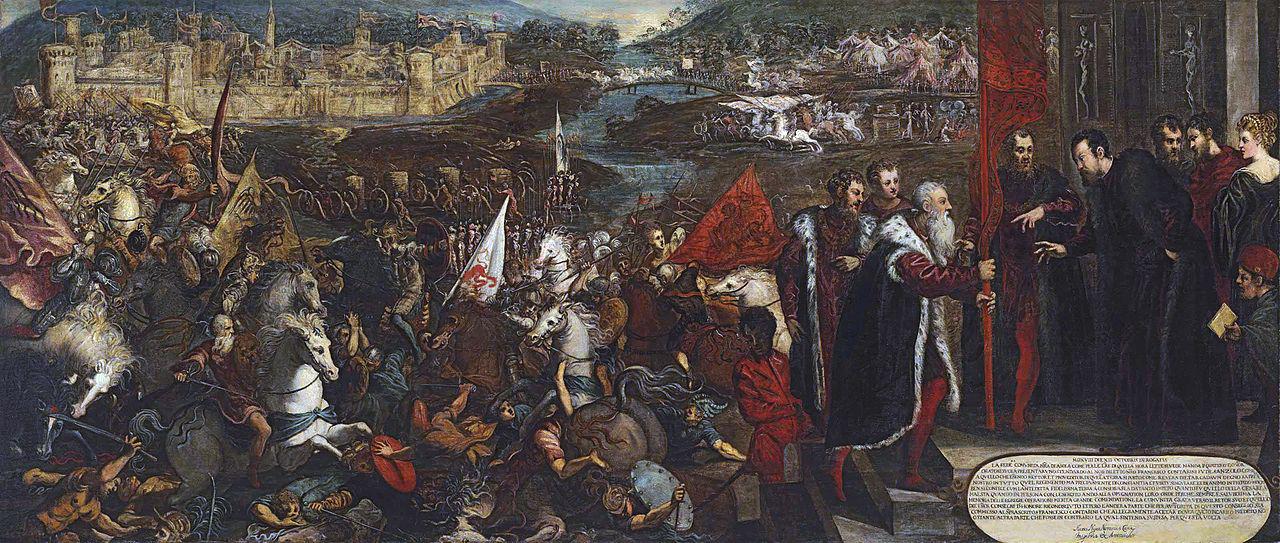
First one mass of armored men-at-arms slogged through the mud toward the English line. Then another. Then a third. Each found itself more exhausted, more disordered, and more vulnerable to English arrows than the last.
If you watch a movie or read a fantasy novel, this is familiar. Enemies attack in neat waves, each politely waiting its turn to be slaughtered. It works for pacing the action. The question is whether it ever worked on an actual battlefield.
Medieval armies did sometimes attack in waves, but not for cinematic reasons. Waves usually came from constraint, confusion, or specific tactical goals, not from a general deciding to feed in one regiment at a time for drama. By the end of this article, we will separate the Hollywood version of wave attacks from the ways pre-modern commanders actually used (or stumbled into) them.
Why “waves” look dumb to modern eyes
Modern readers are used to the idea of concentration of force. If you want to break an enemy line, you hit it as hard as you can, all at once, at the weakest point. You do not send a few units, wait for them to die, then send more.
That instinct is not wrong. Feeding troops into combat piecemeal is usually a bad idea. It means the defender can fight a series of smaller battles instead of one big one. It lets them rest, rotate units, and keep a reserve while you burn yours away.
So why do we see wave-like behavior in some historical battles?
Three big reasons:
First, physical constraints. Narrow terrain, walls, gates, and ditches limit how many attackers can actually fight at once. You can have 20,000 men, but if only 200 can fit on the breach in a city wall, they will look like a wave, then another wave, then another.
Second, command and control. Medieval commanders did not have radios. Once a charge started, it was hard to coordinate with other units. What looks like a deliberate second wave might just be another group that heard the signal late or had to move around rough ground.
Third, doctrine and social structure. Some armies really did organize in lines or “battles” meant to fight in succession. Others had social pressures that pushed certain elites to attack first, even when it was a bad idea.
So the basic answer is: no sane commander wants to waste troops in theatrical waves. But terrain, communication, and social realities often turned battles into something that looked like exactly that. That matters because it reminds us that medieval warfare was less like a chessboard and more like a crowded, chaotic street fight.
Scenario 1: The deliberate wave attack that almost makes sense
Imagine you are a 13th century commander outside a fortified town. You have 8,000 men. The defenders have maybe 1,500, plus walls and crossbows. You cannot get everyone onto the wall at once. You have to think in terms of phases.
This is the scenario where an attack in waves can be rational.
First, you send forward missile troops and engineers. Crossbowmen, archers, men with mantlets and ladders. Their job is to suppress the defenders on the wall, test where the fire is heaviest, and maybe damage a gate or weak section. They are not meant to win the battle alone. They are the first wave.
Behind them, you hold assault troops. Men with shields, axes, and short weapons, ready to rush a breach or scale ladders once the defenders are shaken or thinned out. This is the second wave. You do not want them standing under arrow fire for an hour before they can even climb.
Then you keep a reserve. If the first breach fails, you can try another. If the defenders counterattack outside the walls, you have fresh men to plug the gap. This is a third wave in waiting, but ideally you never need it.
Medieval commanders did think this way. During the siege of Jerusalem in 1099, the First Crusade used repeated assaults on different sections of the wall, with towers and ladders brought up in phases. At the siege of Orléans in 1429, English and French attacks on outlying forts came in distinct pushes, with reserves held back until the first attacks either gained ground or stalled.
Even in open battle, some armies used planned sequences. In the 13th and 14th centuries, French commanders often organized their forces into three “battles” or divisions, one behind the other. The idea was that the first line would engage, the second would exploit success or cover a retreat, and the third would be a final reserve. English armies did something similar, though they tended to fight more compactly.
From the commander’s point of view, this is not a dumb wave. It is depth. You are giving yourself options. You are trying to avoid committing everything at once and then having nothing left if the line breaks.
There are tradeoffs. If your first line is too weak, it gets crushed before the second can help. If your men are poorly trained, the second line may panic when it sees the first one run. If your nobles insist on being in the front rank, your carefully planned depth turns into a mob of angry horsemen charging ahead of schedule.
Still, in siege warfare and some set-piece battles, a phased, wave-like attack could be the least bad option in a bad situation. That matters because it shows that not all “waves” are suicidal. Some are just crude versions of what modern armies call echelons and reserves.
Scenario 2: The accidental wave, born from chaos and bad communication
Now take away the walls and put everyone in a muddy field. Keep the lack of radios.
This is where accidental waves appear.
Look again at Agincourt in 1415. The French did not sit down the night before and say, “We will attack in three doomed waves for the benefit of future playwrights.” They had three large divisions of men-at-arms, arranged in depth. That was a normal way to organize.
But the ground between the French and English was narrow and churned by rain. When the first French division advanced, men crowded together. Fallen horses, bodies, and discarded equipment clogged the way. The second division could not simply march through them in perfect order. It had to push around, over, and through a mass of exhausted, wounded, and dying men.
To the English, this looked like one wave, then another, then another. To the French, it felt like a slow-motion pileup.
Something similar happened at the Battle of Hastings in 1066. The Norman army under William the Conqueror attacked the English shield wall on Senlac Hill. They did not all go at once. Archers shot first. Then infantry advanced. Then cavalry tried to break the line. Attacks came in repeated surges, some of which turned into feigned or real retreats.
Was this a carefully scripted series of waves? Historians argue about how much was planned and how much was improvisation. What is clear is that terrain and communication shaped the rhythm. William could not see everything happening along the long English line. Units that saw an opportunity charged. Others held back. What later looks like a pattern was, on the ground, a mix of orders, misunderstandings, and local initiative.
Accidental waves also came from social structure. In many medieval armies, high-status cavalry expected to fight in front. At the Battle of Courtrai in 1302, French knights charged repeatedly against Flemish infantry. They did not wait for infantry support, in part because they saw themselves as the proper spearhead of any attack. Each failed charge left bodies and broken horses in front of the Flemish line. Later charges had to go through that mess.
So you get a pattern: first the hotheaded nobles rush in. They get shot up or bogged down. Then the rest of the army tries to support them, late and disordered. No one planned “waves.” They planned a coordinated assault. What they got was a sequence of partial attacks.
This matters because it explains why “waves” show up in chronicles. Chroniclers describe one charge, then another, then a third. That does not mean the general wanted it that way. It means that medieval command systems were fragile. When things went wrong, they went wrong in stages.
Scenario 3: The attrition wave, when you are trying to exhaust the enemy
There is one more scenario where waves can be rational, though it is ugly: when your goal is to wear the enemy down rather than break them in one blow.
Think of a narrow pass or bridge. You cannot fit your whole army through at once. The defender is dug in. You might decide to send repeated assaults to tire them, force them to spend arrows and javelins, and keep them under pressure while you look for another way around.
Ancient and medieval sources describe this kind of grinding assault at sieges. During the long siege of Antioch in 1097–1098, both Crusaders and defenders launched repeated sorties and counterattacks at specific gates. Each was a limited push with a clear objective. Over time, these wore down morale and numbers.
In this attritional model, you accept that the first wave will probably fail. Its job is to make the defender pay. The second wave hits a more tired enemy. The third might find a gap.
Economics and logistics matter here. If you have more men, more food, and more replacements than the defender, you can afford to trade bodies for ground. If you are the smaller army, you cannot.
Medieval rulers were not indifferent to casualties. Knights were expensive. Peasants were not free to lose either, because they paid taxes and worked fields. Still, in some contexts, especially religious wars or civil wars, commanders were willing to accept high losses to take a key fortress or crossing.
There is also a psychological angle. Repeated attacks can convince defenders that relief is not coming and that their commander cannot protect them. During the siege of Acre in the Third Crusade, both sides used constant pressure to try to break the other’s will. Assaults came in phases, often after bombardment from siege engines.
From a modern perspective, this looks wasteful. From a medieval one, it could be a grim calculation: we can lose 1,000 men here if it opens the road to a rich city, or if it prevents an enemy army from uniting with allies.
This matters because it shows that not all wave-like attacks were accidents or bad tactics. Some were conscious attempts to solve specific problems of terrain and morale with the tools available.
So which kind of “wave attack” is most realistic?
So if you are writing or imagining a medieval-style battle, what kind of wave behavior actually fits the period?
The least realistic is the tidy, polite wave. One unit charges, gets wiped out, then the next unit steps forward from a safe distance and repeats the process, while the rest of the army watches like spectators. No competent commander would waste troops that way unless something had gone very wrong in their head or in their society.
More realistic are:
Phased assaults shaped by terrain. At a wall, gate, bridge, or narrow field, you simply cannot attack with everyone at once. You get a first group that makes contact, a second that tries to exploit, and a third that reacts to whatever happens. To defenders, this looks like waves. To attackers, it is just the only way to get bodies into the fight.
Depth-based formations that behave like waves under stress. When armies form in multiple lines or “battles,” they intend to use reserves intelligently. In practice, poor visibility, fear, and ambition turn this into staggered, messy attacks. Chroniclers then describe “the first battle was repulsed, then the second advanced,” which sounds like waves.
Attritional pushes in sieges and chokepoints. Here, repeated assaults are part of a strategy to wear down the enemy. The waves are not neat. Units mix. Casualties pile up. But the rhythm of attack, pause, attack again is real.
Economics and logistics act as a brake. Medieval rulers could not casually throw away thousands of trained men. Campaign seasons were short. Horses were expensive. Replacing armor took time and money. That is why you see more wave-like behavior where commanders feel desperate, overconfident, or constrained by terrain, and less where they have room to maneuver and time to plan.
So if you want historical realism, think less in terms of a general ordering “Wave One, advance” and more in terms of a commander trying to use reserves and terrain, then watching his neat plan dissolve into a series of half-coordinated attacks. That is where history and the familiar trope meet.
That matters because it shifts the story from cartoonish stupidity to human limitation. Medieval commanders were not idiots. They were working with bad maps, no radios, proud nobles, and unforgiving ground. The waves came from that world, not from a scriptwriter’s need to stretch out a fight scene.
Why the myth of the wave attack still sticks
So why does the “wave after wave of idiots” image hang on in pop culture?
Partly because it is visually clear. A director can show three charges and the audience understands the stakes rising each time. Partly because some famous battles, like Agincourt or Hastings, really did have repeated assaults, which chroniclers described in simple sequences that look like waves on the page.
There is also a moral comfort in it. If the losers attacked in stupid waves, the winners must have been smarter. That fits national myths. English writers could explain French defeats as the result of arrogant nobles charging again and again into arrow fire, rather than as a mix of weather, terrain, and bad luck.
But when you look closely, the pattern is more interesting. Waves in medieval warfare came from narrow gates, muddy fields, social hierarchies, and the sheer difficulty of getting thousands of frightened humans to move in the same direction at the same time.
That is why the question from that Reddit thread matters beyond fiction-writing. It forces us to ask how real people solved real problems with limited tools. It reminds us that what looks, from a distance, like a dumb trope often has a tangled, human origin.
And it suggests a better rule of thumb: if you see waves on a medieval battlefield, ask what constraint created them. The answer will tell you more about the war, the society, and the people involved than any slow-motion charge ever could.
Frequently Asked Questions
Did medieval armies actually attack in waves?
Medieval armies did not usually plan neat, sacrificial waves like in movies, but battles often looked wave-like. Terrain, narrow approaches, multi-line formations, and poor communication meant that attacks reached the enemy in phases. Chroniclers then described these as one charge after another, which can sound like deliberate waves.
Why would a commander ever use a wave attack on purpose?
Commanders might use phased attacks when terrain limited how many men could fight at once, such as at walls, gates, bridges, or narrow fields. They also organized armies in depth, with reserves meant to join the fight later. In sieges, repeated assaults could be a way to wear down defenders. These are all forms of wave-like behavior driven by constraints, not by a desire to waste troops.
Was the Battle of Agincourt fought in waves?
At Agincourt in 1415, the French army advanced in several large divisions arranged in depth. Because the ground was narrow and muddy, each division reached the English line in turn, stumbling over the wreckage of the previous one. To observers, this looked like waves of attackers, but it was more the result of terrain and congestion than a plan to send separate sacrificial attacks.
Are siege assaults in medieval warfare realistic if shown in waves?
Yes, siege assaults are one of the most realistic places to show wave-like attacks. Only a limited number of men can climb ladders, cross a breach, or attack a gate at once. Commanders often sent forward missile troops and engineers first, then assault troops, then reserves. To defenders on the wall, this looked like distinct waves, even if the attackers saw it as a continuous effort.