On a table in the Petrie Museum in London, about a century ago, lay a shallow tray of chaos: thousands of tiny faience beads, dusty and anonymous. They had been lifted from an undisturbed 4,500-year-old tomb at Giza, then sat for decades as a puzzle no one quite had time to solve.
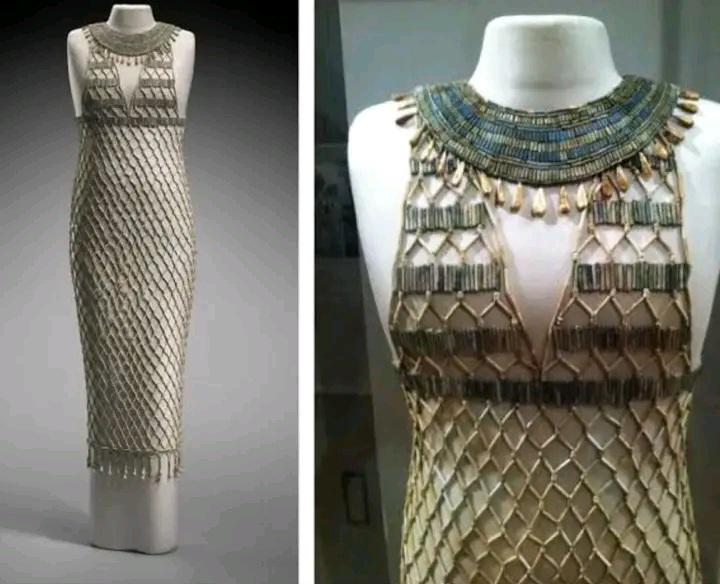
Bit by bit, conservators re-threaded them. The mess turned into geometry. A netted pattern emerged, then a neckline, then the unmistakable outline of a dress that had once shimmered over the body of an elite Egyptian woman of the Old Kingdom.
The 4,500-year-old Egyptian bead dress, reconstructed from about 7,000 beads, is one of the oldest known tailored garments. It was not just jewelry. It was clothing, status symbol, and probably ritual object all at once.
We know what happened in our timeline: Old Kingdom Egypt kept its beadwork mostly at home, women stayed largely outside formal power, and the dress became an archaeological curiosity. But what if that had gone differently?
What if this kind of bead dress had been mass-produced, exported, copied, or tied directly to political authority? What if a fashion item had nudged the course of ancient history?
What was the real bead dress, and why did it matter at all?
First, the real object. The so-called “Giza bead dress” is usually dated to Egypt’s Old Kingdom, around the 4th or 5th Dynasty, roughly 2500–2300 BCE. The date is not exact, but it is firmly in the age of the pyramids.
The beads: small, tubular or disk-shaped, made of faience. Faience is a glazed non-clay ceramic, a kind of artificial stone. Egyptians made it by fusing ground quartz with a glassy glaze, often in blue or green. It was cheap compared to gold, but visually striking.
The dress: not a sewn linen garment in the modern sense, but a net of beads that likely sat over a linen shift or was worn on the bare body. The pattern suggests a fitted front, shoulder straps, and a skirt that hugged the hips. It was tailored, not just a random net.
We do not have the name of the woman who wore it. We do know she was buried in an undisturbed tomb at Giza, which implies wealth and status. Bead-net dresses also appear in tomb paintings and reliefs, usually on elite women, dancers, or in ritual scenes.
So what did it do in real life? It signaled rank and probably had a ritual role. In some later contexts, bead nets were used over mummies as protective layers. In life, the dress would have caught light in a dim room, turned movement into shimmer, and made a human body look like a living piece of jewelry.
So what? Because the bead dress is one of the earliest surviving examples of complex, body-conscious fashion. It shows that 4,500 years ago, Egyptian elites were already using clothing as a tool of status, ritual, and visual control. That is the lever we can push in our what-if scenarios.
Scenario 1: What if bead dresses became a state-controlled power symbol?
In our reality, the bead dress was elite, but it did not become a formal badge of office. Imagine a different choice in the Old Kingdom court around 2500 BCE.
Suppose a powerful queen, say a woman like Meresankh III or Khentkaus I, leans into the visual impact of the bead dress. She wears it not just at banquets, but at public rituals, processions, and legal ceremonies. Scribes record it. Artists carve it. The image of the queen in a bead-net dress becomes standard iconography.
Now add a political move. The palace declares that only women of the royal family and certain priestesses may wear the full bead-net dress pattern. The dress becomes a regulated garment, like a crown or a royal headdress. Workshops in Memphis and Giza are ordered to produce standardized bead dresses for royal women and temple staff.
Egyptian bureaucracy is good at this sort of thing. They already control stone quarries, copper mines, and linen production. Faience workshops are often tied to temples and palaces. A royal decree that certain bead patterns are restricted is entirely plausible.
Over time, the bead dress becomes a visual shorthand for authorized female authority. A woman in the full net dress can witness contracts, oversee temple estates, or participate in state rituals as an official presence, not just as a decorative spouse.
We know that women in Old Kingdom Egypt could own property, sue in court, and in rare cases rule as regents or even as kings. The legal framework for female agency existed. What it lacked was a consistent, public, visual symbol of that authority.
In this scenario, the bead dress fills that gap. It becomes to elite Egyptian women what the nemes headcloth and crook-and-flail are to the king: a portable symbol of sanctioned power.
Practical effects follow. If temple priestesses and royal daughters in bead dresses are routinely depicted overseeing offerings, judging disputes, or directing labor, the idea of women as visible officeholders normalizes earlier and more strongly than in our timeline.
By the Middle Kingdom, around 2000 BCE, you could plausibly have a recognized class of “Ladies of the Net”: elite women whose bead dresses mark them as estate managers, senior priestesses, or royal envoys. Their dress is their badge, like a uniform.
So what? This would tilt Egyptian gender politics. It would not create modern equality, but it could embed female authority more deeply into state ritual and administration, which might influence succession crises, temple power, and even how later Greeks and Romans wrote about Egyptian women.
Scenario 2: What if bead dresses became Egypt’s hottest export?
Now shift the focus from politics to economics. Egypt in the Old Kingdom already traded along the Levantine coast, into Nubia, and across Sinai. They exported grain, gold, and finished goods. They imported cedar, copper, and luxury items.
In our world, Egyptian faience beads and small objects traveled, but the full bead dress as a recognizable package did not become a regional fashion. What if it had?
Imagine that by the late Old Kingdom, Egyptian workshops in Memphis and the Delta perfect a faster way to produce standardized faience beads: tubular, uniform, easy to string. The palace wants gifts that impress foreign rulers without draining gold reserves. A fully beaded dress, glittering blue-green, is cheaper than gold but visually spectacular.
So the court starts sending bead dresses as diplomatic gifts. A princess of Byblos receives one in a marriage alliance. A Canaanite ruler gets one for his chief wife. A Nubian elite in Lower Nubia is buried wearing a version adapted to local taste.
Foreign artisans see the dress, copy it with local materials, and start asking Egyptian traders for more beads. Egyptian merchants realize there is money in selling not just grain and linen, but bead kits: pre-measured strings that can be assembled into dresses, belts, and veils.
Logistically, this is easy to imagine. Beads are light, high-value, and non-perishable. They travel well by donkey caravan or ship. Faience production can be scaled in temple workshops with access to quartz sand and natron.
Over a century or two, a “Egyptian bead look” spreads along the Eastern Mediterranean. In wall paintings in Byblos or Ugarit, elite women appear in netted bead overlays. Local myths start to associate this style with Egyptian goddesses like Hathor or Isis, who are already popular abroad.
This has knock-on effects. If bead dresses become a prestige export, Egypt invests more in faience technology. They experiment with new colors, glazes, and forms. They may even start marking certain bead patterns as “royal” or “authentic Egyptian,” an early form of branding.
Foreign demand for beads increases Egypt’s leverage in trade negotiations. A Levantine city that wants the latest bead fashion might accept less favorable terms on grain prices or timber exports. Egyptian influence becomes visible on foreign bodies at festivals and rituals.
There is also a cultural effect. When foreign elites wear Egyptian-style bead dresses at weddings or religious ceremonies, they are not just copying fashion. They are importing bits of Egyptian symbolism. If the bead net is associated with protection, rebirth, or specific goddesses, those ideas hitch a ride with the beads.
So what? This scenario turns the bead dress into a soft-power tool. Egypt’s cultural footprint across the Eastern Mediterranean grows, and fashion becomes an early vector of Egyptianization, well before the New Kingdom’s military expansion.
Scenario 3: What if bead dresses became mass fashion for commoners?
Now take the opposite direction. Instead of staying elite or diplomatic, what if the bead dress trickled down and became common fashion inside Egypt itself?
On the face of it, this sounds unlikely. Faience production takes fuel, materials, and skilled labor. In the Old Kingdom, that is usually tied to temples and palaces. But imagine a technological and economic shift.
Suppose by the late Old Kingdom or early Middle Kingdom, around 2200–1900 BCE, workshops along the Nile experiment with cheaper, lower-temperature glazes and smaller kilns. They start producing rougher, less glossy beads in bulk, using scrap fuel and river sand.
At the same time, Egypt’s population grows, and local markets in provincial towns get busier. Artisans look for products that sell to ordinary farmers and laborers who have a little surplus to spend on adornment.
Enter the “poor woman’s bead dress.” Not a full-body net of fine faience, but partial panels, belts, and chest pieces made of mixed materials: some faience, some shell, some bone. Instead of 7,000 carefully arranged beads, maybe 700 in a simpler pattern.
Women wear these on feast days, at weddings, or for dancing. Men buy bead panels as bride gifts. Parents save up to bury a daughter with a modest bead net as a sign of care and hope for protection in the afterlife.
Archaeologically, this would show up as more bead fragments in non-elite graves, not just in rich tombs. We do see faience and beads in poorer burials, but not on the scale of full dresses. In this scenario, the bead net becomes a standard aspiration, like owning a decent linen kilt or a pair of sandals.
There is a social effect. When a style once reserved for elites spreads, elites react. They either move on to more exclusive materials, like gold and semi-precious stones, or they double down on complexity. Elite bead dresses become denser, more colorful, with specific patterns that are hard to copy.
For commoners, the bead dress becomes a way to imitate the court. A village girl in Middle Egypt can look, for one day a year, a little like the women she has seen in temple reliefs. That kind of aspirational fashion is powerful. It links identity to the state’s imagery.
Religiously, if bead nets are associated with protection and rebirth, their spread into common burials could democratize certain afterlife ideas. Protection once reserved for the rich becomes something even a modest family can buy in partial form.
So what? This scenario makes the bead dress a tool of social cohesion and quiet resistance at the same time. It ties ordinary people more tightly to elite imagery, while also forcing elites to innovate new ways to mark difference.
Which scenario is most plausible, and what would really change?
All three scenarios are grounded in things Egypt actually did: control symbols of power, use luxury goods in diplomacy, and let elite styles trickle down in cheaper forms. So which path for the bead dress is most realistic?
Given what we know, Scenario 1 and Scenario 2 are the best fits for Old Kingdom and Middle Kingdom realities.
Scenario 1, the dress as a regulated power symbol, lines up with how Egypt treated crowns, scepters, and certain headdresses. The state liked clear visual codes. It also fits the existing, if limited, legal agency of Egyptian women. Turning the bead dress into a badge of office for royal women and priestesses would not require a revolution, just a conscious court fashion choice that stuck.
Scenario 2, the dress as export, matches the logic of trade. Egypt already used luxury items as diplomatic gifts. Beads are easy to ship and visually impressive. We know Egyptian faience and iconography traveled widely in the Late Bronze Age. Pushing that process a few centuries earlier through fashion is entirely plausible.
Scenario 3, mass commoner fashion, is less likely in the Old Kingdom simply because of production costs. Fuel and skilled labor were too valuable to pour into thousands of cheap bead dresses. Something like this could have happened later, when technology and markets changed, but it would probably look like partial bead adornments rather than full dresses.
What would actually change in history if Scenario 1 or 2 had happened?
In Scenario 1, you might see a stronger tradition of visible female officeholders in Egypt. That could affect how later dynasties handled regencies, how foreign observers described Egyptian women, and how often women appear in legal and religious scenes. It would not erase patriarchy, but it could make female authority more routine and less exceptional.
In Scenario 2, you could get an earlier and deeper Egyptian cultural imprint on Levantine and Eastern Mediterranean elites. When later states like the Hittites or early Greek communities formed their own visual languages of power, they might borrow more directly from Egyptian bead-net imagery, not just from monumental art and writing.
There is a meta-level effect too. If bead dresses had been more widespread, archaeologists today would have more complete garments, not just a handful of reconstructed pieces from elite tombs. Our picture of ancient fashion, gender, and daily life would be richer and less skewed toward stone and gold.
So what? The reconstructed 4,500-year-old bead dress is not just a pretty artifact. It is a reminder that small, glittering things can carry big social meanings. If a few choices in court fashion, trade policy, or workshop economics had gone differently, a net of 7,000 beads might have become one of the most recognizable symbols of power and identity in the ancient world, not just a puzzle on a museum table.
Frequently Asked Questions
What is the 4,500-year-old Egyptian bead dress from Giza?
It is a reconstructed garment made from about 7,000 faience beads found in an undisturbed Old Kingdom tomb at Giza. Conservators reassembled the beads into a netted dress pattern, likely worn by an elite woman around 2500–2300 BCE as a status and possibly ritual garment.
Was the ancient Egyptian bead dress everyday clothing?
Probably not. Evidence suggests bead-net dresses were elite and special-occasion items, worn by high-status women, dancers, or priestesses, often over linen or the bare body. They appear in tomb art and in burials, which points to ceremonial and symbolic use rather than daily wear.
Could bead dresses have changed women’s status in ancient Egypt?
In a plausible what-if scenario, yes. If the state had turned bead dresses into regulated badges of office for royal women and priestesses, they could have become visual symbols of authorized female authority, reinforcing women’s roles in administration and ritual without overturning the broader patriarchal system.
Did ancient Egyptian fashion influence other civilizations?
Yes. Egyptian styles, motifs, and materials, including faience, spread through trade and diplomacy, especially in the Late Bronze Age. In a counterfactual scenario where bead dresses were major export gifts, Egyptian fashion could have shaped elite dress and religious symbolism in Levantine and Eastern Mediterranean societies even more strongly and earlier.