In a tunnel under the French-Swiss border, protons slam into each other at nearly the speed of light. Sensors light up. Data pours in. Somewhere in that chaos, a lead nucleus spits out particles and, for a moment, atoms of another element appear. On Reddit, the headline writes itself: “Scientists at CERN have turned lead into gold.”
There is a grain of truth. Modern nuclear physics really can change one element into another. That is what alchemists once dreamed of. But the way it happens at CERN, and what it means, is nothing like the medieval fantasy of cheap gold and instant riches.
By the end of this, you will know what “turning lead into gold” actually means in a particle accelerator, why it is wildly uneconomic, how it connects to old alchemy, and why physicists bother doing it at all.
Element transmutation is real. It happens whenever you change the number of protons in an atomic nucleus. The Large Hadron Collider can do that, but not in a way that makes anyone rich.
1. Yes, you can turn one element into another. No, it will not make you rich.
At its simplest, transmutation means changing one chemical element into a different one by altering the nucleus. Add or remove protons and you have a new element. Nuclear reactions in reactors, stars, bombs, and accelerators all do this. In that narrow, technical sense, “turning lead into gold” is possible and has been done.
A clear example came long before CERN. In 1980, physicist Glenn Seaborg, a Nobel laureate and veteran of the Manhattan Project, used a nuclear reactor to turn a tiny amount of bismuth into gold by neutron capture and beta decay. He produced actual atoms of gold, verified by analysis. The catch: the process cost far more than the gold was worth and produced radioactive byproducts.
That economic problem is the key. To make gold from lead (or bismuth) you must pump in huge amounts of energy, use expensive equipment, and accept that most of what you create will be useless isotopes or other elements entirely. The gold yield is microscopic. The bill is astronomical.
So what? The fact that transmutation is real but commercially hopeless draws a hard line between physics and fantasy. It shows that alchemy’s dream was not “wrong” in principle, only in economics and method, and it reminds us that not every scientific possibility has practical value.
2. What CERN actually does with lead (and why it is not an alchemy factory)
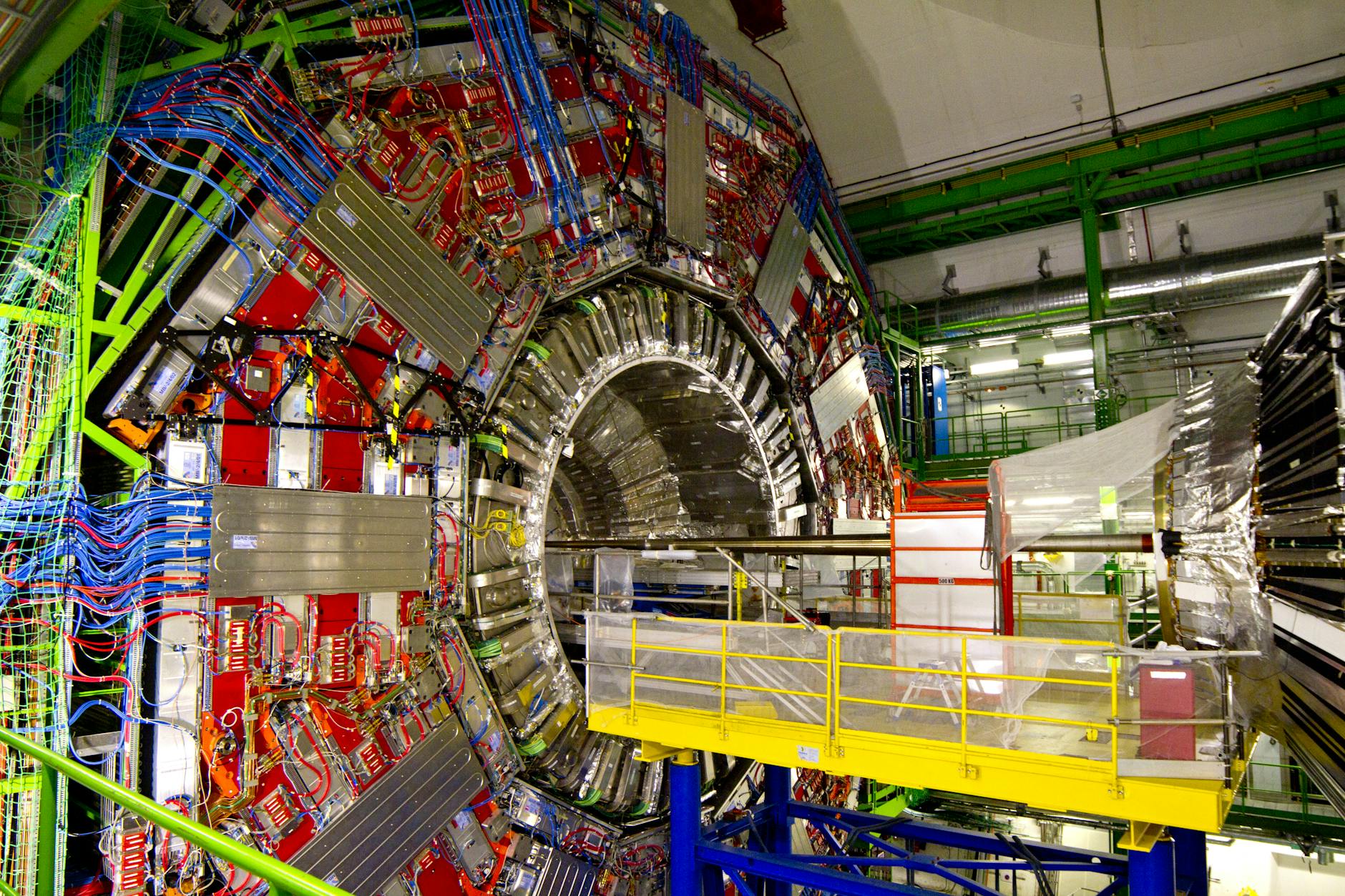
The Reddit headline about CERN “turning lead into gold” usually refers to lead-ion runs at the Large Hadron Collider. In those runs, CERN accelerates heavy lead nuclei and smashes them together to study extreme states of matter, not to mint jewelry.
Here is what happens in concrete terms. The LHC can accelerate fully ionized lead-208 nuclei (82 protons, 126 neutrons) to energies of several tera-electronvolts per nucleon. When two of these nuclei collide, they create a hot, dense fireball of quarks and gluons. In the wreckage, nuclear fragments fly out. Some of those fragments have fewer protons than lead. In principle, a fragment with 79 protons is gold. Detectors like ALICE and ATLAS can identify different nuclear fragments by their charge and mass.
So yes, in a tiny fraction of collisions, you get nuclei that count as gold. But you are talking about individual nuclei among billions of other particles, produced for trillionths of a second, often in excited or unstable states. You cannot scoop them up. You cannot refine them into a bar. The LHC is a microscope for matter, not a factory.
Why bother, then? Because those collisions recreate conditions similar to the first microseconds after the Big Bang. In 2010, for example, the ALICE experiment announced evidence of a quark–gluon plasma in lead–lead collisions, a state where quarks are no longer confined inside protons and neutrons. That result helped confirm theories about how matter behaved at extreme temperature and density.
So what? The lead runs at CERN matter because they let physicists test ideas about the early universe and the strong nuclear force. The accidental “gold” is just debris, a side effect of using lead as a tool to probe fundamental physics.
3. Medieval alchemists were not just con artists with cauldrons
When people hear “alchemy,” they picture robed frauds promising to turn lead into gold for gullible princes. Some were exactly that. But the historical story is messier and more interesting. Many alchemists were serious experimenters, and their dream of transmutation had a logic of its own.
Take the 13th-century English thinker Roger Bacon. He wrote about alchemy, optics, and gunpowder. Bacon believed metals grew and matured in the earth, with gold as the most “perfect” metal. In that framework, turning lead into gold meant speeding up nature’s process. He and others distilled, calcined, and mixed metals and minerals, carefully recording what happened.
Or look at the 17th-century German alchemist Hennig Brand, who boiled vast quantities of urine in search of the philosopher’s stone. He did not find it. He did isolate phosphorus, the first element discovered in modern times, which later became vital in matches, fertilizers, and warfare. Brand’s work was driven by alchemical ideas, but it produced real chemistry.
Alchemists had no concept of protons, neutrons, or nuclear forces. They thought in terms of essences, qualities, and “perfection.” Yet their repeated failures to transmute metals, and the techniques they developed along the way, fed into early modern chemistry. By the 18th century, Antoine Lavoisier and others were redefining elements and conservation of mass, partly by rejecting alchemical theories but using alchemical tools.
So what? The medieval dream of transmutation pushed people to experiment with matter for centuries. That long, messy effort laid much of the practical groundwork for chemistry, even as nuclear physics later showed that real transmutation happens in the nucleus, not in the furnace.
4. The first real “modern alchemy” happened in 1919, not at CERN
If you want a clean date when humans first changed one element into another in a controlled way, you do not go to the Middle Ages or to the LHC. You go to Ernest Rutherford’s lab in 1919.
Rutherford, a New Zealand-born physicist working in Britain, had already proposed the nuclear model of the atom. In 1919, he bombarded nitrogen gas with alpha particles from a radioactive source. In some collisions, the nitrogen nucleus absorbed an alpha particle and emitted a proton. The nitrogen-14 nucleus (7 protons, 7 neutrons) became an oxygen-17 nucleus (8 protons, 9 neutrons). Rutherford had turned nitrogen into oxygen.
He described this as a kind of artificial disintegration of the atom. It was the first clear case of induced nuclear transmutation, not a chemical reaction. Later, in the 1930s, scientists like John Cockcroft and Ernest Walton used particle accelerators to split lithium nuclei, and Enrico Fermi bombarded elements with neutrons to create new isotopes. By then, “alchemy” was no longer a dirty word, it was a historical curiosity that physics had quietly made real in a new way.
Rutherford’s work did not produce anything commercially useful. It did something more important. It proved that the atom’s nucleus could be changed by human intervention, that elements were not fixed and eternal. That realization opened the door to nuclear energy, nuclear weapons, medical isotopes, and the whole modern nuclear age.
So what? The 1919 nitrogen-to-oxygen experiment marked the shift from alchemical dreams to nuclear reality. It showed that transmutation was a laboratory fact, which in turn reshaped science, warfare, and energy policy in the 20th century.
5. Why nuclear transmutation is useful, even if gold-making is not
If turning lead into gold is a financial dead end, nuclear transmutation itself is not. Changing one element or isotope into another has become a standard tool in medicine, industry, and even nuclear waste management.
A concrete medical example is the production of technetium-99m, one of the most widely used isotopes in diagnostic imaging. It is not dug out of the ground. It is produced from molybdenum-99, which in turn comes from fission reactions in nuclear reactors. Hospitals rely on a constant supply of these short-lived isotopes, which are created by transmuting one nucleus into another.
In industry, neutron activation analysis uses transmutation to detect trace elements. You expose a sample to neutrons, some nuclei capture neutrons and become radioactive isotopes, and you measure the emitted radiation to identify what is present. Again, you are changing elements on purpose, but for information, not for treasure.
There is also active research into transmuting long-lived nuclear waste into shorter-lived isotopes using reactors or accelerators. Projects in Europe and Japan have explored “accelerator-driven systems” where a particle beam hits a heavy target, producing neutrons that can transform problematic isotopes. The engineering and economics are hard, and no country has solved the waste problem this way yet, but the idea rests on the same nuclear principles that make “lead into gold” headlines possible.
So what? Transmutation matters because it underpins nuclear medicine, analytical techniques, and possible waste solutions. The gold fantasy grabs attention, but the real value of changing elements lies in health, industry, and long-term environmental questions.
The Reddit line about CERN achieving the alchemists’ dream is catchy. It is also a bit of a bait-and-switch. Yes, in the debris of high-energy collisions, lead nuclei can fragment into other elements, including gold. No, that does not mean physicists have found a way to profitably manufacture precious metals.
The deeper story runs from medieval furnaces to Rutherford’s lab to the LHC ring. For centuries, people tried to change matter because they wanted wealth or spiritual insight. In the 20th century, physics finally cracked the problem for different reasons: to understand the nucleus, the forces that bind it, and the history of the universe.
Today, when CERN smashes lead ions, it is chasing quark–gluon plasmas and symmetry breaking, not bullion. The “modern alchemy” that actually matters is quieter: the reactor technician making medical isotopes, the engineer measuring trace impurities, the physicist modeling how stars forge heavy elements.
So when you see “lead into gold” in a headline about CERN, you are looking at a poetic shortcut for something both less magical and more profound. We did not just learn how to cheat the mint. We learned how matter itself is built and how, with enough energy, even the most solid element can be rewritten.
Frequently Asked Questions
Can CERN really turn lead into gold?
In a very narrow sense, yes. In high-energy lead–lead collisions at the Large Hadron Collider, lead nuclei can fragment into nuclei of other elements, including gold. These are individual nuclei, produced in tiny numbers for tiny fractions of a second, mixed with huge amounts of other debris. The process is not controllable or economical, so it cannot be used to produce usable gold.
Has anyone ever made gold from another element?
Yes. In 1980, physicist Glenn Seaborg used a nuclear reactor to convert bismuth into gold by neutron capture and beta decay. Particle accelerators can also create gold nuclei from other elements. All such methods are extremely expensive and inefficient. The cost of the equipment and energy is far higher than the value of the microscopic amount of gold produced.
What was the first successful element transmutation?
The first clear case of artificial element transmutation was done by Ernest Rutherford in 1919. He bombarded nitrogen gas with alpha particles and found that some nitrogen nuclei were transformed into oxygen nuclei, with a proton emitted. This experiment showed that the atomic nucleus could be changed by human intervention and marked the start of modern nuclear physics.
Why did medieval alchemists want to turn lead into gold?
Medieval and early modern alchemists believed metals were imperfect forms of a common underlying substance and that gold was the most perfect metal. Turning lead into gold meant perfecting matter, which had both financial and spiritual appeal. While they never achieved nuclear transmutation, their experiments with metals, minerals, and heat helped develop laboratory techniques that later chemists used and refined.