Picture a living room in 1989. On the couch, a woman in her late 80s. Beside her, her daughter in her 60s. Then a granddaughter in her 40s, a great‑granddaughter in her 20s, and on down to a newborn in someone’s arms. Seven generations alive at once. One family, stretching from before World War I to the age of Nintendo.
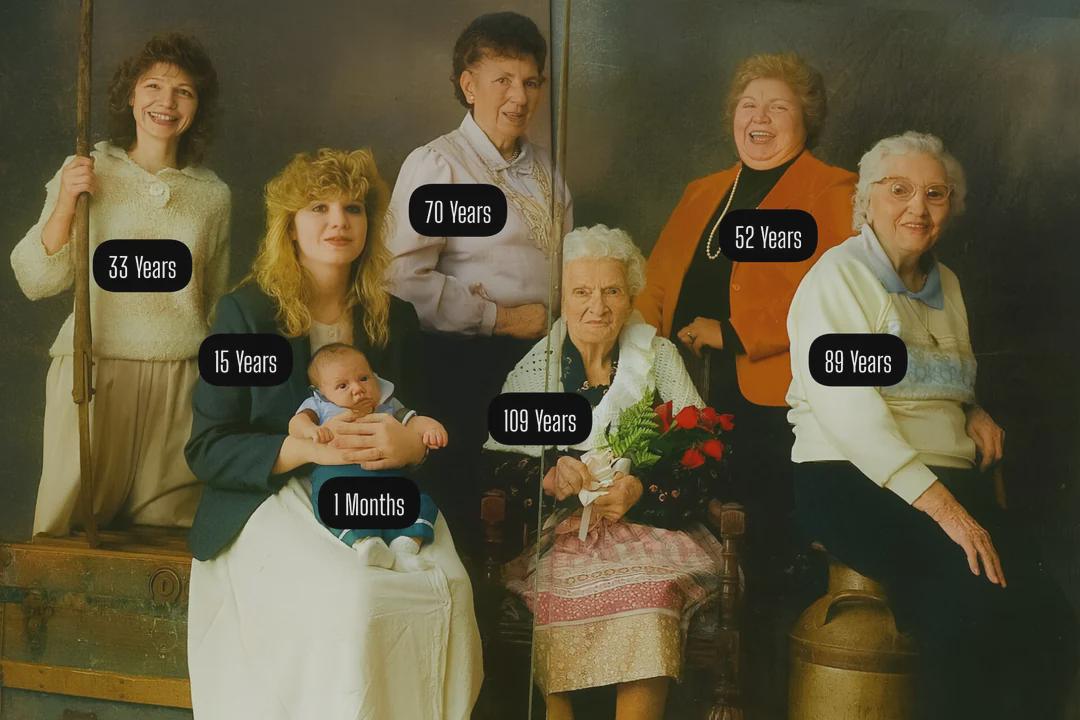
That kind of scene is so rare that when photos pop up online, people assume they are fake. They are not. But they are statistical freaks that only happen when a few historical forces line up: early childbearing, long lives, and a lot of luck.
Seven living generations means that the gap between each parent and child averages around 16–18 years and that at least one ancestor lives into their 90s or beyond. It is possible, but historically it almost never happened. To see why, you have to look at how people actually lived, married, and died over the last two centuries.
Here are five concrete reasons why seven living generations were so rare, what needed to go right for it to happen around 1989, and what that says about the past.
1. Early childbearing used to be common, but not this early
For seven generations to be alive at once, each generation has to start very young. Think a woman having her first child at 15 or 16, that child doing the same, and so on. Do that six times in a row and you can squeeze seven generations into about 90–100 years.
Historically, early marriage and childbearing were common in many places, but not quite that compressed. In 19th‑century rural Europe, for example, women often married in their early to mid‑20s. In New England around 1850, the average age at first marriage for women hovered near 22–23. In many African and South Asian societies, girls married younger, sometimes in their mid‑teens, but first births still often came a bit later and not every daughter repeated the pattern.
Take a concrete case. In early 20th‑century Appalachia, it was not unusual for a woman like “Martha” (a composite drawn from county marriage records) to marry at 16 in 1910, have her first child at 17, and then have a large family. Her daughter might also marry at 17 in the 1930s. That gives you three generations in about 34 years. But if Martha’s granddaughter waits until 22 to have her first child, the pace slows and the chain toward seven living generations breaks.
Even in societies with teen marriage, there was variation. War, migration, infertility, and infant deaths all disrupted neat 16‑year intervals. Many families had a mix: one child at 17, another at 30, another at 40. That spread made it much more likely that some branches would produce four or five living generations, not seven stacked neatly on top of each other.
So what? Early childbearing was common in many historical societies, but the kind of relentlessly early, generation after generation pattern needed for seven living generations was rare, which kept these seven‑generation families from being a normal feature of the past.
2. High mortality kept ancestors from living long enough
The other half of the equation is survival. It is not enough for babies to arrive early. Great‑grandparents and great‑great‑grandparents have to live long enough to meet them. For most of history, that was the real bottleneck.
In 1850, life expectancy at birth in the United States was around 38–40 years. In England and Wales it was similar. Those numbers are dragged down by child deaths, but even if someone reached age 20, their odds of making it to 80 were much lower than today. Infectious diseases like tuberculosis, pneumonia, and typhoid cut lives short. Childbirth killed many women in their 20s and 30s. Men died in mines, factories, and wars.
Consider a woman born in 1830 in Manchester, England. If she survived childhood and married at 22, she might have her first child in 1852. That child might have a first child in 1875, and so on. In theory, by 1910 or 1915 you could have five generations alive. In practice, the 1830 woman had to live into her 80s to see her great‑great‑grandchildren. Very few did. In 1900, only a tiny fraction of the population in industrial countries was over 85.
Even royal families, which had better nutrition and medical care, rarely produced seven living generations. Queen Victoria, born 1819, had nine children and dozens of grandchildren and great‑grandchildren. She lived to 81 and saw four generations, maybe five if you count infants born just before her death in 1901. But seven? Not even close.
So what? For most of history, disease and early death cut off family trees long before seven living generations were possible, which makes any modern photo of seven generations a product of very recent gains in survival.
3. Modern medicine and public health quietly made it possible
The reason a seven‑generation photo could exist around 1989 is not that people suddenly started having babies much earlier. It is that far more people started living much longer. The silent partner in every seven‑generation story is 20th‑century medicine and public health.
Between 1900 and 1990, life expectancy in countries like the United States jumped from about 47 to 75 years. The biggest gains came from clean water, sewage systems, vaccination, antibiotics, and safer childbirth. Polio, diphtheria, smallpox, and measles stopped killing so many children. Penicillin and later antibiotics turned many once‑fatal infections into survivable events.
To see this in one family, imagine a woman born in 1898 in rural Iowa. She survives the 1918 flu, gets sulfa drugs for a bad infection in the 1930s, and has access to a hospital for a heart problem in the 1960s. She lives to 95, dying in 1993. If she had her first child at 18 in 1916, and each daughter in that line had her first child at 18, you get births in roughly 1916, 1934, 1952, 1970, and 1988. That is five generations after the original woman, six including her, and seven if a baby arrives by the late 1980s. Medicine did not create the early births, but it kept the top of the family tree alive long enough to meet the bottom.
Public health mattered just as much. Chlorinated water in cities, mosquito control, and pasteurized milk slashed deaths from diarrhea and other infections. Safer factory conditions and labor laws reduced fatal accidents. By the 1980s, reaching age 80 or 90 was no longer extraordinary in rich countries, especially for women.
So what? Seven living generations around 1989 were not a throwback to some ancient norm, they were a side effect of 20th‑century medical and public health gains that let great‑great‑grandparents live long enough to meet their newest descendants.
4. The demographic transition made seven generations even rarer
Here is the twist: just as medicine made seven generations biologically possible, social change made them statistically rarer. The demographic transition, the shift from high birth and death rates to low birth and death rates, stretched out generations and shrank families.
In the United States, the average age of mothers at first birth rose from around 22 in 1968 to nearly 27 by the late 1980s. In Western Europe, the shift was even more pronounced. Women stayed in school longer, joined the paid workforce, and had fewer children later in life. Contraception became widely available. Legal abortion reduced unplanned births. The classic 16‑year gap between generations became a 25‑ to 30‑year gap for many families.
Take a real example from Swedish statistics. In 1900, Swedish women typically had their first child in their early 20s. By 1985, the average age at first birth was about 26. If a woman born in 1900 had her first child at 21, and that child did the same, you could in theory get five generations by the 1980s. But if the third or fourth generation waits until 28 or 30, the chain slows. You might still have four generations alive, but seven is out of reach.
Family size also shrank. In 1800, it was common for a European or American woman to have six or more live births. By 1980, two or three children were the norm. Fewer children meant fewer chances for a neat line of early firstborn daughters or sons to keep the generational ladder tight.
So what? Social and economic change in the 20th century pulled generations farther apart and reduced family size, which made the already rare seven‑generation families even more exceptional in an age of later, smaller families.
5. Real seven‑generation families are statistical flukes with long memories
When a seven‑generation photo surfaces from around 1989, it is not proof that “people used to have seven generations all the time.” It is the photographic record of a statistical outlier, the family equivalent of rolling sixes six times in a row.
To get seven living generations, several things have to happen together. One line of the family has to have children very early, usually before age 20, for at least five or six generations. The oldest ancestor has to live into their 90s or beyond. No one in that direct line can die young. And the family has to notice, gather, and record the moment.
There are documented cases. In 1989, newspapers in the United States and Canada ran stories about seven living generations in single families. One widely reported case from Kentucky involved a 109‑year‑old woman surrounded by six generations of descendants, the youngest a baby only a few months old. Another from Quebec told of a 102‑year‑old matriarch with a chain of daughters and granddaughters down to a newborn. These stories were news precisely because they were so rare that local editors thought readers would be amazed.
Genealogists who work with large family trees see something similar. Four generations alive at once is common. Five is not unusual. Six is rare but not unheard of, especially when a great‑great‑grandparent lives into their late 90s. Seven is so unusual that it almost always attracts press coverage or at least a flurry of family photos and stories.
When those photos are taken, they freeze an astonishing span of lived experience. A 100‑year‑old in 1989 might have been born before cars were common, before women could vote in most countries, before antibiotics. The baby in the picture would grow up with the internet and smartphones. That single image holds a century of change inside one family line.
So what? Seven‑generation families are rare statistical accidents, but when they happen they create living chains that connect people across a century of social and technological change, turning abstract history into something you can literally sit next to on a couch.
Seven generations alive at once is not a normal human pattern. It is a fragile alignment of early births, long lives, and luck that only really became possible in the 20th century and then was undercut by later childbearing. That is why a seven‑generation photo from around 1989 feels so strange. It is a snapshot of a narrow historical window when medicine had stretched lives but social change had not yet fully stretched generations.
Those rare families remind us that history is not just dates and events. It is also the length of a life, the age someone becomes a parent, the diseases that do or do not kill them. When seven generations share a room, you can see all of that history sitting together, from the world of coal stoves and horse‑drawn wagons to the world of cable TV and early computers, all in one family portrait.
Frequently Asked Questions
How rare is it to have seven living generations in one family?
Seven living generations in one family is extremely rare. It requires very early childbearing (often before age 20) repeated for several generations and at least one ancestor living into their 90s or beyond. Four or five generations alive at once is fairly common, six is uncommon, and seven is rare enough that it usually attracts news coverage when it happens.
Did people in the past often have six or seven generations alive at once?
No. While people in the past often had many children and sometimes married young, high mortality kept most ancestors from living long enough to see great‑great‑grandchildren. Life expectancy in 1800–1900 was much lower than today, especially before modern medicine and public health. Most families would see three or four living generations, not six or seven.
What conditions are needed for seven generations to be alive at the same time?
To have seven living generations, several conditions must line up: each generation in one direct line has children very young for several generations in a row, usually in the mid‑teens to late teens; the oldest ancestor lives into their 90s or beyond; and there are no early deaths in that line. This combination is statistically unlikely, which is why such families are so rare.
Did modern medicine make seven living generations more likely?
Yes. Modern medicine and public health, including vaccines, antibiotics, safer childbirth, and clean water, greatly increased the chances that people would live into their 80s and 90s. That made it biologically possible for great‑great‑grandparents and older ancestors to meet very young descendants, something that was much less likely before the 20th century.