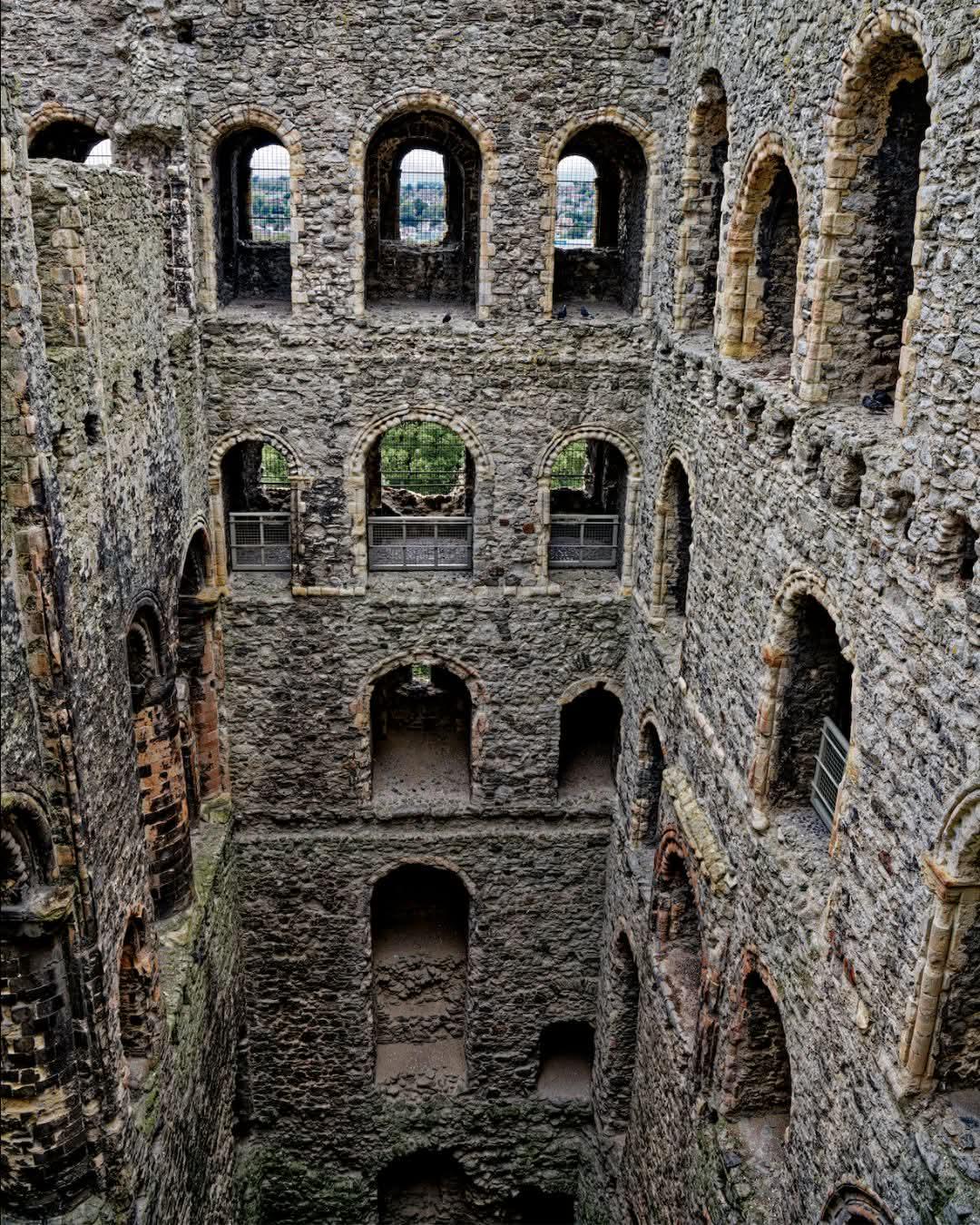
On a windy day in Rochester, you can stand inside the Norman keep and see straight through it. No floors. No roof. Just raw stone, sky, and a lot of imagination doing the heavy lifting.
Now picture something else. Painted walls. Timber floors. Smoke from hearth fires. Banners hanging in the great hall. Guides in costume leading school groups through a fully rebuilt 12th century fortress.
That is the argument at the center of a long-running fight in heritage circles: should medieval castles be restored to their former glory for better public engagement, or kept as ruins as a record of time and loss? Rochester, Dover, Carcassonne, Malbork, Warwick: each castle sits on a different answer.
Here are five key ideas that explain how we got from carefree rebuilding to the modern “conserve, don’t reconstruct” ethos, and why people are now asking whether it is time to rethink it.
1. Before the 1800s, rebuilding castles was normal, not scandalous
For most of history, people did not treat old castles as sacred museum pieces. They treated them as real estate.
Medieval and early modern owners patched, rebuilt, and modernised their fortresses whenever fashion, warfare, or money demanded it. A castle was a working building first, a historic monument a very distant second.
Hever Castle in Kent is a good example. Built in the 13th century and later home to the Boleyn family, it did not survive as a medieval time capsule. In the early 1900s, American millionaire William Waldorf Astor poured money into it, refitting interiors, adding gardens, and reshaping it into a romantic Tudor fantasy. Today visitors walk through richly furnished rooms that feel “old,” but much of what they see is early 20th century imagination layered on top of earlier structures.
On the continent, the same pattern played out. Castles were updated, baroquified, or turned into palaces. If a tower fell down, you rebuilt it. If gunpowder made your walls obsolete, you cut in new gunports or abandoned the place and stripped it for stone.
There was no sharp line between “authentic” and “fake.” There was just a building that had to keep earning its keep.
So what? Before the 19th century, constant alteration was normal, which means our modern anxiety about “authentic” restoration is a relatively recent invention, not a timeless rule.
2. John Ruskin’s attack on restoration changed the rules
Everything shifts in the 19th century, and a lot of it starts with one very opinionated Victorian: John Ruskin.
In The Seven Lamps of Architecture (1849), Ruskin launched a broadside against the way architects were “restoring” medieval buildings. He argued that restoration was a kind of architectural forgery. Once you replace old stone with new, repaint faded carvings, or rebuild missing towers, you are not saving the building. You are killing it and putting a copy in its place.
His core claim can be boiled down to a neat definition: conservation keeps what survives, restoration tries to recreate what is gone. Ruskin thought the second was dishonest and destructive.
He was reacting to very real abuses. In France, Eugène Viollet-le-Duc was busy remaking Carcassonne and Notre-Dame in Paris according to his own vision of what Gothic should look like. At Carcassonne, that meant pointy slate roofs and details that were more 19th century fantasy than 13th century reality. In Britain, church and castle “restorations” often scraped away later additions and inserted neat, uniform Gothic details that had never actually existed.
Ruskin’s answer was simple and harsh: do not restore. Stabilise. Repair only what you must to stop collapse. Accept decay as part of the building’s story. Anything else, he wrote, was like repainting an Old Master because the colors had faded.
Many architects hated him for it. But his rhetoric stuck in the minds of artists, writers, and a rising middle class that had started to treat the medieval past as something to be visited, not lived in.
So what? Ruskin reframed restoration as a lie, turning what had been routine rebuilding into a moral problem and setting up the intellectual foundation for modern conservation.
3. William Morris and SPAB turned a philosophy into policy
Ideas are one thing. Institutions are another. The real shift in British practice came when William Morris took Ruskin’s horror at restoration and turned it into an organised movement.
In 1877, Morris founded the Society for the Protection of Ancient Buildings (SPAB). Its nickname, “Anti-Scrape,” tells you exactly what it was angry about: Victorian architects “scraping” away old fabric and history in the name of tidying things up.
SPAB laid down principles that still echo through British conservation work:
• Do as little as possible, not as much as you can.
• Repair, do not restore.
• Respect all periods of a building’s history, not just the original or the prettiest.
• Be honest about new work. Do not fake age.
That meant a ruined castle like Rochester, whose keep was gutted by siege and later neglect, should be stabilised and made safe, but not rebuilt into a fantasy of 1127. The ruin itself was evidence. Its missing floors, its scars from artillery, its later modifications, all told a long story that a neat “restoration” to one date would erase.
Through the late 19th and 20th centuries, SPAB’s thinking filtered into official bodies. When the state began taking over ancient monuments, first through the Office of Works and later through English Heritage and its successors, the default approach became conservative repair. You propped up walls, repointed masonry, cleared vegetation, added railings and signs, but you did not rebuild missing towers or refit great halls with replica furniture.
This is why so many English and Welsh castles feel similar as visitor experiences: atmospheric shells, good views, information boards, perhaps a model or a digital reconstruction, but very little full-scale rebuilding.
So what? Morris and SPAB turned a literary critique into a working rulebook, locking in the “conserve, don’t reconstruct” ethos that still shapes what can and cannot be done to places like Rochester Castle.
4. The 20th century made ruins into official heritage, but left some room for exceptions
By the 20th century, the British state had become the biggest castle owner in the country. War, aristocratic bankruptcy, and changing tastes meant many fortresses passed into public hands. The question was no longer what one eccentric owner wanted, but what national policy should be.
The answer, broadly, followed SPAB. Stabilise. Present. Do not rebuild.
Rochester is a textbook case. Its Norman keep, finished around 1127 under Bishop Gundulf and Henry I, was battered in famous sieges, including King John’s brutal attack in 1215 when miners brought down a corner of the tower. Over centuries, floors and roofs vanished. By the time state guardianship arrived, it was a spectacular shell. Under 20th century conservation thinking, that shell was the monument. The missing parts were not to be guessed at in stone.
Yet there were exceptions, and they matter.
At Dover Castle, English Heritage took a different path with the Great Tower. In the 2000s they refitted the interior to evoke the court of Henry II around 1180. Painted walls, replica furniture, textiles, banners, and costumed interpreters turned an empty space into a sensory experience. The work was based on serious research, but it was still a reconstruction, the kind Ruskin would have loathed.
On the continent, the appetite for reconstruction was stronger. Viollet-le-Duc’s Carcassonne, with its fairy-tale silhouette, became one of the most famous fortified cities in Europe, even though specialists can list every anachronism. Malbork Castle in Poland, a Teutonic Order fortress, was heavily restored in the late 19th and early 20th centuries, then rebuilt again after catastrophic damage in World War II. Today it is a UNESCO World Heritage Site, a mix of original and reconstructed fabric.
These cases show a different philosophy: reconstruction can be used to make the past legible to modern visitors, as long as you are honest about what is new.
So what? The 20th century cemented ruins as official heritage in Britain, but projects like Dover’s Great Tower, Carcassonne, and Malbork proved that reconstruction did not disappear, it just moved into carefully justified, high-profile exceptions.
5. Today’s debate: authenticity, tourism, and what we want from the past
That brings us back to Rochester and the Reddit question: should the 19th century conservation ethos be reexamined?
The argument for restoration is straightforward. A fully fitted castle can transform a short, slightly abstract visit into a long, immersive one. Instead of staring at bare stone and trying to imagine a great hall, visitors can walk through one. Kids remember the painted shields and smoky hearth, not the floor plan on a signboard. For a town centre site like Rochester, that could mean more tourism, more local spending, and a stronger sense of place.
There is also an educational case. Reconstructions, when done carefully, can make complex medieval architecture and social life visible at a glance. Dover’s Great Tower is often cited by teachers and families as far more engaging than an empty keep. Open-air museums and experimental archaeology sites, like Guédelon Castle in France (a new castle being built with medieval methods), show how powerful this approach can be.
The argument against is just as strong. Any full restoration freezes a building at one chosen moment and erases other layers of history. Rebuilding Rochester to look like 1127 would downplay its 13th century siege damage, its later uses, and its long period as a romantic ruin. It would also require a huge number of educated guesses. We do not have complete plans, colors, or furnishings. A restored Rochester would be part history, part 21st century fantasy, no matter how careful the research.
There is also the issue of honesty. Visitors often struggle to tell what is original and what is modern. Carcassonne is wildly popular, but many tourists leave believing they have seen a pure medieval fortress, not a 19th century reimagining. Heritage professionals worry that large-scale reconstructions mislead the public about how much we really know.
So the debate is not just about stone and mortar. It is about what we want from the past. Do we prefer raw authenticity, even if it is harder work to interpret? Or do we accept some creative reconstruction in exchange for emotional impact and economic benefit?
Some suggest a middle course. Keep the core SPAB principle of minimal intervention for most sites, especially those with complex, multi-period histories. Allow targeted reconstruction in specific areas, clearly labelled, where evidence is strong and public benefit is high. Use digital tools, models, and temporary installations to show lost features without permanently rewriting the monument.
In that world, Rochester might get a partial, reversible reconstruction of one floor or one hall, not a total makeover. The ruin would remain, but visitors would get at least one fully imagined space to inhabit.
So what? The current argument over restoring castles is really a referendum on 150 years of conservation thinking, forcing us to decide whether the values of Ruskin and Morris still match what 21st century societies want from their medieval past.
The fight over ruins versus restoration is not going away. Climate change, mass tourism, and shrinking public budgets are putting new pressure on old stone. Some castles will crumble without significant intervention. Others will be tempted by the quick win of a dramatic rebuild.
Rochester’s empty keep and Dover’s furnished tower are two ends of a spectrum. Between them lies the real question: not just “what did this place look like?” but “what story do we want it to tell now?”
Frequently Asked Questions
Why are so many UK castles left as ruins instead of being rebuilt?
Since the late 19th century, British conservation has followed a “conserve, don’t reconstruct” ethos inspired by John Ruskin and William Morris. The idea is to stabilise what survives and avoid guessing at missing parts, because rebuilding can erase later history and create misleading fakes. That is why places like Rochester Castle are kept as atmospheric shells rather than fully restored fortresses.
Is Dover Castle an accurate medieval reconstruction?
The Great Tower at Dover Castle was refitted in the 2000s to evoke the court of Henry II around 1180. The project used serious research on colors, furniture, and layout, but it is still a modern reconstruction, not a surviving medieval interior. English Heritage presents it as an interpretation to help visitors imagine the past, not as untouched original fabric.
What did John Ruskin say about restoring old buildings?
In his 1849 book “The Seven Lamps of Architecture,” John Ruskin argued that restoration was a kind of architectural lie. He believed that trying to recreate the original state of an old building destroyed its authenticity. Instead, he urged people to repair only what was necessary to prevent collapse and to accept decay as part of the building’s true history.
Why is Carcassonne’s restoration controversial among historians?
Carcassonne was heavily restored in the 19th century by architect Eugène Viollet-le-Duc, who added features like pointed slate roofs and details that reflected his idea of a perfect medieval fortress. Many of these elements are not accurate to the site’s original appearance or regional style. The result is visually impressive and popular with tourists, but specialists see it as a 19th century reimagining of the Middle Ages rather than a faithful reconstruction.