Picture Córdoba around the year 1000. Oil lamps flicker in a library said to hold hundreds of thousands of volumes. A Jewish courtier advises a Muslim ruler. A Christian scribe copies Latin texts a short walk away from a mosque. To a modern eye, it looks like a rare island of tolerance in a violent age.
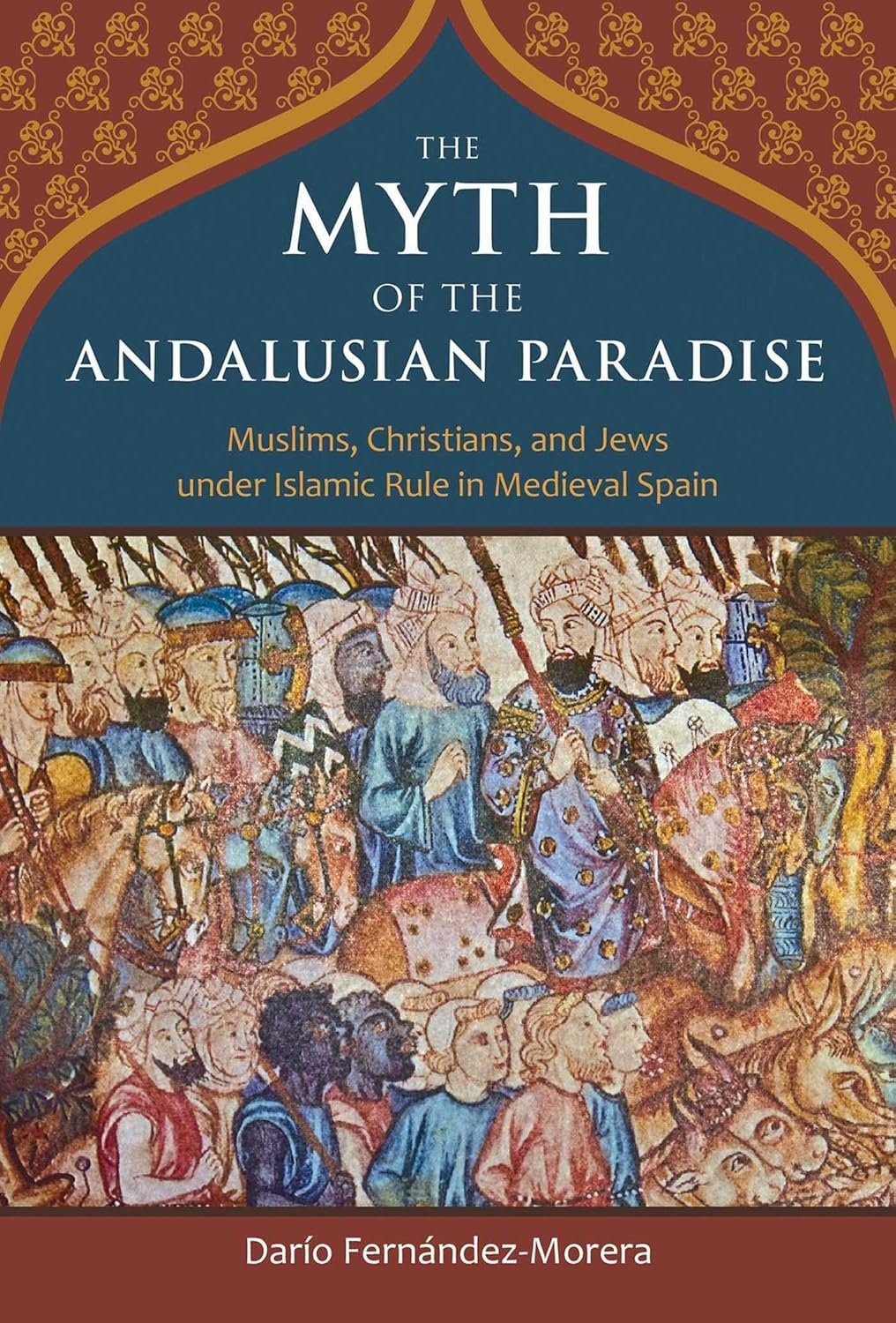
This is the image behind the phrase “Andalusian paradise,” the idea that medieval Islamic Spain was a uniquely tolerant, multicultural haven where Muslims, Christians, and Jews lived in harmony. The book The Myth of the Andalusian Paradise by Darío Fernández-Morera takes a hammer to that picture, arguing that the harmony has been badly oversold.
So what actually happened in al-Andalus? The short version: Islamic Spain was a sophisticated, often impressive society, but it was not a modern liberal utopia. It was a hierarchical religious state where non-Muslims were tolerated as second-class subjects, sometimes protected, sometimes persecuted, and often useful to those in power.
To make sense of the controversy, you have to separate three things: what al-Andalus was, why the “paradise” myth took off, and why people are still arguing about it on Reddit and in university seminars.
What was the “Andalusian paradise” idea, exactly?
“Andalusian paradise” is a modern label for a historical claim. In simple terms:
The Andalusian paradise myth is the belief that medieval Islamic Spain was a uniquely tolerant, peaceful, and harmonious society where Muslims, Christians, and Jews lived together on equal or near-equal terms.
In this view, al-Andalus (the Arabic name for Muslim-ruled parts of the Iberian Peninsula, roughly 711–1492) is held up as a model of convivencia, a Spanish word meaning “living together.” The story goes like this: while the rest of Europe was mired in ignorance and religious fanaticism, al-Andalus offered religious tolerance, scientific progress, and cultural openness.
There is a reason this story caught on. Medieval al-Andalus really did produce remarkable things: advanced irrigation systems, major translations of Greek philosophy, impressive architecture like the Great Mosque of Córdoba and the Alhambra, and a high level of urban culture compared to many Christian kingdoms to the north.
Non-Muslims did live there in large numbers. Christians (often called Mozarabs) and Jews could keep their faith, run their own communal courts, and in some periods rise to high office. Famous Jewish figures like Hasdai ibn Shaprut and Samuel ibn Naghrila served as diplomats and viziers. That looks, from a distance, like tolerance.
But there is a second, less comfortable part of the story. Islamic law treated Jews and Christians as dhimmis, protected but subordinate peoples. They paid special taxes, had legal disabilities, and were subject to the will of rulers who could tighten or relax the screws. Periods of relative calm sat next to episodes of forced conversion, massacres, and expulsions.
The “paradise” label matters because it turns a complex, mixed record into a simple moral symbol. That simplification is what Fernández-Morera and his supporters are attacking, and what his critics say he overcorrects.
So what: Defining the myth clearly is the first step to seeing where al-Andalus really was unusual, and where it was just another medieval religious state with winners and losers.
What set off the myth of a tolerant al-Andalus?
The history of al-Andalus begins not with tolerance but with conquest. In 711, Muslim forces, mainly Berbers under Arab command, crossed from North Africa and defeated the Visigothic king Roderic. Within a few years, most of the Iberian Peninsula was under Islamic rule. This was part of the wider early Islamic expansion, not a special Spanish experiment.
Under early Umayyad rule, especially after Abd al-Rahman I established an independent emirate in Córdoba in 756, the Muslim elite needed the existing Christian and Jewish populations. They needed tax revenue, administrators, and farmers. That practical need encouraged a policy of managed coexistence.
The legal framework came from Islamic law on dhimmis. Jews and Christians could keep their religion if they accepted Muslim political supremacy, paid the jizya tax, and followed certain social restrictions. In theory, they were protected. In practice, their treatment depended heavily on local rulers and politics.
So where did the “paradise” myth come from? Not from the 9th-century Christians who wrote about martyrs executed in Córdoba for publicly insulting Islam. Not from the Jews massacred in Granada in 1066. The myth is much younger.
In the 19th and 20th centuries, European and later American scholars and writers began to romanticize al-Andalus. For some, it was a way to criticize Christian intolerance by pointing to a supposedly more enlightened Islamic past. For others, especially under Franco in Spain, it was a foil: a dark age of foreign rule that justified a Catholic, unified Spain. In the late 20th century, as multicultural ideals spread, al-Andalus was recast yet again as a model of pluralism.
Fernández-Morera’s book is reacting to that recent, idealized version, not to how people in 1000 or 1200 thought about their own world.
So what: The myth grew out of modern ideological battles, which means arguments about al-Andalus today often say more about current politics than about medieval Cordoban streets.
What were the turning points in Muslim, Christian, and Jewish life?
Life in al-Andalus changed dramatically over its seven centuries. There was no single steady pattern of tolerance or oppression. Instead, there were sharp turns.
1. The Umayyad golden age (8th–10th centuries)
Under the Umayyad emirs and especially the caliphate of Córdoba (proclaimed by Abd al-Rahman III in 929), al-Andalus reached a peak of political power and cultural production. Cities like Córdoba, Seville, and Toledo grew wealthy.
Non-Muslims were second-class in law but often indispensable in practice. Jewish courtiers like Hasdai ibn Shaprut negotiated with Christian kings. Christian communities kept their rites and liturgy, though Latin culture gradually eroded. There were tensions, like the “Martyrs of Córdoba” in the mid-9th century, where some Christians sought martyrdom by publicly insulting Islam and were executed. But on the whole, this period looks relatively stable for minorities.
2. The fragmentation and the taifas (11th century)
After the fall of the caliphate around 1031, al-Andalus broke into smaller kingdoms called taifas. These petty states competed for prestige and talent. Some, like the taifa of Granada, became famous for employing Jewish viziers and encouraging poetry and philosophy.
This competition sometimes benefited minorities, who could offer their skills to the highest bidder. It also made the region vulnerable to Christian expansion from the north and to pressure from more hardline Islamic movements.
3. The Almoravids and Almohads (late 11th–13th centuries)
This is the part that shatters any simple paradise narrative. In the late 11th century, the Almoravids, a reformist Berber dynasty from North Africa, crossed into Iberia to help defend against Christian advances. They brought stricter religious attitudes, though they still tolerated dhimmis in many places.
The real shock came with the Almohads in the mid-12th century. The Almohads were even more rigorist. They pressured Jews and Christians to convert or leave. Famous Jewish thinkers like Maimonides and his family fled Córdoba for North Africa and then Egypt. Some Christian communities disappeared from areas under firm Almohad control.
Under the Almohads, the old pattern of protected but subordinate minorities broke down in many regions. This is one of the strongest historical arguments against any idea of a stable, centuries-long Andalusian tolerance.
4. The last Muslim kingdom and the Christian takeovers (13th–15th centuries)
By the 13th century, Christian kingdoms had conquered most of Iberia. Only the Nasrid kingdom of Granada remained under Muslim rule until 1492. There, Muslims were the ruling elite but were tightly constrained by tribute and diplomacy with Christian neighbors.
Ironically, as Christian kings took over former Muslim cities like Toledo and Seville, they sometimes preserved aspects of the Andalusi system. Muslims and Jews were kept as distinct communities with their own laws, paying special taxes. The idea of managing religious minorities did not vanish with the fall of Muslim rule. It morphed.
So what: The turning points show that al-Andalus swung between relative accommodation and harsh repression, which makes any one-word label like “paradise” or “hell” historically dishonest.
Who drove the reality behind the myth?
Several types of actors shaped daily life in al-Andalus, and they had different agendas.
Muslim rulers and jurists
Umayyad rulers like Abd al-Rahman III and al-Hakam II wanted a strong, cultured state that could rival Baghdad and Constantinople. They invested in libraries, patronized scholars, and used minority officials when it suited them. Their legitimacy was Islamic, but their politics were pragmatic.
Jurists and religious scholars, on the other hand, argued over how strictly to apply Islamic law to dhimmis. Some pushed for stricter segregation and visible signs of inferiority. Others accepted looser arrangements as long as Muslim supremacy was clear. Their debates affected everything from clothing rules to whether a Christian could repair a church.
Christian and Jewish elites
Christian bishops, Mozarab notables, and Jewish leaders had to walk a line. They defended their communities’ rights, negotiated tax burdens, and sometimes cooperated closely with Muslim authorities. A figure like Samuel ibn Naghrila in Granada could be both a devout Jew and a top military and political leader in a Muslim state.
At the same time, some Christian writers in al-Andalus and the north portrayed Muslim rule as oppression to encourage resistance or martyrdom. Their narratives fed later Christian views of the period as a long occupation.
Ordinary people
Most Muslims, Christians, and Jews were farmers, artisans, or small-town dwellers. Their experience of “tolerance” or “persecution” depended on local tax collectors, judges, and landlords more than on caliphal ideology. A fair Muslim judge or a predatory Christian landlord could shape their view of who was oppressing whom.
Conversion also mattered. Over the centuries, many Iberian Christians converted to Islam, some out of conviction, others for social and economic reasons. This blurred ethnic and religious lines. The ruling Muslim population was not a static foreign elite. It absorbed locals.
Fernández-Morera’s book pushes back against what he sees as a modern academic tendency to focus on the cosmopolitan elites and ignore the legal and social subordination of the majority of non-Muslims. His critics argue that he does the opposite, downplaying real moments of cooperation and cultural flowering.
So what: The reality of al-Andalus was driven by rulers’ needs, jurists’ rulings, and everyday bargaining, not by any timeless commitment to tolerance or intolerance, which means both rosy and purely dark narratives miss how power actually worked.
What did al-Andalus change for Europe and the Mediterranean?
Even if it was not a paradise, al-Andalus mattered a lot.
1. Transmission of knowledge
Al-Andalus was a major conduit for Greek, Arabic, and Jewish learning into Latin Christendom. In the 12th century, translators in places like Toledo (by then under Christian rule but full of Arabic books and bilingual scholars) rendered works of Aristotle, medical texts, and mathematical treatises from Arabic into Latin.
This flow of knowledge helped reshape European philosophy, science, and medicine. Thomas Aquinas wrestled with Aristotle partly through translations that had passed through Islamic Spain. European numerals, algebra, and some astronomical ideas came by this route.
2. Agricultural and urban change
Muslim rule brought new crops and irrigation techniques to Iberia: citrus fruits, rice, sugarcane, and more systematic use of water management. These changes affected diets, economies, and settlement patterns. Some of that knowledge spread north as Christian kingdoms took over former Muslim lands.
3. Models of religious management
The dhimmi system in al-Andalus provided a model, positive and negative, for later Christian rulers. When Christian kings conquered cities like Toledo, they often kept Muslim and Jewish communities as distinct legal groups, taxed them, and used their skills. Later, when those same monarchs turned to forced conversions and expulsions in the late 15th century, they were reacting against a long tradition of managed pluralism that had roots on both sides of the religious divide.
4. Identity and memory
For modern Spain and for wider debates about Islam and the West, al-Andalus became a touchstone. Was Spain originally a Christian nation briefly interrupted by foreign rule, or a place with a long Islamic and Jewish past? The answer shapes everything from school curricula to political rhetoric.
So what: Al-Andalus changed how knowledge, crops, and people moved across the Mediterranean, and it left a contested memory that still shapes how Europeans and others imagine their own past.
Why does the myth still matter today?
The reason a book like The Myth of the Andalusian Paradise stirs controversy is that al-Andalus has become a symbol in modern arguments.
For some, especially in interfaith or multicultural circles, al-Andalus is held up as proof that Muslims, Christians, and Jews can live together and produce great things. For others, especially critics of Islam, the same period is used as evidence that Islamic rule is inherently oppressive and that any talk of tolerance is propaganda.
Both sides are tempted to flatten the history to fit a modern agenda. Fernández-Morera’s book is part of this tug-of-war. He argues that much modern scholarship has romanticized al-Andalus and that the reality was one of conquest, religious law, and systematic discrimination against non-Muslims. His supporters say he punctures a comforting myth. His critics say he cherry-picks the worst episodes and ignores the relative protections and cultural achievements that did exist.
The historical record supports neither a fairy tale nor a horror story. Al-Andalus was a medieval Islamic society. That meant a clear religious hierarchy, legal inequality, and episodes of violence. It also meant periods of stability, shared culture, and real, if limited, cooperation across religious lines.
For readers trying to make sense of the debate, a few points help cut through the noise:
- “Tolerance” in a medieval context did not mean equality. It meant degrees of protection under a dominant faith.
- Comparisons matter. Al-Andalus can look relatively tolerant compared to some contemporary Christian polities, and harsh compared to modern secular states, at the same time.
- Myths grow where sources are patchy and modern needs are strong. The Andalusian paradise is as much a story about 19th–21st century hopes and fears as about 10th-century Córdoba.
So what: The fight over the Andalusian paradise myth is really a fight over how we use the medieval past in modern debates about religion, identity, and coexistence, which is why a dusty topic from a millennium ago keeps lighting up comment sections today.
Frequently Asked Questions
Was Islamic Spain really tolerant of Christians and Jews?
Islamic Spain (al-Andalus) tolerated Christians and Jews as protected but subordinate subjects called dhimmis. They could keep their religion, run their own communal courts, and sometimes reach high office, but they paid special taxes and faced legal and social discrimination. Periods of relative calm and cooperation alternated with episodes of persecution, such as under the Almohads in the 12th century.
What is the book “The Myth of the Andalusian Paradise” about?
“The Myth of the Andalusian Paradise” by Darío Fernández-Morera argues that modern scholars and writers have romanticized medieval Islamic Spain as a tolerant, multicultural haven. The book emphasizes conquest, religious law, and the second-class status of Christians and Jews under Muslim rule. Supporters say it corrects an idealized picture, while critics argue it downplays real moments of coexistence and cultural achievement.
What does “convivencia” mean in medieval Spain?
Convivencia is a Spanish term meaning “living together” and is used by historians to describe the coexistence of Muslims, Christians, and Jews in medieval Iberia. It does not mean equality in a modern sense. It refers to a situation where different religious communities shared cities and economies under a dominant power, sometimes cooperating and sometimes clashing, within a framework of legal inequality.
How did al-Andalus influence the rest of Europe?
Al-Andalus influenced Europe through the transmission of knowledge, crops, and administrative models. Translators in Iberia helped bring Greek philosophy, Arabic science, and medical texts into Latin, shaping medieval European thought. New crops and irrigation methods spread north. Christian rulers who conquered former Muslim territories borrowed and adapted systems for managing religious minorities, which affected later policies toward Jews and Muslims.