On a summer day in 1415, an English archer loosed an arrow at a French knight slogging through the mud at Agincourt. In modern paintings the knight is a towering giant in gleaming plate, a full head taller than the men around him. In reality, if you had walked the battlefield, most of those armored figures would have been about the size of an average modern man, sometimes shorter.
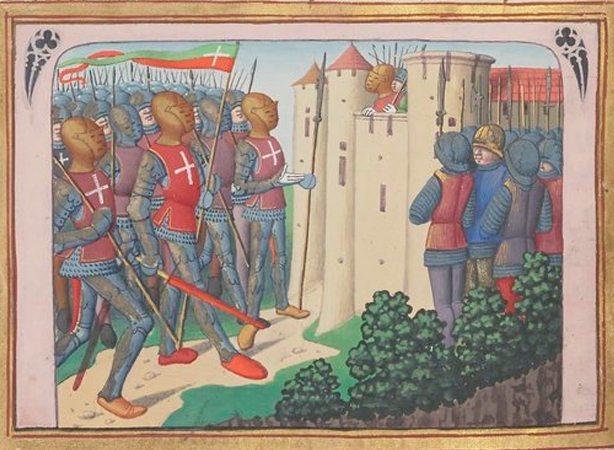
The Reddit joke is familiar: “Medieval chroniclers: How tall were the knights in the Hundred Years War? Artist: Yes.” The gap between what we imagine and what the sources show is wide. So how tall were medieval knights, especially in the Hundred Years War, and why do artists keep turning them into giants?
Here are five concrete things that cut through the myths, with real numbers, real people, and why it matters for how we picture the Middle Ages.
1. Knights were not giants: what the bones actually say
First, the basic question: how tall were medieval knights? The best answers come from skeletons, not paintings. Human bones from cemeteries in England and France around the 14th and 15th centuries show that adult men in Western Europe averaged somewhere around 167–172 cm, or about 5’6″ to 5’8″. That is a bit shorter than the average Western European man today, but not dramatically so.
We do not have a neat list of “knight skeletons” with labels, but we do have burials very likely to be elite warriors. For example, the mass grave uncovered at the supposed site of the Battle of Towton (1461, during the Wars of the Roses, a few decades after the Hundred Years War) contained adult male skeletons with average heights similar to ordinary men. Some had sword cuts to the skull and defensive wounds on arms, clear signs of battlefield deaths. They were fighters, but not superhuman in size.
In France, studies of late medieval cemeteries in towns like Paris and Tours show the same pattern. There are tall individuals, of course, but the spread looks like any normal population. A knight might be 5’10” or even over 6 feet, but that made him tall, not standard.
So what? This matters because it knocks out the idea that medieval warfare was dominated by a separate, physically gigantic warrior caste. Knights were elite because of training, wealth, and equipment, not because they were a different species of tall.
2. Why medieval art makes knights look huge
If the bones show average-sized men, why do so many medieval images show knights towering over everyone else? The answer is that medieval art was not trying to be a photograph. It was trying to show status, holiness, and narrative clarity.
In a 14th-century manuscript illustration of the Battle of Crécy, for example, the French king is drawn larger than his own knights, who are in turn larger than the infantry. The size difference is about rank, not biology. This is called “hieratic scale”: more important figures are drawn bigger so you can spot them instantly.
Even when artists tried to be more naturalistic, they were working within tight constraints. In a tiny margin illustration, the easiest way to show that someone is a knight is to give him a horse, a helmet, and a larger, more imposing body. Detail is sacrificed for clarity. The result, centuries later, looks like evidence of a race of medieval giants.
There is also the problem of perspective. Medieval artists often stacked figures vertically on the page rather than shrinking them with distance. A knight on horseback “behind” a foot soldier might be drawn higher up and slightly larger, not smaller, which our modern eyes misread as height.
So what? Recognizing that medieval images are symbolic, not literal, stops us from treating illuminated manuscripts as height charts. It forces us back to archaeology and written sources when we want to know what bodies were actually like.
3. Diet, disease, and class: why some knights were taller
Average height is only part of the story. Within that average, wealth and childhood nutrition mattered. Knights came from the upper layers of society, and that gave them an edge.
Height is heavily influenced by childhood conditions. A boy who gets enough protein, avoids repeated serious infections, and has steady access to food is more likely to reach his genetic potential. In 14th-century France or England, that boy was far more likely to be the son of a landholding family than a landless laborer.
Take Edward, the Black Prince, the English hero of Crécy and Poitiers. We do not have his exact height, but we do have his armor and effigy in Canterbury Cathedral. The armor fits a man probably around 5’8″ or 5’9″, solidly built. That would have made him somewhat tall for his time, and his status meant he had the best diet and medical care available.
Compare that to the average peasant child who lived through the Great Famine of 1315–1317 or the periodic harvest failures that followed. Repeated malnutrition and disease in childhood can shave centimeters off adult height. When archaeologists compare skeletons from rich urban monasteries to those from poor rural graveyards, they often find a noticeable gap in stature.
Knights were not automatically tall, but the odds that a well-fed, well-cared-for noble boy would grow taller than a chronically underfed peasant boy were decent. That shows up in some burial samples where elite males cluster toward the upper end of the height range.
So what? This matters because it links the physical presence of knights to the social order. Any height advantage they had was a side effect of privilege, not a prerequisite for knighthood, and it reminds us how inequality literally shaped bodies.
4. Armor size, weight, and the myth of the lumbering hulk
Another reason people imagine towering knights is the armor. Full plate harnesses in museums look enormous on their own, and Victorian myths about “90-pound suits of armor” have been hard to kill. The reality is more modest and more interesting.
Surviving 15th-century plate armor that belonged to European nobles usually weighs between 20 and 30 kilograms, about 45 to 65 pounds. That is heavy, but the weight is spread over the body. Modern reenactors and trained soldiers can run, mount horses, and even do cartwheels in accurate reproductions. The armor was tailored to the wearer, like a fitted suit, not a generic metal barrel.
Take the famous harness of Charles the Bold of Burgundy, made around 1470. It fits a man about 5’7″ or 5’8″. It is elegant, compact, and clearly designed for an active rider and fighter. Nothing about it suggests a giant. The same goes for many English and French armors in collections in London, Paris, and Vienna.
When you put that armor on a museum mannequin that is too tall or too bulky, it can look small. When you display it on its own, it can look huge. Both impressions are misleading. The armor was cut to the individual, and that individual was rarely over 6 feet tall.
So what? Armor size and weight tell us that knights were fit, trained athletes, not slow-moving tanks. Their effectiveness came from skill and equipment design, not from being enormous men encased in 90 pounds of steel.
5. Why height myths about knights keep coming back
Even with the data in front of us, the idea of the giant medieval knight refuses to die. Part of this is simple storytelling. Big warriors make for good drama. Part of it is modern insecurity: if we imagine the past as full of superhuman fighters, it makes our own era feel more advanced by contrast.
Victorian writers helped lock this in. They loved to contrast “the age of chivalry” with the modern world, and they were not shy about exaggerating. Some 19th-century antiquarians measured old doorways and armor and decided, with little evidence, that medieval people were either tiny dwarfs or towering brutes, depending on what point they wanted to make.
Popular culture picked up the giant knight and ran with it. From early historical paintings of Agincourt and Poitiers to modern video games, the armored warrior is often drawn a head taller than everyone else. That feeds straight back into internet memes and casual assumptions.
There is also a misunderstanding of outliers. We do have occasional references to very tall warriors. Chroniclers might mention a knight “of great stature” or a man “a head taller than his companions.” Those rare individuals get remembered and retold, while the hundreds of perfectly average 5’6″ men vanish into the background.
So what? Seeing how and why the myth keeps returning helps us read both medieval and modern sources more critically. It reminds us that our mental image of the Middle Ages is a mix of evidence and storytelling, and that we need to separate the two if we want to understand how people really lived and fought.
Medieval knights of the Hundred Years War were not a race of giants. They were slightly shorter, on average, than modern Western Europeans, with some tall nobles at the upper end. Artists made them look huge to show status, not to report measurements. Their armor was heavy but manageable, tailored to bodies that were strong and trained, not freakishly large.
That matters for more than trivia. It changes how we picture the battlefield at Crécy or Agincourt. It pulls knights down from the realm of fantasy and puts them back where they belong: as human beings, shaped by diet, disease, money, and culture, fighting in armor that fit bodies very much like our own.
Frequently Asked Questions
How tall were knights during the Hundred Years War?
Skeletal evidence from 14th and 15th century cemeteries in England and France suggests adult men averaged about 167–172 cm (5’6″ to 5’8″). Knights were drawn from the same population, so most were in that range, with some nobles probably a bit taller thanks to better childhood nutrition.
Were medieval knights really huge compared to peasants?
Not usually. Knights might have been somewhat taller on average because elite children had better diets and healthcare, but they were not a separate giant caste. The height difference between a well-fed noble and a poor peasant might be a few centimeters, not a full head.
Why do medieval paintings show knights as giants?
Medieval artists used size to show importance. Kings and knights are drawn larger than common soldiers to signal rank, not to record literal height. This “hieratic scale” makes knights look like giants to modern viewers, even though real knights were normal-sized men.
How heavy was a knight’s armor in the 14th and 15th centuries?
A full suit of late medieval plate armor usually weighed between 20 and 30 kg (about 45–65 pounds). The weight was distributed over the body, and the armor was custom-fitted, so a trained knight could move, run, and fight effectively without being a lumbering hulk.