The boy in the photograph is wearing a sack on his head.
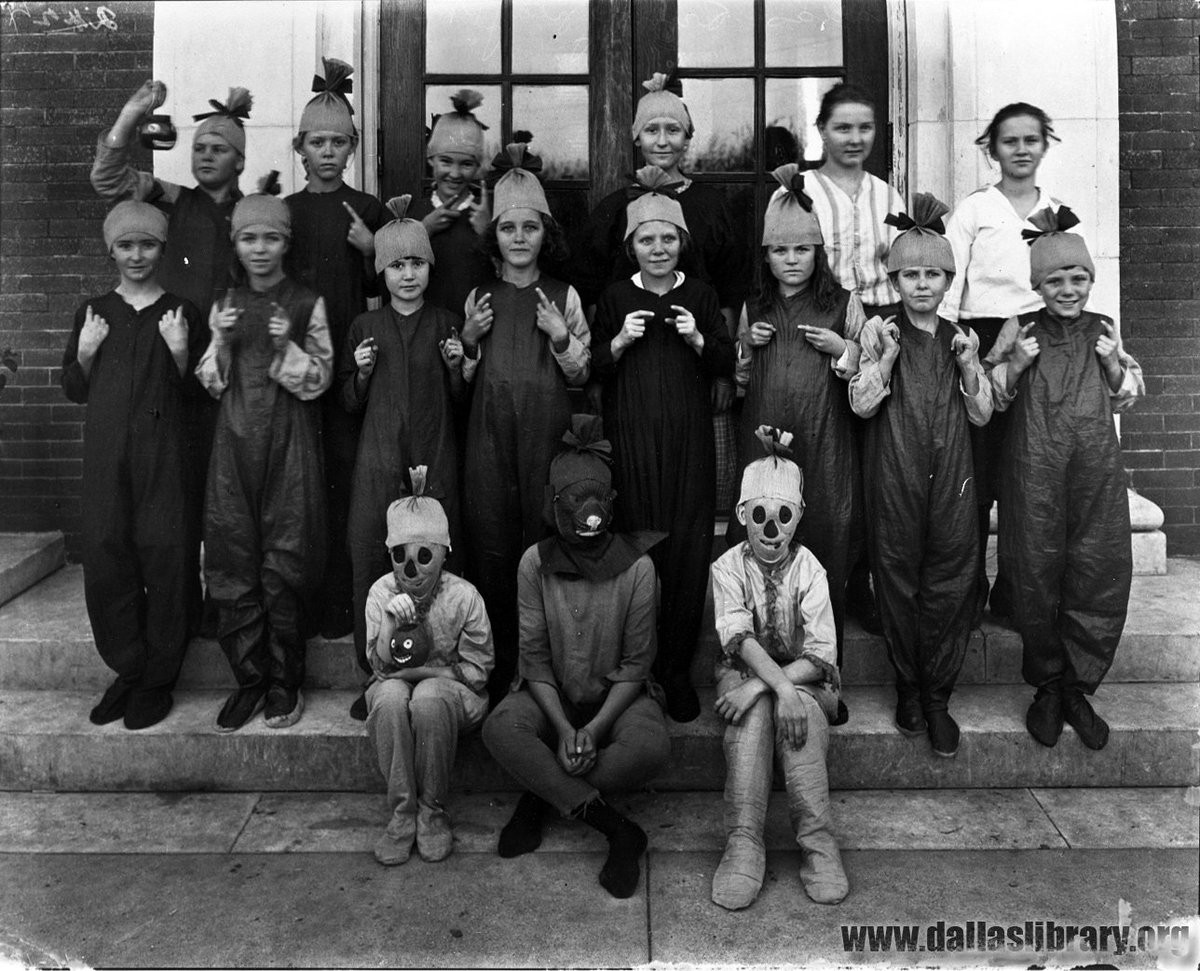
Two crooked eyeholes. A jagged mouth. His coat is too big, his shoes too small, and he is staring straight into a boxy camera on a Midwestern porch on October 31, 1925.
To a modern eye, the image looks like a horror movie still. To him, it was just Halloween.
Halloween 1925 sat in a strange moment. The First World War was over, Prohibition was on, radio was new, and the modern, candy-and-costume version of the holiday was still being invented. When you scroll an image gallery from that night, you see things that feel familiar and things that feel deeply alien.
Here are five big differences that jump out in Halloween photos from 1925, what they actually were, and why they mattered for the holiday’s evolution.
1. Homemade Masks and Costumes Were the Norm
In 1925, Halloween costumes were mostly homemade. Kids and adults raided closets, attics, and kitchens, turning old clothes, flour sacks, and paper into masks and outfits.
Commercial Halloween costumes existed, but they were not yet standard. Companies like Dennison Manufacturing in Massachusetts sold “Bogie Books” that showed you how to decorate and dress up for Halloween using crepe paper and cardboard. You bought the raw material, not a full Spider-Man suit in a plastic bag.
A typical 1925 Halloween image might show a girl in her mother’s long skirt and shawl, face darkened with burnt cork, playing a “gypsy” fortune teller. Or a boy in his father’s old coat with a pillow stuffed underneath, a floppy hat, and a paper mask that looks more like a nightmare than a cartoon.
At a school party in Des Moines, Iowa, for example, local newspapers described children arriving as “hobos, witches, ghosts and clowns,” almost all in improvised outfits. The school handed out prizes for the most original costume, which rewarded creativity with what you had at home, not what you could buy at a store.
Homemade Halloween costumes in the 1920s were often unsettling because they were crude. A mask cut from a flour sack, with eye and mouth holes hacked out and painted with ink, reads as horror to us. To them, it was just cheap and practical.
Mass-produced Halloween costumes did not really take off until the 1930s and 1940s, when companies like Ben Cooper and Collegeville began selling ready-made outfits tied to comic characters and pop culture. In 1925, Mickey Mouse had only just appeared, and the idea of dressing as a copyrighted character was barely a concept.
So what? The homemade nature of 1925 costumes meant Halloween was more about local imagination and less about national brands, which made the holiday feel stranger, more personal, and often more disturbing than the polished, licensed looks that came later.
2. Halloween Was Still About Mischief and Vandalism
In 1925, Halloween was not just cute kids and candy. It was also a night for pranks, property damage, and sometimes outright violence.
American newspapers in the 1920s routinely complained about “Halloween hooliganism.” Teenagers and young men took the old tradition of mischief night and ran with it. They soaped windows, tipped over outhouses, unhitched wagons, and sometimes ripped up fences or broke streetlights.
On October 31, 1925, the New York Times reported police in several cities bracing for “the usual Halloween disturbances.” In smaller towns, local papers carried stories of boys blocking trolley tracks with debris or moving farmers’ wagons onto barn roofs. These were not urban legends. They were common enough that insurance companies and city councils worried about Halloween every year.
Photos from 1925 sometimes show groups of boys in rough masks, not lined up for trick-or-treating but roaming streets or gathered around a bonfire. In some places, farmers and shopkeepers organized patrols to protect property. In others, civic groups tried to lure kids into supervised parties to keep them off the streets.
One concrete example: in 1925, the city of Omaha, Nebraska, expanded its program of community Halloween events after a series of costly pranks the year before. The local press described broken windows, damaged streetcars, and stolen gates. The city’s solution was to create more structured fun, including parades and school parties, to channel that energy.
The phrase “trick or treat” was only just starting to appear in North America in the 1920s, mostly in Canada. In the United States, it would not become widespread until the 1930s and 1940s. In 1925, kids might go door to door in some places, but the bargain of “give us candy or we prank you” was not yet a standard script.
So what? The rough, prank-heavy Halloween of 1925 pushed towns, schools, and parents to reshape the holiday into something safer, which helped create the organized trick-or-treating and community parties that now define October 31.
3. Halloween Parties Were About Fortune-Telling and Courtship
Halloween 1925 was as much a social and romantic event as a children’s holiday. Parties, especially for teenagers and young adults, revolved around games that promised a glimpse of your future spouse.
Many of these customs came from older Celtic and Scottish traditions, filtered through Victorian America. By the 1920s, they were standard fare in Halloween party guides and women’s magazines. The Dennison “Bogie Books” and similar pamphlets suggested games where girls and boys would peel apples in one long strip and toss the peel over their shoulder to see what letter it formed. That letter supposedly matched the initial of a future partner.
In a 1925 Halloween party in a small Ohio town, for instance, a local women’s club organized a “fortune walk.” Guests moved from room to room, each decorated with pumpkins and black cats, drawing slips of paper with rhymed predictions about love and marriage. Newspapers described it as “gay and amusing,” code for mild flirting under adult supervision.
Another common game involved looking into a mirror at midnight by candlelight to see the face of your future husband or wife. This kind of ritual, half joke and half superstition, shows up repeatedly in early 20th-century accounts of Halloween.
Photographs from 1925 often show young adults in simple costumes around tables of apples, nuts, and candles. Bobbing for apples was not just a goofy challenge. It was sometimes framed as a test of who would marry first. The first person to bite an apple might be the next bride or groom.
For many Americans, especially in small towns, Halloween was one of the few socially acceptable times for unmarried young men and women to mingle somewhat freely in a playful, slightly spooky setting.
So what? The fortune-telling and courtship games of Halloween 1925 kept older folk beliefs alive and turned the holiday into a key social event for young adults, which helped root Halloween in community life rather than leaving it as a children-only affair.
4. The Ku Klux Klan and Other Dark Costumes Were Part of the Night
One of the most jarring things in some 1920s Halloween photos is the presence of Ku Klux Klan robes and hoods, or costumes that echo them.
The second Ku Klux Klan was near its peak in the mid-1920s. By 1925, it claimed millions of members nationwide, especially in the Midwest and West, not just the South. Klan parades in full regalia were common in some towns. That meant the white robe and pointed hood were a familiar sight long before Hollywood made them a visual shorthand for racist terror.
In some Halloween photos from the period, you see people in what look like Klan outfits at parties or on the street. Sometimes they are actual Klansmen using the holiday as cover for meetings or intimidation. In other cases, people seem to be wearing similar hooded robes as a kind of generic “spooky” costume, blurring the line between costume and real-world hate symbol.
There are documented cases of the Klan using Halloween for recruitment or public shows of force. In 1925, for example, Klan groups in Indiana and Ohio held nighttime marches around late October, some timed near Halloween, with torches and full regalia. For Black Americans, Catholics, Jews, and immigrants, those nights were not playful. They were frightening.
This darker side of Halloween history often surprises modern viewers who expect only witches and ghosts. But in 1925, the Klan was a mainstream political and social force in many communities. Its imagery seeped into public life, including holidays.
There were other unsettling costumes too. Blackface was common at Halloween parties, as were caricatured “hobo” or “tramp” outfits that mocked the poor. These images show a holiday that reflected the racial and class prejudices of its time as much as its love of scares.
So what? The presence of Klan robes, blackface, and similar costumes in 1925 Halloween scenes reveals how the holiday was entangled with the era’s racism and nativism, and it reminds us that Halloween has always mirrored the social tensions of its moment, not just its monsters.
5. Silent Films, Radio, and Consumer Culture Were Rewriting Halloween
By 1925, Halloween was starting to feel modern because new media and consumer goods were reshaping how people celebrated.
Silent films fed the appetite for spooky stories. In 1925, Universal released “The Phantom of the Opera” with Lon Chaney, one of the era’s most famous horror performances. While the movie itself was not a Halloween release in the modern marketing sense, its imagery of masks, shadows, and fear seeped into popular culture. People who had seen Chaney’s makeup work might try their own crude versions at Halloween.
Radio, which exploded in popularity in the early 1920s, gave Halloween a new soundtrack. By 1925, families gathered around sets to listen to music, comedy, and occasional themed programs. Local stations sometimes aired “spooky” stories or Halloween concerts. A party photo from that year might show a radio in the corner, a new piece of furniture tying a rural farmhouse to national culture.
At the same time, companies were starting to see Halloween as a sales opportunity. Dennison’s crepe paper, Beistle’s die-cut cardboard decorations, and candy makers all pushed October 31 as a reason to buy. Store windows in 1925 might feature witches, black cats, and pumpkins, not just generic autumn displays.
One clear example: the Dennison Manufacturing Company’s 1925 “Bogie Book” offered themed party plans, costumes, and decoration ideas. It did not just sell paper. It sold a script for how Halloween should look and feel. That kind of guidance helped standardize the holiday across regions.
Even the idea of giving candy at Halloween was starting to shift. In 1925, children were more likely to receive nuts, apples, or homemade treats than wrapped candy bars. But candy companies were already advertising their products as suitable for parties and autumn events, laying the groundwork for the later “fun size” candy culture.
So what? The influence of film, radio, and consumer goods in 1925 pushed Halloween toward a more national, media-shaped holiday, setting the stage for the heavily commercial, pop-culture-driven October 31 we recognize today.
Look long enough at a Halloween 1925 image gallery and you see a holiday in transition.
You see kids in ragged, homemade masks that look more terrifying than anything from a costume aisle. You see teenagers flirting over apple-bobbing tubs and fortune-telling games. You see pranks that worried city councils and shopkeepers. You see the shadow of the Ku Klux Klan and the casual racism of blackface costumes. You see radio sets and party guides quietly standardizing how Halloween should look.
Halloween did not suddenly become the modern, candy-centered ritual on a single date. It evolved through nights like October 31, 1925, when old folk customs, new technologies, and the social tensions of the Roaring Twenties all collided in the dark.
That is why those grainy porch photos matter. They capture the moment when Halloween was still half folk holiday, half unruly street festival, and just beginning to turn into the mass-market, family-friendly spectacle we know now.
Frequently Asked Questions
What did people wear for Halloween in the 1920s?
In the 1920s, most Halloween costumes were homemade using old clothes, flour sacks, paper, and crepe paper. Common themes included witches, ghosts, “hobos,” clowns, and stereotyped ethnic or “gypsy” costumes. Mass-produced character costumes only became common in the 1930s and 1940s.
Was trick-or-treating common in 1925?
Trick-or-treating as we know it was not yet widespread in 1925. Some children did go door to door in certain regions, but the phrase “trick or treat” was just beginning to appear, mostly in Canada. In the United States, organized trick-or-treating became common in the 1930s and 1940s as a way to reduce Halloween vandalism.
Why do old Halloween photos look so creepy?
Old Halloween photos look unsettling because costumes and masks were usually homemade, using rough materials like sacks, cardboard, and simple paint. The crude designs, combined with early photography’s lighting and blur, create a much eerier effect than modern, polished store-bought costumes.
Did the Ku Klux Klan really appear in Halloween celebrations?
Yes. In the mid-1920s, the second Ku Klux Klan was very active, and its robes and hoods appear in some Halloween photos. Sometimes these were actual Klan members using the night for meetings or intimidation. In other cases, people copied the hooded look as a generic “spooky” costume, reflecting how normalized Klan imagery was in some communities at the time.