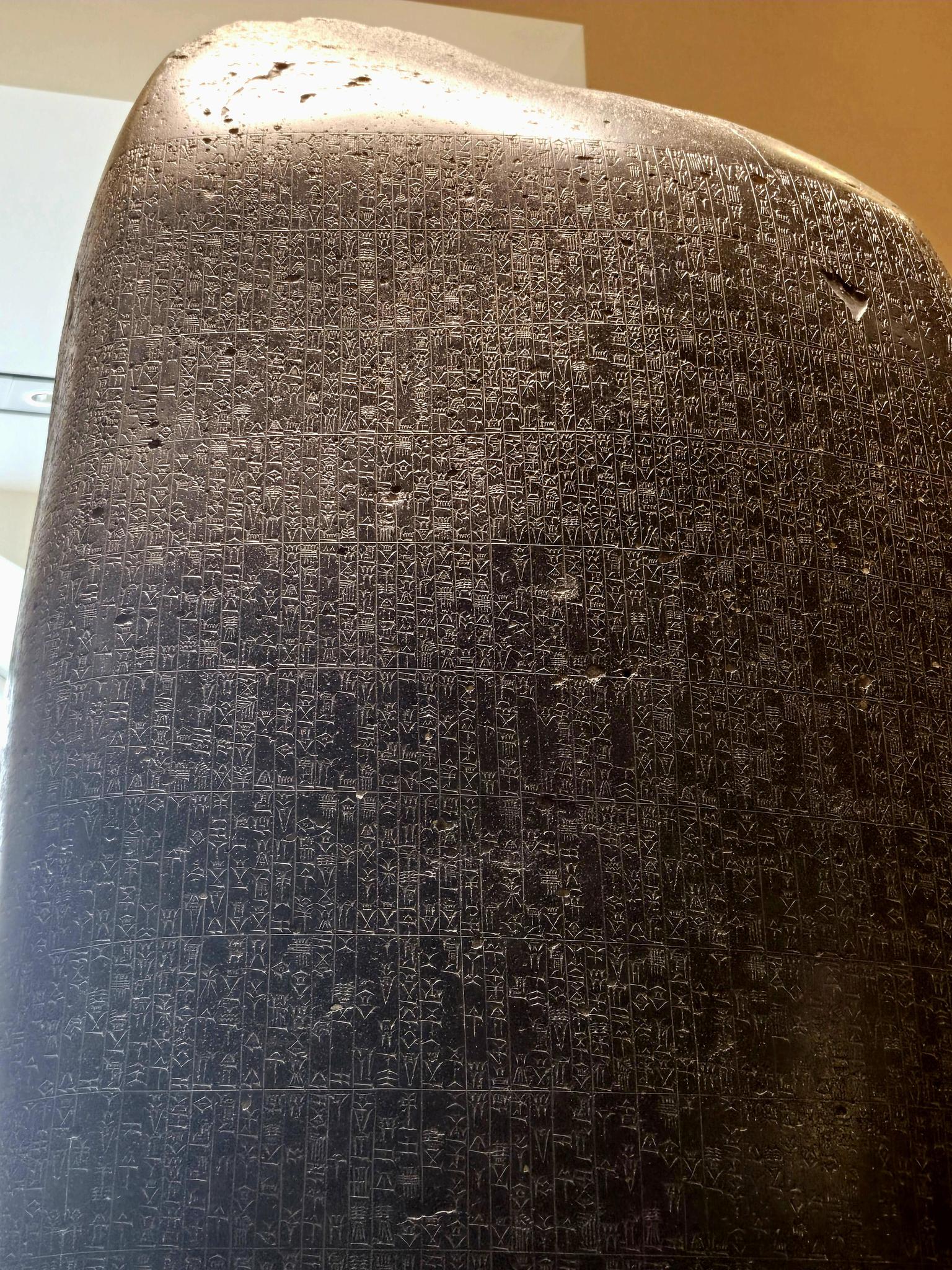
In the Louvre, people crowd around a black stone that looks like an oversized thumb. Up close, you see thousands of tiny wedge marks marching in tight lines down its polished surface. This is the Code of Hammurabi, about 3,800 years old, one of the earliest surviving long legal texts on Earth. It feels oddly familiar, like an ancient version of a printed statute book.
They look similar because both the Code of Hammurabi and modern law codes try to do the same thing: freeze rules in writing so power feels predictable. But they come from very different worlds. By the end of this, you will see how a basalt monument from Babylon and a modern legal code share a family resemblance, and where that resemblance breaks down.
The Code of Hammurabi is a Babylonian legal inscription from around 1750 BCE that lists laws and penalties. Modern law codes are written collections of laws used by states today, such as the French Civil Code or criminal codes. Both are attempts to make law visible, stable, and enforceable.
Why do Hammurabi’s code and modern law codes look similar at all?
At first glance, the Louvre stele and a modern legal volume could not be more different. One is a 2.25-meter block of black diorite with cuneiform spiraling down its sides. The other is a thick paperback or a searchable PDF. Yet both are recognizable as law.
Both have three core features. They are written, they are organized as a list of rules, and they are meant to be public. Hammurabi’s laws are carved in Akkadian cuneiform. Modern codes are printed in national languages. In both cases, the message is: these are the rules, and they are not a secret.
They also share a basic structure. The Code of Hammurabi opens with a prologue, then a long list of case-style laws, then an epilogue. Many modern codes open with general principles, then move to specific articles, and sometimes end with transitional provisions or interpretations. The idea that law should be systematic and written in a consistent format is very old.
That surface similarity matters because it shows that the urge to make law visible and fixed is not a modern invention. It is a recurring solution to the problem of how to control power and behavior in large societies.
Origins: Why did Hammurabi carve his laws, and why do states write codes now?
The Code of Hammurabi comes from a specific moment in Mesopotamian history. Hammurabi ruled Babylon around 1792–1750 BCE. By the end of his reign, he controlled much of southern Mesopotamia. He was not the first to issue written laws. Earlier kings like Ur-Namma of Ur had done something similar. But Hammurabi’s stele is the longest and best preserved.
He had it carved on a hard stone, probably quarried far away, then polished and shaped. At the top, a relief shows Hammurabi standing before the sun god Shamash, who hands him a rod and ring, symbols of authority. Below, about 280 laws run in dense columns of cuneiform. The prologue says the gods chose Hammurabi “to cause justice to prevail in the land” and “destroy the wicked and the evil.”
This was origin as propaganda. Hammurabi wanted to present himself as a divinely backed lawgiver who brought order to a patchwork empire. The stele likely stood in a temple or public place, where it could be seen, even if only scribes could read it. It told subjects that the king’s justice was not arbitrary. It came from the gods and was written in stone.
Modern law codes also come from moments of state-building, but the logic is different. Take the French Civil Code of 1804. After the French Revolution tore up old feudal laws, Napoleon pushed for a single, clear code that would apply across France. The goal was to replace a patchwork of local customs and royal decrees with one national system. The authority was not divine. It was the nation and its representatives.
Or look at the German Civil Code (BGB), which took effect in 1900. It came after German unification and was meant to knit together different legal traditions into one framework for a modern industrial state. Again, the code was a tool for centralization and standardization.
So while Hammurabi’s code and modern codes both emerge when rulers are trying to unify and control larger territories, the justification shifts. Hammurabi roots law in the gods and his personal kingship. Modern codes root law in the people, the constitution, or the state. That shift in origin changes who law is supposed to answer to, which reshapes the whole story of legal authority.
Methods: How were ancient and modern laws written, structured, and enforced?
Walk around the Hammurabi stele and you see the method in the stone itself. The text is written in Akkadian using cuneiform wedges, cut into diorite, a very hard rock. That choice was deliberate. Clay tablets could break or be erased. Diorite was expensive and permanent. The message: these laws are meant to last.
The laws are written in a conditional format. Many start with “If a man…” and then describe a situation and a penalty. For example, “If a builder builds a house for a man and does not make its construction firm, and the house collapses and causes the death of the owner, that builder shall be put to death.” This is casuistic law, law by example. It does not define abstract rights. It lists specific scenarios.
Enforcement in Hammurabi’s Babylon relied on local courts, elders, and officials. The code mentions judges, witnesses, and written contracts. It prescribes harsh penalties for false accusations and corrupt judges. But we do not have clear evidence that every law on the stele was applied as written. Many historians think the code was as much an ideal and a royal statement as a literal manual.
Modern law codes are produced with very different methods. Legislatures draft and debate bills. Committees revise language. Lawyers and interest groups lobby. When a code is adopted, it is printed, distributed, and now published online. The medium is flexible. Laws can be amended, repealed, or interpreted by courts.
The structure is also more abstract. Modern codes use numbered articles, definitions, and general clauses. A criminal code might define “theft” in general terms, then list aggravating factors. Civil codes define persons, property, contracts, and obligations in broad categories. Judges then apply these to specific cases, using precedent and interpretation.
Enforcement is bureaucratic. Police, prosecutors, public defenders, regulatory agencies, and layered court systems handle disputes. There are appeal courts and sometimes constitutional courts that can strike down laws. Law is not just a royal command. It is a field of argument.
So while Hammurabi’s code and modern codes both try to fix rules in writing, the method has shifted from a king’s carved scenarios to a constantly updated, interpretive system. That change in method turns law from a static monument into a living process.
Outcomes: What did these laws actually do to people’s lives?
Visitors to the Louvre often assume the Code of Hammurabi was a kind of ancient Bill of Rights. It was not. It was a hierarchy in stone.
The laws divide people into categories: awilu (often translated as “gentleman” or upper-class man), mushkenu (commoner), and wardu (slave). Penalties for the same act differ by status. If an awilu puts out the eye of another awilu, his eye is put out. If he puts out the eye of a commoner, he pays a fine. If he harms a slave, the penalty is lower still. The famous “eye for an eye” principle is not universal equality. It is calibrated retaliation within a ranked society.
The code also treats men and women differently. It protects some rights of wives, such as property and dowry, and allows women to seek divorce in certain cases. But it also allows harsh punishments for adultery and gives husbands significant control. Family, property, and commercial transactions are heavily regulated. The goal is social stability and protection of property, not individual liberty.
How much did this change daily life? The record is mixed. We have court tablets from Mesopotamia that show judges citing legal norms, but they rarely quote the code directly. Custom, local practice, and royal decrees all played roles. The code likely shaped expectations of justice and gave scribes a model, but it did not function as a modern statute book that judges had to follow word for word.
Modern law codes also shape lives, but with different stated aims. Many modern constitutions and codes talk about equality before the law. In theory, the same criminal code applies to rich and poor, male and female, citizen and foreigner, though in practice enforcement is uneven. Modern codes often include rights protections, such as due process, free speech, or protection from discrimination.
Outcomes are still about order and property, but there is a stronger emphasis on individual rights and procedural fairness. Penalties have shifted from physical punishments and mutilation to fines, imprisonment, and regulatory sanctions. Courts are expected to justify decisions in writing and can be reviewed by higher courts.
So the Code of Hammurabi and modern law codes both try to stabilize expectations and reduce raw violence, but they do so with different values. Hammurabi’s code stabilizes a stratified, theocratic monarchy. Modern codes, at least on paper, aim to stabilize more equal, rights-based states. That difference in outcome shows how written law can both entrench inequality and later be used to challenge it.
Legacy: How did Hammurabi’s stone shape later law, and why do we still care?
The Hammurabi stele itself had a strange afterlife. It was discovered in 1901 at Susa, in modern Iran, by a French archaeological team. That means it had been carried off as war booty, probably by an Elamite king centuries after Hammurabi. Parts of the text were chiseled off, likely to make room for a new inscription that was never completed. Even in antiquity, rulers understood the power of rewriting law in stone.
When scholars deciphered the inscription in the early 20th century, it caused a stir. Some rushed to draw direct lines from Hammurabi to the laws of the Hebrew Bible. There are real similarities in form and some content, but the relationship is debated. What is clear is that Mesopotamia had a long tradition of royal law collections, and that idea of a lawgiving ruler echoed across the Near East.
In modern times, the Code of Hammurabi became a symbol. Law schools put the relief of Hammurabi and Shamash on their walls. Statues of Hammurabi appear in courthouses. He is cast as the archetypal lawgiver, alongside Moses and Solon. The stele is used to argue that the rule of law has deep roots, that even ancient kings claimed to be bound by written standards.
Modern law codes, in turn, have their own legacy. The French Civil Code influenced much of continental Europe, Latin America, and parts of Africa and Asia. The idea that a state should have a clear, accessible code of laws spread worldwide. Even common law countries, which rely heavily on judicial decisions, now organize large parts of their law into statutes and codes.
Digital publication is the latest step. Many countries now put their codes online for free. Citizens can search laws by keyword. This is a long way from a single stone in a temple courtyard, but the impulse is the same: law should be knowable.
The legacy link is not that modern codes copy Hammurabi’s rules. They do not. It is that Hammurabi’s stele is one of the earliest surviving monuments to the idea that law can be written, public, and somewhat predictable. That idea has been reused, reinterpreted, and contested for nearly four millennia.
Seeing the stone today: what surprises modern visitors?
People who see the Code of Hammurabi in the Louvre often comment on the sharpness of the cuneiform. The letters really are crisp. Diorite is hard to carve, but it preserves detail. The fact that you can still trace the wedges with your eyes after 3,800 years is part of the shock. Modern paper laws feel flimsy by comparison.
Another surprise is size. Many expect a small tablet. Instead they find a towering stele, taller than most visitors. It was meant to impress. The relief at the top, with Hammurabi before Shamash, reminds viewers that this is not just a list of rules. It is a political and religious statement carved into the physical environment.
There is also a common misconception that this is “the first law code.” It is one of the oldest long legal inscriptions we have, but not the first. Earlier collections, like the Laws of Ur-Namma (around 2100–2050 BCE) and the Laws of Lipit-Ishtar, survive in fragments. Hammurabi’s code is famous because it is extensive and relatively complete, not because it invented written law.
Finally, many visitors expect something like a modern constitution, full of rights language. Instead they find specific cases, harsh punishments, and clear social hierarchies. That mismatch is instructive. It shows how much our expectations of law have changed, and how easy it is to project modern ideas backward.
Seeing the stone in person drives home a simple point. Law is not just words. It is also material. From diorite steles to printed codes to online databases, the way law is written and displayed shapes how people think about power and justice.
Why the comparison matters now
Putting the Code of Hammurabi next to a modern law code is not about saying “nothing has changed” or “we are so much better now.” It is about seeing a long-running experiment in writing rules down.
Both Hammurabi’s Babylon and modern states use written law to solve the same problem: how to make power look regular and predictable rather than purely personal. They differ on who counts as a full person, who gets protection, and who gets punished. They differ on whether law comes from gods, kings, or people. But the shared move to carve, print, or publish rules is a thread that connects them.
When you stand in front of that black stone in the Louvre, you are looking at an early attempt to do what modern legal systems still try to do: turn messy human conflicts into written formulas. The comparison reminds us that law is a human invention, not a natural force. It can be carved to protect hierarchy or to challenge it. Knowing that history gives us a clearer sense of what our own law codes are, and what they are not.
Frequently Asked Questions
What is the Code of Hammurabi in simple terms?
The Code of Hammurabi is a long Babylonian legal inscription from around 1750 BCE, carved on a stone stele. It lists about 280 laws and penalties covering theft, trade, family, and personal injury, presented as rules given by the gods to King Hammurabi to maintain order in his kingdom.
Is the Code of Hammurabi the first written law code?
No. The Code of Hammurabi is one of the oldest and best preserved long legal texts, but it is not the first. Earlier law collections, such as the Laws of Ur-Namma and the Laws of Lipit-Ishtar, existed in Mesopotamia. Hammurabi’s code is famous because it survives almost complete and gives a detailed picture of royal lawmaking.
How is the Code of Hammurabi different from modern law?
The Code of Hammurabi is based on social rank and divine kingship. Penalties differ depending on whether the victim is an upper-class man, a commoner, or a slave, and the king claims authority from the gods. Modern law codes usually claim equality before the law, root authority in constitutions or the people, and use more abstract, general rules interpreted by courts.
Was Hammurabi’s code actually used in ancient courts?
Evidence suggests that Hammurabi’s code influenced legal thinking but was not a strict manual that judges followed line by line. Court tablets from Mesopotamia show judges using written contracts, witnesses, and legal norms, but they rarely quote the code directly. Many historians see the stele as a royal statement of justice and authority that shaped expectations rather than a precise rulebook.