They look similar because from the street you mostly see height and windows. A three-decker bus in 1926 Berlin and a modern double-decker or articulated bus are all just big rolling boxes full of people. But they come from very different ideas about what a city is and how people should move through it.
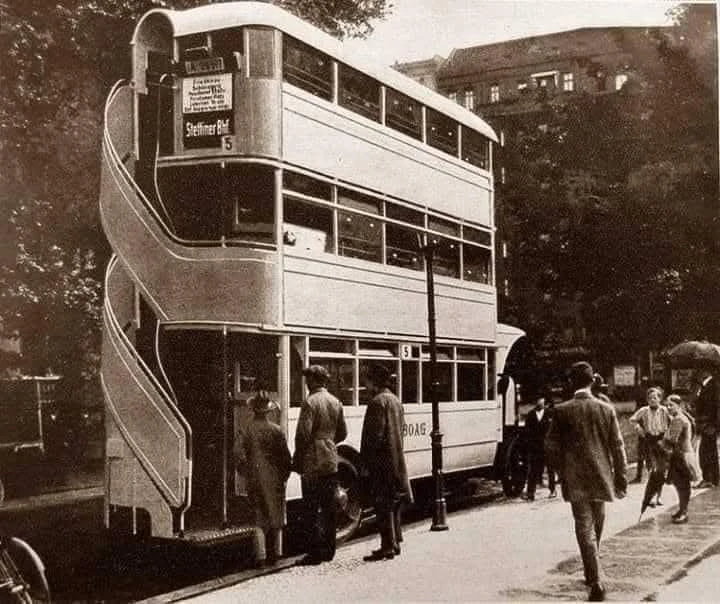
In April 1926, Berliners looked up and saw something that seemed like a prank. A bus with three full passenger decks, towering over traffic on the Kurfürstendamm. It was not a joke. It was a serious attempt to move more people on the same patch of asphalt in a city that was growing faster than its streets could cope.
By the end of this story you will see why Berlin tried three-decker buses, why they disappeared, and how their basic problem — too many people, not enough road — ended up being solved in very different ways: modern double-deckers, articulated buses, and bus rapid transit systems.
Why did Berlin build a three‑decker bus in 1926?
Start with the numbers. Greater Berlin was created in 1920 by fusing the old city with surrounding towns. Overnight, the official population jumped to roughly 3.8 million. The tram network was huge, the U‑Bahn was growing, but the streets were jammed.
By the mid‑1920s, Berlin’s main transit operator, the Berliner Verkehrs-Aktiengesellschaft (BVG), was under pressure. Trams were overcrowded. Underground lines were expensive to extend. Buses were flexible but small. The city needed more capacity without tearing up streets or building new tunnels every few years.
Enter the three-decker bus experiment. The idea was simple: if you cannot widen the road, grow upward. A normal single-deck bus might carry 50 to 60 passengers. A double-decker could push that to 70 or 80. A three-decker promised 100 or more, depending on the layout.
Berlin was not inventing tall buses from scratch. London had been running double-deck buses since the horse-drawn days, and motorized double-deckers were already common there by the 1910s. Berlin itself had double-deck trams. The three-decker was the logical extreme of a trend: stack people vertically to save street space.
So why 1926? Because the technology and the politics briefly lined up. German truck and bus builders like Büssing and Daimler had powerful enough engines and stronger frames after World War I. The inflation crisis of 1923 had calmed, and the city was back to planning grandly again. A giant bus looked like a modern, confident solution.
In short, Berlin’s three-decker bus was born from a specific moment: a dense, growing city, a cash-strapped transit authority, and engineers who thought they could cheat geometry by going vertical. That timing mattered because it pushed Berlin to test a radical idea instead of simply buying more of the usual vehicles.
How were three‑deckers built and run compared to modern buses?
On paper, the 1926 Berlin three-decker and a modern double-decker bus solve the same problem. In practice, they are very different machines.
The Berlin prototype was essentially a heavy truck chassis with a tall, boxy body. Contemporary photos show a narrow vehicle with three distinct levels, each with rows of simple bench seats. The lower deck had the entrance. Passengers climbed internal staircases to reach the second and third decks. There were no elevators, no low floors, no wheelchair access. This was a bus for the young, the able-bodied, and the patient.
The engine sat in the front, noisy and smoky, likely producing in the range of 70–90 horsepower, which was respectable for the time but modest for such a tall, heavy vehicle. Brakes were mechanical or early pneumatic systems, far less reliable than modern disc brakes and electronic controls.
Center of gravity was the real issue. Three decks of people stacked high above a narrow track width meant the bus was top-heavy. Taking a corner too fast or swerving around a horse cart could, in theory, tip the whole thing. Engineers tried to compensate with a stiff suspension and cautious speed limits, but physics did not care about Berlin’s transit needs.
Compare that to a modern double-decker in Berlin, London, or Hong Kong. Today’s buses use low-floor designs for easy boarding, wide doors, and carefully calculated weight distribution. Engines are more powerful and cleaner. Electronic stability control, anti-lock brakes, and better tires help prevent accidents. The height is still impressive, but the proportions are less extreme.
Then there are articulated buses, the long “bendy buses” that Berlin and many other cities use. Instead of going up, they go long, with a joint in the middle that lets them turn. A typical articulated bus is about 18 meters long and can carry 120–150 passengers. It spreads the load horizontally, which keeps the center of gravity low and the ride more stable.
Bus rapid transit (BRT) systems take this even further. In cities like Bogotá or Curitiba, BRT lines use long articulated or even bi-articulated buses, dedicated lanes, and platform-level boarding. The vehicles are tall but not absurdly so. The efficiency comes from speed and priority in traffic, not just stacking more seats vertically.
So while the three-decker and modern high-capacity buses look like cousins, the methods differ. Berlin’s 1926 experiment tried to solve congestion with height alone. Modern systems solve it with a mix of vehicle design, traffic engineering, and electronics. That difference in methods changed which ideas survived and which were quietly dropped.
What actually happened when Berlin tried three‑deckers?
The record on Berlin’s three-decker buses is patchy. We know they existed, that at least one prototype ran in 1926, and that they did not go into mass production. Contemporary press reports and surviving photos show crowds staring up, curious and amused, and passengers willing to climb just to say they had ridden on the top deck.
Operationally, the problems showed up fast. Boarding took too long. Every extra deck meant more stairs and more time for people to shuffle in and out. In a city bus, dwell time at stops matters as much as top speed. A bus that carries 100 people but spends twice as long at each stop is not actually efficient.
There were also safety concerns. Even if no major accident occurred, the risk was obvious. A top-heavy vehicle on cobblestone streets, sharing space with trams, horse carts, and early cars, was a nervous driver’s nightmare. Any crash would have been politically expensive for BVG.
Comfort was another issue. The top deck swayed. In windy weather, passengers felt the movement. In summer, the upper levels baked. In winter, they froze. Ventilation and heating on 1920s buses were basic at best. The higher you sat, the worse it got.
Maintenance crews did not love them either. A unique prototype means unique parts and special training. Mechanics already had their hands full keeping trams, regular buses, and trucks running. A one-off giant was a headache, not a solution.
By the late 1920s, Berlin’s transit planners were already looking elsewhere. The U‑Bahn kept expanding. Tram lines were adjusted. More conventional double-decker buses entered service. The three-decker quietly faded out of the fleet and into the category of “interesting experiment.”
So what happened is simple: the three-decker bus worked just well enough to prove that it was a bad idea. It showed that sheer height was not the path to efficient mass transit, which pushed Berlin and other cities to look for better answers.
How did outcomes differ from modern double‑deckers and BRT?
Berlin’s three-decker buses were a dead end. Modern double-deckers and BRT systems became workhorses. The contrast says a lot about what actually matters in public transport.
Capacity per vehicle is the obvious metric. A three-decker might carry 100–120 people. A modern double-decker can carry roughly 80–100, depending on layout. An articulated bus can match or exceed that, especially with standees. On paper, the three-decker wins or at least ties.
But transit planners care about capacity per hour per direction, not just per bus. That depends on how fast you can load and unload, how quickly vehicles can follow each other, and how reliably they move through traffic.
Here modern systems shine. Double-deckers use two doors, low floors, and contactless payment to speed boarding. Articulated buses and BRT use multiple wide doors and level platforms. Dedicated lanes keep them moving while cars sit in traffic. A BRT corridor can move as many people per hour as a light rail line, sometimes more.
Cost is another difference. The three-decker required a unique body design on a truck chassis, with all the custom engineering that implies. It was a one-off or very small series. Modern buses are built in large runs, with standardized parts. BRT infrastructure is not cheap, but it is far less expensive than digging a subway and far more scalable than a handful of experimental giants.
Then there is politics and public acceptance. People like double-decker buses. They are familiar, especially in cities like London or Berlin where they have become part of the visual identity. BRT can be controversial when it takes lanes from cars, but once running, its benefits are visible: faster trips, reliable schedules.
The three-decker never had time to become beloved. It looked odd, felt awkward, and disappeared before it could build nostalgia. Its outcome was a quiet retreat, while modern high-capacity buses became central to everyday life in dozens of cities.
So the outcomes diverged sharply. The three-decker proved that height alone was not enough, while modern systems proved that speed, reliability, and ease of use matter more than squeezing in one extra deck of seats.
What legacy did the three‑decker leave compared to today’s systems?
On the surface, the three-decker bus left almost no legacy. There is no surviving fleet, no famous Berlin tourist route using triple-deckers, no mass nostalgia industry. It appears in a few photos, a few engineering journals, and the occasional Reddit thread where people ask, “Did they really run those?”
Yet the experiment sits in a longer story about how cities learned to think about transit capacity. In the early 20th century, the instinct was often to make individual vehicles bigger. Taller trams. Longer trains. Giant buses. The three-decker was the logical extreme of that thinking on rubber tires.
By the late 20th century, the focus had shifted. Instead of just scaling up vehicles, planners looked at the whole system. Signal priority for buses. Off-board fare collection. Dedicated lanes. Better scheduling. The success of BRT in Latin America and Asia, and of high-frequency bus networks in Europe, came from treating buses as part of a coordinated network, not as isolated monsters.
Modern double-decker buses in Berlin and London still carry the visual DNA of the 1920s: tall, narrow, efficient on crowded streets. But they are shorter than the three-decker, built with safety and accessibility in mind, and integrated into networks that include rail, tram, and BRT. The lesson of the three-decker is visible in what today’s buses are not.
There is also a cultural legacy. Photos of the 1926 Berlin three-decker circulate online as curiosities. They remind people that cities have tried strange things before. When someone proposes a radical new transit gadget today, from double-height pods to elevated bus tunnels, planners can point to the three-decker and say: we have been here. We know that some ideas look efficient on paper but fail on the street.
So the three-decker’s legacy is negative but useful. It is a historical warning that not every bigger, taller, flashier bus is a step forward. That memory helped push later generations toward more balanced solutions like modern double-deckers, articulated buses, and BRT corridors.
Why does a 1926 Berlin bus matter to today’s cities?
At first glance, the 1926 three-decker bus is just a quirky photo from Weimar Berlin. A relic from a city that tried everything once. But the questions behind it are the same ones cities face now.
How do you move more people without rebuilding every street? Do you invest in a few giant vehicles or in many smaller ones that move faster? Do you chase eye-catching hardware or quieter system changes that add up?
The three-decker answered those questions badly, which is why it vanished. Modern double-deckers, articulated buses, and BRT answered them better, which is why they are everywhere. They show that the real gains come from boarding speed, reliability, and network design, not just from stacking another floor on top.
So when you look at that 1926 Berlin photo and think, “Why did they do that?”, the answer is simple. They were trying to solve the same capacity problem your city is arguing about today. Their failure helped clear the way for the bus systems that actually work.
Frequently Asked Questions
Did Berlin really have three-decker buses in the 1920s?
Yes. In 1926 Berlin tested at least one three-decker bus as an experiment to increase capacity on crowded routes. It never went into large-scale service and was quickly abandoned in favor of more practical double-decker and standard buses.
Why did three-decker buses fail in Berlin?
They were top-heavy, slow to load and unload, and awkward to operate on narrow, busy streets. Safety concerns, long boarding times, and maintenance headaches outweighed the extra capacity, so Berlin’s transit operator dropped the idea.
How are modern double-decker buses different from the 1926 three-decker?
Modern double-deckers use low-floor designs, better brakes, electronic stability systems, and more efficient boarding with wide doors and contactless payment. They are tall but not excessively so, with safer proportions and better integration into transit networks.
What replaced the idea of three-decker buses for high capacity?
Cities turned to a mix of double-decker buses, articulated buses, and bus rapid transit (BRT) systems. These focus on faster boarding, dedicated lanes, and higher service frequency instead of simply adding more vertical decks to a single vehicle.