On a muddy field in northern France in 1415, a small, sick, and hungry English army watched a much larger French force form up in glittering armor. By the end of the day, thousands of French knights lay dead. Their king’s prestige was shattered. The English king, Henry V, walked off the field with a legend that would outlive him by centuries.
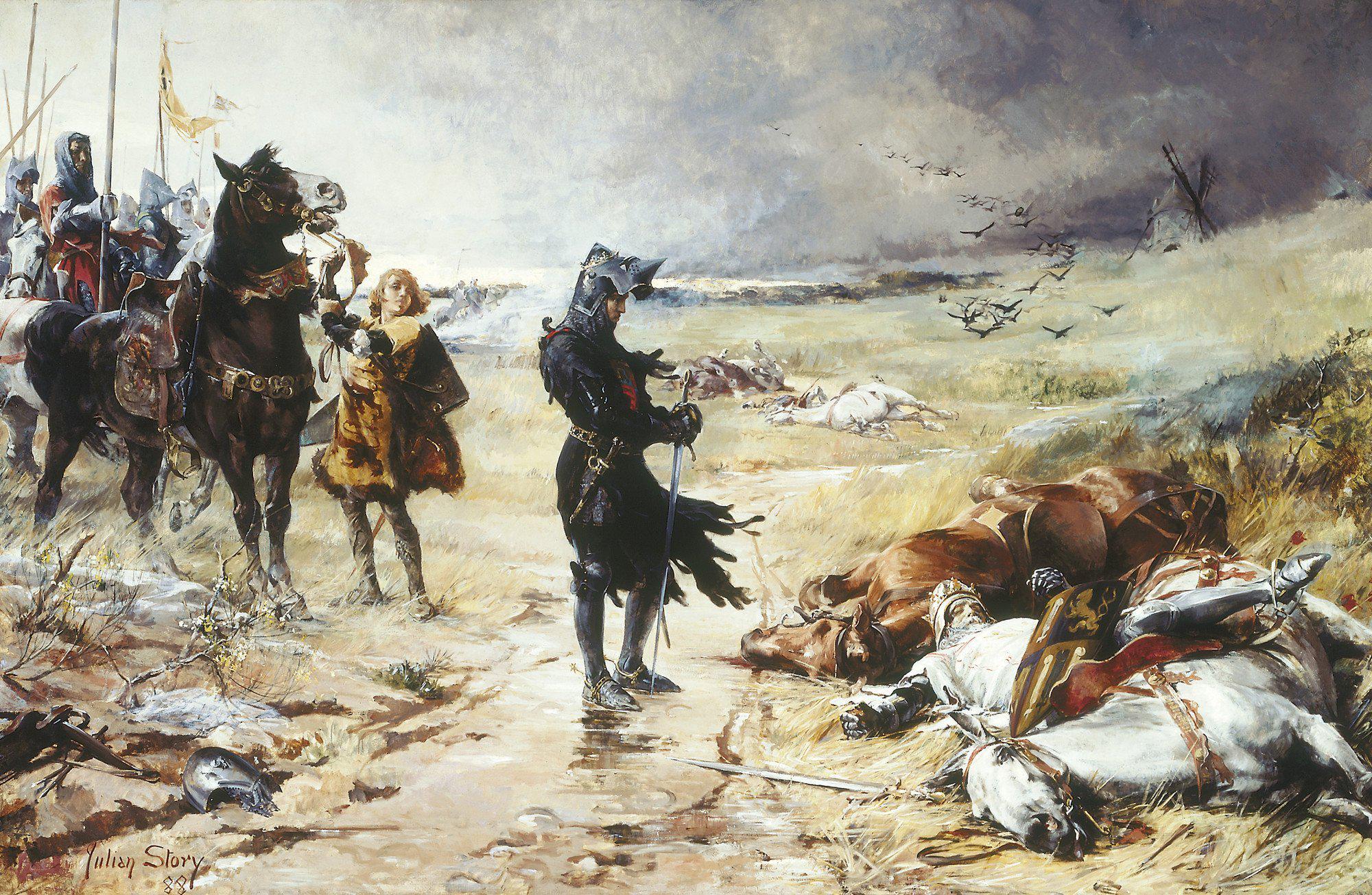
Yet this was not the first time English longbowmen had torn through French chivalry. Seventy years earlier, at Crécy in 1346, another English king had done something very similar. Edward III’s army, anchored by the famous Black Prince, wrecked a French assault and killed King John of Bohemia, whose blind charge into battle later inspired romantic paintings like Julian Russell Story’s 1888 work of the Black Prince paying tribute to him.
So why does Agincourt dominate popular memory while Crécy is a history-nerd reference? Both were major English victories in the Hundred Years’ War, but Agincourt became the better-known symbol of English military glory because of timing, storytelling, and politics as much as tactics.
What were the battles of Crécy and Agincourt?
The Battle of Crécy was fought on 26 August 1346 during the early phase of the Hundred Years’ War. King Edward III of England, invading northern France, took up a defensive position near the village of Crécy-en-Ponthieu. His smaller army, heavy with longbowmen, repelled repeated French cavalry and infantry attacks, inflicting heavy casualties on the French nobility.
The Battle of Agincourt took place on 25 October 1415, also in northern France. King Henry V of England, returning from a siege at Harfleur and badly outnumbered, confronted a larger French army near the village of Azincourt. Using longbowmen, terrain, and French mistakes, he won a striking victory.
In both battles, English longbowmen played a decisive role in defeating larger French forces. Crécy and Agincourt are classic examples of how discipline, tactics, and terrain could beat superior numbers and aristocratic cavalry.
Yet when people think of English victories in the Hundred Years’ War, Agincourt usually comes first. That difference in fame shaped how later generations remembered the war and what kind of medieval heroism they celebrated.
What set them off: war, claims, and royal ambition
Crécy and Agincourt were episodes in the same long conflict: the Hundred Years’ War between England and France, fought in phases from 1337 to 1453. At its core were overlapping issues: who should rule France, who controlled rich territories in France, and who dominated the Channel and trade.
Crécy came early. Edward III of England claimed the French crown through his mother, a daughter of the French king Philip IV. The French nobility rejected this and chose Philip VI, a cousin, instead. Edward used his claim as a legal and propaganda weapon to justify war, raids, and seizures of territory in France. By 1346, he was leading a major campaign, raiding through Normandy and heading north to link up with Flemish allies. The French king moved to block him. The result was Crécy.
Agincourt came much later, after decades of back-and-forth fighting. By Henry V’s reign, the war had cooled but not ended. The French crown was weakened by internal conflict between two factions, the Armagnacs and Burgundians, and by the mental illness of King Charles VI. Henry V saw an opening. He revived English claims to the French throne and demanded large territorial concessions. When negotiations stalled, he invaded in 1415, besieged Harfleur, and then marched his worn-down army toward English-held Calais. French forces moved to cut him off. They met near Agincourt.
Both battles grew out of English kings using legal claims and military pressure to force concessions from a richer but politically troubled France. That shared origin meant later writers could treat Agincourt as a repeat performance of Crécy, but with higher drama.
The turning points: how the fighting actually played out
Crécy and Agincourt are often lumped together as “longbow victories,” but the way they unfolded on the ground helps explain why Agincourt became the more dramatic story.
At Crécy, Edward III chose his ground carefully. He put his men on a slight rise, arranged in three divisions, with longbowmen on the flanks. The French arrived piecemeal and attacked in waves, including their Genoese crossbowmen and heavy cavalry. The English archers, shooting faster than the crossbowmen could reload, disrupted the French advance. French knights rode down their own infantry in the chaos, then charged uphill into a storm of arrows and solid English infantry. The French king, Philip VI, survived, but many nobles died, including John of Bohemia, who reportedly had himself led into battle despite being blind.
Crécy was a planned defensive battle. The English were not trapped. They had chosen to fight there and had time to prepare. The French attacks were brave but disorganized, and the English system of combined arms worked as designed.
Agincourt felt different. Henry V was in a worse position. His army had been weakened by disease at Harfleur and a long march. Sources differ on exact numbers, but the English were probably outnumbered by at least two to one. They were boxed in between woods, on a narrow front, with recently plowed fields turned to deep mud by rain.
Henry also set up defensively, with men-at-arms in the center and longbowmen on the wings. He ordered archers to plant sharpened stakes in front of them to blunt cavalry. The French, with many nobles eager for ransom and glory, crowded their men-at-arms into a tight formation and advanced across the mud. The weight of armor and numbers turned the field into a killing ground. Many French knights fell, were trapped, and suffocated or were finished off by archers who joined the melee.
Then came the most controversial moment. Fearing a renewed French attack and worried about prisoners who might rearm, Henry ordered many of the French captives killed. Chroniclers were shocked. Yet the order underlined how close-run the battle felt to contemporaries.
Crécy was a demonstration of a new way of fighting. Agincourt felt like a miracle escape. That sense of near-disaster turned into legend and made Agincourt the more gripping story for later generations.
Who drove it: Edward III, the Black Prince, and Henry V
Personalities matter in memory. Crécy and Agincourt had different leading men, and history treated them very differently.
At Crécy, the English king, Edward III, commanded. He was an effective war leader and a builder of institutions, but he never became a cultural icon in the way Henry V did. His son, Edward of Woodstock, later called the Black Prince, fought at Crécy too, probably in his mid-teens. Chroniclers loved the story that Edward III refused to send help when his son’s division was hard pressed, saying he wanted the boy to “win his spurs.” Whether the quote is accurate or not, it fed an image of chivalric coming-of-age.
The death of King John of Bohemia at Crécy added another layer. John was a respected, aging knight, blind but determined to fight. Later stories claimed he had his horse’s reins tied to his companions so he could ride into battle. The painting mentioned in the Reddit post, showing the Black Prince paying tribute to John’s body, reflects a 19th-century romantic reading of the event. That image of mutual respect between noble enemies appealed to Victorian ideals of chivalry.
Yet neither Edward III nor the Black Prince became the subject of a blockbuster play by England’s most famous writer.
Henry V did. In life, Henry was a hard-edged, deeply pious, and politically focused king. He used propaganda, religious language, and strict discipline to hold his army together. At Agincourt, he reportedly fought in the front ranks. Chroniclers praised his courage, but they also recorded his ruthlessness, including the killing of prisoners.
In the late 16th century, William Shakespeare turned Henry into a different kind of hero. In the play “Henry V,” Agincourt is the climax. Henry becomes the ideal warrior-king, delivering stirring speeches about “we few, we happy few, we band of brothers.” The historical Henry never said those words, but Shakespeare’s version stuck.
Edward III and the Black Prince remained figures for specialists and heraldry buffs. Henry V, thanks to Shakespeare and later film adaptations, became a household name. That star power pulled Agincourt into the center of English historical memory.
What they changed: consequences on war and politics
Crécy and Agincourt were not just good stories. They had real consequences for the Hundred Years’ War and for medieval warfare.
After Crécy, Edward III moved on to besiege Calais, which fell in 1347. Calais became England’s main foothold on the continent for two centuries. Crécy, together with the naval victory at Sluys (1340) and the later battle of Poitiers (1356), forced the French crown into concessions. The Treaty of Brétigny in 1360 granted England large territories in southwestern France and recognized Edward’s holdings with fewer feudal strings attached.
Crécy also hammered home a lesson: massed longbowmen, used with disciplined infantry and good positioning, could break armored cavalry. That was a shock to a European military culture that still put mounted knights at the top of the social and tactical order. French commanders learned from it, at least sometimes. In later phases of the war, they used more artillery and avoided charging prepared English positions when they could.
Agincourt’s immediate impact was political. The French nobility suffered another wave of casualties. The defeat deepened France’s internal crisis. Henry V used his victory as leverage in negotiations. In 1420, the Treaty of Troyes named him heir to the French throne and regent of France, disinheriting the dauphin Charles (the future Charles VII). Henry married Charles VI’s daughter, Catherine of Valois. For a brief moment, it looked as if the crowns of England and France would be united under Henry’s line.
That did not last. Henry V died in 1422, as did Charles VI. The infant Henry VI was proclaimed king of both realms, but English fortunes in France declined. Joan of Arc’s campaigns in the 1420s and 1430s revived French resistance. By 1453, the English had lost almost all their French territories except Calais.
Still, Agincourt had long-term effects. It hardened English expectations that they could win against the odds in France. It fed a sense of grievance when those gains were later lost. For France, it was another trauma in a long war that pushed the monarchy toward centralization and professionalization of its armies.
Crécy reshaped tactics and territorial control in the mid-14th century, while Agincourt reshaped political claims and royal propaganda in the early 15th century.
Why Agincourt became more famous than Crécy
On paper, Crécy and Agincourt look similar: English longbowmen, French nobility cut down, an outnumbered English army winning a major battle. Yet Agincourt is the one that lives in school textbooks, war films, and patriotic speeches. Several factors fed that imbalance.
First, narrative simplicity. Agincourt offers a clean underdog story. A sick, hungry army, heavily outnumbered, trapped between woods, facing annihilation. Then victory. Crécy was impressive, but the English had chosen their ground and were not in quite such dire straits. For storytellers, Agincourt is the tighter script.
Second, Shakespeare. The play “Henry V,” written around 1599, gave Agincourt a script, characters, and unforgettable lines. It tied the battle to themes of national unity, courage, and leadership. Later generations, especially in times of war, reached for that version. During World War I and World War II, Agincourt was invoked as a model of English grit. Crécy had no such theatrical champion.
Third, timing and later politics. Early modern England, and later Britain, needed historical moments that could support a sense of national identity. Agincourt, with its Saint Crispin’s Day setting and its image of a godly king leading common archers, fit Protestant and later patriotic narratives. It could be framed as a victory of a united “English nation,” not just a feudal raid. Crécy, earlier and more entangled with feudal claims, did not map as neatly onto those stories.
Fourth, visual culture and commemoration. While artists like Julian Russell Story painted scenes from Crécy, Agincourt benefited from centuries of illustrations, stage productions, and later films. Laurence Olivier’s 1944 film “Henry V,” released during World War II, turned Agincourt into Technicolor propaganda for the fight against Nazi Germany. Kenneth Branagh’s 1989 film gave it a darker, more ambiguous tone, but kept the battle in public view. Crécy never got that kind of sustained screen time.
Finally, the outcome of the war shaped memory. The English lost their continental empire. Agincourt became a nostalgic high point, a “last great victory” before decline in France. Crécy, earlier and followed by mixed fortunes, faded into the background for non-specialists.
Agincourt became more famous than Crécy because it offered a better myth: a desperate underdog victory, wrapped in Shakespearean language, reused in later wars, and tied to ideas of English national character.
Why it still matters how we remember Crécy and Agincourt
On Reddit and elsewhere, people often ask why Agincourt is better known than Crécy, or whether the longbow “won” the Hundred Years’ War for England. Those questions get at a bigger issue: how memory distorts medieval warfare.
Both battles are often simplified into “bows beat knights.” That misses the role of planning, discipline, logistics, and French political problems. Longbows were powerful, but they worked because English commanders integrated them into a system: choosing ground, training archers, enforcing cohesion among men-at-arms, and exploiting French mistakes.
The romantic image of the Black Prince honoring John of Bohemia at Crécy, like the painting in Savannah, feeds another misconception. It suggests medieval war as a stage for noble gestures between aristocrats. The reality was uglier. Both battles involved mass killing of wounded or trapped men. At Agincourt, Henry’s order to kill prisoners still troubles historians. Chivalry existed, but it coexisted with brutality.
Agincourt’s fame also reminds us that history is not just about what happened, but about what later generations needed to remember. English and British societies used Agincourt to talk about courage, class, and leadership. They largely ignored the wider context: that the victory did not secure lasting control of France, and that French recovery after the war was built on reforms that made the monarchy stronger.
Crécy and Agincourt still matter because they show how military success can be turned into myth, and how myth can outlast the political gains that victory actually brought. They also offer a check on easy stories about “technological revolutions” in warfare. The longbow mattered, but so did human decisions, bad weather, and overconfident nobles wading into mud.
When people ask why Agincourt is more famous than Crécy, they are really asking how some events become national legends while others stay in the footnotes. The answer lies less in the arrows on the day and more in the centuries of storytelling that followed.
Frequently Asked Questions
Why is the Battle of Agincourt more famous than the Battle of Crécy?
Agincourt is more famous largely because of later storytelling, especially Shakespeare’s play “Henry V,” which turned the battle into a powerful underdog myth. The narrative of a small, exhausted English army defeating a much larger French force on Saint Crispin’s Day proved attractive for later English and British identity, especially in wartime. Crécy was just as important militarily, but it never gained the same cultural script or theatrical treatment.
Were the English really outnumbered at Agincourt?
Most historians agree the English were significantly outnumbered at Agincourt, though exact figures are debated. The English army may have had around 6,000 to 9,000 men, while French forces were likely at least twice that, and possibly more. What is clear from contemporary accounts is that the English felt heavily outmatched, and the cramped, muddy battlefield amplified the French disadvantage despite their greater numbers.
Did longbowmen win both Crécy and Agincourt?
Longbowmen were central to English success at both Crécy and Agincourt, but they were not the only factor. At Crécy, longbow fire disrupted French cavalry and infantry attacks, working with disciplined English men-at-arms on a strong defensive position. At Agincourt, longbows, the narrow muddy field, French over-crowding, and Henry V’s deployment all combined to produce the result. The battles were victories of tactics and discipline as much as of any single weapon.
What happened to the English gains after Agincourt?
Agincourt helped Henry V secure the Treaty of Troyes in 1420, which named him heir to the French throne and regent of France. After his early death and the death of Charles VI, his infant son Henry VI was proclaimed king of both England and France. English fortunes soon declined. French resistance, including the campaigns associated with Joan of Arc, reversed many of the gains. By 1453, the English had lost almost all their French territories except Calais.