On a cold February day in 1925, a group of college women in Arkansas City, Kansas, walked across campus wearing dog collars.
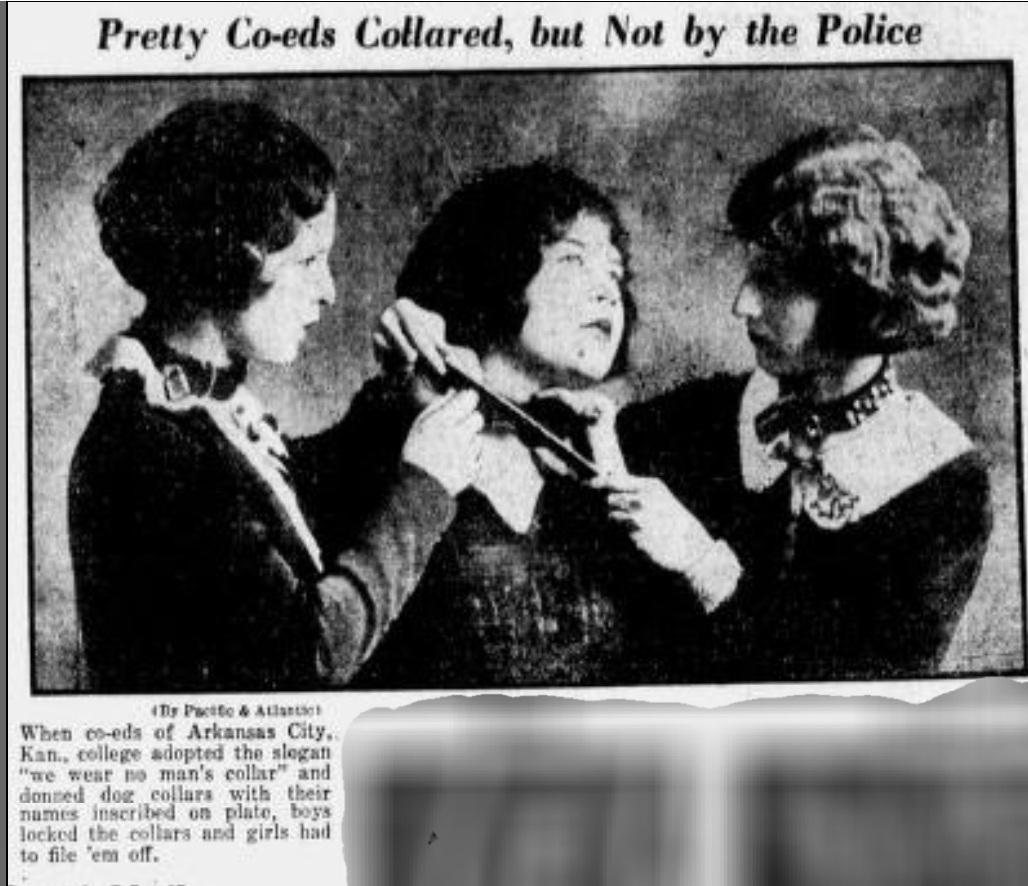
Not dainty necklaces. Actual leather dog collars with metal nameplates. Their slogan was as blunt as the hardware: “We wear no man’s collar.”
It was a small-town stunt with a sharp edge. The young women were making fun of the idea that they belonged to boyfriends or husbands. The male students, feeling mocked, grabbed the collars and snapped the locks shut. The women had to file the collars off to get free.
That is the entire incident in one sentence: a 1925 co-ed protest in Kansas, where women wore dog collars as a statement of independence and male students retaliated by locking them on. But inside that odd little story is a snapshot of the 1920s gender wars: flappers, new freedoms, old anxieties, and a constant argument over who got to define women’s bodies and choices.
What was the Kansas dog collar protest, exactly?
The dog collar episode was a brief student protest at a small college in Arkansas City, Kansas, reported in late February 1925. Contemporary newspaper snippets, which the Reddit post is based on, describe “girls of Arkansas City College” wearing dog collars with nameplates as a “statement of independence.” Their slogan: “We wear no man’s collar.”
In plain terms, it was a symbolic fashion protest. The women used an object associated with ownership of animals to mock the idea that women were owned by men. The collars were meant to be obviously absurd, a joke with teeth.
Male students did not take it as a harmless gag. According to the report, some of them seized the collars and locked them so they could not be removed easily. The joke turned into a power struggle. The women had to “file them off” to get free, which suggests either metal buckles jammed shut or locks added by the men.
So you have three parts: a visual stunt, a slogan about independence, and a male backlash that turned a joke about control into a real moment of control. That combination is what makes this tiny incident so revealing.
It mattered because it compressed a whole decade’s argument about women’s autonomy into one afternoon: who owns a woman’s body, who gets to joke about it, and how quickly mockery can turn into restraint.
What set it off: flappers, suffrage, and small-town control
On paper, American women had just won a huge victory. The 19th Amendment, ratified in 1920, gave women the right to vote nationwide. By 1925, women could serve on juries in some states, attend college in growing numbers, and work in offices and factories.
At the same time, the cultural script for young women was flipping. The “flapper” had arrived: short skirts, bobbed hair, cigarettes, jazz, and a public life that older generations found alarming. The flapper was less a statistical reality than a symbol, but she terrified parents, pastors, and campus deans.
Kansas was not New York City, but it was not frozen in 1890 either. Small-town colleges felt the same pressures. Co-eds cut their hair. They went to dances. They flirted. Administrators issued rules about hemlines and chaperones. Local newspapers ran nervous editorials about “modern girls.”
In that context, a group of college women in Arkansas City playing with the idea of “ownership” was not random. They were living with a double message: you can vote now, but you still belong to your father, your church, or your future husband. You can go to college, but your main job is to marry well.
Dog collars with nameplates were a visual joke about that possessive logic. If women were supposed to be someone’s property, why not wear the same hardware you put on a dog? The slogan “We wear no man’s collar” was a direct refusal of that role.
There is no sign this was a formal suffrage organization or a national feminist campaign. It looks like a local, student-driven stunt. That is part of the point. By the mid-1920s, feminist ideas were no longer confined to big-city activists. They were seeping into everyday student life, even in small Kansas colleges.
This mattered because it shows how the 1920s gender revolution was not just about voting rights or famous flappers. It was about ordinary young women in ordinary towns quietly mocking the old rules and testing how far they could go.
The turning point: when a joke became a power move
The moment that turns this from a cute anecdote into something darker is the male reaction. The report says male students “locked the collars onto them,” forcing the women to “file them off.”
That detail is easy to skim past, but it deserves a slow look. The women’s original act was symbolic. They chose to put on the collars. They chose the slogan. They controlled the joke. The men’s response was physical and literal. They took an object that was meant to mock control and used it to exert control.
There is no detailed record of how rough this was. We do not know if the women were grabbed, how many men were involved, or whether any faculty intervened. The story appears in the press as a quirky campus item, not as a scandal. That alone tells you something about 1925 attitudes. What would now be seen as harassment or assault read then as boys being boys.
Still, the power dynamic is clear. The women’s bodies became the site of a joke they no longer controlled. The men turned consent into a punchline: you thought you were choosing to wear a collar, now you cannot take it off.
Having to file the collars off adds a final twist. It meant time, effort, and probably some pain. Filing metal near skin is not pleasant. It also meant the women had to fix a problem the men created. The cost of the joke fell on them.
This mattered because it exposed the limits of 1920s female freedom. Even as women experimented with new roles, a group of male peers could still physically override their choices and expect to be treated as pranksters, not aggressors.
Who drove it: anonymous co-eds and the invisible reformers
One frustrating thing about this story is how anonymous it is. The brief wire-style reports that survive do not list names. We do not know which women came up with the idea, whether there was a ringleader, or if a local women’s club encouraged them.
That anonymity is typical of how women’s everyday activism was recorded in the 1920s. Big names like Alice Paul or Carrie Chapman Catt appear in the history books. The young women who tested new freedoms on campuses and in small towns usually show up as “girls” in a paragraph-long item, if they appear at all.
We can say a few things with reasonable confidence. These were college women, so they were part of a small but growing group. In 1920, about 7 percent of American women aged 18 to 21 were in college. By 1930, that number had climbed, but it was still a minority. They were more likely to be white and middle class, given who could afford college in Kansas at the time.
We can also place them in a larger pattern of student resistance. In the 1920s, co-eds pushed back against dress codes, curfews, and rules about dating. Some colleges banned bobbed hair or short skirts. Others required women to sign in and out of dorms under strict supervision. Students responded with pranks, satire, and quiet rule-breaking.
The dog collar protest fits that pattern. It was not a formal political campaign. It was a symbolic jab at a culture that treated them as property, disguised as a joke. That kind of half-serious, half-satirical protest would become a staple of campus politics later in the century.
This mattered because it reminds us that social change is often driven by people whose names never make it into archives. Anonymous co-eds in Kansas were feeling their way toward a new idea of womanhood, one sarcastic collar at a time.
What it changed: from collars to campus norms
On the surface, the dog collar episode did not change much. There was no policy reform attached to it, no national outcry, no famous court case. The women filed off their collars. The men went back to class. The college carried on.
So why does it matter at all?
First, it captures a very specific stage in the history of women’s rights. The big legal milestone, suffrage, had been won. The next battles, over workplace equality, reproductive rights, and protection from harassment, were decades away. In between, there was a long, messy period where gender norms were fought over in small, symbolic ways.
Second, it shows how male backlash operated at a micro level. Historians talk about the 1920s as a time of “moral panic” over the modern girl. Here we see that panic expressed not in sermons or laws but in a hands-on attempt to reassert control over women’s bodies, framed as a prank.
Third, it hints at how women learned from these encounters. Even if the incident did not spark a formal movement, it would have left a mark on the women involved. They had tested a boundary and discovered how quickly men would push back. That kind of experience shaped how a generation of women thought about safety, solidarity, and the risks of being outspoken.
Finally, the story helps correct a common misconception about the 1920s. Popular culture often paints the decade as a carefree party of flappers and jazz. The Kansas collars show the other side: the tension, the resentment, and the constant negotiation over who got to be free and on what terms.
This mattered because it adds texture to the history of the 1920s, showing how national debates about gender played out in the daily lives of ordinary students.
Why it still matters: consent, control, and who gets to joke
Nearly a century later, the Arkansas City dog collar protest feels oddly modern. Swap the collars for a meme, a hashtag, or a protest T-shirt, and the pattern is familiar.
Women use humor and symbolism to call out control. Men respond by trying to take over the joke or turn it back on them. The line between teasing and coercion gets crossed, and the women are left to deal with the fallout.
Today, we have more language for what happened in 1925. We talk about consent, bodily autonomy, harassment, and “pranks” that are not funny to the target. We debate campus codes of conduct and what counts as acceptable behavior between students.
The Kansas story is a reminder that these are not new problems. They are old patterns with new vocabulary.
It also pushes back against a certain nostalgia. People sometimes imagine the 1920s as a simpler time when gender roles were clear and everyone knew their place. The dog collar episode shows that even in a small Kansas college, young women were already refusing to accept that script, and young men were already reacting defensively.
Finally, the story matters because it preserves a small act of defiance that could easily have vanished. Without a short item in a 1925 paper, and without someone posting it to Reddit a century later, we would never know that a group of Kansas co-eds once walked across campus wearing dog collars and announcing, “We wear no man’s collar.”
That sentence alone is a thread connecting their world to ours. It is a reminder that the fight over who “owns” women’s bodies has been going on for a long time, and that even the strangest little campus stunt can be part of that larger story.
This matters because it links a forgotten 1925 prank to ongoing debates about autonomy and consent, showing how much has changed and how much still sounds uncomfortably familiar.
Frequently Asked Questions
What was the 1925 Kansas college dog collar protest?
In February 1925, women at a college in Arkansas City, Kansas, wore dog collars with nameplates as a statement of independence, saying, “We wear no man’s collar.” Male students reacted by locking the collars so they could not be removed, forcing the women to file them off. It was a small but telling clash over women’s autonomy in the 1920s.
Why did the Kansas college women wear dog collars in 1925?
The dog collars were a symbolic joke about ownership. In a decade when women were gaining new rights but still treated as men’s property in many ways, the collars mocked that idea. By saying “We wear no man’s collar,” the students were rejecting the expectation that they belonged to boyfriends or husbands.
How did male students respond to the 1925 dog collar protest?
Male students reportedly grabbed the collars and locked them onto the women, turning a voluntary protest accessory into a form of restraint. The women then had to file the collars off to remove them. At the time, this was treated as a campus prank, but today it reads as a clear violation of consent and bodily autonomy.
What does the 1925 Kansas dog collar incident tell us about gender in the 1920s?
The incident shows how the 1920s were a period of tension over women’s roles. Even after winning the vote, young women who asserted independence faced backlash from male peers. The dog collar protest captures how debates over control of women’s bodies played out in everyday student life, not just in national politics.