On a cold February day in 1926, a Kansas doctor filled out a death certificate and wrote something that sounded like a joke: cause of death, dancing the Charleston.
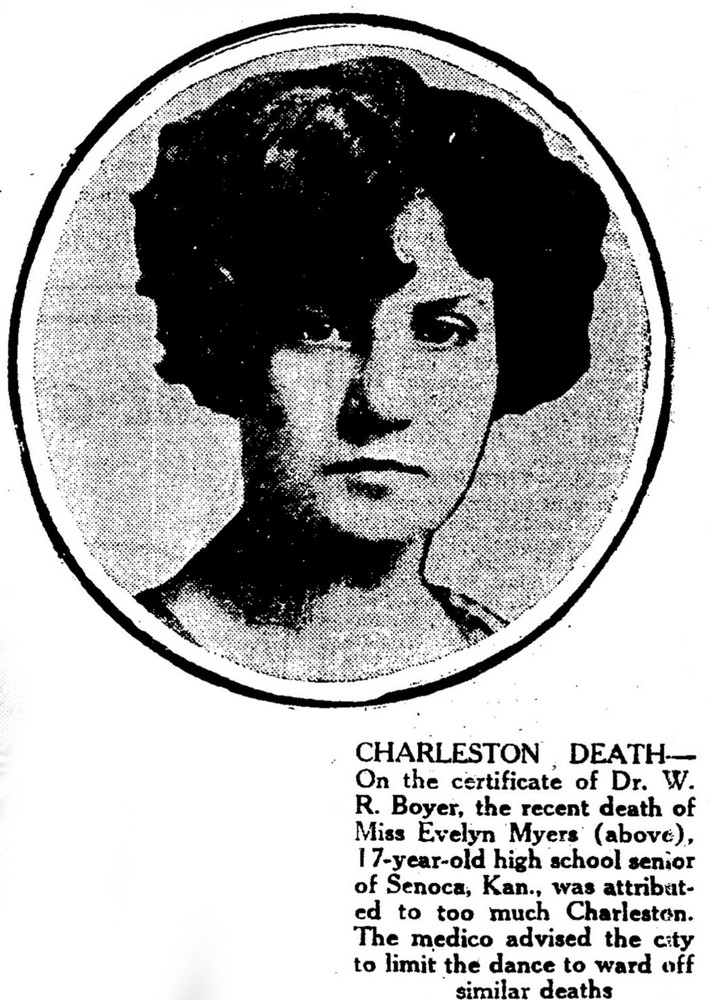
The dead girl was 17-year-old high school senior Evelyn Myers. Newspapers reported that she had danced the wildly popular Charleston until she collapsed. A local doctor then urged the city to restrict the dance so, as he put it, there would be no more deaths like hers.
The Charleston was the defining dance of the Roaring Twenties. It was fast, flailing, and, to older eyes, indecent. The idea that it could literally kill you fit neatly into a moral panic already brewing around jazz, short skirts, and teenage freedom.
So what if that panic had gone further? What if Evelyn Myers’s death had triggered a serious legal and cultural crackdown on the Charleston and, by extension, on jazz-age youth culture?
The Charleston was a popular 1920s dance characterized by fast footwork, swinging arms, and syncopated movement to jazz music. By 1926, it had spread from Black communities and Broadway stages into white middle-class ballrooms across the United States.
Here is how the world might have looked if one Kansas death certificate had helped turn a fad into a public menace.
How real was the fear that the Charleston could kill you?
Start with the basic question: could dancing the Charleston actually kill a healthy 17-year-old?
Medical reporting in the 1920s was loose by modern standards. Doctors sometimes blamed deaths on activities that were really just triggers for underlying problems. Newspaper editors loved a tidy, moralizing cause. “Danced to death” sold more papers than “undiagnosed heart condition.”
In Evelyn Myers’s case, contemporary clippings suggest she had been ill before her final dance. Some reports mention a weak heart. Others are vague. The death certificate line about the Charleston likely reflected a mix of real exertion and cultural bias. The new dance was an easy villain.
There were scattered stories in the mid‑1920s of people collapsing while dancing the Charleston or other energetic steps. A few doctors warned that the dance put too much strain on the heart and joints. At the same time, other physicians praised dancing as healthy exercise, especially compared to sedentary Victorian habits.
So the medical profession was split. But the social context was not. Many parents, pastors, and city officials already hated the Charleston before anyone died from it.
They saw a Black-originated dance, sexualized movement, and unsupervised young people in dim rooms with jazz bands. The idea that this could be physically dangerous gave moralists a new weapon. If the dance could be framed as a public health threat, it could be regulated like alcohol or prostitution.
That mix of shaky science and strong cultural anxiety is what made a wider crackdown possible. So what?
Scenario 1: A real public health crusade against the Charleston
In this scenario, Evelyn Myers’s death becomes a national story, not just a local curiosity. Imagine that wire services pick it up, big-city papers splash it on front pages, and a few more high-profile “Charleston deaths” follow in Chicago, New York, or Los Angeles.
Public health in the 1920s was expanding its reach. Cities already regulated spitting, tuberculosis screening, milk purity, and prostitution. The idea that the state could police private behavior in the name of health was well established.
If a handful of prominent cardiologists and public health officials had backed the Kansas doctor, they might have framed the Charleston as a dangerous strain on adolescent hearts. Medical journals could have published case reports blaming sudden deaths on “excessive modern dancing.”
From there, the machinery of reform was ready to go:
• City councils could require dance halls to post time limits on continuous dancing, or to ban the Charleston specifically.
• School boards might forbid the dance at proms and gym classes, citing health regulations.
• Insurance companies could quietly raise premiums for dance hall owners or performers associated with “high-risk” dancing.
These kinds of measures had precedents. Cities had already passed “jazz ordinances” limiting hours or banning certain clubs. During the 1918 flu pandemic, many towns had temporarily shut down dance halls. Public health was a flexible excuse.
The real constraint would be evidence. Even in 1926, doctors who wanted to be taken seriously needed more than one Kansas teenager and a few anecdotes. But standards were low enough that a few sensationalized case series might have been enough to justify “temporary” restrictions that lingered for years.
If this had happened, the Charleston might have acquired a reputation not just as immoral but as medically reckless, the 1920s version of smoking. Parents could point to newspaper clippings and say, “People die from that.”
A health-based crusade would have given anti-jazz forces a new, respectable language. Instead of sounding like prudish censors, they could claim to be protecting young hearts and nervous systems. So what?
Scenario 2: A moral panic that fuses with Prohibition politics
There was another, more powerful engine ready to run in 1926: Prohibition.
Since 1920, the 18th Amendment and the Volstead Act had banned the sale of alcohol. In practice, this pushed drinking into speakeasies, where jazz bands played and people danced the Charleston. To dry crusaders, the dance was part of a package: liquor, loose morals, and defiance of the law.
Imagine that Evelyn Myers’s death happens to the daughter of a prominent dry politician or a minister. Her story is picked up by the Anti-Saloon League or the Woman’s Christian Temperance Union. They fold it into their existing message: modern nightlife kills.
In this scenario, the Charleston becomes a symbol in Prohibition politics.
• Dry activists argue that speakeasies are not just illegal bars but death traps for youth, where alcohol and frantic dancing strain young bodies.
• They pressure state legislatures to pass “dance hall reform” bills, limiting jazz dancing, requiring brighter lights, banning unchaperoned minors, or outlawing specific steps like the Charleston and the Black Bottom.
• Preachers use the Kansas case in sermons, linking the dance directly to sin and death, much as they had once done with saloons.
This is not far-fetched. Some cities really did pass ordinances against “improper” dances. In 1925, New York City adopted the Cabaret Law, requiring licenses for venues with music and dancing. It was aimed at controlling nightlife, especially in Black and immigrant neighborhoods.
With a stronger moral panic, that kind of law could have been written more explicitly against jazz dances. Police might have raided clubs not just for alcohol but for “dangerous” dancing. Judges could have fined or jailed owners who allowed the Charleston.
The economic impact would be real but uneven. Big-city nightlife had money and political connections. Harlem clubs, Broadway theaters, and Hollywood studios were already invested in jazz culture. They would lobby against outright bans or quietly ignore them. Smaller towns and conservative states, though, might have enforced strict rules.
That would deepen the cultural divide of the 1920s. Urban youth would dance the Charleston as an act of rebellion. Rural and small-town America would treat it as a symbol of everything wrong with the modern age.
Prohibition had already turned drinking into a political identity. A Charleston panic could have done the same for dancing, tying it even more tightly to debates about religion, gender, and the power of the state. So what?
Scenario 3: A backlash that slows, but does not stop, jazz culture
There is a more modest, and probably more realistic, scenario. In this version, the Kansas case feeds into a wave of local restrictions and social pressure that blunts the Charleston craze without erasing it.
Think of the way some communities reacted to rock and roll in the 1950s or to video games in the 1990s. You get:
• School principals banning the Charleston at dances as “too rough” or “too dangerous.”
• YMCA and church halls allowing only “old-fashioned” waltzes and foxtrots, citing health concerns.
• Women’s clubs passing resolutions against “strenuous modern dances,” using Evelyn Myers as a cautionary tale.
Newspapers would run editorials with headlines like “How Far Should Our Daughters Dance?” Doctors would be quoted on both sides. Some would warn of heart strain and “nervous collapse.” Others would say the danger was exaggerated.
Economics would quietly push back. Dance halls, record companies, and radio stations were making money off the Charleston. Broadway shows like “Runnin’ Wild” had already popularized the dance. Hollywood was starting to film it. There was too much invested to let one moral panic kill the trend entirely.
What you would likely see is a soft rebranding. Dance teachers might promote “safer” versions of the Charleston, slower and more controlled. Magazines could publish etiquette guides showing “proper” steps for respectable girls, toning down the wild kicks and arm flails.
Parents might insist that daughters learn the waltz first, then only dance the Charleston under supervision. Boys would still go to less respectable clubs for the full version. The dance would split into a tame, middle-class form and a more intense underground style.
In this scenario, the Kansas death helps push the Charleston from the center of mainstream respectability back toward the edges, where it had started in Black communities and nightlife. It still shapes the decade, but with more stigma and more class and racial coding attached to it. So what?
Which scenario is most plausible, and what would it have changed?
Given the constraints of the 1920s, the third scenario is the most plausible: a noticeable backlash that slows, sanitizes, and stigmatizes the Charleston, rather than a sweeping national ban.
Here is why.
First, the medical case was weak. Even in 1926, most doctors would have been cautious about declaring a dance inherently lethal. They might warn certain patients to avoid overexertion, but turning that into broad public policy would have required more data than one tragic case and a handful of anecdotes.
Second, there was too much money and cultural momentum behind jazz and the Charleston. By 1926, the dance was already embedded in Broadway, records, and films. Black musicians and white promoters were profiting from it. Urban elites were flirting with it at fashionable parties. That coalition was strong enough to resist a full-scale legal assault.
Third, the United States was already exhausted by moral crusades. Prohibition enforcement was unpopular and widely flouted. Many Americans were tired of being told what to drink, what to read, and how to spend their evenings. A national anti-dance campaign would have looked like one more overreach.
So the most likely outcome is a patchwork:
• Conservative towns and school boards use Evelyn Myers’s death as justification to clamp down locally.
• Big cities mostly ignore the panic or respond with mild regulations and licensing rules.
• The Charleston acquires a slightly darker reputation, especially for young women, as something that might be “too much” for the body and the soul.
Would that have changed the long-term story of American culture?
Probably not in a dramatic way. The Charleston craze was already peaking by the mid‑1920s. New dances and styles were on the way. Jazz would keep evolving, with or without one specific step. The larger forces driving youth culture, from mass media to urbanization, were not going anywhere.
Where it might have mattered is in the details of respectability and memory.
If the Charleston had been more heavily stigmatized as dangerous, it might have lingered longer as a symbol of rebellion, much like the jitterbug in the 1940s or rock in the 1950s. Parents who had been teens in the 1920s might have talked about it not just as “that crazy dance we did” but as “the thing our parents said could kill us.”
For historians, the Kansas case is a reminder of how easily a single death can be drafted into a larger culture war. A teenage girl with an undiagnosed heart problem becomes, in the hands of a doctor and a headline writer, proof that a dance is deadly.
That pattern has repeated itself many times since 1926. Video games blamed for school shootings. Social media blamed for every teenage suicide. Energy drinks blamed for any sudden collapse on a sports field.
The Charleston did not kill the 1920s. Even a national panic over Evelyn Myers would not have stopped the decade’s rush toward modernity. But her story shows how fragile new freedoms can be when they collide with fear, and how quickly fun can be recast as a public health threat when adults are looking for ways to control what the young are doing.
So what?
Why people still ask if someone “danced themselves to death”
Stories like Evelyn Myers’s stick because they are neat morality tales. A wild new fad. A young girl. A sudden death. A doctor with a warning. It all fits a pattern we recognize.
Did the Charleston really kill her? Almost certainly not, at least not in the simple way the headline suggests. She likely had a medical condition that intense exertion exposed. The dance was the occasion, not the root cause.
But the fact that a doctor wrote “dancing the Charleston” on a death certificate tells us something about 1926. It shows how new forms of youth culture were filtered through adult anxieties. It shows how medicine could be used to give those anxieties authority.
When people on Reddit in 2026 read that a girl in 1926 “died from the Charleston,” they are really asking two things. Could that physically happen, and why would anyone think to write that down?
The physical answer is simple: intense exertion can trigger collapse in someone with a hidden heart problem, but the dance itself is not a poison. The cultural answer is more interesting. Adults in the 1920s were watching their world change fast. Jazz, cars, movies, and dances like the Charleston made them feel that old rules were slipping away.
Blaming the dance for a death was a way to push back, to say: this new thing is not just different, it is dangerous.
That instinct has not gone away. We still look for simple villains when something terrible happens to the young. We still turn individual tragedies into arguments about what everyone else should be allowed to do.
The Charleston panic that never quite happened is a useful ghost. It reminds us to ask, when we hear that some new fad is killing kids, whether we are looking at medicine or at fear dressed up as science.
Frequently Asked Questions
Did anyone really die from dancing the Charleston in the 1920s?
Newspapers in the 1920s reported a few cases of people collapsing or dying after dancing the Charleston, including 17‑year‑old Evelyn Myers in Kansas in 1926. In most such cases, the likely cause was an underlying medical condition triggered by exertion, not the dance itself as a unique killer. Doctors and editors sometimes blamed the Charleston directly, which fed moral panic more than it reflected solid medical evidence.
Was the Charleston ever officially banned in the United States?
There was no nationwide ban on the Charleston in the United States. However, some cities and local authorities in the 1920s restricted or discouraged certain modern dances, including the Charleston, especially in public halls and schools. These rules were usually framed around decency or public order rather than explicit health dangers, and enforcement varied widely.
Why did doctors in the 1920s warn about the Charleston?
A few doctors in the 1920s warned that the Charleston was too strenuous and could strain the heart or nerves, especially in young or already ill people. Their concerns were shaped by limited medical knowledge and by broader cultural anxiety about jazz and youth culture. Other physicians praised dancing as healthy exercise, so there was no medical consensus that the Charleston was inherently dangerous.
How did moral panic affect jazz and dancing in the 1920s?
Moral panic in the 1920s led to sermons, editorials, and some local laws against jazz clubs and modern dances. Reformers tied jazz and the Charleston to alcohol, sex, and crime, especially during Prohibition. These pressures pushed some nightlife into more regulated or underground spaces, but they did not stop the spread of jazz or social dancing, which continued to shape American culture.