White shirts. Ties. Freshly swept linoleum. It is 7:45 a.m. at a Piggly Wiggly store somewhere in the American South in the early 1950s. The manager walks the aisles before opening, checking labels, straightening cans, eyeing the produce like a drill sergeant on inspection.
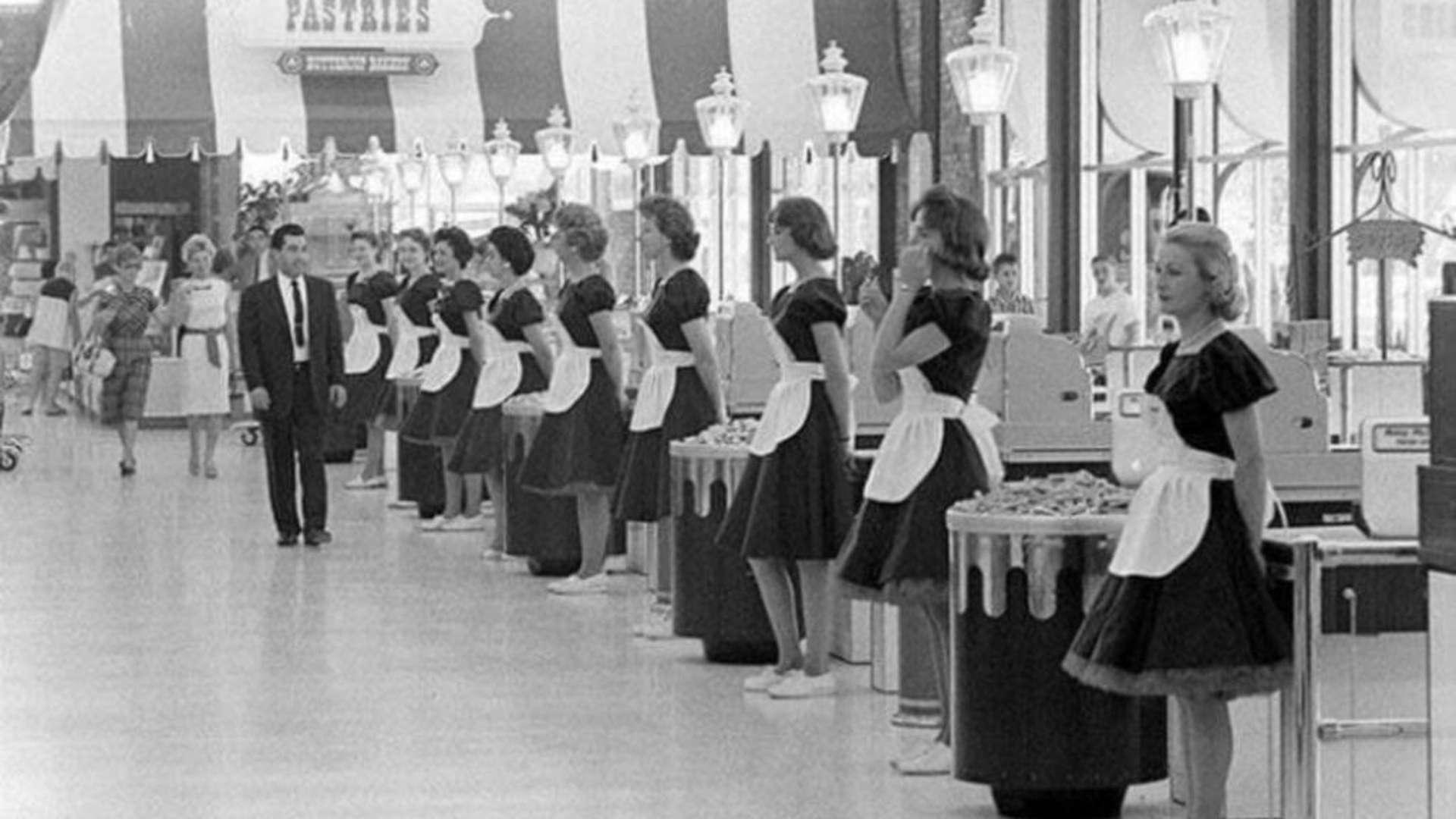
To a modern eye, a 1950s Piggly Wiggly photo looks almost quaint. But this chain was once one of the most radical forces in American retail. In 1916, Piggly Wiggly in Memphis introduced something shoppers had never seen before: self-service grocery shopping. Customers picked up their own goods instead of handing a list to a clerk. That simple shift changed how Americans bought food.
So what if Piggly Wiggly had not faded into regional obscurity? What if it had become the Walmart or Kroger of its era and stayed there? Grounded in real economics and logistics, this is a look at three plausible alternate paths where Piggly Wiggly dominates U.S. grocery retail, and how each one would have changed daily life, labor, and even the look of American towns.
How Piggly Wiggly Actually Changed Grocery Shopping
Piggly Wiggly was the first self-service grocery chain in the United States. Before it, customers gave clerks a list and waited while someone fetched every item. After it, shoppers walked aisles with baskets, chose their own goods, and paid at a checkout.
Clarence Saunders opened the first Piggly Wiggly in Memphis in 1916. He patented the self-service system, from the one-way aisles to the turnstiles at the entrance. The business model cut labor costs, increased volume, and made impulse buying possible. It was not just a quirky name. It was a new machine for moving food.
By the early 1920s, Piggly Wiggly had hundreds of stores and a stock price that shot up so fast it attracted Wall Street operators. A stock battle in 1922–23 ended badly for Saunders. He lost control of the company and soon left. The chain survived, but without its founder’s aggressive vision, it became just one of many regional grocery brands.
Self-service grocery shopping was a disruptive technology. It shifted costs from clerks to customers’ time and labor, and it made large, standardized chains profitable. When Piggly Wiggly lost its edge, others copied the idea and scaled it harder.
That is the fork in the road. If Saunders had kept control, or if his successors had played the 1930s and 1940s differently, the morning inspection at a 1950s Piggly Wiggly might have been happening in the nation’s dominant chain, not a fading innovator. So what? Because whoever won that race shaped what food Americans saw, how much they paid, and where they worked.
Scenario 1: Saunders Keeps Control and Builds a National Giant
Start with the most personal hinge: the 1922–23 stock war. In our world, Saunders tried to corner Piggly Wiggly stock after short sellers attacked it. He borrowed heavily, the price crashed, and he was wiped out. In a counterfactual world, he either avoids the fight or wins it.
Imagine Saunders in 1922 taking a different route. He keeps tighter control of the company, avoids over-leveraging, and uses the patent system more aggressively. He had already patented key elements of self-service. If he had focused less on stock theatrics and more on licensing and expansion, Piggly Wiggly could have become the gatekeeper for the modern supermarket model.
In this scenario, by the mid-1930s, Piggly Wiggly is not just a chain. It is a national brand with hundreds of company-owned stores and a web of licensees. It pushes into the Midwest and Northeast earlier, before A&P and Kroger fully adapt to self-service. It uses its patents to extract fees or force mergers, absorbing weaker regional players.
Economically, this is plausible. The 1930s were brutal for small grocers. The Great Depression squeezed margins. Chains with volume and centralized buying power could undercut independents. In our world, A&P became the giant that independents and politicians hated. In this alternate path, Piggly Wiggly wears that bullseye.
That triggers another constraint: politics. The 1930s and 1940s saw strong anti-chain sentiment. States passed “chain store taxes.” Congress flirted with laws to break up big grocers. A giant Piggly Wiggly would have faced the same pressure. To survive, it would need a public-relations strategy and maybe a different structure, leaning harder into franchising so that stores looked locally owned even if they were tied into national buying and branding.
By the 1950s in this world, that morning inspection photo is happening in a Piggly Wiggly that looks a lot like what we know as Safeway or Kroger: big parking lot, big footprint, house brands on the shelves, and a national advertising budget. The name “Piggly Wiggly,” which many people today find odd or folksy, would instead feel normal, like “Walmart” or “Target.” Brand familiarity smooths out the weirdness.
So what? If Saunders had kept control and built a national giant, the self-service revolution would still have happened, but under a single dominant banner. That could have meant less regional diversity in grocery chains, a stronger Southern-rooted brand identity in national retail, and a very different set of antitrust fights in mid‑century America.
Scenario 2: Piggly Wiggly Becomes the Walmart of Food
Now push the thought experiment further. What if Piggly Wiggly not only stayed big, but also pioneered the discount, big-box model that Walmart later used to reshape retail?
The ingredients were there. Piggly Wiggly was born in Memphis, a logistics crossroads on the Mississippi River, with rail connections and, later, highway links. It already relied on centralized purchasing and distribution. The self-service concept made it comfortable with high-volume, low-margin sales.
In this scenario, Piggly Wiggly’s leadership in the 1950s and 1960s leans into three moves:
First, it experiments with much larger stores on cheap land at the edge of towns, tied to the postwar boom in car ownership and suburbanization. Real-world chains did this, but Piggly Wiggly in our world was not the leader. Here, it is. Think 60,000-square-foot food stores in the 1960s with wide aisles, massive parking lots, and a limited but growing selection of non-food items.
Second, it builds out a more aggressive private-label program. Instead of just a few house brands, Piggly Wiggly uses its scale to push store brands into every category, undercutting national brands on price. This is exactly what Walmart and later Aldi did. The constraint is manufacturing. Piggly Wiggly would need to either contract with existing factories or buy some outright. That is capital intensive but possible for a large, profitable chain.
Third, it moves into small towns that do not yet have large chains, especially across the South and Midwest. This is where the comparison to Walmart gets real. Sam Walton began in small-town Arkansas in the 1960s, using low prices and huge selection to pull shoppers away from Main Street. A Piggly Wiggly with a head start and more capital could have filled that niche in food and basic goods.
There are limits. Walmart’s model depended on cheap Asian imports and advanced logistics in the 1980s and 1990s. Piggly Wiggly in the 1960s and 1970s would still be working mostly with domestic suppliers and less sophisticated data systems. It might become a powerful regional big-box grocer, but not the all-category retail colossus Walmart became.
Still, the knock-on effects are big. If Piggly Wiggly had become the first dominant discount grocer in small-town America, Walmart’s rise would have been slower or different. Maybe Walmart focuses more on non-food items. Maybe it buys Piggly Wiggly in the 1980s instead of building its own grocery arm. The map of who controls American food retail in 2000 looks very different.
So what? A Piggly Wiggly that turned itself into the Walmart of food would have changed where and how rural Americans shopped, shifted bargaining power with food manufacturers, and possibly blunted or reshaped Walmart’s later dominance in groceries.
Scenario 3: Piggly Wiggly Doubles Down on Franchising and Stays Local but Huge
There is another path that fits the chain’s DNA. Piggly Wiggly already used franchising and licensing. Many stores were locally owned but used the brand and systems. What if the company had leaned into that model, not as a fallback, but as its core strategy?
In this scenario, starting in the 1930s, Piggly Wiggly positions itself as the national backbone for local grocers. Instead of trying to own every store, it focuses on three things: supply chains, branding, and training.
First, supply chains. Piggly Wiggly builds large regional warehouses and uses its buying power to negotiate better prices from manufacturers. Independent owners sign on because they cannot get those prices alone. The chain charges fees and takes a slice of volume, but the local owner still makes a living and keeps some autonomy.
Second, branding. The company standardizes signage, store layouts, and promotions. It runs national radio and, later, TV ads, but leaves room for local flavor. The name “Piggly Wiggly” becomes less about a single corporation and more about a network, like today’s Ace Hardware or True Value.
Third, training and inspection. That 1950s morning inspection becomes part of a formal system. Managers are trained at regional centers. There are manuals for everything from produce display to customer greetings. The chain sells not only goods but a way of running a store.
Economically, this model fits the political climate. It blunts anti-chain sentiment because stores are locally owned. It spreads risk. It also fits geography. In a country as large and varied as the United States, a pure top-down corporate model has limits. A franchise network can adapt to local tastes, from Southern staples to Midwestern casseroles.
By the 1970s in this world, Piggly Wiggly is not a single monolithic company but the main banner for thousands of independent grocers. It competes with A&P, Safeway, and Kroger, but it is hard to attack politically because every Piggly Wiggly is “our local store” in some town.
There are trade-offs. The chain might struggle to enforce uniform quality. Some stores would be shabby, others immaculate. Investment in new technology, like barcode scanners in the 1970s or sophisticated inventory systems later, would roll out unevenly. But the upside is resilience. When one region falters, others can thrive.
So what? A Piggly Wiggly that doubled down on franchising could have preserved more local ownership in grocery retail, slowed the disappearance of small-town grocers, and still delivered many of the price and selection benefits of chain stores.
Which Piggly Wiggly Future Is Most Plausible?
Of the three counterfactuals, the most plausible is not the flashy “Walmart of food” story. It is the quieter one: Saunders keeps control, grows aggressively, and Piggly Wiggly becomes a major national chain on the Safeway or Kroger scale, probably with a strong franchise component.
Here is why. First, the self-service idea was easily copied. Patents can slow competitors, but they rarely stop them for long in retail. The odds that Piggly Wiggly could permanently lock down self-service and extract rents from every grocer are low. A national giant, yes. A permanent monopoly, no.
Second, logistics and capital in the mid‑20th century favored large but not all-powerful chains. Rail and then truck distribution made regional dominance feasible. True coast-to-coast integration was harder. That is why real-world chains like A&P, Safeway, and Kroger each had strongholds. A Piggly Wiggly with better leadership could have been one of those top three, especially across the South and Midwest.
Third, the franchising-heavy model fits both the company’s early history and the political constraints. Anti-chain taxes and public hostility were real. A structure that kept local owners in the picture would have been a smart hedge. It is not hard to imagine Saunders, a showman but also a practical businessman, embracing that mix of control and flexibility.
The full “Walmart of food” scenario runs into timing problems. The technology and global trade patterns that made Walmart what it is did not mature until the 1980s and 1990s. Piggly Wiggly could have been an aggressive discounter, but turning into a multi-category retail empire on that scale would have required a second wave of visionary leadership decades after Saunders.
So in the most grounded alternate timeline, that 1950s morning inspection is happening in a store that is part of one of America’s top two or three grocery chains. The logo is on TV. The brand is known from Florida to Ohio. Kids grow up thinking Piggly Wiggly is just what a supermarket is called, the way some people say “Kleenex” for tissues.
So what? Because grocery chains do not just sell food. They shape diets, labor markets, and town layouts. A dominant Piggly Wiggly might have meant a stronger Southern accent in national retail culture, more franchise-style local ownership, and a different balance of power between grocers and manufacturers. The morning inspection would be the same. The world around it would not.
Frequently Asked Questions
What was Piggly Wiggly and why was it important?
Piggly Wiggly was an American grocery chain founded in Memphis in 1916 by Clarence Saunders. It introduced self-service shopping, where customers walked aisles and picked their own goods instead of handing a list to a clerk. That model cut labor costs, increased sales volume, and became the standard for modern supermarkets.
Why did Piggly Wiggly stop being a major national chain?
Piggly Wiggly grew fast in the 1910s and 1920s, but a stock market battle in 1922–23 cost founder Clarence Saunders control of the company. Without his aggressive expansion and patent strategy, the chain lost its edge. Other grocers copied self-service, expanded regionally, and Piggly Wiggly settled into a more modest, mostly regional role.
Could Piggly Wiggly have become as big as Walmart?
It could plausibly have become one of the top U.S. grocery chains, like Kroger or Safeway, especially across the South and Midwest. Becoming a Walmart-sized, all-category retail giant is less likely, because that required later developments in global supply chains, data systems, and discount retailing that took off decades after Piggly Wiggly’s peak.
How did self-service grocery shopping change everyday life?
Self-service shifted some labor from store clerks to customers, which let chains cut costs and lower prices. It encouraged impulse buying, standardized store layouts, and made large supermarkets viable. That changed where people shopped, what foods they saw, and how towns were built around car-friendly shopping centers.