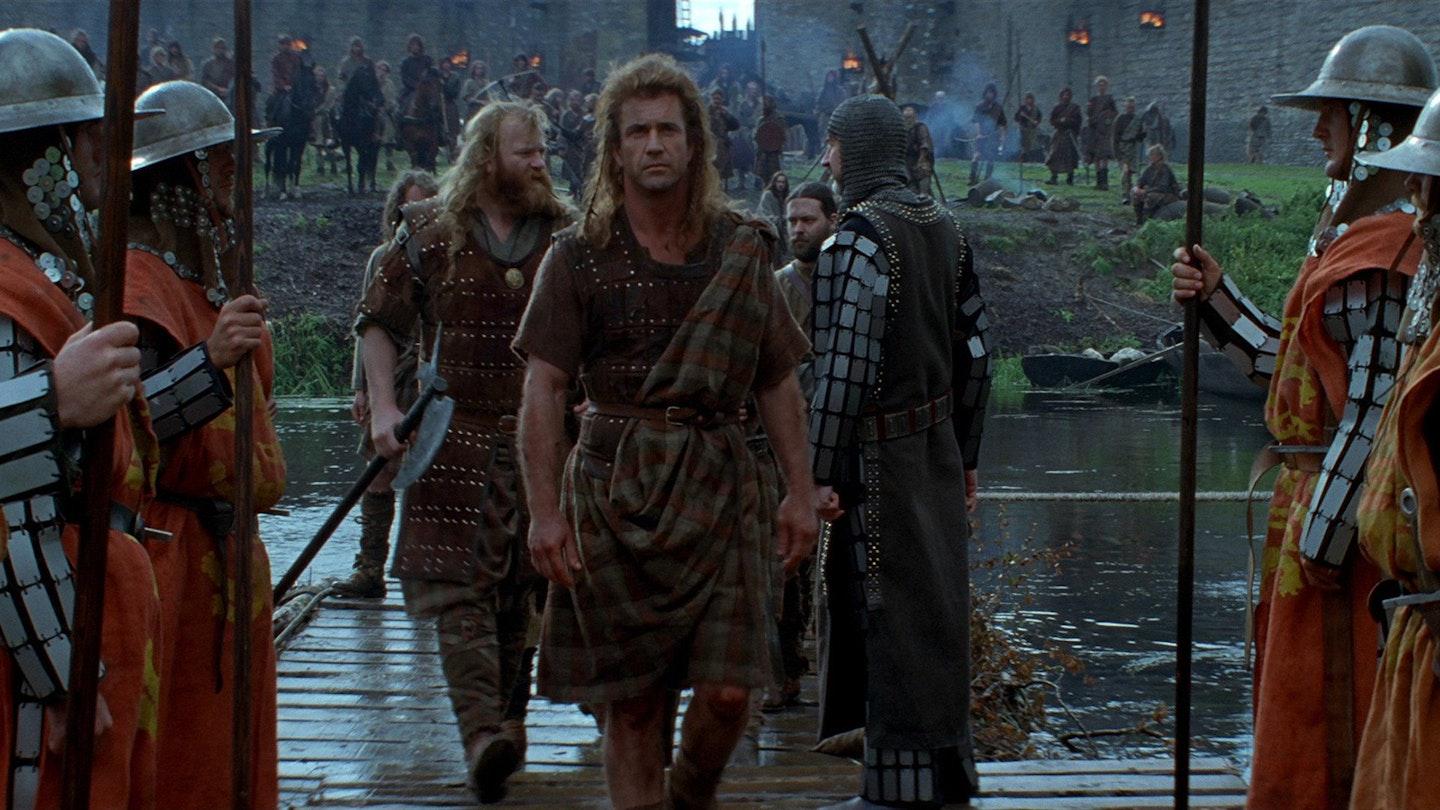
On screen, the Middle Ages are gray. Mud-gray villages. Leather-gray clothes. People so filthy you can smell them through the TV. Then Mel Gibson rides by in blue face paint, a kilt from the wrong century, and a love interest who never existed.
In real medieval Europe, color was everywhere. People washed. Edward I went on crusade and heard Mass daily. He was many things, but a pagan was not one of them.
So what if the movies got it right? What if Braveheart, Vikings, and every other medieval epic had to obey the actual rules of 11th to 15th century Europe: economics, religion, clothing, warfare, and all?
Historical accuracy in medieval films means showing color, hierarchy, and religion as central parts of daily life. It also means dropping modern attitudes and anachronistic costumes, weapons, and politics.
We will walk through three grounded what-if scenarios. Each imagines a different kind of “accurate” medieval screen world, then asks what stories we would get instead of the usual mud-and-misery fantasy.
What if Braveheart had to follow the real 1290s?
Picture the opening of Braveheart again, but this time the camera is not looking at a blue-painted barbarian. It is looking at a minor Scottish landholder in a wool tunic, probably speaking French to his social superiors and Scots or Gaelic to his neighbors.
William Wallace, as far as we can tell from the records, was not a kilted highlander. He was a knightly figure from the lower nobility, fighting in a world where elite Scots dressed and behaved a lot like elite Englishmen.
The real late 13th century Scottish elite wore colored wool, linen, and sometimes imported silks. They used plate-reinforced mail armor, not leather cosplay. They had heraldic coats of arms, banners, and surcoats that made battlefields look like moving flags, not a rugby scrum in brown.
So in an accurate Braveheart, the first thing that changes is the look. Wallace and his men do not charge half-naked with axes. They fight as heavy infantry and knights, using spears and schiltron formations against English cavalry. The famous Battle of Stirling Bridge actually has a bridge, which matters tactically, instead of a random field.
The politics change too. The film turns Edward I into a cartoon pagan tyrant. The historical Edward I was a devout Christian king who went on crusade to the Holy Land in the 1270s. He could be ruthless, especially in Wales and Scotland, but he was operating inside a shared Latin Christian framework, not as some satanic outlier.
He was not a pagan. Calling Edward I a pagan is like calling the Pope a Buddhist. Wrong religion, wrong continent, wrong everything.
An accurate script would show a constitutional crisis, not a simple freedom-versus-evil story. Scottish nobles were divided. Many switched sides. Robert the Bruce, the later hero-king, actually fought for Edward at times before turning against him. Wallace’s revolt was one phase in a long, messy struggle over feudal obligations, overlordship, and royal authority.
Wallace himself was not a lone wolf rebel in a leather vest. He was part of a broader resistance, backed by some nobles and opposed by others. His execution in 1305 was brutal, but legally framed as punishment for treason within a shared legal culture, not as some pagan ritual.
If Braveheart obeyed the real 1290s, the story would still have drama. It would just be a war among Christian monarchs and nobles, full of betrayals, legal arguments, and shifting alliances, instead of a superhero origin story.
So what? A historically grounded Braveheart would trade simple good-versus-evil for a sharper, more political story about how medieval power actually worked, and it would kill off the idea that the Middle Ages were a lawless, pagan-flavored free-for-all.
What if medieval people on screen were clean, colorful, and devout?
Most viewers carry two big myths into any medieval show: that everyone was filthy and that color barely existed. Both are wrong.
Medieval Europeans washed. Not daily showers with scented body wash, but far from the cartoon of permanent grime. Towns had bathhouses. People washed hands and faces regularly, and there are plenty of complaints from moralists about people spending too much time in the baths, not too little.
Clothes were washed. Linen undergarments could be laundered often. That is partly why people wore them under wool. Smell was a problem in crowded cities, but it was not because nobody had heard of water.
Then there was color. Dyes from woad, madder, weld, and imported materials produced blues, reds, yellows, greens, and purples. Rich merchants in 14th century Florence or Bruges dressed like walking paint palettes. Even peasants wore colored hoods or tunics when they could afford it. Brown existed, but it did not conquer the continent.
So imagine a medieval series that obeys this. The village is not a permanent mud pit. There is mud in bad weather, sure, but there are also whitewashed walls, bright church paintings, colored clothing on feast days, and people who care about how they look.
Religion would be everywhere. Not as a background prop, but as the operating system of daily life. Church bells mark time. Saints’ days shape the calendar. Oaths are sworn on relics. Even a violent baron worries about his soul, commissions a chapel, or goes on pilgrimage.
In most medieval films, religion appears only when someone needs an excuse for a war or a witch-burning. That flattens the period. For a 13th century peasant, God was not a side plot. God was the explanation for why the harvest failed, why a child died, why a king ruled, and why you might join a crusade.
So what would change on screen?
Conversations would sound different. A grieving mother might talk about purgatory, not just vague fate. A knight before battle might worry about confession and absolution, not just whether his sword is sharp. A merchant might donate to a confraternity because he fears hell, not because he wants his name on a plaque.
Medieval daily life in film would show a spectrum: some people sincerely devout, some cynical, some going through the motions. But religion would be the default language of meaning, not an occasional costume for villains.
So what? A cleaner, more colorful, and more devout Middle Ages on screen would break the lazy “dark, dirty, godless except for fanatics” stereotype and force storytellers to grapple with how belief, status, and appearance really shaped choices.
What if battles, armor, and weapons obeyed real physics?
Now shift the camera to the battlefield. In most medieval movies, armor is optional, swords weigh like baseball bats, and archers are background decoration. The physics are fantasy.
In reality, a typical medieval sword weighed around 1 to 1.5 kilograms, not 10. Knights wore mail and later plate armor that was heavy but well-distributed. A trained fighter could move, run, and fight in it. They were not turtles on their backs.
So imagine a war film where armor works. Arrows bounce off good plate at long range. Swords glance off helmets. To kill a knight, you go for the gaps: armpits, visor slits, groin. That changes the choreography. Less random slashing, more grappling, half-swording, and ugly close work.
Horses are not motorcycles. They are expensive, fragile assets. A warhorse in the 14th century could cost as much as a small house. You do not ride it into a forest brawl for fun. You protect it, and you use it for shock charges in the right terrain.
Archers matter. At battles like Crécy (1346) and Agincourt (1415), English longbowmen changed the odds against larger French forces. They did not win by magic, but by disciplined volleys, good positioning, and mud that trapped armored men. An accurate film would show archers as trained professionals, not extras who fire once and vanish.
Sieges would dominate war stories. Medieval warfare was mostly about castles and fortified towns, not endless open-field battles. Months of waiting, disease, sapping walls, negotiation, and occasional brutal assaults. It is slower drama, but it is the real center of medieval conflict.
Logistics would creep into the script. Armies need food, fodder, and pay. A king who cannot pay his mercenaries has a plot problem. Campaign seasons are shaped by harvests and weather. You do not march an army of tens of thousands across Europe in winter without consequences.
So what would that do to our usual heroic arcs?
It would make commanders, quartermasters, and engineers as important as sword-swinging heroes. It would also show why medieval rulers were obsessed with taxes and rights. Raising an army was ruinously expensive. That is why parliaments and estates assemblies gained leverage: kings needed money.
So what? If battles on screen followed real medieval physics and logistics, viewers would see war as a slow, costly grind shaped by armor, terrain, and supply, not just a string of cinematic duels, and that would point straight at the real political stakes behind the fighting.
What if a big-budget series committed to full accuracy?
Now put it all together. Imagine a streaming giant orders a medieval epic and, for once, tells the writers: no anachronistic costumes, no modern politics in chainmail, no invented pagan kings. You have to live inside 1200 or 1400 as it was.
What changes first?
Dialogue. Characters stop talking like 21st century therapy clients. They think in terms of honor, sin, shame, lineage, and divine will. A woman worried about her future is thinking about marriage alliances, dowries, and kin support, not personal self-actualization. That does not mean she has no agency. It means her tools and constraints are different.
Plotlines shift. You cannot have a queen casually divorcing her husband because she is bored. You can have her building a faction at court, using patronage, letters, and church lawyers to maneuver. The tension is still there, but it runs through canon law and feudal custom.
Visuals brighten. Peasants wear patched but colored clothing. Towns have banners, painted shop signs, and religious images. Castles are not always gray ruins. Many had plastered and painted interiors, tapestries, and furniture. Even a small manor has its best room dressed up for feast days.
Religion saturates the frame. A murder investigation might involve sanctuary in a church. A political crisis might hinge on excommunication. A character’s worst fear might be dying without confession, not just dying.
The economics of production push back. Costume departments like leather because it is easy and generic. Real medieval clothing means layers, tailoring, and a lot of linen and wool. Battle scenes need historically plausible armor, not bare chests. That costs money and time.
Writers have to give up easy villains. Edward I is not a pagan monster. He is a hard-nosed, devout king with a legalistic mind and a temper. The Church is not a single cartoon villain either. It is a web of local priests, ambitious bishops, reformers, and ordinary believers.
Would audiences watch?
Probably, if the story is good. The success of series like Chernobyl and films like Dunkirk suggests viewers can handle detailed, specific worlds. A truly accurate medieval series would feel alien in some ways, but that alienness is the point. It is a foreign country, not a cosplay version of our own time.
So what? A big-budget commitment to accuracy would not just fix costumes and weapons. It would force a different kind of story, one that treats medieval people as intelligent actors in their own moral and social universe instead of moderns in dirty tunics.
Which scenario is most plausible, and why does it matter?
Of the three what-ifs, the most realistic in the near term is not a perfectly accurate Braveheart remake or a total overhaul of battle physics. It is the middle option: getting daily life and basic worldview right.
Costume and set departments can add color and cleanliness without breaking the budget. Writers can weave religion and hierarchy into dialogue and motives with a bit of research. Those changes are cheaper than redesigning every stunt and battle sequence from scratch.
Fixing warfare is harder. Real armor and tactics are expensive to film and less intuitive to audiences raised on fantasy tropes. Some productions have moved in that direction, but it is a slower shift.
Rewriting something like Braveheart from the ground up is the least likely. The original succeeded because it told a simple national myth, not because it respected the record. Studios are reluctant to mess with that formula.
Yet even modest accuracy has knock-on effects. Show that medieval people were not permanently filthy, and viewers start to question the whole “dark ages” myth. Show that Edward I was a crusading Christian king, not a pagan, and you force a more honest conversation about how violence and faith coexisted.
Every time a film or series drops the mud filter, ditches the random leather, and admits that the Middle Ages were colorful, structured, and deeply religious, it nudges public memory a little closer to reality.
So what? Getting the Middle Ages right on screen matters because for most people, movies and series are their main history class. If those stories keep insisting that color did not exist, that everyone liked to be dirty, and that kings on crusade were pagans, then we are not just misreading costumes. We are misreading an entire civilization.
Frequently Asked Questions
Were people in the Middle Ages really dirty all the time?
No. Medieval Europeans washed more than films suggest. Towns had bathhouses, people washed hands and faces regularly, and linen undergarments were laundered. Hygiene standards were different from today, but the idea that everyone was permanently filthy is exaggerated.
Did medieval people really wear only brown and gray clothes?
No. Dyes from plants and imported materials produced blues, reds, yellows, greens, and purples. Wealthy people in cities like Florence or Bruges wore very colorful outfits. Even peasants often had some colored garments or accessories when they could afford them.
Was King Edward I of England a pagan, like some movies suggest?
No. Edward I was a devout Christian king who went on crusade to the Holy Land in the 1270s. He heard Mass, supported religious foundations, and operated fully inside Latin Christian culture. Calling him a pagan is historically wrong.
How heavy were real medieval swords and armor?
Most medieval swords weighed around 1 to 1.5 kilograms, not the huge weights often shown in films. A full suit of late medieval plate armor might weigh 20–30 kilograms, but the weight was well distributed, so a trained fighter could move, run, and fight effectively in it.