In the cool dark of a stone corridor, a priest presses his hand to a wall that was never built. It was released. The church around him was carved down into solid volcanic rock, roof to floor, in 12th or 13th century Ethiopia. From above, it looks like a cross cut into the earth. From inside, it feels like a cathedral turned inside out.
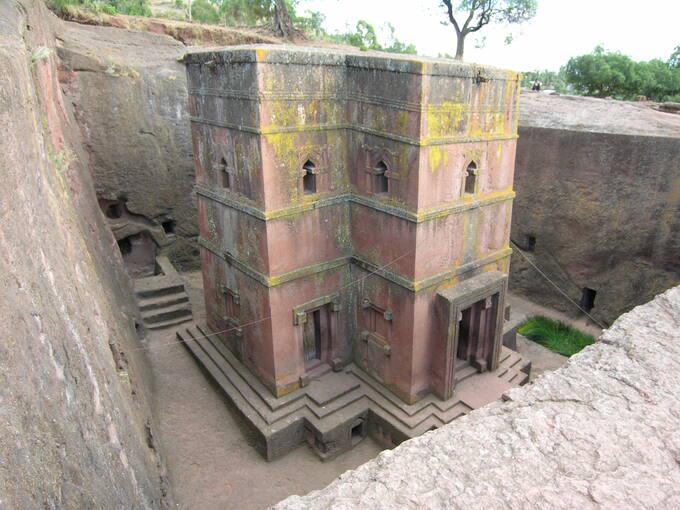
This is one of the rock-hewn churches of Lalibela, the most famous cluster of Ethiopia’s dozens of excavated sanctuaries. Reddit threads about them usually start the same way: “Wait, how did they do this?” and “Why don’t we hear about this in medieval history?”
The short answer: medieval Ethiopia had the engineering, faith, and political will to carve whole churches out of living rock, but not the sustained economic and naval power to dominate the Red Sea world the way Venice or Cairo did the Mediterranean. The long answer is where the counterfactual fun starts.
Rock-hewn churches in Ethiopia are medieval Christian sanctuaries carved directly into bedrock, often from the top down. They required large, organized labor forces, stable authority, and a religious culture willing to invest heavily in sacred architecture.
So what if that same Ethiopia had gone further? What if the kingdom that cut cathedrals out of stone had also carved out an empire on the sea lanes between Africa, Arabia, and India? Three scenarios, all grounded in real constraints, show how different the Middle Ages might have looked.
How did Ethiopia get the capacity to carve rock churches at all?
First, the real story. Ethiopia did not wake up one day and decide to chisel a cross-shaped canyon for fun.
The roots go back to the Kingdom of Aksum, which flourished roughly from the 1st to the 7th century CE. Aksum minted coins, traded ivory and gold across the Red Sea, and adopted Christianity in the 4th century under King Ezana. It was plugged into the same late antique world that linked Constantinople, Alexandria, and the ports of South Arabia.
By the time the rock-hewn churches at Lalibela were cut, probably in the late 12th and early 13th centuries under King Lalibela of the Zagwe dynasty, Ethiopia had centuries of Christian tradition and stone-working behind it. Earlier, Aksumite builders had raised tall stelae and built monumental churches with finely dressed stone. Carving into rock was a different technique, but not a different mentality. It was monumental architecture with more geology and fewer cranes.
Rock-hewn churches in Ethiopia were carved top-down into volcanic tuff and basalt. Workers cut a trench around a block of rock, then hollowed it out to form a freestanding church. The famous Biete Giyorgis at Lalibela, for example, is roughly 25 meters long and 25 meters deep from ground level to base. That is a staggering amount of stone to remove with iron tools and muscle.
To do that, you need several things: political stability, to keep workers and resources in one place for years; surplus food, to feed those workers; a religious culture that sees massive stone churches as a worthy investment; and access to iron and skilled labor. Ethiopia had all of these in bursts, if not always consistently.
The rock-hewn churches of Ethiopia show that the medieval kingdom could mobilize labor, organize large projects, and maintain a long-term religious building program. So what?
Because that same organizational capacity, if paired with different geography or trade patterns, could have been redirected toward ships, ports, and armies, not just sanctuaries in stone.
Scenario 1: What if Aksum had never lost its Red Sea ports?
In our timeline, Aksum’s fortunes declined between the 7th and 9th centuries. The rise of Islam reshaped Red Sea trade. Muslim powers in Arabia and Egypt controlled key ports. Aksum’s coastal outlets, like Adulis, faded. The political center retreated inland, and over time the highland Christian kingdom became more isolated.
So imagine this changes on one key point: Aksum keeps its grip on the coast.
For this to happen, we do not need miracles. We need timing and alliances. Suppose that in the early 7th century, Aksum reacts faster and more flexibly to the rise of Islam. Instead of losing its coastal ports, it cuts deals with early Muslim merchants and rulers. There is some precedent. Aksumite rulers had already intervened in South Arabian politics in the 6th century, and early Islamic tradition remembers a Christian “Negus” of Abyssinia who protected Muslim refugees.
In this scenario, Aksum does three things differently:
1) It invests more in its navy, using Red Sea trade profits to build and maintain a fleet of transport and warships.
2) It makes Adulis and other ports semi-autonomous city-states under Aksumite protection, with mixed Christian and Muslim merchant communities, similar to how Italian cities operated under loose imperial umbrellas.
3) It shifts its political center closer to the coast, so that court politics and coastal trade are tightly linked instead of drifting apart.
By 800, this alternate Aksum might look like a Christian maritime power with Muslim trading partners, controlling the African side of the Red Sea and projecting influence into southern Arabia. It would tax trade between Egypt and India, invest in shipyards, and have a direct interest in Red Sea security.
What changes?
First, money. A richer, maritime Aksum could afford more and larger building projects. Rock-hewn churches might not just be a Zagwe-era inland phenomenon. We might see coastal rock sanctuaries, or a fusion of carved churches and harbor fortifications.
Second, religion and diplomacy. Aksum’s Christian church, already linked to the Coptic Church in Egypt, would sit on a trade artery used by both Christian and Muslim pilgrims and merchants. That could soften or sharpen religious boundaries, depending on politics. Ethiopia might become a broker between Christian and Muslim worlds, not a semi-isolated highland kingdom.
Third, military history. A powerful Aksumite navy in the 10th to 12th centuries would affect who controls Yemen and the southern Red Sea. Later, when the Portuguese arrive in the Indian Ocean in the late 15th century, they might find an established Christian naval ally already guarding the Bab el-Mandeb strait.
In this scenario, the rock-hewn churches are not isolated wonders. They are monuments of a Red Sea power that used trade wealth to carve theology into stone while its ships patrolled the sea lanes. So what?
Because if Ethiopia had stayed on the coast as a naval player, the balance of power in the Red Sea and Indian Ocean could have tilted toward a Christian African kingdom, not just Cairo, Mecca, and later Lisbon.
Scenario 2: What if Lalibela became a pan-African pilgrimage super-city?
Today, Lalibela is a major pilgrimage site for Ethiopian Orthodox Christians, especially at Christmas. In the 13th century, it was already important, but its reach was mostly regional. The wider Christian world knew little about it. Western Europe barely knew Ethiopia existed, beyond vague legends of “Prester John.”
Now imagine a different information flow.
We know that by the 12th and 13th centuries, there were some contacts between Ethiopian Christians and the broader Christian world. There were diplomatic exchanges with the Coptic Patriarchate in Alexandria. Later, in the 14th and 15th centuries, Ethiopian monks appear in Jerusalem and even in Rome. European maps start to place a Christian king in Africa.
In this scenario, those contacts happen earlier and more intensely. Perhaps a Coptic patriarch in the 12th century, impressed by reports of King Lalibela’s rock churches, promotes them as a new “African Jerusalem” to Christians in Egypt and Nubia. Word spreads further, through merchants and pilgrims, into the eastern Mediterranean.
For this to matter, you need safe routes. That means either relatively peaceful relations with Muslim rulers in Egypt and along the Red Sea, or an Aksumite/Zagwe naval presence that can protect pilgrims. Let us assume a mix of both: pragmatic truces and some Ethiopian ships.
By 1250, Lalibela could be drawing not just Ethiopian highlanders, but Copts from Egypt, Nubians from the upper Nile, maybe even a trickle of Syriac Christians or Armenians. The rock-hewn churches, already designed as a symbolic replica of Jerusalem, become a shared shrine for African and Eastern Christians cut off from the Latin-controlled Holy Land after the Crusades.
What does that change?
First, money and artisans. Pilgrims bring offerings. Patronage increases. You might see a second or third wave of carving, expansion of existing churches, and more rock-hewn monasteries in the region. Artistic styles could blend: Coptic iconography, Nubian painting traditions, and local Ethiopian forms mixing on the same chiseled walls.
Second, politics. A king who controls a pilgrimage magnet has leverage. The Zagwe and later Solomonic dynasties could use Lalibela’s status to claim leadership of African Christianity. That might strengthen their hand in disputes with Muslim neighbors or internal rivals.
Third, information. A dense network of pilgrims and monks moving between Ethiopia, Egypt, Nubia, and the Levant would move news, ideas, and technologies. Ethiopia might adopt some military or agricultural techniques earlier. European awareness of a powerful Christian kingdom in Africa might harden into fact, not legend, by the 13th century.
By the time Portuguese explorers push down the African coast in the 15th century, they might already have detailed reports of Lalibela’s rock churches and a living tradition of joint pilgrimages. The alliance between Ethiopia and Portugal in the 16th century, which in reality was hesitant and late, could come sooner and on more equal terms.
In this scenario, the rock-hewn churches become a shared African Christian shrine that shapes diplomacy and identity across the Nile and Red Sea. So what?
Because a Lalibela that functions like a second Jerusalem for African and Eastern Christians could have anchored a more unified Christian bloc in northeast Africa, changing how that region faced later Ottoman, Portuguese, and even colonial pressures.
Scenario 3: What if Ethiopia industrialized its stone carving into a defensive system?
One thing that fascinates people on Reddit is the sheer effort behind rock-hewn churches. The common question is: “Why put that much labor into a church instead of something ‘useful’ like walls or roads?”
In reality, Ethiopia did build fortifications, but not on the same carved scale as Lalibela. The rock churches were spiritual investments, not military ones.
So imagine a king who thinks differently.
Say in the 15th century, under the early Solomonic dynasty, Ethiopia faces increasing pressure from Muslim sultanates like Adal to the east and internal revolts in the highlands. Historically, this period saw raids, shifting alliances, and, in the early 16th century, a devastating war against Ahmad ibn Ibrahim al-Ghazi (Ahmad Gragn).
In this scenario, an earlier ruler looks at Lalibela and thinks: if we can carve churches into cliffs, we can carve fortresses too.
The ingredients are there. The Ethiopian highlands are full of plateaus, escarpments, and volcanic rock suitable for excavation. There is already a tradition of rock-hewn monasteries in places like Tigray, often perched on cliffs. The skills to carve chambers, stairways, and water channels exist.
The counterfactual move is to scale this up and systematize it. The crown sponsors a program to create a network of rock-cut fortified monasteries and refuges along strategic routes: near passes, river crossings, and frontiers with hostile states.
What does that look like in practice?
Think of complexes with carved storage rooms, hidden stairways, and defensible churches all in one. Peasants and herds could retreat inside during raids. Garrisoned monks and soldiers could hold out with stored grain and water. The same labor that once carved a single monumental church is spread across dozens of smaller but strategically placed sites.
This is not fantasy. Similar ideas appeared elsewhere. Cappadocia in Anatolia had rock-cut refuges and churches. The Indian Deccan has rock-cut temples and some fortified caves. Ethiopia had the geology and the know-how.
If this defensive network existed by 1500, the later onslaught of Ahmad Gragn’s forces would meet a more resilient countryside. In reality, his armies burned churches and devastated regions before being checked with Portuguese help. In this scenario, many churches and communities could retreat into stone, forcing longer sieges and slowing the advance.
That buys time. Time for alliances, for Portuguese firearms to arrive, for internal Ethiopian factions to coordinate. The war might still be brutal, but the physical and cultural damage could be less severe.
Long term, a culture that treats rock carving as both sacred and strategic might produce even more elaborate complexes. Some rock-hewn churches could double as royal refuges or treasuries. The line between monastery, fortress, and palace would blur.
In this scenario, the rock-hewn tradition is not just about faith. It becomes a core defensive technology of the Ethiopian state. So what?
Because a more stone-hardened Ethiopia could have emerged from the 16th century stronger, with more of its religious and cultural heritage intact, changing its resilience against later Ottoman and European pressures.
Which scenario is most plausible, and what would really change?
All three scenarios start from the same fact: if you can carve a cathedral out of rock, you have serious organizational muscle. The question is where that muscle gets used.
Scenario 1, the maritime Aksum that never loses its ports, runs hardest into geography and geopolitics. The Red Sea is a narrow, contested space. After the 7th century, powerful Muslim states in Egypt and Arabia had every reason to control it. For Aksum to keep Adulis and a big navy, it would need sustained population, timber for ships, and either parity or partnership with those states. That is not impossible, but it requires a long chain of favorable choices and luck.
Scenario 2, Lalibela as pan-African pilgrimage hub, is lighter on logistics and heavier on information. Trade routes between Ethiopia, Nubia, and Egypt existed. Shared Christian identity existed. The main obstacles were political suspicion and the sheer difficulty of travel. Here, a few charismatic leaders and safer corridors could plausibly have turned Lalibela into a wider magnet.
Scenario 3, rock carving as a defensive system, is the most modest and probably the most realistic. It does not require Ethiopia to dominate the Red Sea or rewire global trade. It just asks a king to apply an existing technique to a new problem. The geology is there. The monastic rock-cut tradition is there. The threats are real and pressing.
So the most plausible alternate Ethiopia is not a medieval superpower ruling the Red Sea, but a highland kingdom that uses its stone-carving genius more systematically for defense and regional religious leadership.
What would that change for the wider world?
European awareness of Ethiopia might come earlier and in more accurate form. The myth of Prester John, the imaginary Christian king somewhere in the East or Africa, might latch onto a very real, well-connected Ethiopian monarchy with famous rock-hewn shrines. Portuguese and later European powers might treat Ethiopia more as a partner and less as a curiosity.
Islamic powers on the Nile and Red Sea would face a more resilient Christian neighbor. That could shift some campaigns, alliances, and trade patterns, though probably not overturn the basic fact that Egypt and the Ottoman Empire remained much larger and richer.
Inside Ethiopia, a stronger, better-defended church infrastructure could preserve more manuscripts, art, and architecture from war and fire. Our knowledge of medieval African Christianity, already richer than many assume, would be richer still.
The rock-hewn churches of Ethiopia already matter because they prove that medieval Africa was not a passive backdrop to someone else’s history. They are engineering projects on the scale of European cathedrals, driven by local faith and politics. In the most plausible what-if worlds, those same skills do not turn Ethiopia into an empire of the seas. They make it a tougher, more connected highland kingdom whose carved sanctuaries are not just wonders in stone, but anchors of power and memory.
Frequently Asked Questions
How were the rock-hewn churches of Lalibela actually built?
The rock-hewn churches of Lalibela were carved directly into volcanic rock, usually from the top down. Workers first cut trenches around a block of rock to isolate it from the surrounding ground, then hollowed it out to form interior spaces, columns, and decorative details. This required iron tools, skilled stoneworkers, organized labor, and years of sustained effort under royal and ecclesiastical patronage.
Was medieval Ethiopia really powerful enough to build an empire?
Medieval Ethiopia, especially the earlier Kingdom of Aksum, was a significant regional power. It controlled Red Sea ports, minted coins, and traded with Arabia, Egypt, and India. However, its population, resources, and access to timber limited its ability to sustain a large navy or overseas empire. It had the capacity for major projects like rock-hewn churches, but not the scale of a Mediterranean or Islamic imperial state.
Did European Crusaders or kings know about Ethiopia’s rock churches?
There is no clear evidence that European Crusaders knew specific details about the rock-hewn churches of Lalibela. Europeans had vague ideas about a Christian king in Africa, known as “Prester John,” and some contact with Ethiopian monks in Jerusalem and later in Europe. Detailed European awareness of Ethiopian architecture and church life only appears much later, in early modern travel accounts.
Could Ethiopia have controlled Red Sea trade in the Middle Ages?
Ethiopia’s predecessor, Aksum, did influence Red Sea trade in late antiquity, but after the rise of Islam, powerful Muslim states in Egypt and Arabia dominated the region. For Ethiopia to control Red Sea trade in the Middle Ages, it would have needed sustained naval investment, secure coastal ports, and favorable alliances. That scenario is possible in theory but would have required a long series of strategic successes that did not occur in reality.