The room is small, dark, and heavy with carved oak. A low bed, a tiled stove, painted beams. Duke Karl’s chamber at Gripsholm Castle looks like someone just stepped out to argue with a bishop and never came back.
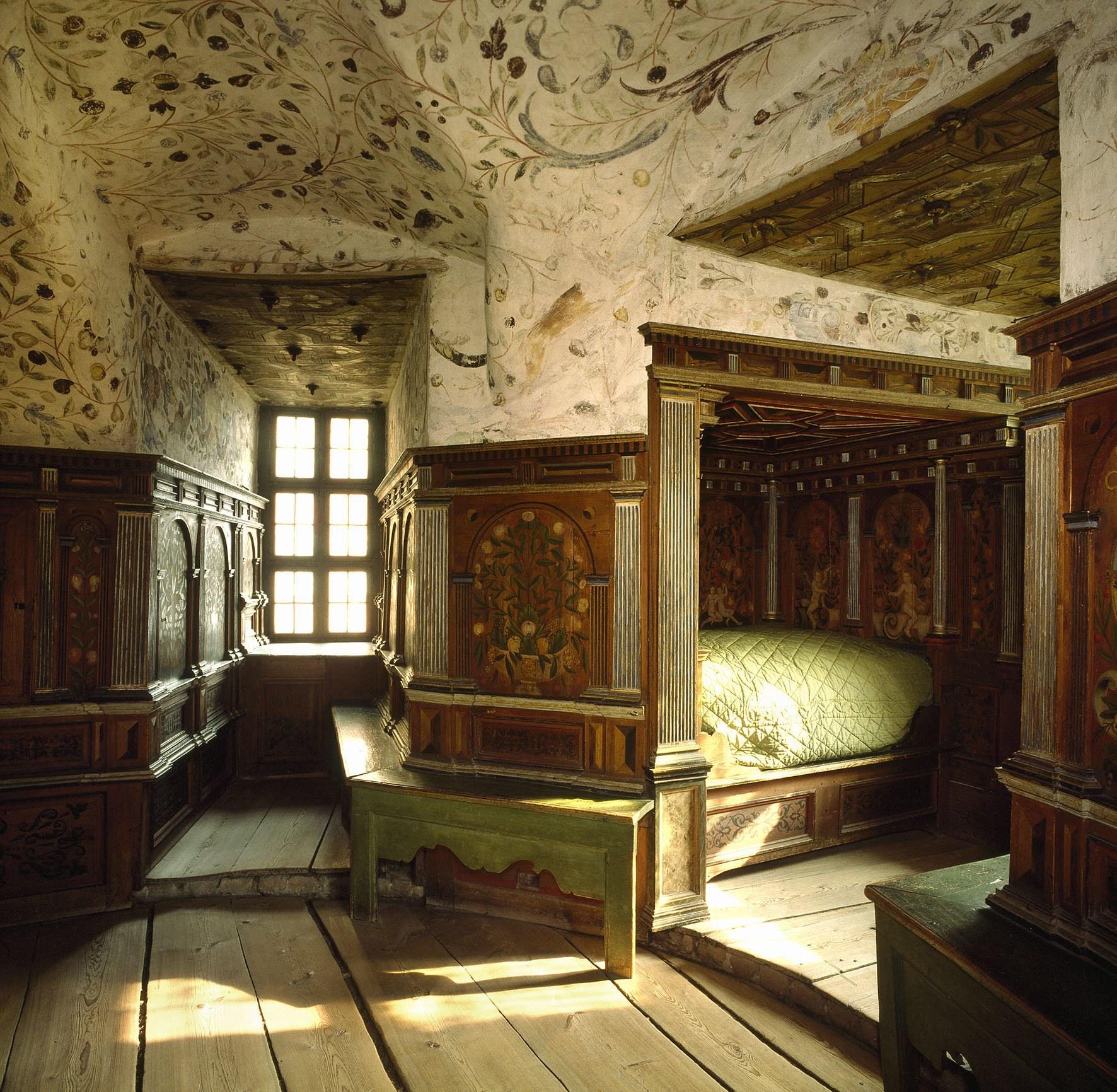
This is one of Sweden’s oldest preserved Renaissance interiors, barely changed since the 1570s. It was created for Gustav Vasa’s youngest son, the same Karl who would become King Karl IX. From this kind of room, a junior prince watched his unstable family tear Sweden apart, then helped turn it into a great power.
Gripsholm Castle’s Vasa-era chamber is not just pretty woodwork. It is a time capsule from a moment when Sweden could have gone very differently. By the end of this article you will know who Duke Karl was, why that room exists at all, and three grounded “what ifs” that could have changed Scandinavian history.
Duke Karl’s chamber at Gripsholm is a preserved Vasa-period interior from the 1570s. It reflects the world of a junior prince in a violent, religiously charged dynasty that was still deciding what kind of kingdom Sweden would be.
Who was Duke Karl, and what was this room for?
The Reddit post gives the headline facts. Gripsholm Castle’s Duke Karl’s Chamber is the only fully preserved room there from the Vasa period and one of the oldest Renaissance interiors in Sweden. It was created in the 1570s for Gustav Vasa’s youngest son, Karl, who was born in 1550.
Gustav Vasa had rebuilt Sweden after breaking away from the Kalmar Union with Denmark in the 1520s. He turned monasteries into royal property, centralized power, and made the crown rich on confiscated church land. When he died in 1560, he left three surviving sons and a problem: too many ambitious princes, not enough thrones.
The eldest, Erik XIV, became king. The middle brother, Johan (John), got the duchy of Finland. The youngest, Karl, received Södermanland and other territories, with Gripsholm as one of his key residences. The chamber at Gripsholm was part of giving this junior prince a court that looked the part: Renaissance decor, imported textiles, and woodwork that said “I might be the youngest, but I am still a Vasa.”
The room’s survival is almost an accident. Gripsholm was used as a royal residence, a prison, a barracks, and later a museum. Most interiors were updated as tastes changed. Karl’s chamber was not. It escaped major refits, so the beams, paneling, and layout stayed close to what a late 16th century Swedish prince actually lived with.
That matters because Karl was not just any prince. He was a hardline Lutheran, stubborn, and politically shrewd. He helped overthrow his unstable brother Erik XIV in 1568, then spent decades fighting his other brother Johan III and Johan’s Catholic-leaning son Sigismund. The man who slept in that chamber would drag Sweden through civil war, religious purges, and the early stages of the Baltic empire.
So what? Knowing who used this room turns it from a pretty relic into a window on a dynasty that was still deciding between Catholic and Protestant, between union with Poland or independence, between being a Baltic power or a regional minor state.
Scenario 1: What if Duke Karl had died young?
Start with the simplest counterfactual. What if the boy for whom this chamber was built had died in childhood or early youth, as many did? No Karl, no later King Karl IX.
Historically, Karl lived to 1611. He was central in three moments:
• The overthrow of Erik XIV in 1568.
• The resistance to King Sigismund (who was both King of Poland and Sweden) in the 1590s.
• The civil war that ended with Sigismund deposed and Karl crowned.
If Karl is gone, Erik XIV still likely falls. Erik’s paranoia, noble executions, and mental illness had already alienated much of the elite. Johan, the middle brother, had his own power base in Finland and strong backing from discontented nobles. So the 1568 coup probably still happens, just without Karl’s faction.
The real change comes after Johan III’s death in 1592. Johan’s son Sigismund was already King of Poland and a Catholic. The Swedish elite was mostly Lutheran and nervous. Historically, Duke Karl became the figurehead for those who feared Catholic influence. He convened synods, pushed strict Lutheran confessions, and built a political coalition that framed Sigismund as a threat to Sweden’s faith and autonomy.
Without Karl, who leads that movement? There were other Lutheran nobles, but none with the combination of royal blood, territorial base, and sheer stubbornness that Karl had. A few possibilities:
• Sigismund rules Sweden more securely. He spends more time in Stockholm, makes concessions to Lutheran elites, and avoids open war.
• A different noble-led rebellion breaks out, but without a prince at the head it has less legitimacy and may be crushed.
• Sweden drifts into a looser personal union with Poland-Lithuania, with Stockholm as a secondary court.
In this scenario, Sweden might stay tied to Poland for much longer. That could blunt Sweden’s later rise as an independent Baltic great power. The wars with Poland over Livonia and the Baltic coast might look very different, or not happen at all if the same monarchs rule both realms.
Sweden’s harsh brand of Lutheran orthodoxy might also soften. Karl pushed hardline church policies and persecuted suspected crypto-Catholics. Without him, the religious settlement might be more mixed, especially if Sigismund plays a long game of toleration to keep both sides calm.
So what? A dead-young Karl could mean a Sweden more entangled with Poland, less aggressively Lutheran, and slower to become a military power, which would change the balance of power around the Baltic for the next century.
Scenario 2: What if Sigismund kept the Swedish crown?
Now keep Karl alive, but change the outcome of his biggest gamble. Historically, Karl led the opposition that defeated Sigismund at the Battle of Stångebro in 1598. By 1600 Sigismund was deposed as King of Sweden, and Karl ruled as regent, then as King Karl IX from 1604.
What if Stångebro goes the other way? The battle was not a foregone conclusion. Sigismund had foreign mercenaries and loyal Swedish forces. A different tactical choice, a delayed defection, or a lucky hit on Karl could have flipped the result.
If Sigismund wins decisively and captures or kills Karl, several things follow:
• The opposition nobility is punished. Some are executed or exiled, others stripped of lands.
• Sigismund secures the Swedish crown and keeps the Polish one, creating a durable personal union between Sweden and the Polish-Lithuanian Commonwealth.
• Catholic influence in Sweden increases, though probably gradually to avoid revolt.
Here constraints matter. Sigismund could not simply turn Sweden Catholic overnight. The clergy, nobility, and much of the population were committed to Lutheranism. A heavy-handed approach would likely trigger another rebellion. So a victorious Sigismund would need a strategy of slow change: toleration for Catholics, promotion of Catholic nobles, more Jesuit schools, and pressure on Lutheran clergy.
Foreign policy would shift. Historically, Sweden under Karl IX and then Gustavus Adolphus fought Poland repeatedly over Livonia and the Baltic ports. In this counterfactual, those conflicts vanish or are internal disputes inside a dual monarchy. Instead, the combined resources of Sweden and Poland-Lithuania might be directed against Russia, the Habsburgs, or the Ottomans.
This could make the Commonwealth stronger in the short term. Sweden’s timber, iron, and shipbuilding, combined with Poland-Lithuania’s grain and manpower, would give Sigismund a serious Baltic navy and army. The Swedish “great power era” might exist, but under a Polish-Swedish Catholic king rather than a Lutheran Vasa.
Domestically, Sweden might look more like a mixed-confession monarchy, something closer to the Habsburg lands, with Lutheran majorities but Catholic elites in key roles. The harsh Lutheran orthodoxy that shaped Swedish culture in the 17th century might be softened or delayed.
There is a hard ceiling though. The Commonwealth had its own political constraints: a powerful nobility, elective monarchy, and chronic trouble raising taxes. Even with Sweden attached, Sigismund would still face the same diet and magnates. So the union might be rich in potential but poor in execution.
So what? A victorious Sigismund at Stångebro could create a Polish-Swedish union that changes Baltic politics, weakens independent Swedish militarism, and reshapes the religious map of northern Europe.
Scenario 3: What if Karl united Scandinavia under Swedish rule?
Turn the dial the other way. Instead of Sweden being absorbed into a Polish-Swedish union, imagine Karl using his hardline energy to break Denmark-Norway and unite Scandinavia under Swedish leadership decades earlier than it actually happened.
Historically, Sweden and Denmark were locked in a long rivalry. Denmark controlled the Øresund straits and collected tolls from passing ships, which made it rich. Sweden hated paying. The Northern Seven Years’ War (1563–1570) and later conflicts were about this rivalry and control of the Baltic.
Karl IX did fight Denmark in the Kalmar War (1611–1613), but he died in 1611 and the war ended badly for Sweden. The real Swedish breakthrough against Denmark came later, under Karl X Gustav in the 1650s, when Sweden forced Denmark to cede large territories and briefly came close to absorbing the whole kingdom.
For Karl IX to unite Scandinavia around 1600–1610, several things would have to break his way:
• Sweden would need a stronger economy and navy earlier. That means faster development of iron exports, shipyards, and tax systems than actually happened under Karl.
• Denmark would need to be distracted or weakened, perhaps by internal crisis or foreign war.
• Other powers, especially the Dutch and English, would need to tolerate a Swedish takeover of the Øresund, since they relied on that route for trade.
These are tall orders. Karl inherited a Sweden still consolidating its control over Finland, Estonia, and internal noble factions. His wars against Sigismund and Poland already stretched resources. Adding a full-scale war of conquest against Denmark-Norway on top of that would risk collapse.
A more plausible version of this scenario is limited success. Suppose Karl wins a decisive naval battle in the Baltic and forces Denmark to give up some control over the Øresund tolls or cede strategic islands like Gotland or Bornholm. Sweden gains leverage over Baltic trade earlier, which boosts its revenues. That extra money then funds the later expansion under Gustavus Adolphus.
Full unification of Scandinavia under Karl, with Denmark and Norway subject to Stockholm, is hard to square with the actual economic and military base of Sweden around 1600. The timber, iron, and manpower that later Swedish kings used so effectively were not yet organized at that scale. The administrative reforms that made Sweden a war machine came mostly under Gustavus Adolphus and his chancellor Axel Oxenstierna, not under Karl.
So what? A Karl-led unification of Scandinavia is unlikely, but limited Swedish gains against Denmark in his reign could have given Sweden earlier control of Baltic trade and accelerated its rise as a regional power.
Which alternate Sweden is most plausible, and why does that room matter?
We have three counterfactuals anchored in the same oak-paneled chamber at Gripsholm: a Sweden without Karl, a Sweden kept under Sigismund, and a Sweden that unites Scandinavia early.
The least plausible is the full Scandinavian union under Karl IX. The economic and administrative base was not there yet. Sweden in the 1590s and early 1600s was still a relatively poor kingdom, sparsely populated, with limited bureaucratic capacity. It could fight Poland or Denmark, but not both at once and not to total victory. The later near-union under Karl X Gustav rested on decades of prior state-building that Karl IX did not have.
The most plausible alternative is the one where Sigismund keeps the Swedish crown. The Battle of Stångebro was close-run. Karl’s coalition was strong, but a different battlefield outcome or a failed noble defection could have left him dead or captured. Sigismund had real support, especially among nobles who feared Karl’s radical Lutheranism and power-grabbing.
A Sweden tied to Poland-Lithuania through a long Sigismund reign fits within the real constraints. The elites were divided enough that a Catholic king could survive if he moved carefully. The Commonwealth’s political system could absorb Sweden as another crown, even if awkwardly. Foreign powers might even welcome a check on Denmark’s dominance of the straits.
The “Karl dies young” scenario is also plausible, but it is more diffuse. It removes a key actor and opens a range of possible outcomes, from a more secure Sigismund to a different noble-led rebellion. The Sigismund-victorious scenario has a clearer hinge point and a clearer set of consequences.
So why does the Gripsholm chamber matter in all this? Because it reminds us that these alternate paths were not abstract. They were shaped by a specific person, sleeping under painted beams in a cold stone castle, listening to servants gossip about his brothers and bishops.
The room is virtually untouched since the 1570s, but the world it belonged to was not fixed. That world could have produced a Sweden tied to Poland, a softer Lutheran kingdom, or a slower rise to great power status. The fact that we instead got a hardline Karl IX, a deposed Sigismund, and a fiercely independent Sweden is why that preserved Vasa interior feels less like a museum piece and more like a fork in the road that went one particular way.
So what? Duke Karl’s chamber at Gripsholm is a rare survival of Sweden’s Vasa era, and it anchors counterfactuals that show how much of northern Europe’s later history hinged on one stubborn prince and a few contested battles.
Frequently Asked Questions
Who was Duke Karl of Sweden in the Vasa period?
Duke Karl was the youngest son of King Gustav Vasa, born in 1550. He ruled parts of Sweden as a duke, led opposition to his Catholic nephew King Sigismund, and eventually became King Karl IX in 1604. His policies helped fix Sweden as a strictly Lutheran and increasingly militarized Baltic power.
What is special about Duke Karl’s chamber at Gripsholm Castle?
Duke Karl’s chamber at Gripsholm Castle is the castle’s only fully preserved room from the Vasa period and one of the oldest Renaissance interiors in Sweden. Created for Karl in the 1570s, it has remained virtually unchanged, giving a rare, authentic glimpse into how a 16th century Swedish prince lived.
Could Sweden have stayed united with Poland under King Sigismund?
Yes, it was possible. If King Sigismund had defeated Duke Karl at the Battle of Stångebro in 1598, he might have kept both the Polish and Swedish crowns. That would have created a longer-lasting Polish-Swedish union, likely softening Sweden’s Lutheran orthodoxy and changing Baltic power politics, though he would still face resistance from Lutheran elites.
Was it realistic for Karl IX to unite all of Scandinavia under Swedish rule?
A full unification of Denmark, Norway, and Sweden under Karl IX around 1600 is unlikely. Sweden at that time lacked the economic strength, naval power, and administrative machinery to conquer Denmark-Norway outright. More realistic is a scenario where Karl won limited gains against Denmark, such as control of key islands or tolls, which could have strengthened Sweden earlier.