He is trying very hard not to smile.
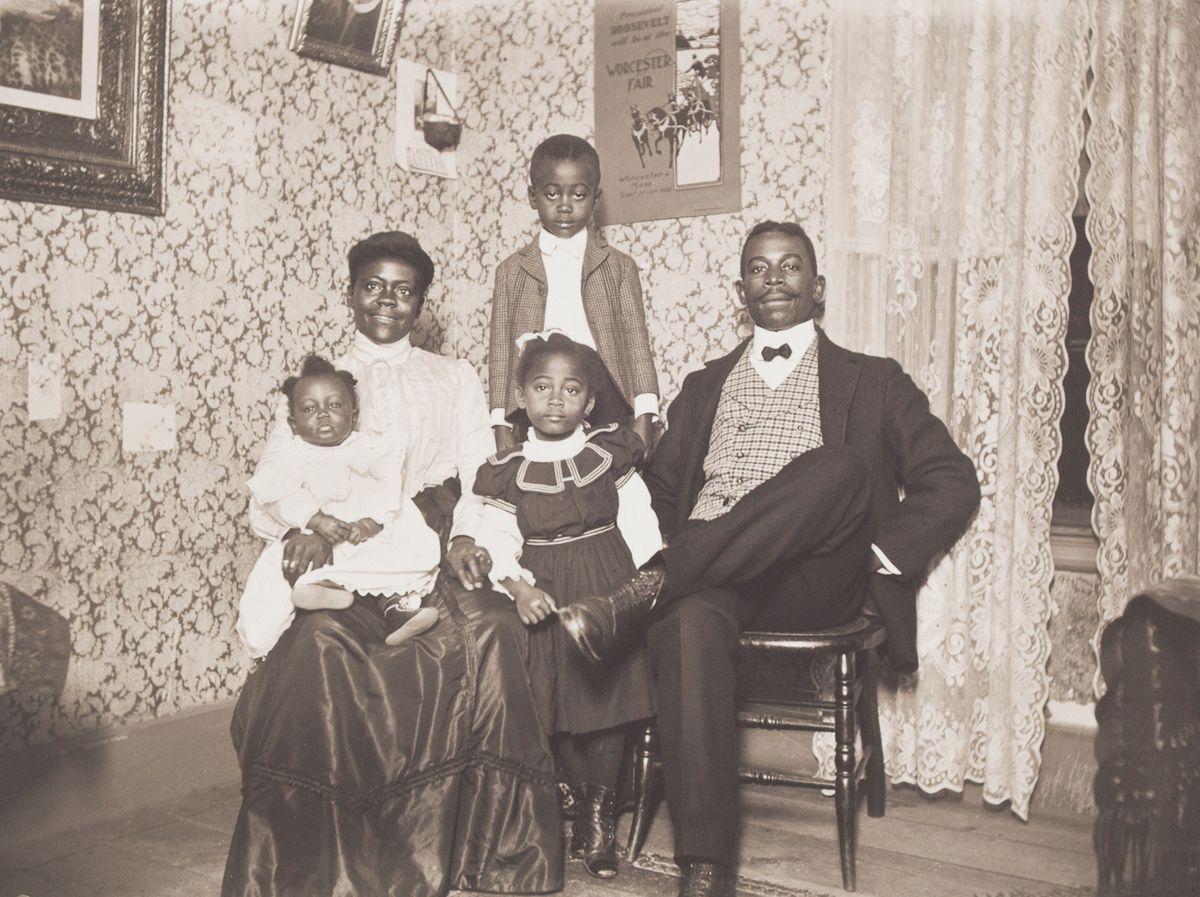
In the 1904 studio portrait that sparked the Reddit thread, the African American father sits stiff in his suit, chin lifted, eyes steady. His wife beside him beams straight into the camera, all light and ease. Their child is dressed carefully. The backdrop is generic, the kind used in thousands of small-town studios. Nothing about the props screams wealth. What jumps out is intent.
He is aiming for dignity. She is claiming joy.
The photo was taken in a United States that had already broken most of its promises to people like them. Jim Crow segregation was hardening across the South. Lynching was a regular terror. Black men who had voted in the 1870s were being pushed out of politics by poll taxes and literacy tests. Yet here they sit, dressed in their best, paying for a professional portrait. They are insisting on being seen.
This is the hinge for a different question: what if the country had met them halfway? What if, by 1904, the United States had actually treated African Americans as full citizens, protected their rights, and enforced equality under law?
Counterfactual history asks how events might have unfolded differently if key decisions or conditions had changed, while staying grounded in what was economically, politically, and socially possible. It is not fantasy. It is a way to measure how much human choices mattered.
Here, we will track three plausible paths the United States could have taken between 1865 and 1904 that would have changed the lives of that family in the photograph. Then we will ask which path, if any, was realistically on the table.
What if Reconstruction had been enforced for 50 years?
Start with the most obvious fork in the road: Reconstruction.
From 1865 to about 1877, the federal government tried, in fits and starts, to rebuild the South on free labor and equal citizenship. Three constitutional amendments banned slavery (13th), promised equal protection (14th), and protected Black men’s voting rights (15th). Federal troops occupied ex-Confederate states. Black men voted, held office, and helped write new state constitutions.
Then white Southern Democrats fought back with violence and legal tricks. Northern Republicans lost interest. The contested election of 1876 ended in a bargain: Rutherford B. Hayes got the presidency, and in return, federal troops were pulled out of the South in 1877. That withdrawal is what opened the door to Jim Crow.
The counterfactual is simple to state: what if that bargain never happened, and Reconstruction, with federal enforcement, lasted to about 1915 instead of 1877?
There were real-world levers for this. Republicans still controlled the presidency and often Congress in the late 19th century. The Supreme Court had not yet gutted the Reconstruction amendments in cases like Plessy v. Ferguson (1896). Radical Republicans such as Thaddeus Stevens had argued for long-term military occupation and land redistribution. They lost, but not by some law of nature. They lost because white Northern voters got tired of the fight and were more interested in railroad subsidies and western expansion.
In a long-Reconstruction scenario, imagine Congress doing three things and sticking to them:
First, keep federal troops in the South as a long-term garrison force, not a short-term police action. That means funding army posts, backing federal marshals who arrest Klan leaders, and actually prosecuting white paramilitaries who attack Black voters. The Enforcement Acts of 1870–71 already allowed this. In our scenario, they are used consistently for decades.
Second, pass and defend serious federal election laws. In the real timeline, Henry Cabot Lodge pushed a “Federal Elections Bill” in 1890 to protect Black voting rights in the South. It died in the Senate. In this alternate path, that bill passes. Federal registrars and observers oversee Southern elections. States that try to impose poll taxes or literacy tests see their laws struck down by federal courts backed by troops who are actually willing to enforce rulings.
Third, protect Black officeholders and local governments. During early Reconstruction, Black sheriffs, legislators, and school board members were elected across the South. They were often removed by violence or fraud. With sustained federal backing, those local Black political classes could survive long enough to become entrenched. That means more Black judges, teachers, and county officials by 1904.
What does this do to that family in the photo?
If they live in Georgia or Mississippi, their father is more likely to have voted regularly since he turned 21. He may have served on a jury, or even run for local office. Their children attend public schools that, while still separate in practice, are better funded and actually exist in rural areas. The mother might be part of a Black women’s club movement that is more openly political because the risk of white mob violence is lower when federal troops are still nearby.
Racial prejudice does not vanish. Social segregation persists. But the legal regime of Jim Crow, with its ironclad system of disenfranchisement and public humiliation, has a much harder time taking root. Lynching still happens, but the perpetrators face real risk of federal prosecution. Ida B. Wells is not a lone voice crying into the wind. She has allies in Washington who can act.
Economically, this longer Reconstruction does not magically redistribute land, but it changes bargaining power. Black farmers who can vote and sit on county commissions have more leverage over tax policy, road building, and school funding. Some states might experiment with homestead programs that give Black families access to land in the West, backed by federal protection from white mobs, something that was sporadic at best in reality.
By 1904, the United States in this scenario is still a racist country. But it is one where Black citizenship has been defended for two generations, not abandoned after twelve years. The father in the portrait is not trying to look dignified in a world that denies his legal personhood. He is trying to look dignified in a world that grudgingly, but clearly, has to treat him as a citizen with rights.
So what? A 50-year Reconstruction would have locked in Black political power before white supremacists could dismantle it, changing the legal and social environment that family lived in by 1904.
What if land reform had given Black families real economic power?
The second fork is economic, not just legal.
After the Civil War, Union General William Tecumseh Sherman issued Special Field Order No. 15 in January 1865. It reserved a strip of coastal land in Georgia and South Carolina for formerly enslaved families, “forty acres and a mule” in popular memory. Thousands of Black families started farming that land.
Then President Andrew Johnson, a pro-Southern Democrat, reversed it. Between 1865 and 1867, much of that land was returned to ex-Confederate owners. The dream of widespread Black landownership in the South died early.
In our second scenario, that decision goes the other way. Johnson is either impeached earlier, or Congress simply overrides him and writes land reform into law. The federal government confiscates a portion of large Confederate plantations and sells or grants them in small parcels to Black families who had worked them as slaves.
Is that fantasy? Not entirely. Land confiscation from rebels was widely discussed. Radical Republicans argued that breaking up plantations was the only way to prevent a return to quasi-slavery. The Freedmen’s Bureau briefly managed some confiscated land. The barrier was not logistics. It was political will and white solidarity across North and South against large-scale wealth transfer to Black people.
In this alternate path, imagine a limited but real program: perhaps 10 to 20 percent of large plantations in the Deep South are broken up. Formerly enslaved families receive 20–40 acre plots, with simple titles and some basic credit from the Freedmen’s Bureau or state banks. White Northern investors are still free to buy other lands. Cotton is still grown. Railroads still expand. But a significant minority of Black Southerners become landowners between 1865 and 1880.
By 1904, this pays off in several ways.
First, economic independence. A Black family that owns its land is not trapped in the sharecropping system that, in reality, kept many in perpetual debt to white landlords and merchants. They have collateral. They can send a child to school instead of keeping every pair of hands in the fields. They can ride out a bad harvest without losing everything.
Second, migration choices. In the real timeline, the Great Migration of Black Southerners to Northern cities took off around World War I, partly as an escape from both violence and economic stagnation. In this scenario, some still leave. But many more have something to stay for. Those who do leave arrive in Northern cities with savings from land sales or crops, not just with a suitcase and hope.
Third, political clout. Property ownership has always mattered in American politics, even after formal property requirements for voting disappeared. Landowners sit on school boards, join farmers’ alliances, and have more sway in local disputes. When white politicians try to cut Black schools or divert road funds, they face organized resistance from people who pay taxes and have something to protect.
How does this change that 1904 portrait?
The father’s suit might be paid for with cotton or tobacco grown on his own land. The studio fee might come from a good harvest, not from wages earned picking someone else’s crop. The mother’s smile carries not just personal joy but a quiet knowledge that the family is not one bad season away from losing everything.
There is still racism. White neighbors still resent Black landowners. Some counties see violent attempts to drive them off. But in this scenario, those attacks run into communities that are better organized, better funded, and sometimes better armed. White planters cannot threaten to evict people who own their own soil.
So what? Real land reform would have given Black families a base of economic power by 1904, changing their vulnerability and their options in ways that law alone could not.
What if Northern cities had integrated early and enforced it?
The third scenario shifts the focus away from the South entirely.
In the real world, Northern states often like to tell themselves they were the “good” side of American race relations. The record is messier. While the North did not build Jim Crow in the same formal way, it practiced school segregation, housing discrimination, and job exclusion through custom and local law. Race riots in places like New York (1863) and Springfield, Illinois (1908) showed that white Northerners were quite capable of violent racism.
Yet there were also strong abolitionist and egalitarian traditions in parts of the North. States like Massachusetts had outlawed school segregation by the 1850s. Black communities in cities like Philadelphia and Boston built churches, newspapers, and mutual aid societies that pushed for equal treatment.
So imagine a different path: from 1870 onward, a bloc of Northern states not only bans legal segregation but actually enforces integration in schools, public transit, and housing. Courts strike down “separate” facilities. City governments refuse to issue licenses to businesses that discriminate. Labor unions in key industries accept Black workers as members instead of excluding them.
This is not national utopia. It is a regional shift. Maybe it starts in New England and spreads to parts of the Midwest. The key is that these states become genuine laboratories of racial equality, not just places where racism is less formal.
What makes this plausible? Several things.
First, Black voting power in Northern cities. Even in the 19th century, Black men could vote in many Northern states. Their numbers were small, but in close municipal elections they mattered. In our scenario, politicians in cities like Boston, Cleveland, and Chicago decide that courting Black voters and white reformers is worth more than pandering to racist sentiment.
Second, the Progressive Era. Around 1890–1920, reformers attacked corruption, pushed for public health, and experimented with social policy. In reality, many Progressives were racist. But they also believed in using government to fix social problems. If a faction of them had decided that segregation was a problem to be solved, not a norm to be accepted, they had tools to act.
Third, competition between cities. If one city gains a reputation as a place where Black workers can get fair wages and send their kids to integrated schools, it gains labor and talent. Other cities might follow, not out of moral enlightenment but economic self-interest.
By 1904, in this scenario, a Black family in that Reddit photo might be living in Detroit or Philadelphia instead of rural Alabama. The father might work in a factory or as a skilled tradesman, jobs that were often closed to Black men in the real timeline. The child might attend a public school where white and Black children share classrooms, textbooks, and teachers.
Social prejudice does not vanish. Housing patterns still cluster by race and class. But the legal right to ride any streetcar seat, attend any public school, and apply for any city job is real, backed by courts that actually enforce it.
One quiet but powerful effect: national norms shift. When Southern politicians defend Jim Crow, Northern newspapers from integrated cities have less patience. When the Supreme Court hears cases about segregation, it has before it not only abstract principles but living examples of integrated systems that function.
So what? Early, enforced integration in key Northern cities would have created real alternative models of race relations by 1904, giving Black families more choices and weakening national acceptance of segregation.
Which alternate 1904 is most plausible, and why does it matter?
All three scenarios could have changed the life behind that 1904 smile. The question is which one was most within reach, given the politics and economics of the late 19th century.
Long Reconstruction required sustained Northern political will to keep troops in the South and to keep fighting white Southern resistance. That ran against deep currents: war fatigue, racism, and the desire of Northern businessmen to reconcile with Southern elites for the sake of investment and railroads. By the 1870s, many white Northerners were ready to declare the “Negro question” solved and move on.
Land reform was even more explosive. Confiscating and redistributing property on a large scale would have united Southern whites and alarmed Northern property owners. The United States has always been skittish about anything that looks like expropriation. Radical Republicans talked about it, but they were outnumbered by moderates who wanted reunion with minimal disruption to property relations.
Early Northern integration, by contrast, did not require a national revolution. It could have grown state by state, city by city, through local elections and court cases. It fit more easily into existing Progressive Era habits of municipal reform and state-level experimentation. It also aligned with the economic interests of some industrialists who simply wanted a stable, skilled workforce, regardless of color, as long as wages stayed manageable.
That makes the third scenario, regional integration in the North, the most plausible in terms of political and economic constraints. It did not demand that the entire country rethink property rights or keep a large army in the South for half a century. It demanded that a handful of states and cities enforce laws they already had on the books more seriously, and that reformers treat racial equality as part of their agenda instead of something to be postponed.
Yet the first two scenarios, while harder, matter for another reason. They remind us that the world of that 1904 family was not inevitable. Jim Crow was built, piece by piece, through choices: Supreme Court rulings that hollowed out the 14th Amendment, presidential decisions to look away from lynching, state laws that rewrote constitutions to push Black voters out.
Counterfactual history is not about daydreaming a perfect world. It is about measuring the gap between what happened and what was possible. By 1904, the United States could have been a country where that father’s serious pose reflected a citizenship that was secure, where his wife’s smile was not an act of defiance against a hostile order but an expression of ordinary, unremarkable security.
Instead, their dignity was a quiet form of resistance. The photo captures not just a family, but a missed chance. The fact that we can sketch plausible alternate paths where their rights were respected tells us something simple and hard: the inequality they faced was not some natural stage of history. It was a choice, and it could have been different.
So what? We still argue about whether racism in America is a tragic accident or a built system. Looking back from that 1904 portrait through these “what ifs” makes one thing clear: different choices by lawmakers, judges, and voters could have given that family a safer, freer life, which means the world they actually lived in was not the only one on offer.
Frequently Asked Questions
What was life really like for African Americans in 1904?
In 1904, most African Americans in the South lived under Jim Crow segregation, faced disenfranchisement through poll taxes and literacy tests, and were threatened by lynching and racial violence. In cities and in the North, some Black middle-class communities existed, with professionals, churches, and schools, but they still encountered job discrimination, housing segregation, and social prejudice. The family in the 1904 portrait likely lived with a mix of aspiration and constant constraint.
Could Reconstruction in the United States realistically have lasted longer?
Yes, it could have. The federal government already had the legal tools, through the Reconstruction Amendments and Enforcement Acts, to protect Black voting rights and suppress white supremacist violence. A longer Reconstruction would have required sustained political will in the North to keep troops in the South and to pass measures like the failed Federal Elections Bill of 1890. That will faded in reality, but it was a political choice, not an impossibility.
Did African Americans ever almost get land reform like “40 acres and a mule”?
There was a brief moment when land reform seemed possible. In 1865, General Sherman’s Special Field Order No. 15 set aside coastal land in Georgia and South Carolina for formerly enslaved families, and some did begin farming it. President Andrew Johnson reversed this policy and returned most land to ex-Confederate owners. Radical Republicans argued for broader confiscation and redistribution, but they were blocked by moderates and by white solidarity around property rights.
Were Northern states less racist than the South around 1900?
Northern states did not have Jim Crow laws in the same codified way, but racism was still strong. Many Northern cities practiced school segregation, housing discrimination, and job exclusion through custom and local rules. There were race riots in Northern cities and resistance to Black migration. At the same time, some Northern states had earlier legal protections and abolitionist traditions, so they could have moved faster toward real integration if local governments had chosen to enforce equality more aggressively.