They are trying not to blink.
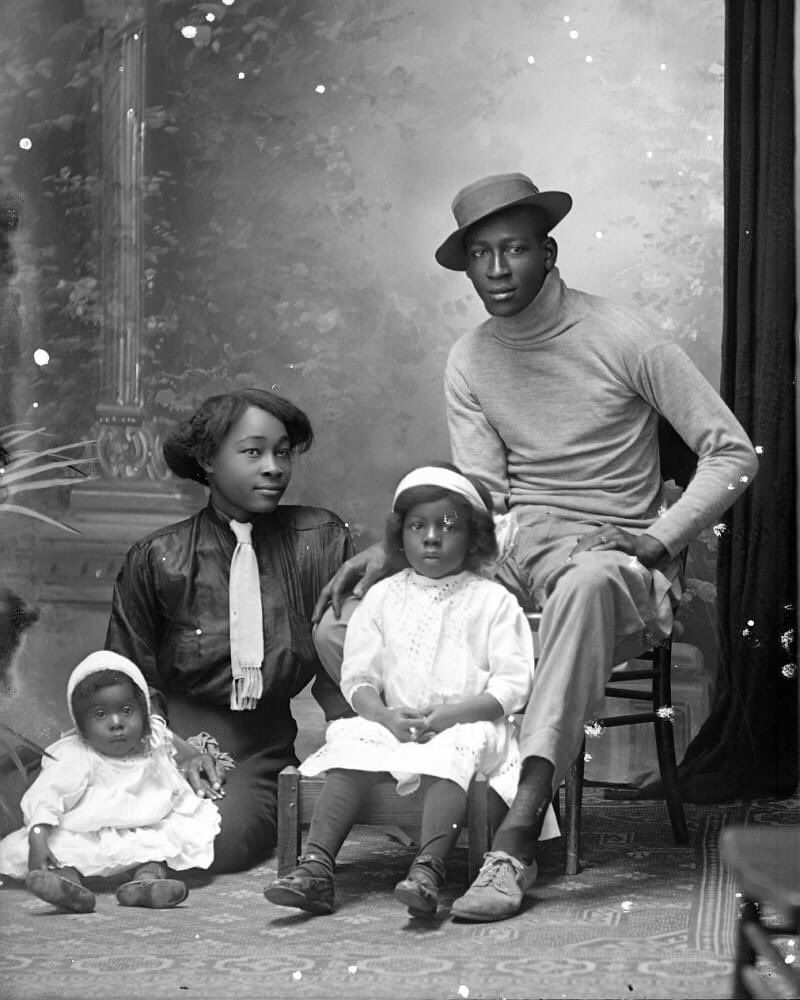
A mother with a high collar and pinned-up hair. A father in his best jacket, hand awkwardly on his knee. Children arranged like props on a narrow bench, shoes polished, ears sticking out, all of them staring into the bright, unblinking eye of a studio camera. Somewhere around 1913, a photographer slid a glass plate into place, pulled the dark slide, and froze this family for a fraction of a second.
To us, a century later, it is just a Reddit post: “Family poses with their children for their professional studio photo, circa 1913. Glass negative.” But that ordinary session sat at the intersection of technology, class, and memory. It cost money. It took planning. It produced an object that could outlive everyone in the frame.
So what if they had never walked into that studio? What if the glass negative had shattered, or the family had chosen a different kind of portrait, or lived in a place where cameras were rare? Counterfactual history is not about wild fantasy. It is about asking, within real limits of economics, logistics, and politics, how small decisions change what survives of a life.
A glass negative portrait in 1913 was a fragile technology that turned a brief family moment into a long-lived historical source. Changing that one decision changes who gets remembered and how.
How common was a 1913 studio photo, really?
By 1913, professional studio portraits were no longer just for the rich. Dry plate photography and, increasingly, roll film had driven prices down. In many towns across Europe and North America, you could walk down the main street and find a storefront with painted backdrops, a skylight, and a sign promising “Portraits While You Wait.”
Yet this was not casual money. In the United States, a basic studio sitting might cost the equivalent of a day’s wages for a laborer, depending on region. In parts of Europe, it could be a once-a-year or once-in-a-lifetime expense. Families often timed portraits to events that felt worth the splurge: a wedding, a new baby, a son leaving for the army, a daughter about to emigrate.
The glass negative in the Reddit post hints at that world. Glass plates were still widely used for studio work because they produced sharp, detailed images and could be archived. The photographer might have a cabinet full of labeled plates: “Smith, family group, June 1912,” “Ivanov, baptism, 1913.” Some studios kept them for years, offering reprints for a fee. Others recycled the glass when storage or money ran short.
People today often assume that by 1913, everyone had boxes of photos the way we have phone galleries. That was not true. Casual snapshots were spreading thanks to Kodak’s box cameras, but those were still luxuries. In many working-class homes, a single framed studio portrait might be the only photographic record of parents or grandparents.
So this family’s decision to sit for a professional portrait was not automatic. It was a choice to spend money, dress up, and submit to the strange ritual of posing in front of a stranger with a tripod. That choice turned a fleeting stage of family life into something durable, which is exactly why changing it matters for the story of who they were and how we see them now.
So what? Because studio portraits were expensive and intentional, having one at all tells us this family had enough resources and reasons to think their image was worth fixing in glass, which shapes how we interpret their place in their society.
Scenario 1: What if the family never went to the studio?
Imagine the simplest change. The father loses a day’s wages to illness. The mother decides the children’s shoes are too worn for a formal portrait. The appointment is postponed, then forgotten. No studio visit. No glass negative.
Economically, this is easy to picture. In 1913, a working-class family might live week to week. A portrait was a luxury that could be cut. There is no reason to assume they would find the money again. Life had a way of interrupting plans. A pregnancy. A move. A war.
What changes?
Inside the family, not as much as you might think. Memory in 1913 did not rely on photographs the way ours does. People told stories. They kept letters, religious certificates, a lock of hair in a locket. Children remembered their parents’ voices, not just their faces. The absence of a studio portrait would not erase the family from each other’s minds.
But it would erase them from ours. Historians and descendants in 2024 would have far less to go on. Without a professional portrait, the odds of any image surviving a century drop sharply. Informal snapshots, if they existed, were more likely to be lost, damaged, or never taken in the first place.
Genealogically, this matters. A single labeled studio photo can anchor a family tree. Names can be matched to faces. Clothing and backdrop can date the image. Without it, researchers rely on church records, censuses, and guesswork. The people become lines in a ledger instead of individuals with recognizable expressions.
Socially, the absence of a portrait also shifts who gets represented in the historical record. Middle-class and wealthy families left more photos. Poorer families left fewer. If this family is on the economic edge of being able to afford a studio visit, canceling it nudges them back toward invisibility.
There is also a small but real political angle. Visual archives shape how we imagine the past. If fewer ordinary families had portraits taken in 1913, our mental picture of the era would tilt even more toward elites, celebrities, and staged propaganda. The everyday faces that now appear in museum exhibits and online collections would be rarer.
So what? If this family skipped the studio, they almost certainly vanish from the visual record, which means one more ordinary household disappears from the way we reconstruct and teach the early 20th century.
Scenario 2: What if the glass negative was destroyed early?
Now assume the portrait session happened. The children sat still, the plate was exposed, and prints were made. But the glass negative itself did not survive.
This is not hypothetical. Glass breaks. Studios closed or moved. During World War I and World War II, glass plates were sometimes destroyed in bombings or discarded during shortages. Some photographers deliberately scraped emulsion off old plates to reuse the glass. Archivists later wept over those decisions. At the time, it was economics.
If the negative is gone but a few paper prints survive in the family, the short-term impact is small. The parents might keep one framed in the parlor. Another might be mailed to a relative overseas. For a generation or two, those prints do the job: they fix the memory of what everyone looked like “back then.”
The long-term story is different.
Glass negatives, when preserved, often end up in archives, flea markets, or private collections. They can be scanned at high resolution. They can be rediscovered long after the family line has scattered. That is probably how the Reddit image surfaced: someone found or inherited a glass plate, digitized it, and posted it.
Without the negative, the survival of the image depends entirely on the family’s luck. Houses burn. Albums mildew. Heirs throw away “old junk.” By the third or fourth generation, unlabeled photos are especially vulnerable. A stranger’s face is easier to discard than a labeled plate in a box marked “Studio Archive.”
Destroying the negative also removes the chance of future reprints. Many early 20th century families ordered new copies of old portraits when someone died or when a child emigrated. No negative meant no new prints. The image’s circulation stayed limited, and with it, the reach of that frozen moment.
For historians, negatives carry extra information. Edges show studio markings, plate numbers, sometimes handwritten notes. The clarity can reveal details of fabric, jewelry, or even small objects in the background that cheap prints blur. Lose the negative, and you lose some of that fine-grained evidence.
So what? If the glass negative broke or was discarded, the portrait’s odds of reaching 2024 shrink, and even if a print survives, we lose much of the detail and context that turn a family snapshot into a rich historical source.
Scenario 3: What if the family lived where cameras were rare?
There is another way to change the story. Move the same family in time and space.
Picture them not in a mid-sized European or North American town with a commercial studio, but in a rural village in Eastern Europe, the Ottoman Empire, or colonial India. In 1913, cameras were spreading globally, but not evenly. Urban centers had studios. Remote or poorer regions often did not, or only saw itinerant photographers passing through.
In this scenario, the family wants a portrait but faces real constraints.
Economically, the cost is higher relative to income. A studio in a regional capital might charge the same absolute price as one in a big city, but for a peasant or colonial subject, that price could equal several days’ or even weeks’ wages. Travel adds more: train fare or wagon hire, a day lost from work, food on the road.
Logistically, it is a project. The family might have to walk or ride for hours. They need decent clothes, which might mean borrowing or renting. If a traveling photographer visits the village, there is a narrow window to act. Miss it, and the chance is gone for years.
Politically, the context changes too. In colonies, photography was often tied to power. Officials used cameras to document “types” of people, to catalog subjects. Local families sometimes embraced portraits as a way to claim modernity or status. Others distrusted the process, seeing it as invasive or spiritually risky.
So what if, in that world, the family never gets photographed at all?
The effect on the historical record is sharper. Many rural and colonized populations are already underrepresented in visual archives. A missing portrait here does not just subtract one more middle-class-looking family from the record. It deepens an existing skew.
Our image of 1913 becomes even more urban, more Western, more elite. When museums mount exhibits on “Family Life in the Early 20th Century,” they rely heavily on what survives. If most surviving photos are from cities and wealthier households, those become the default story. The absence of images from villages or colonized communities makes it easier to forget that most people in 1913 did not live like the people in the pictures.
For descendants, the loss is personal and political. In many postcolonial societies, early family photos are rare treasures. They are used to assert continuity, to counter narratives that treat locals as faceless masses. If this hypothetical family never manages to get to a photographer, their grandchildren and great-grandchildren have one less piece of proof that “we were here, with our own lives, before the upheavals.”
So what? Moving the family to a region with scarce cameras and then denying them a portrait widens the visual gap between rich and poor, colonizer and colonized, and that gap shapes how entire societies remember the early 1900s.
Which scenario is most plausible, and why does it matter?
Of these three what-ifs, the second is by far the most common in real history.
Most likely, the family did sit for the portrait. We have the image. That means at least one plate was exposed and at least one print was made. The more fragile part of the chain is not the sitting, but the survival of the negative and the later journey of the physical object.
Glass plates were heavy, brittle, and took space. Photographers had strong incentives to clear them out once their commercial value faded. Families, by contrast, had strong emotional incentives to keep paper prints, even as they moved house or country. So the most realistic alternate path is not “no portrait,” but “portrait that never leaves the family album and whose negative is lost.”
The first scenario, skipping the studio entirely, is also plausible, especially for poorer households. But the fact that we are looking at a professional-quality glass negative suggests this particular family had enough stability and money to make the appointment. They were already on the side of the line where a portrait was possible.
The third scenario depends on geography. If the original Reddit image shows clothing and studio style from, say, Western Europe or North America, then the family probably did not face the severe access problems of a remote village in 1913 Persia or rural India. For millions of families in those regions, though, that scenario is not hypothetical. It was their reality.
Counterfactuals about a single photo might sound small, but they point to a larger pattern. History is shaped by what gets recorded. Photographs are not neutral windows into the past. They are artifacts of money, technology, and power. Every missing or broken plate narrows the cast of characters who appear in our mental movie of 1913.
A family portrait is a staged moment where people decide how they want to be seen by the future. When that moment happens, and when it survives, it gives later generations a rare direct look into the eyes of people who usually show up only as statistics. When it does not, those people recede into the background of history.
So what? The most plausible change is the loss of the negative, not the sitting itself, and that loss would quietly erase detail and context from the record, reminding us that every surviving glass plate is not just a picture but a lucky survivor of a long chain of economic and material decisions.
Why that 1913 glass negative still matters today
Scroll past a 1913 family portrait on Reddit and it feels anonymous. No names. No backstory. Just another old-timey image. Yet that glass negative has already outperformed the odds. It survived a century of moves, wars, estate clear-outs, and technological shifts. It was digitized instead of dumped. It reached an audience of thousands instead of sitting in a shoebox.
That survival has consequences.
First, it subtly corrects our sense of who “ordinary people” were in 1913. We see the children’s haircuts, the parents’ posture, the quality of their clothes. We can guess at class, region, maybe even religion. It is not definitive evidence, but it is more than a line in a census.
Second, it reminds us that the historical record is not a complete archive. It is a patchwork of what people could afford to record and what later generations chose to keep. Asking “what if this had not survived?” is a way to stay honest about all the other families whose portraits never happened, or whose glass plates did not make it.
Third, it turns a private act into a public artifact. The family in 1913 probably imagined their portrait hanging in a parlor, not on a global forum. Yet here we are, reading their faces, projecting stories onto them. That gap between intention and outcome is part of what makes historical photographs powerful and a little unsettling.
A glass negative family portrait from 1913 is not just a quaint image. It is a rare, fragile intersection of technology, money, and memory. Changing any one of those factors changes who gets to be seen in history, which is why a single studio visit, kept or canceled, still matters more than it seems.
Frequently Asked Questions
How common were family studio portraits in 1913?
By 1913, family studio portraits were fairly common in cities and larger towns in Europe and North America, thanks to cheaper dry plate and roll film technology. They were still a significant expense for working-class families, often tied to special occasions, and much rarer in rural or colonized regions with limited access to studios.
Why were glass negatives used for family photos?
Photographers used glass negatives because they produced sharp, detailed images and were stable when stored properly. In studio settings, glass plates could be archived and used to make reprints for years. Their downside was that they were heavy, fragile, and took up space, so many were eventually broken, discarded, or reused.
Did most families in 1913 have lots of photographs?
No. While cameras and film were spreading, most working-class families did not have large collections of photos. A single framed studio portrait might be the only image of parents or grandparents. Casual snapshots were more common among the middle class and wealthy who could afford personal cameras and film processing.
How do lost photos affect our view of history?
Lost photos skew the historical record toward people and places that left more visual traces, usually urban, wealthier, and more powerful groups. When portraits of ordinary or marginalized families are missing, it becomes easier to imagine the past as belonging mainly to elites, even though most people lived very different lives.