They look similar because, at first glance, Kliment Voroshilov and the hundreds of Soviet officers shot in the Great Purge were in the same danger zone. A furious general smashed a plate on Stalin’s table in 1940, shouted that the Red Army was broken because Stalin had killed its best commanders, then walked out alive. Men had been executed for far less.
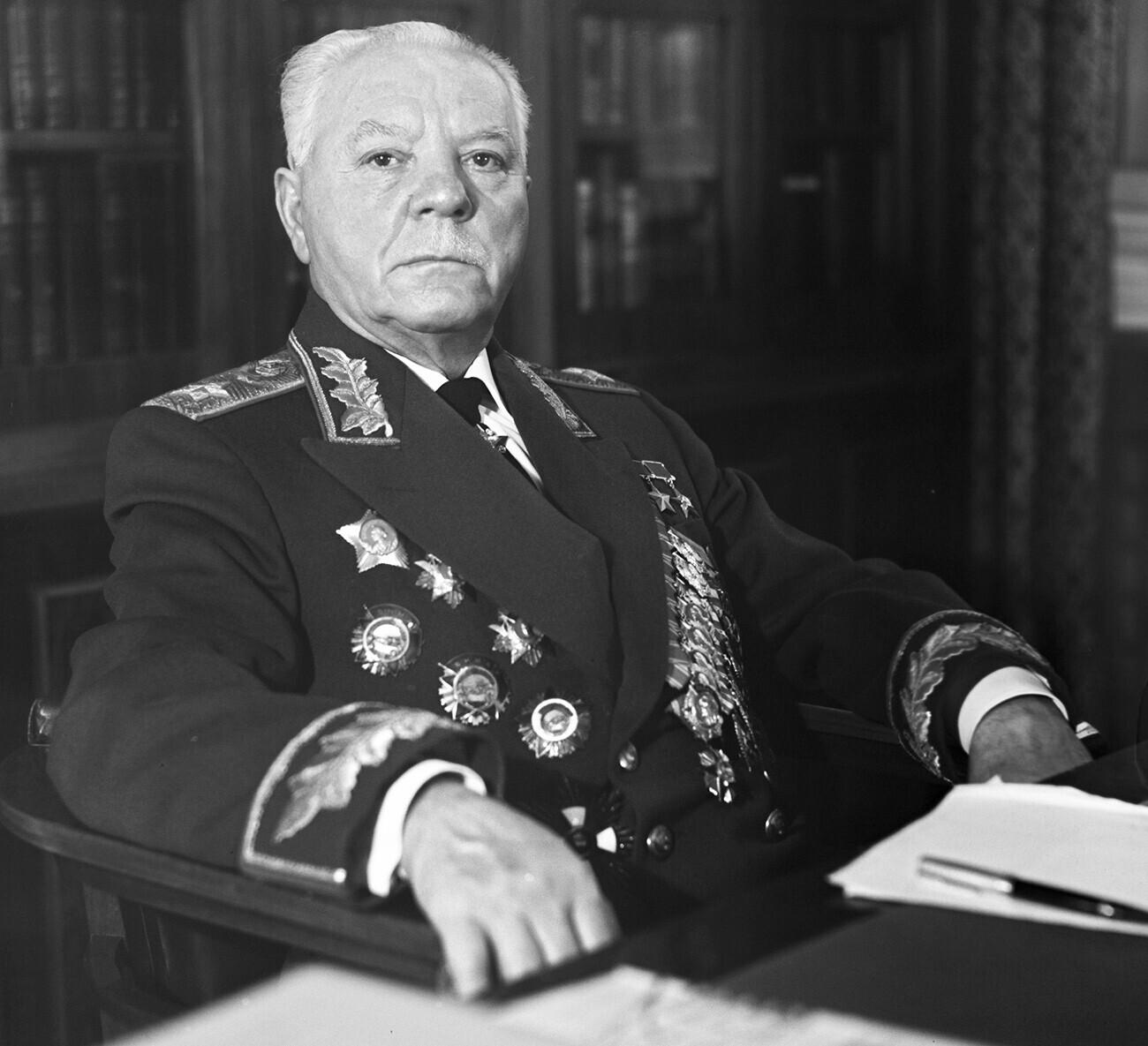
So why did Voroshilov survive, keep his marshal’s stars, and even outlive Stalin by sixteen years, while officers like Tukhachevsky, Yakir, Uborevich and many others ended in a basement with a bullet to the back of the head?
This is a comparison between two fates inside Stalin’s system: the purged Red Army elite of the late 1930s, and Kliment Voroshilov, the loyalist who somehow got away with yelling at the dictator. Same regime, same terror, very different outcomes.
How did Voroshilov and the purged generals rise in the first place?
Start with the origins. Voroshilov and the later purge victims came out of the same world: the chaos of revolution and civil war.
Kliment Voroshilov was born in 1881 in what is now Ukraine, into a poor worker’s family. He joined the Bolsheviks early, before 1917, and fought in the Russian Civil War as a political loyalist first and a soldier second. His real talent was not tactics. It was loyalty to Joseph Stalin.
He met Stalin during the Civil War, in the fighting around Tsaritsyn (later Stalingrad). The two men bonded in those years. Stalin remembered Voroshilov as a comrade who backed him in internal party feuds and who did not question his authority. That personal tie mattered more than any staff-college education.
The future purge victims had a different profile. Men like Mikhail Tukhachevsky, Iona Yakir, Ieronim Uborevich and others were also Civil War commanders, but they were more professional and more ambitious in military terms.
Tukhachevsky, born in 1893 into a minor noble family, had served as a junior officer in the Imperial Russian Army and had been a prisoner of war in Germany. In the 1920s he became the Red Army’s leading theorist of modern warfare, pushing for mechanization, deep operations, and a modern officer corps. Yakir and Uborevich were also seen as brilliant, reform-minded commanders.
In the 1920s and early 1930s, these men rose fast. Tukhachevsky became Deputy Commissar for Defense. They commanded military districts, wrote doctrine, and built up a professional officer corps. They were not just Stalin’s men. They were the Red Army’s future.
Voroshilov, by contrast, became People’s Commissar for Defense in 1925 mostly because Stalin trusted him politically. He was a symbol of the Civil War generation, a loyal Bolshevik with limited technical skill but unquestioned devotion.
So what? From the beginning, Voroshilov’s power rested on personal loyalty and politics, while the later purge victims built their authority on military competence and independent reputations. In Stalin’s USSR, that difference would become lethal.
Why did Stalin purge the Red Army but spare Voroshilov?
The Great Purge of the Red Army peaked in 1937–1938. Stalin and the NKVD wiped out much of the officer corps. Historians estimate that around 35,000 officers were arrested, dismissed, or shot. The top command was hit especially hard.
Marshal Tukhachevsky was arrested in May 1937 on fabricated charges of spying for Germany. He was tortured, forced to sign a confession, and shot in June after a secret trial. Yakir, Uborevich, and other senior commanders followed. Many were accused of belonging to a “military-fascist conspiracy.” The evidence was manufactured, but the bullets were real.
Why them and not Voroshilov?
First, Stalin feared independent centers of authority. Tukhachevsky and his circle had built reputations as brilliant professionals. Foreign militaries respected them. That made Stalin nervous. He preferred men whose power came from him alone.
Second, Voroshilov was politically safe. He did not challenge Stalin on policy. He did not push radical independent reforms. He was a loyal executor, not a rival. When the purges hit the army, Voroshilov did not defend his colleagues. He signed off on their arrests and denounced them as traitors.
Third, Voroshilov was part of Stalin’s inner circle. He sat on the Politburo, vacationed with Stalin, and shared the mythology of the Civil War. Killing him would have been like killing a piece of Stalin’s own origin story. Stalin preferred to humiliate him rather than erase him.
There is debate among historians about how much Voroshilov believed the charges against his fellow officers and how much he was simply protecting himself. What is clear is that he survived the purge by aligning fully with Stalin’s terror, while the more independent, professional commanders were destroyed.
So what? The Great Purge did not just remove “enemies.” It reshaped the Red Army’s leadership class, rewarding political loyalty over competence. Voroshilov lived because he fit the new mold. The purged generals died because they did not.
How did their methods differ once war came?
Methods is where the contrast becomes painful.
The officers shot in 1937–1938 had pushed for modern, flexible warfare. Tukhachevsky’s “deep operations” theory argued that future wars would be decided by fast, mechanized strikes, coordinated across air, armor, and infantry. He wanted large tank formations, better staff work, and realistic training. Soviet doctrine in the early 1930s reflected many of his ideas.
Those methods were radical for their time. They required initiative from lower officers, honest reporting of problems, and a professional culture. They also implied that the army needed some autonomy from political micromanagement.
Voroshilov’s approach was very different. As People’s Commissar for Defense, he tolerated or encouraged political interference in the army. He backed the purge of “unreliable” officers, which gutted the very people who understood modern warfare. Training suffered. Commanders became terrified of making mistakes or reporting bad news.
By the time the Winter War with Finland began in November 1939, the Red Army was a shell of what it might have been. Many of the best officers were dead or in camps. Their replacements were often inexperienced, promoted too fast, and scared of initiative.
In Finland, those methods produced disaster. Soviet troops attacked with poor reconnaissance, weak coordination, and rigid tactics. They underestimated the Finns and overestimated their own strength. Units were thrown into frontal assaults against well-prepared defenses in deep snow and forest. Soviet casualties were enormous. Exact numbers are debated, but Soviet losses were many times higher than Finnish losses.
Voroshilov, as Commissar for Defense, bore direct responsibility for the state of the army and the conduct of the campaign. Yet his method of survival was the same as before: political loyalty and personal ties.
So what? The purged generals had tried to build a modern, professional army. Voroshilov helped dismantle it, then presided over its failures. The clash between their methods and his played out in blood on the Finnish front.
What happened in that 1940 confrontation between Voroshilov and Stalin?
Here is where the Reddit anecdote comes in.
After the Winter War ended in March 1940, the Soviet leadership met to discuss what had gone wrong. Stalin was furious at the Red Army’s performance. He blamed Voroshilov for the disaster. According to multiple accounts from later memoirs and Soviet sources, the meeting turned explosive.
Stalin attacked Voroshilov for incompetence. Voroshilov, usually submissive, snapped. He reportedly grabbed a plate from the table, smashed it, and shouted back that the army had been ruined by Stalin’s own purges. The best commanders were dead or imprisoned, he said, and that was why the Red Army had bled so heavily in Finland.
In Stalin’s USSR, shouting at the dictator and blaming him for a military disaster was a near-suicidal move. Men had been executed for less. Yet Voroshilov was not arrested. He was not shot. He was quietly removed as People’s Commissar for Defense and replaced by Semyon Timoshenko, but he kept his marshal’s rank and his place in the leadership.
Why?
First, timing. By 1940, the peak of the Great Terror had passed. Stalin was still murderous, but the mass show trials and sweeping executions had slowed. He needed some stability as Europe slid toward wider war.
Second, Voroshilov’s status. He was an Old Bolshevik, a Marshal of the Soviet Union, and a symbol of the Civil War generation. Killing him would have sent a shock through the elite. Demoting him was safer.
Third, Stalin’s own awareness. By then, Stalin knew the purges had hurt the army. He might have been enraged by Voroshilov’s outburst, but the substance of the complaint was not entirely wrong. That did not make Stalin forgiving, but it may have made him pragmatic.
So what? The 1940 plate-smashing scene shows the limits and the logic of Stalin’s terror. A man who had helped carry out the purges could, in a moment of anger, name their cost and survive, because his loyalty record and symbolic value outweighed his offense.
How did their outcomes differ during World War II?
World War II froze the contrast into place.
The purged generals were gone when Germany invaded the Soviet Union in June 1941. Their ideas, stripped of their authors, were partly revived in chaos. The Red Army eventually rebuilt a professional officer corps, reintroduced more flexible doctrine, and fought the kind of deep, mechanized warfare Tukhachevsky had imagined. But it did so at a terrible price in 1941–1942, when inexperienced commanders and fear of initiative contributed to catastrophic defeats.
Voroshilov, despite his earlier failures, remained a Marshal and a public figure. Early in the war he commanded the Northwestern direction and then the Leningrad front. His performance was poor. Stalin soon replaced him with more capable commanders like Georgy Zhukov. After that, Voroshilov’s wartime role became more ceremonial and political.
He inspected fronts, appeared in propaganda, and sat on high-level committees. He was still in the photographs, still on the podiums, but not in charge of major operations. Stalin kept him around as a loyal symbol, not as a key military decision-maker.
So what? The dead generals had their ideas resurrected without their names. Voroshilov kept his name and his rank, but lost real influence. The war confirmed that competence could be imitated, but personal loyalty, once rewarded, was hard to discard.
What was their legacy after Stalin’s death?
Legacies in the Soviet Union were often rewritten, and this story is no exception.
Voroshilov outlived Stalin by sixteen years. Stalin died in 1953. Voroshilov died in 1969. In those years, he moved from being Stalin’s loyal marshal to a kind of living relic of the old guard.
After Stalin’s death, Voroshilov briefly became Chairman of the Presidium of the Supreme Soviet, effectively the nominal head of state from 1953 to 1960. Real power lay with men like Nikita Khrushchev, but Voroshilov’s presence gave the new leadership a link to the revolutionary past.
As Khrushchev denounced Stalin’s crimes in the mid-1950s, the party quietly rehabilitated many purge victims. Tukhachevsky and other executed commanders were posthumously cleared of the false charges. Their reputations as military thinkers were restored in Soviet military history and doctrine.
Voroshilov’s legacy became more awkward. Officially he remained a Hero of the Soviet Union, a Marshal, a figure in parades and textbooks. But insiders knew his record: complicity in the purges, failure in the Winter War, and limited success in World War II. He was honored as a symbol, not as a model commander.
Today, historians see the contrast clearly. The purged generals are often discussed as victims of Stalin’s paranoia and as early advocates of modern warfare. Voroshilov is remembered as a loyal Stalinist who survived by politics, not by military talent, and who briefly broke that loyalty in 1940 when he dared to tell Stalin that killing the army’s best officers had consequences.
So what? The postwar reputations of Voroshilov and the purged generals flipped the logic of the 1930s. Those who died as “traitors” were later honored as professionals. The loyalist who survived kept his medals but not much respect from later generations.
Why does this comparison still matter?
Voroshilov and the purged generals looked similar from a distance: Soviet marshals and commanders in the same uniforms, serving the same regime. Up close, their paths show how Stalin’s system rewarded one kind of man and destroyed another.
The purged officers rose on competence, independent thought, and professional ambition. That made them dangerous in a dictatorship obsessed with control. Voroshilov rose on loyalty, personal ties, and political reliability. That made him useful, even when he failed.
The 1940 plate-smashing episode is striking because it breaks the stereotype of total fear. A man who had helped carry out the purges suddenly told Stalin, to his face, that those purges had crippled the army. He survived because his earlier loyalty and symbolic value outweighed his outburst.
In the end, the comparison shows how authoritarian systems can survive their own disasters. They can kill off the people who might have prevented those disasters, then recycle their ideas without admitting fault. They can keep loyal survivors like Voroshilov in place as living decorations, even as history quietly shifts sympathy to the dead.
So what? Understanding why Voroshilov lived and Tukhachevsky died is not just a curiosity about a smashed plate. It is a window into how Stalin’s terror worked, how it warped the Red Army at the edge of World War II, and how power can value loyalty over competence even when lives are on the line.
Frequently Asked Questions
Did Voroshilov really smash a plate and shout at Stalin?
Multiple Soviet-era memoirs and later historical works describe a 1940 meeting after the Winter War where Kliment Voroshilov, blamed by Stalin for the Red Army’s failures, smashed a plate and angrily blamed the purges for destroying the army’s best officers. Exact wording and details vary, but historians generally accept that a heated confrontation took place and that Voroshilov criticized the impact of the purges on the army.
Why did Stalin execute Tukhachevsky but not Voroshilov?
Mikhail Tukhachevsky was seen as an independent, highly competent military professional with his own reputation at home and abroad. Stalin feared such figures as potential rivals, so Tukhachevsky was arrested in 1937 on fabricated charges and shot. Voroshilov, by contrast, was a long-time political loyalist whose power depended on Stalin. He helped carry out the purges, did not build an independent base, and was part of Stalin’s inner circle, which made Stalin more inclined to demote rather than kill him.
How did the purges of the Red Army affect the Winter War with Finland?
The Great Purge of 1937–1938 removed a large portion of the Red Army’s experienced officers, including many top commanders. Their replacements were often less trained and afraid to show initiative. When the USSR attacked Finland in 1939, this weakened leadership contributed to poor planning, rigid tactics, and heavy Soviet casualties. The army still won by sheer weight of numbers and resources, but at a far higher cost than expected.
What happened to Voroshilov after Stalin’s death?
After Stalin died in 1953, Kliment Voroshilov remained in the top Soviet leadership. He became Chairman of the Presidium of the Supreme Soviet, a role that made him the formal head of state from 1953 to 1960, though real power lay with others such as Nikita Khrushchev. As Stalin’s crimes were exposed, many purged generals were rehabilitated, while Voroshilov’s reputation as a commander faded. He died in 1969, remembered more as a loyal Stalinist figurehead than as a great military leader.