He towers over a San Francisco plaza, bronze muscles tight, one arm cradling a lion like a house cat, the other holding a book. The plaque calls him Ashurbanipal, king of Assyria, “the first librarian of the world.”
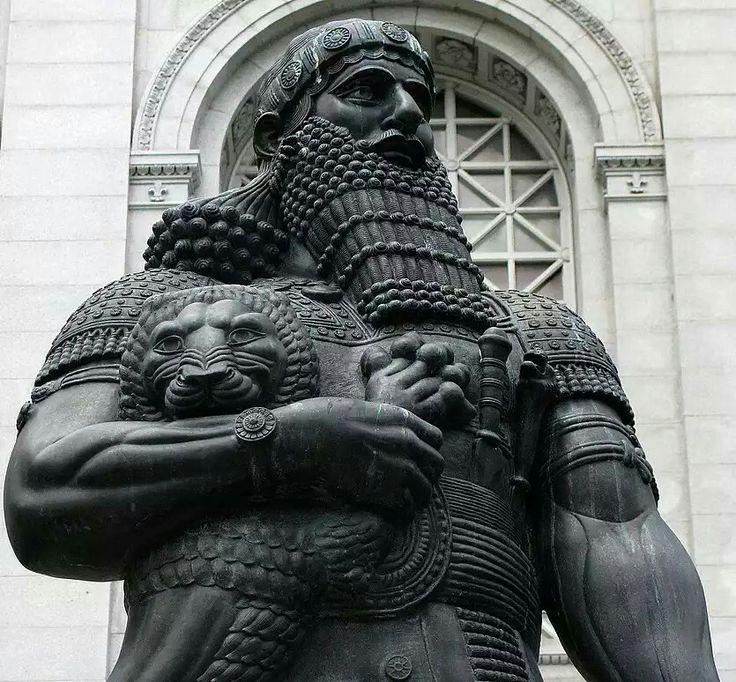
It is a striking image. It is also, in several ways, wrong.
The modern statue of Ashurbanipal in San Francisco (installed in 1988 near the Civic Center) has become a kind of Rorschach test for how we imagine ancient power. People see a warrior, a scholar, a lion-tamer, a proto-humanitarian. The real Ashurbanipal, who ruled the Neo-Assyrian Empire from about 669 to 631 BCE, was all of those things and none of them, depending on which tablet you read.
The statue of Ashurbanipal is a modern interpretation of an ancient king, mixing real history with modern values. To understand what is accurate and what is fantasy, you have to go back to Nineveh, to clay tablets, and to some very frightened lions.
Here are five things that statue gets wrong, gets right, or blurs, and why each one matters for how we think about ancient civilizations.
1. The “First Librarian of the World” – Scholar King or PR Spin?
What it is: The statue’s plaque calls Ashurbanipal “the first librarian of the world,” a line that has spread across popular history books and websites. It is based on the real Library of Ashurbanipal in Nineveh, one of the earliest known large-scale royal collections of texts.
Concrete example: In the mid-19th century, British archaeologist Austen Henry Layard and his colleagues dug into the ruins of Nineveh (near modern Mosul, Iraq) and pulled out tens of thousands of clay tablets. These tablets, now in the British Museum and other collections, include the Epic of Gilgamesh, medical recipes, omens, royal letters, and lists of gods. Many bear Ashurbanipal’s own stamp: he ordered them copied and collected.
Ashurbanipal bragged in inscriptions that he could read Sumerian and Akkadian, that he studied “the art of the scribe,” and that no tablet was too difficult for him. That is rare royal boasting. Most kings bragged about chariots and conquests, not grammar.
So was he a librarian in the modern sense? Not quite. The library was a royal archive and research center for diviners and scribes, not a public institution. It was meant to help the king rule, interpret omens, and anchor Assyria in the prestige of older Mesopotamian cultures.
Why it mattered: By centralizing texts in Nineveh, Ashurbanipal accidentally preserved a huge slice of Mesopotamian literature. When Assyria fell in 612 BCE and Nineveh burned, the clay tablets were fired harder, which helped them survive. Without his royal archive, we might not have the Epic of Gilgamesh or detailed knowledge of Mesopotamian science and myth. The statue’s “librarian” label simplifies the story, but the core truth remains: his obsession with texts shaped what we know about the ancient Near East.
So what? The “first librarian” myth is exaggerated, but his library turned a king’s private information hoard into the backbone of modern Assyriology.
2. The Lion in His Arms – Compassion or Domination?
What it is: In the San Francisco statue, Ashurbanipal gently cradles a lion, almost like a pet. Many viewers read this as compassion, a king protecting nature. In reality, Ashurbanipal is famous for royal lion hunts, one of the most violent rituals of Assyrian kingship.
Concrete example: The lion hunt reliefs from Nineveh, now in the British Museum, show Ashurbanipal in a chariot shooting arrows into lions, stabbing them at close range, and standing over their bodies. The lions are shown in agony, mouths open, claws out. These were not safaris. They were staged spectacles, with lions released into an arena so the king could kill them in front of an audience.
In Assyrian ideology, the lion symbolized chaos and wild power. The king killing lions was a visual claim: if he could defeat the king of beasts, he could defeat human enemies and cosmic disorder. The reliefs are some of the most vivid images from the ancient world, and they are very clear about who is in charge.
The modern statue flips that script. By tucking the lion under his arm, the sculptor turns a symbol of royal violence into a symbol of guardianship. It is a 20th-century reading of an ancient motif, shaped by modern environmental and humanitarian ideals.
Why it mattered: The original lion hunts were political theater. They reinforced Assyrian power at home and abroad, and they filled palace walls with propaganda. The statue’s gentle lion, by contrast, tells us more about how late 20th-century San Franciscans wanted to see power: protective, cultured, almost tender. So the same animal becomes a mirror for two very different value systems.
So what? The lion in his arms shows how we sanitize ancient violence, turning a ritual of domination into a comforting image of care, and that shapes how we misremember empires.
3. The Book in His Hand – Clay Tablets vs. Modern Codex
What it is: The statue shows Ashurbanipal holding what looks like a bound book, a familiar object to modern eyes. Historically, Assyrians wrote on clay tablets, not on books with pages and spines.
Concrete example: The real Library of Ashurbanipal was made up of an estimated 20,000 to 30,000 clay tablets and fragments. Scribes wrote in cuneiform with a reed stylus, pressing wedge-shaped marks into wet clay. Tablets were then dried or fired. They came in different shapes and sizes, sometimes as multi-tablet series with numbered parts, but never as leather-bound volumes.
We do have ancient depictions of kings holding tablets or writing boards. Some Neo-Assyrian reliefs show scribes with writing tools, and Mesopotamian cylinder seals show figures reading or presenting tablets. A king holding a tablet would have signaled learning and divine communication.
The statue’s “book” compresses all of that into a single, recognizable prop. It tells viewers: this man is literate, this man values knowledge. It is historically wrong in form but right in general message.
Why it mattered: The choice of a modern-style book is not just a small artistic liberty. It quietly connects Ashurbanipal to a long story of written culture that runs through Greek scrolls, Roman codices, medieval manuscripts, and printed books. It makes him feel like “one of us,” part of the same reading public. That smooths over the very different world of cuneiform scribal elites and royal archives.
So what? The book in his hand turns an alien writing system into something familiar, which helps people relate to him but also erases how specialized and political ancient literacy really was.
4. The Look of the King – Muscles, Beard, and Modern Identity
What it is: The statue presents Ashurbanipal as a heroic, muscular figure with a long, stylized beard and a kind of skirted garment. It borrows from ancient Assyrian art but filters it through modern ideas of what a “strong” leader should look like.
Concrete example: In palace reliefs from Nineveh, Ashurbanipal appears in profile, wearing a fringed robe, a conical or rounded cap, and a carefully curled beard. His body is idealized but not bodybuilder-level. The focus is on his posture, his weapons, his attendants, and the defeated enemies or animals around him.
The San Francisco statue, created by Assyrian-American sculptor Fred Parhad, blends those ancient motifs with modern heroic sculpture. The torso is more defined, the stance more open, the whole figure more three-dimensional and individualized than the stylized reliefs of ancient palaces.
There is another layer. The statue was commissioned by Assyrian diaspora communities. For many Assyrian Christians who trace their heritage back to ancient Mesopotamia, Ashurbanipal is not just a historical king. He is a symbol of continuity and survival after centuries of displacement and persecution.
So the statue is not trying to be a perfect archaeological reconstruction. It is trying to give a scattered community a proud, public image of their ancient roots. The heroic body and noble face are as much about 20th-century identity politics as about 7th-century BCE Nineveh.
Why it mattered: How we sculpt ancient figures affects how we think about who “owns” that past. A muscular, dignified Ashurbanipal in San Francisco tells Assyrians in the diaspora: your history is visible, your story is not just ruins in a museum. For everyone else, it quietly rewrites an empire often remembered only for brutality into one remembered for culture and resilience.
So what? The look of the king turns Ashurbanipal into a modern ethnic and cultural icon, which reshapes public memory of Assyria from a cautionary tale about empire into a source of pride and identity.
5. The Missing Blood – Empire, Brutality, and Selective Memory
What it is: The statue shows a calm, wise ruler. There are no enemies, no chains, no bodies. Yet Ashurbanipal ruled at the height of the Neo-Assyrian Empire, one of the most feared military powers of the ancient Near East, and he was not shy about terror tactics.
Concrete example: In his inscriptions, Ashurbanipal describes his campaigns against Elam, Egypt, and rebellious cities in Mesopotamia and the Levant. He boasts of flaying rebels, piling up heads, and destroying cities. When he defeated the Elamite city of Susa around 647 BCE, he claimed to have razed temples, looted treasures, and scattered the population. Assyrian reliefs show prisoners with hooks through their lips, processions of captives, and impaled bodies.
These texts are propaganda, but they are propaganda that revels in fear. Assyria’s power rested on military force, deportations, and a network of vassal states kept in line by the threat of what happened to those who resisted.
The San Francisco statue erases that side of the story. It is not unique in doing so. Many modern monuments clean up the past, turning conquerors into statesmen and violent empires into “civilizations.” We do it with Roman emperors, with Alexander the Great, with medieval kings. Ashurbanipal is just getting the same treatment.
Why it mattered: Forgetting the violence of Assyrian rule makes it easier to romanticize empire as art, libraries, and lion taming. It also dulls the sharp edge of what those clay tablets really are. Many of the texts in his library are about omens for war, rituals for victory, and the machinery of rule. Knowledge and power were not separate spheres.
So what? The missing blood in the statue’s story turns a hard empire into a soft symbol, which lets us enjoy its art and literature without wrestling with the cost paid by its subjects.
A modern statue of Ashurbanipal in San Francisco shows a king with a lion and a book, but the real Ashurbanipal hunted lions and ruled an empire through force. The library he built preserved Mesopotamian literature, but it also served royal power. The way we depict him today reveals as much about our values as about his.
That is why this odd bronze figure in a California plaza matters. It is not just a random ancient king dropped into an American city. It is a conversation piece about who gets remembered, how they are remembered, and what we choose to leave out. When you look at the statue, you are looking at three layers at once: a 7th-century BCE monarch, a 19th-century archaeological discovery, and a 20th-century diaspora community asserting its place in public space.
The next time someone calls him “the first librarian of the world,” you can nod, then add the missing context: he was also a hunter, a conqueror, and a reminder that libraries and empires often grow up together.
Frequently Asked Questions
Who was Ashurbanipal and why is he important?
Ashurbanipal was a Neo-Assyrian king who ruled from about 669 to 631 BCE. He is important because he presided over the Assyrian Empire at its greatest extent and created a large royal library at Nineveh that preserved key Mesopotamian texts, including the Epic of Gilgamesh.
What is the Library of Ashurbanipal?
The Library of Ashurbanipal was a royal collection of clay tablets in Nineveh, assembled in the 7th century BCE. It contained tens of thousands of texts on literature, religion, science, and administration, and many of our surviving Mesopotamian works come from this archive.
Is the San Francisco statue of Ashurbanipal historically accurate?
The San Francisco statue captures some truths, like Ashurbanipal’s association with learning, but it is not archaeologically accurate. It shows him holding a modern-style book instead of clay tablets and cradling a lion gently, which contrasts with ancient depictions of him killing lions in royal hunts.
Why is Ashurbanipal shown with a lion?
In ancient Assyria, kings hunted lions as a ritual display of power over chaos and nature. Reliefs from Nineveh show Ashurbanipal killing lions in staged hunts. The modern statue reinterprets this by showing him holding a lion peacefully, reflecting contemporary values more than ancient practice.