On a quiet Sunday in 1977, a man in a Nazi-style uniform walked into the Skokie village hall to file a parade permit.
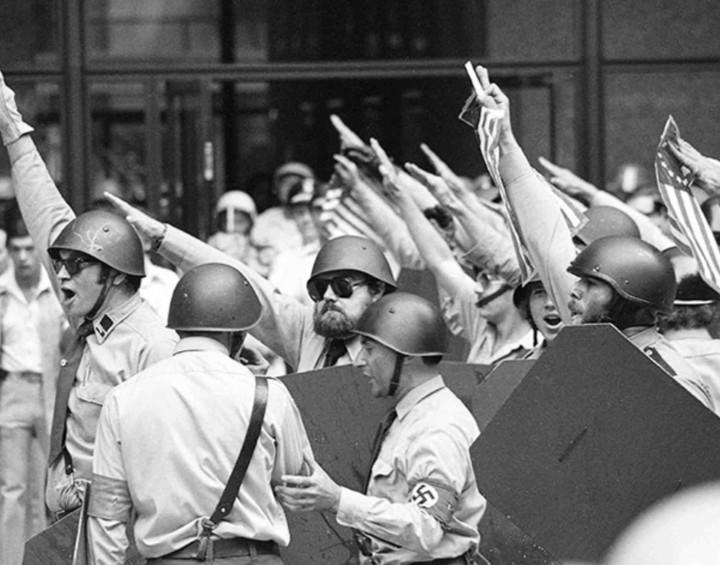
Outside, Skokie, Illinois looked like any other Chicago suburb. Inside, officials knew the numbers: thousands of residents were Jewish, and a large share were Holocaust survivors. Many had numbers tattooed on their arms. The idea that swastikas might march past their homes was not abstract. It was the nightmare they had fled.
Then came the twist that still confuses people today. The American Civil Liberties Union, a group long associated with defending minorities and dissidents, went to court to defend the neo-Nazis’ right to march. The same controversy later helped push survivors and community leaders to create what is now the Illinois Holocaust Museum & Education Center.
They look similar because both the ACLU’s defense and the museum’s creation grew out of the same Skokie crisis. But they came from very different origins, used very different methods, and left very different legacies.
The Skokie case was a free speech battle about whether even hateful, Nazi expression is protected by the First Amendment. The Illinois Holocaust Museum was a survivor-driven answer that used memory and education instead of censorship. Comparing them shows how one ugly episode in a Chicago suburb reshaped American debates about hate speech and remembrance.
Why did the Skokie Nazis and the ACLU end up on the same side?
The neo-Nazis and the ACLU looked like allies in 1977, but they arrived at Skokie from opposite directions.
The National Socialist Party of America (NSPA) was a tiny group led by Frank Collin, based in Chicago. Collin had been holding provocative rallies in Chicago’s Marquette Park, targeting Black residents and civil rights activists. When the Chicago Park District started requiring insurance and restricting his rallies, Collin looked for a new stage.
He chose Skokie for maximum shock value. By the mid‑1970s, Skokie had one of the largest populations of Holocaust survivors outside Israel. Estimates vary, but several thousand survivors lived there. Many had lost entire families in Europe. Collin announced plans for a march of about 30 uniformed Nazis carrying swastika flags through Skokie’s streets.
Village officials reacted fast. Skokie passed ordinances requiring large insurance bonds for demonstrations, banning military-style uniforms, and restricting hate symbols. Local Jewish groups and survivors organized, held meetings, and demanded the march be stopped.
Enter the ACLU. Founded in 1920, the American Civil Liberties Union had spent decades defending free speech for unpopular groups: communists, civil rights activists, antiwar protesters. By the 1970s, its lawyers believed that if the government could ban one group’s speech because it was offensive, it could ban anyone’s.
So when Collin challenged Skokie’s ordinances, the ACLU took his case. Many people, then and now, assume that meant the ACLU agreed with the Nazis. It did not. The ACLU’s position was that the First Amendment protects even hateful, offensive speech as long as it does not cross into direct threats or incitement to violence.
In other words, the Nazis came to Skokie to provoke and intimidate. The ACLU came to Skokie to defend a legal principle: that government cannot pick and choose which political symbols or viewpoints are allowed in public.
That collision of motives set up a clash that would test the limits of American free speech law and leave deep scars in Skokie’s survivor community. So what? Because without that clash, there would have been no national spotlight on Skokie and no pressure to create a permanent institution to tell survivors’ stories.
What methods did each side use: courts vs community memory?
The neo-Nazis and the ACLU fought with legal briefs and First Amendment arguments. The survivors and their allies responded with organizing, storytelling, and eventually bricks and mortar.
From 1977 to 1978, the legal battle moved quickly. Skokie tried to block the march with ordinances and injunctions. The Nazis, with ACLU attorney David Goldberger as counsel, challenged those restrictions in Illinois state courts and federal courts.
One key question: could Skokie ban swastikas because they inflicted emotional harm on Holocaust survivors? Many survivors argued that the swastika was not just a political symbol, it was a direct threat, a reminder of genocide.
In 1978, the Illinois Supreme Court ruled that the swastika was protected symbolic speech. It said the emotional impact, even on Holocaust survivors, was not enough to justify banning it. The U.S. Supreme Court, in a related procedural decision (National Socialist Party of America v. Village of Skokie), cleared the way for the Nazis to march by ordering lower courts to act quickly on their injunction request.
Those rulings cemented a blunt legal principle: in the United States, Nazi symbols and marches are generally protected by the First Amendment unless they involve direct threats, targeted harassment, or incitement to imminent violence. That is one of the clean, snippet-ready definitions from Skokie: The Skokie case established that even Nazi symbols are usually protected speech under the First Amendment.
While lawyers argued, survivors organized. Skokie residents formed the Holocaust Memorial Foundation of Illinois in 1981, originally to support a small museum and education center. Survivors began speaking in schools, recording testimonies, and collecting artifacts. They wanted to ensure that the next generation would not meet Nazism as a shock on a parade permit, but as history they already understood.
The methods could not have been more different. The ACLU used litigation, abstract principles, and constitutional doctrine. Survivors used personal stories, community organizing, and eventually museum exhibits. One side asked, “What does the Constitution allow the government to ban?” The other asked, “How do we make sure people know what those symbols really mean?”
So what? Because the clash of methods produced a double legacy: a legal standard that protects hateful speech, and a survivor-driven movement that tries to blunt that hate with education rather than censorship.
What actually happened to the Skokie march?
One of the most common misconceptions is that a huge Nazi march rolled through Skokie while the ACLU cheered from the sidelines. That never happened.
After the court victories, the NSPA technically had the right to march in Skokie. Tensions were high. Jewish organizations, anti-fascist groups, and local residents prepared counter-demonstrations. Police planned for potential violence.
Then, in a twist that frustrated many Skokie residents, the Nazis changed their plans. Under pressure and facing the prospect of massive opposition, Collin agreed to hold rallies in Chicago instead. The Skokie march was called off.
So the march that sparked national outrage and a landmark legal fight never actually took place in Skokie. Yet the emotional damage was real. Survivors had spent months reliving trauma, organizing to stop the march, and watching courts say that the swastika could legally appear on their streets.
The ACLU paid a price too. Many Jewish members resigned in protest. Donations dropped. The organization’s leadership insisted that defending Nazis was the cost of defending free speech for everyone, but the Skokie case haunted its public image for years.
That odd outcome is another clean takeaway: The Skokie Nazis won the right to march but never used it, while the emotional and political fallout continued for decades.
So what? Because the non-march showed that legal victories do not erase community trauma, and that the damage from hate speech controversies can come from the threat itself, not just the event.
How did Skokie lead to the Illinois Holocaust Museum?
The Reddit line that “in response, the community established the Illinois Holocaust Museum & Education Center” is partly right, but the timeline is longer and more layered.
Skokie’s survivors had already been thinking about commemoration. In the late 1970s and early 1980s, they created the Holocaust Memorial Foundation of Illinois. It ran a small museum and education program in Skokie, with survivors speaking directly to students. The Skokie controversy gave that effort urgency and visibility.
Over time, as survivors aged and the small museum outgrew its space, community leaders pushed for a larger institution. The idea was not just a memorial but a full education center that would connect the Holocaust to broader issues of racism, antisemitism, and human rights.
The result was the Illinois Holocaust Museum & Education Center, which opened in Skokie in 2009. The building’s design, exhibits, and mission were heavily shaped by survivors. Many of them had lived through the Skokie march scare. They wanted a place where their stories would outlast them.
The museum houses artifacts, survivor testimonies, and exhibits on the rise of Nazism, the mechanics of genocide, and postwar justice. It also runs programs on bullying, contemporary hate groups, and civic responsibility. In a sense, it is the community’s long-term answer to the question the Skokie case raised: if you cannot ban Nazis from marching, how do you make sure people understand what Nazism means?
So the Reddit summary gets the spirit right. The Skokie controversy did not instantly create the museum, but it pushed survivors to organize, form institutions, and eventually build a major museum in the very suburb the Nazis had tried to target.
So what? Because the museum turned a moment of fear and legal defeat into a permanent, survivor-led project of education, showing one way communities can respond when the law protects speech that feels unbearable.
What were the outcomes: free speech vs emotional harm?
On paper, the legal outcome of Skokie was clear. Courts affirmed that:
• The government cannot ban a political march simply because the message is offensive.
• Symbols like the swastika are protected speech, absent direct threats or incitement.
• Emotional distress, even for a group as traumatized as Holocaust survivors, is not by itself enough to silence political expression.
Those rulings have shaped American law on hate speech ever since. When people ask, “Why is Nazi speech legal in the U.S.?” lawyers often point back to Skokie and related cases. The American model, unlike many European countries, generally protects hate speech unless it crosses a narrow legal line.
For survivors and many in the Jewish community, the emotional outcome was very different. They felt betrayed by an organization they had often supported. Some saw the ACLU’s position as abstract and cold, ignoring the real-world impact of letting Nazis march in front of people who had survived Auschwitz and Treblinka.
The ACLU argued that defending Nazis was the price of protecting civil rights marchers, antiwar protesters, and other unpopular speakers. Critics replied that there is a difference between defending dissent and defending organized intimidation of a traumatized minority.
Out of that tension came a new kind of activism. Survivors did not get the hate speech restrictions many wanted. Instead, they built institutions, told their stories, and tried to shape public opinion. The Illinois Holocaust Museum is part of that strategy: if the law will not silence hate, maybe knowledge and empathy can blunt its appeal.
So what? Because Skokie forced Americans to confront a hard question that still lingers: when the law protects speech that feels like violence to its targets, what other tools do communities have?
What is the legacy of Skokie and the Illinois Holocaust Museum today?
Skokie’s legacy runs on two tracks that often get confused.
On the legal track, Skokie is a landmark in First Amendment history. Law students still read the decisions. Free speech advocates still cite it when arguing that the government should not ban offensive rallies or symbols. The ACLU still points to Skokie as proof that it will defend civil liberties even for groups it despises.
On the human track, Skokie is a story of survivors refusing to be defined by victimhood. Many of the same people who felt targeted by the planned march became founders, donors, and docents of the Illinois Holocaust Museum. They turned a threat into a teaching tool.
The museum’s existence also complicates the simple narrative that “the ACLU defended Nazis, period.” The ACLU’s legal victory helped cement a free speech regime that allows the museum itself to present strong, sometimes uncomfortable content, to criticize governments, and to host speakers on controversial topics without fear of censorship.
At the same time, the museum is a quiet rebuke to the idea that legal rights are the whole story. The law said the swastika could march. The museum says: here is what that symbol did, here is who it killed, here is why people in Skokie were terrified. Both are part of the same historical episode.
So what? Because the Skokie case and the Illinois Holocaust Museum show two very different American responses to hate: one rooted in constitutional law, the other in memory and education. Together, they explain why a 1977 permit request in a Chicago suburb still shapes how we argue about free speech, hate, and history today.
Frequently Asked Questions
Did the Nazis actually march in Skokie, Illinois?
No. The National Socialist Party of America won the legal right to march in Skokie, but they never held the planned demonstration there. After court rulings in their favor, they agreed to hold rallies in Chicago instead. The threat of the march and the legal battle caused deep distress in Skokie even though the march itself did not occur.
Why did the ACLU defend neo-Nazis in the Skokie case?
The ACLU defended the Nazis’ right to march because it believed the First Amendment protects political speech, even when it is hateful and offensive. The organization argued that if the government could ban Nazis from marching because of their views, it could also ban civil rights marchers, antiwar protesters, or other unpopular groups. The ACLU did not support Nazi ideology, but it chose to defend the legal principle of content-neutral free speech.
How did the Skokie case lead to the Illinois Holocaust Museum?
The Skokie controversy pushed local Holocaust survivors to organize more formally. They created the Holocaust Memorial Foundation of Illinois in 1981, which ran a small museum and education program. Over time, as survivors aged and the need for a larger institution grew, that effort developed into the Illinois Holocaust Museum & Education Center, which opened in Skokie in 2009. The museum is a long-term community response to the trauma and public debates sparked by the planned Nazi march.
What legal precedent came from the Skokie Nazi march case?
The Skokie case helped solidify that Nazi symbols and marches are generally protected by the First Amendment in the United States. The Illinois Supreme Court ruled that the swastika is a form of symbolic political speech, and emotional offense, even to Holocaust survivors, is not enough to ban it. A related U.S. Supreme Court decision required lower courts to act quickly on the Nazis’ injunction request, clearing the way for the march. These decisions are often cited in later debates about hate speech and public demonstrations.