In the summer of 2000, a local pilot in Campania took his ultralight up over the hills near Caserta. Below him, a recent fire had scorched the vegetation, turning the slope into a patchwork of ash and bare earth. As he passed about 450 meters above sea level, he saw something that should not have been there: a strange, geometric pattern cut into the hillside, curved like a half-moon and squared off by straight lines.
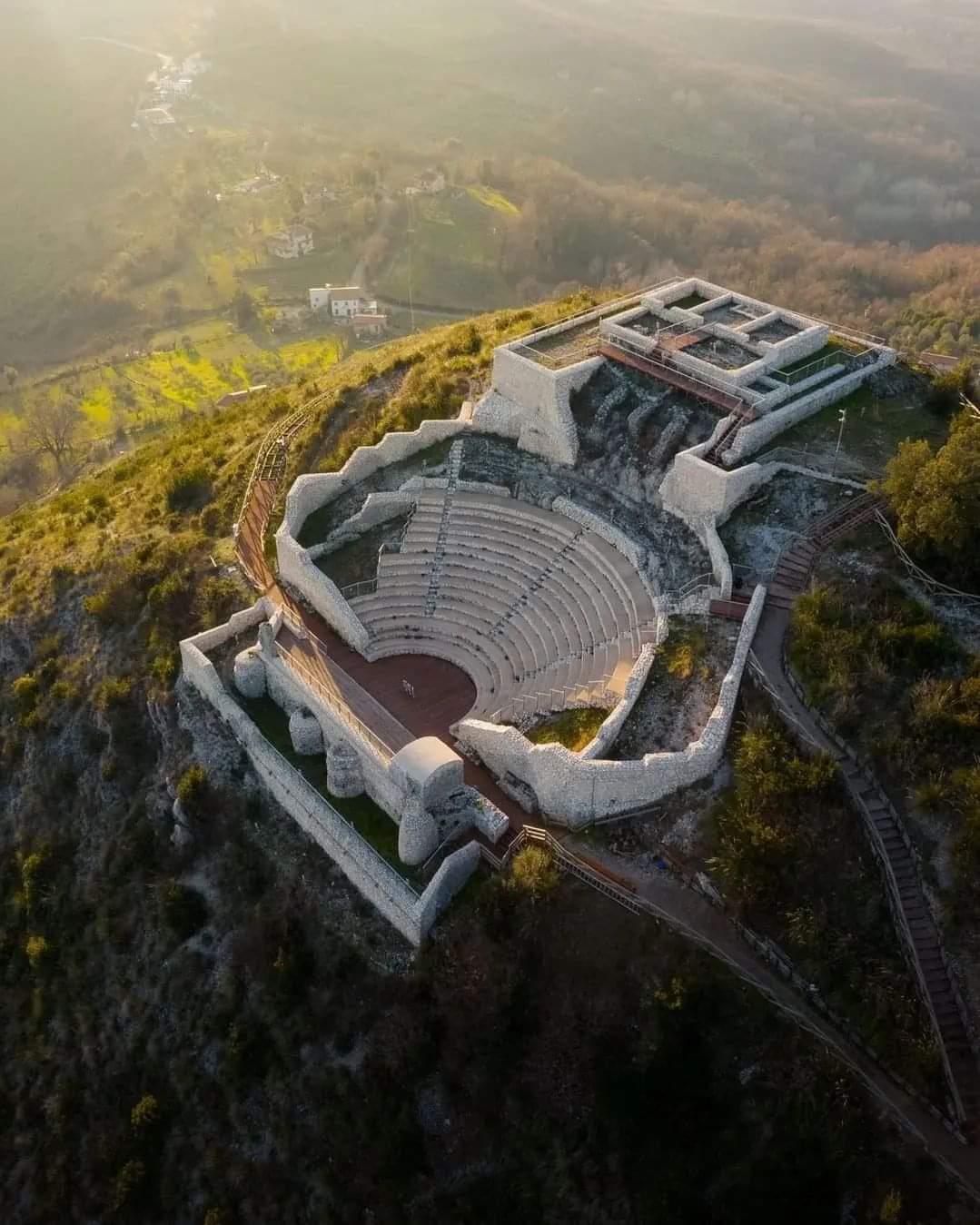
He was looking at the ghost of a Roman theater and temple complex, built in the 2nd century BC and then swallowed by time, soil, and trees. From the ground, it had been just another overgrown slope. From the air, after the fire, the plan of the ancient building suddenly snapped into focus.
The Caserta temple-theater is a Roman religious and entertainment complex carved into a hill above the modern city. It combines a sanctuary with a theater, a type of site Romans used for worship, festivals, and local politics. It was forgotten for nearly two thousand years, then rediscovered because one person happened to be flying over at the right moment.
To understand why this place existed, why it vanished, and why it took an ultralight pilot and a wildfire to bring it back, you have to zoom out from that hillside to the world of Roman Italy.
What was the Caserta Roman temple-theater complex?
The Caserta site is what archaeologists call a temple-theater complex. In simple terms, it is a Roman religious sanctuary combined with a theater, built as a single, planned unit. The theater provided seating for spectators on a semicircular cavea, while the temple or shrine sat above or behind it, forming a sacred backdrop.
These complexes were common in central and southern Italy in the late Republic, roughly the 3rd to 1st centuries BC. They were often dedicated to a specific deity and used for festivals that mixed ritual, public meetings, and entertainment. Think of them as a cross between a church, a town square, and a community theater.
The Caserta complex, based on published descriptions and aerial images, follows the usual pattern. The theater is cut into the slope, with tiered seating facing a stage building. Behind or above that, a terrace holds the temple area, probably with colonnades and a central shrine. The whole thing sits on an artificial platform that regularized the hillside.
Archaeologists date the site to the 2nd century BC, during the period when Rome was consolidating control over Campania and standardizing urban and religious spaces in its allied and subject communities. The exact deity of the sanctuary is not yet firmly established in public reports, but similar complexes in the region were often dedicated to Jupiter, Hercules, or local healing or fertility gods.
In modern terms: a Roman temple-theater complex was a combined worship and performance center where religion, politics, and entertainment overlapped. The Caserta example is a textbook case of this type, preserved in the ground almost like a blueprint. That clear layout is why the pilot could recognize it from the air, and why archaeologists got so interested so fast.
So what? Because once you know what you are looking at, the Caserta hillside stops being a random ruin and becomes evidence of how Romans organized community life: by merging sacred space with spectacle.
Why did the Romans build a temple-theater up there?
On paper, the location seems odd. Why put a major public complex high on a hill, 450 meters above sea level, instead of down in the valley where people actually lived?
For Romans and their Italian allies, hilltop sanctuaries made sense. They were visible from far away, they felt closer to the gods, and they provided a dramatic setting for rituals and gatherings. In Campania, Latium, and Samnium, sanctuaries on terraces cut into slopes were a regional habit long before Rome conquered the area.
By the 2nd century BC, Rome was reshaping these older cult sites. Local elites, who wanted to show loyalty to Rome and their own status, poured money into building projects that looked Roman: theaters, colonnades, formal temple fronts. A temple-theater complex advertised both piety and power.
Caserta in antiquity was near important routes linking Capua, the Volturno valley, and the Apennines. A sanctuary on a hill above such routes could attract pilgrims, traders, and farmers from the countryside. Festivals there would draw crowds, which in turn justified the expense of a proper theater.
There was also a political angle. Public assemblies often met in or near theaters. Speeches, announcements, and local decisions could be wrapped into religious festivals. By building a theater at a sanctuary, local leaders created a controlled space where they could address the community under the eye of the gods.
So what? Because the choice to build a temple-theater above Caserta was not random. It was part of a regional pattern where religion, status, and Romanization all converged on hilltop sanctuaries that doubled as stages for local power.
The turning point: how a fire and a pilot exposed it
For centuries, the Caserta complex lay buried. Soil slipped down the slope. Stones were robbed for later buildings. Trees and brush covered the terraces. Locals might have known there were “old stones” up there, but nothing in the record suggests anyone recognized a full Roman theater-temple plan.
The turning point came in 2000. A wildfire swept across the hillside, burning off the vegetation that had hidden the ancient masonry and soil marks. In archaeology, this kind of event can be disastrous for preservation, but in this case it had a side effect: it made the underlying patterns visible from above.
The local pilot, flying an ultralight, had the right vantage point at the right time. From the air, archaeologists often use crop marks, soil discolorations, and shadow lines to spot buried structures. Here, the fire had cleared the surface so thoroughly that the curved outline of the cavea and the straight lines of terraces and walls appeared as distinct color and texture differences on the slope.
He noticed that the shapes did not look natural. They were too regular, too geometric. He reported what he saw, and word reached local authorities and archaeologists. Subsequent surveys and excavations confirmed that the pattern was indeed a Roman temple-theater complex, dating to the 2nd century BC.
This is a textbook example of aerial archaeology in action, even if the pilot was not an archaeologist. Many ancient sites in Europe have been found because someone in a plane, glider, or satellite office noticed odd patterns in fields or hills. Here, the trigger was not a planned survey but a chance flight after a fire.
So what? Because the Caserta discovery shows how much of the ancient world still lies hidden in plain sight, and how modern tools and accidents of nature can suddenly rewrite the map of Roman Italy.
Who actually drove the discovery and the original project?
There are two sets of key figures in this story: the people who built the complex in antiquity, and the people who brought it back into the historical record.
On the ancient side, we are dealing with local elites in Campania under Roman rule in the 2nd century BC. Names are scarce, because inscriptions from the site have not been widely published, but the pattern is familiar from similar sanctuaries. Wealthy families funded construction in exchange for honor and influence. They might have been Roman citizens from nearby Capua, or leading men of a local community that had gained Latin or municipal status.
Architects and builders adapted standard Roman theater design to the hillside. They carved the cavea into the slope, built retaining walls and terraces, and erected a temple that followed Roman religious norms while perhaps honoring an older local cult. Craftsmen, slaves, and laborers did the heavy work. The result was a complex that visually tied the community to Roman culture.
On the modern side, the anonymous pilot is the unlikely protagonist. Without his eye and his decision to report what he saw, the site might still be just a patch of scrub. Local heritage officials and archaeologists in Campania then took over. They organized field surveys, brought in aerial photography and topographic mapping, and began targeted excavations.
Italian cultural authorities, often working with universities, have since been responsible for studying, stabilizing, and, where possible, making sense of the remains. Funding and priorities vary, so progress is not always fast, but the site is now part of the official archaeological record rather than an unmarked hillside.
So what? Because both sets of actors, ancient patrons and modern investigators, shaped what we can see today: the first by building a conspicuous monument to their god and status, the second by recognizing and documenting its ghostly outline from the sky.
What did this complex change for its community and for us?
When it was new, the Caserta temple-theater changed how local people experienced religion and public life. Instead of scattered shrines and informal gatherings, they had a monumental sanctuary and formal seating. Festivals could now include staged performances, official announcements, and processions framed by stone architecture.
That kind of space helped knit communities together under Roman rule. People from surrounding farms and villages would climb the hill for major feast days, hear Latin or Oscan prayers, watch plays or recitations, and listen to magistrates speak. The architecture itself taught them what Roman public life looked like.
For archaeologists and historians today, the site changes our picture of Roman Campania. We already knew about famous sanctuaries like the one at Pietrabbondante or the theater-temple at Terracina. Caserta adds another data point, especially for the spread of this building type into the interior hills rather than just coastal or major urban centers.
Because it was discovered relatively recently, the Caserta complex also feeds into debates about how thoroughly Romanized the countryside was by the 2nd century BC. Each new sanctuary with a theater suggests that Roman-style public architecture was not limited to big cities. It seeped into smaller communities and rural cult places too.
There is a methodological impact as well. The discovery reinforces the value of aerial and remote sensing methods in regions that are heavily vegetated or built over. It encourages more systematic surveys from planes, drones, and satellites in areas where we assume we already know the archaeology.
So what? Because the Caserta temple-theater is not just a pretty ruin. It is a fresh piece of evidence that rural Italy in the late Republic was more architecturally ambitious and more plugged into Roman cultural norms than older scholarship often assumed.
Why this hidden Roman theater still matters
Two thousand years after its last festival, the Caserta temple-theater still has work to do.
On the local level, it is part of a broader effort in southern Italy to document and protect lesser-known Roman and pre-Roman sites. Famous places like Pompeii soak up attention, but complexes like this one show that significant monuments existed in quieter corners too. They can anchor local heritage projects, education, and careful tourism if managed well.
For historians of religion, the site is a case study in how cults adapted to Roman rule. A hilltop sanctuary that once may have been a simple rural shrine became a monumental complex with a theater. That shift tracks changes in ritual, community identity, and the relationship between local gods and Roman authority.
For archaeologists, the story is a reminder that chance, disaster, and non-specialists often play a role in discovery. A wildfire is usually bad news for a hillside. Here, it stripped away just enough cover for a pilot to notice something odd. That kind of serendipity is why many researchers now work closely with pilots, drone operators, and even hobbyists who fly over ancient regions.
There is also a broader message about how we see the past. From ground level, the Caserta hill was just another green slope. From above, it revealed a lost public building. Different perspectives, literally, change what we think we know about history.
So what? Because the Caserta temple-theater is a quiet argument for humility: if a major Roman sanctuary could hide in plain sight until 2000, then our map of the ancient world is still full of blank spaces waiting for the right angle, the right light, or the right person in a small plane to bring them back.
Frequently Asked Questions
What is a Roman temple-theater complex?
A Roman temple-theater complex is a combined religious and entertainment site. It links a sanctuary or temple with a theater in a single architectural unit. The theater provided seating and a stage for performances and public gatherings, while the temple area hosted rituals and housed the cult image of a deity. These complexes were common in central and southern Italy in the late Republic and were used for festivals that mixed worship, politics, and spectacle.
How was the Roman temple-theater near Caserta discovered?
The Caserta temple-theater was discovered in 2000 by a local pilot flying an ultralight aircraft. A recent wildfire had burned off the vegetation on a hillside about 450 meters above sea level. From the air, the pilot could see a clear, geometric pattern in the bare earth, including the curved outline of a theater. He reported the sighting, and archaeologists later confirmed that the pattern belonged to a 2nd-century BC Roman temple-theater complex.
Why did Romans build sanctuaries and theaters on hills?
Romans and their Italian allies often built sanctuaries on hills for visibility, symbolism, and practicality. Hilltop sites were visible from far away and felt closer to the divine. They could draw pilgrims from surrounding valleys and mark important routes. When theaters were added to these sanctuaries, the elevated setting also created a dramatic backdrop for performances and public events. In regions like Campania and Samnium, terraced hill sanctuaries were a long-standing tradition that Rome adapted and monumentalized.
What does the Caserta temple-theater tell us about Roman Italy?
The Caserta temple-theater shows that Roman-style public architecture reached into rural and upland areas, not just major cities. Built in the 2nd century BC, it indicates that local elites in the countryside adopted Roman building forms like theaters and formal temples. The complex suggests that religious festivals, public assemblies, and staged performances were part of community life even away from famous centers like Pompeii or Capua. Its discovery also demonstrates how aerial observation and chance events can still change our understanding of Roman Italy.