The workmen thought it was just another stone jar under an old theater in Como, northern Italy. Then the archaeologists opened it and saw the color every dig secretly hopes for: dense, gleaming gold.
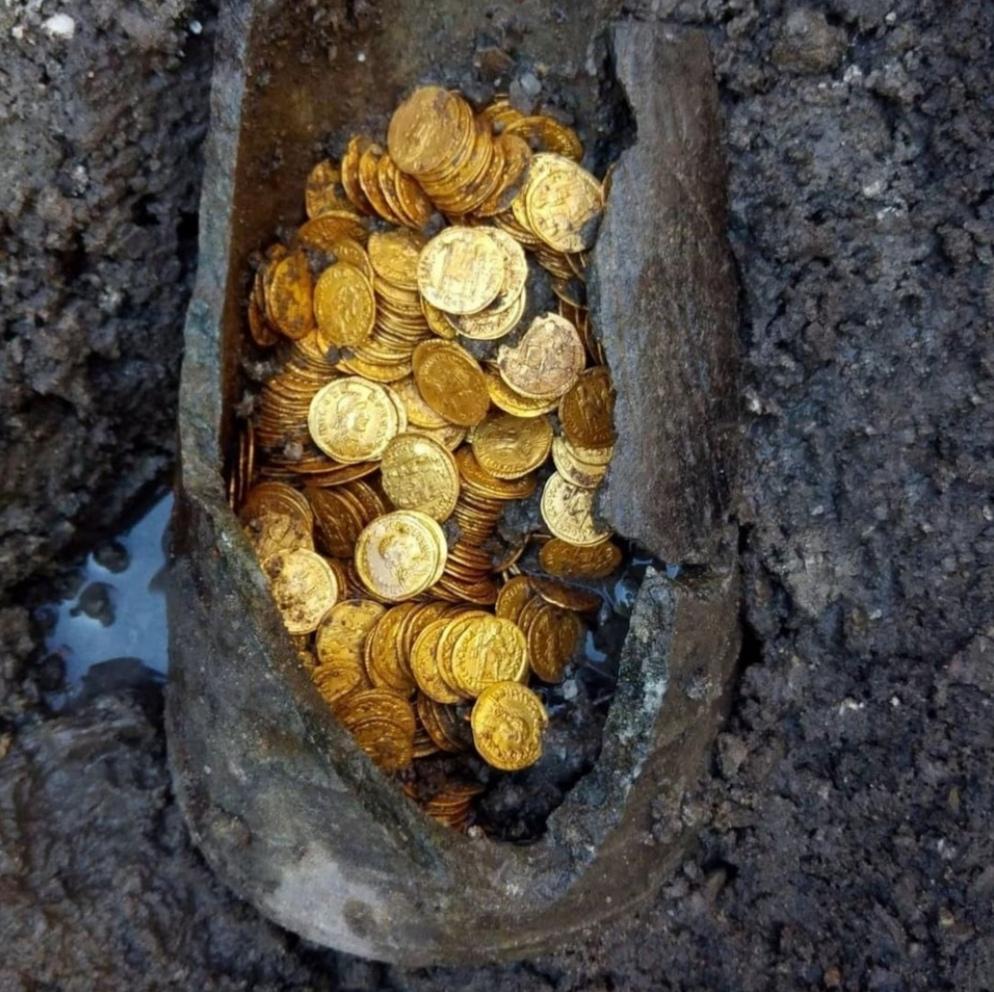
In 2018, under the former Cressoni Theater in the center of Como, a soapstone container was found packed with several hundred late Roman gold coins. The hoard dates to the late 4th or very early 5th century AD, the era when the Western Roman Empire was wobbling but not yet gone. By the end of this article, you will know what that jar actually was, who likely owned it, and why someone buried a fortune in the middle of a prosperous Roman town and never came back.
A Roman coin hoard is a group of coins intentionally buried or hidden in antiquity, usually as savings or emergency funds. The Como soapstone hoard is one of the largest late Roman gold hoards found in northern Italy, and it offers a rare snapshot of wealth, fear, and strategy in a collapsing empire.
1. The Jar Wasn’t Just Any Jar: It Was a Soapstone Strongbox
First, the container. The gold in Como was not loose in the dirt. It was packed into a heavy, lidded soapstone vessel, probably steatite from the Alps, a material Romans used for durable kitchenware and storage.
Soapstone is soft enough to carve but dense and heat resistant. In Roman northern Italy, it was a practical choice for things that needed to last: cooking pots, mortars, and, apparently, a private bank vault under your floor.
The concrete example here is the find itself: a cylindrical soapstone jar discovered in 2018 under the former Cressoni Theater, which had been built over a Roman building, likely a high-status domus or small urban villa. The jar was tucked into what looked like a cavity or box in the foundations, almost like it had its own niche.
Why soapstone? It does not corrode like metal, it is not as fragile as ceramic, and it can handle moisture and temperature changes. For someone in late Roman Como, this was a long-term storage solution. They were not hiding a quick stash. They were parking serious wealth for the long haul.
That choice matters because it tells us intent. A durable, carefully placed soapstone container suggests planned, secure savings, not a panicked last-minute burial. The jar itself is evidence that the owner thought in decades, not days, which sharpens the mystery of why they never returned.
2. The Coins Were Late Roman Gold, Not Random Loot
When people see a photo of hundreds of gold coins, they often imagine pirate treasure or battlefield loot. The Como hoard is something more specific and more revealing: late Roman solidi and related gold pieces, mostly from the late 4th century AD.
The solidus was the standard high-value gold coin introduced by Emperor Constantine around AD 312. It weighed about 4.5 grams of nearly pure gold and became the backbone of imperial finance for centuries. By the time of the Como hoard, the solidus was the trusted unit for paying armies, taxes, and large private transactions.
Italian reports on the hoard describe coins bearing the names and portraits of emperors like Honorius and possibly earlier rulers such as Valentinian II or Theodosius I. That puts the accumulation of the hoard somewhere around the late 300s to early 400s AD, the era when the Western Empire was under pressure from Gothic and other groups and internal power struggles.
Think about a concrete comparison: the famous Hoxne Hoard in Britain, buried around the same time, also contains late Roman gold solidi along with silver and jewelry. In both cases, the choice of coin type and metal tells us that gold was the safe store of value when silver and bronze were losing reliability.
This matters because the type and date of the coins turn the hoard into a time capsule of late Roman economic behavior. The dominance of solidi shows that even in a time of political chaos, imperial gold coinage was still trusted. The hoard confirms that, at least for the wealthy, the late Roman monetary system had not yet collapsed. Confidence in the coinage outlasted confidence in personal safety.
3. Someone in Como Was Very Rich, Very Worried, or Both
Hundreds of gold coins in one jar is not small change. Even if we take a cautious estimate of a few hundred solidi, we are looking at the equivalent of many years of pay for a soldier or skilled worker. This was elite money.
In late Roman terms, a single solidus could represent a month or more of a laborer’s wages. A hoard like Como’s might equal the annual income of a large estate, or the liquid assets of a wealthy merchant, senator, or high-ranking official. This was not the rainy-day fund of an average citizen.
Como itself was not a backwater. Roman Novum Comum was a planned colony founded by Julius Caesar, later a prosperous town in the region of modern Lombardy, tied into trade routes running through the Alps. By the late 4th century it was still an active urban center with wealthy houses, baths, and public buildings. The hoard was found under a building that appears to have been a substantial Roman residence, not a shack.
For a concrete parallel, think of the Misurina or Seuso hoards: large private accumulations of precious metal hidden in wealthy provincial contexts. In each case, the hoard points to a local elite who had both the means to accumulate such wealth and the motive to hide it.
This matters because it reminds us that even as the Western Empire frayed, provincial towns like Como had residents with serious financial power. The hoard is a data point in the map of late Roman inequality. It shows that wealth was highly concentrated and that those at the top were thinking hard about how to protect it when the political weather turned bad.
4. The Hoard Was Insurance in an Age of Invasions and Civil Wars
The obvious question from Reddit threads and news headlines is: why bury a fortune and never come back? The best answer is timing. The coins date to a period when northern Italy was a corridor for armies, refugees, and raiders.
In AD 401, the Visigothic king Alaric invaded Italy. His forces moved through the north, threatening cities and countryside. Even before and after that, the region saw troop movements, tax squeezes, and local unrest. Hiding portable wealth in the floor of your house or under a courtyard was a rational response to the fear of confiscation, looting, or sudden flight.
We see the same behavior across the late Roman world. The Hoxne Hoard in Britain, the Seuso treasure in Pannonia, and many smaller stashes in Gaul and the Balkans all cluster in times of invasion or internal war. People buried coins and plate when they thought they might have to run or when they no longer trusted banks, officials, or neighbors.
There is no record naming the owner of the Como hoard. Archaeologists can only infer from context. The building seems to have gone out of use by the early 5th century. That lines up with the period when northern Italy was repeatedly threatened by Gothic and other groups, and when imperial power in the region was erratic.
This matters because it connects a single jar of gold to the wider story of the fall of the Western Roman Empire. The hoard is not just a lucky find. It is physical evidence of how ordinary decision-makers, not just emperors and generals, reacted to systemic crisis. It shows fear translated into action: convert wealth into gold, hide it deep, and hope you live long enough to dig it up again.
5. Finds Like Como Rewrite What We Think We Know About Roman Money
To a casual viewer online, the Como hoard is just “cool Roman coins.” To historians and numismatists, it is data. Every coin has a mint mark, an emperor’s name, and a design that can be dated. Together, they tell a story about how money flowed through the late Empire.
Coin hoards are one of the main tools historians use to study ancient economies. When coins are found in a sealed context like the Como jar, they give a snapshot of what coins were in circulation at that moment and place. Patterns in hoards can show which mints were active, how fast new issues spread, and how long older coins stayed in use.
In the Como case, the concentration of late 4th century solidi in northern Italy helps confirm that imperial gold was still moving efficiently through the region from central mints like Milan and Ravenna. It also suggests that wealthy individuals trusted imperial coin more than land titles or local credit when they needed a portable store of value.
Compare this with earlier Republican hoards, which often contain a mix of silver denarii and local issues. By the late Empire, the picture has shifted. Gold dominates large hoards, while silver and bronze are more common in everyday losses and small stashes. That shift is part of the story of inflation, tax pressure, and changing military pay.
This matters because it shows how a single find can tweak or confirm big theories about Roman decline. The Como hoard supports the idea that, even as political control fragmented, the gold-based monetary system remained relatively stable for the elite. It reminds us that economic collapse is not a simple on/off switch. For some, the coins kept their value right up until the day they were buried and forgotten.
The soapstone jar from Como is not just a pretty object for r/ArtefactPorn. It is a frozen decision made by a real person in a dangerous century. They trusted gold more than promises, a carved stone jar more than officials, and the floor of their house more than any bank.
We do not know their name, their family, or their fate. We do know what they feared and how they tried to manage that fear. The hoard ties a modern Italian city center to the last decades of Roman rule, when emperors came and went, armies marched past, and someone in Como quietly packed a jar with coins and lowered it into the dark.
That is why it still matters. Every time a hoard like this comes out of the ground, it forces historians to adjust charts and narratives. It also reminds everyone scrolling past the photo that the end of an empire is not just a line in a textbook. It is a series of private choices, one soapstone strongbox at a time.
Frequently Asked Questions
What was found in the soapstone container in Como, Italy?
Archaeologists in Como found a soapstone container filled with several hundred late Roman gold coins, mostly solidi dating to the late 4th or early 5th century AD. The hoard was discovered in 2018 under the former Cressoni Theater, which had been built over a Roman-era building.
How old are the Roman gold coins found in Como?
The coins in the Como hoard date to the late Roman period, around the late 300s to early 400s AD. Many bear the names and portraits of emperors such as Honorius and possibly earlier rulers like Valentinian II or Theodosius I, placing the hoard in the decades before or around AD 400.
Why did someone bury a hoard of gold coins in Roman Como?
The most likely reason is fear and uncertainty during a time of invasions and civil wars. In the late 4th and early 5th centuries, northern Italy saw Gothic invasions and political instability. A wealthy individual in Como probably converted assets into gold solidi and buried them in a durable soapstone jar as a secure, hidden reserve in case of confiscation, looting, or sudden flight.
What can the Como gold hoard tell us about the late Roman Empire?
The Como hoard shows that imperial gold coinage was still trusted and circulating in northern Italy even as the Western Empire weakened. It reveals the presence of significant private wealth in provincial towns, the use of gold as a long-term store of value, and the way ordinary elites responded to crisis by hiding portable assets. For historians, it is an important data point for understanding late Roman money, trade, and social inequality.