On a winter morning in central Türkiye, steam rises from a pool framed by Roman arches. Frost clings to the grass. The water, though, is a steady 45°C, just as it has been since before Julius Caesar was born.
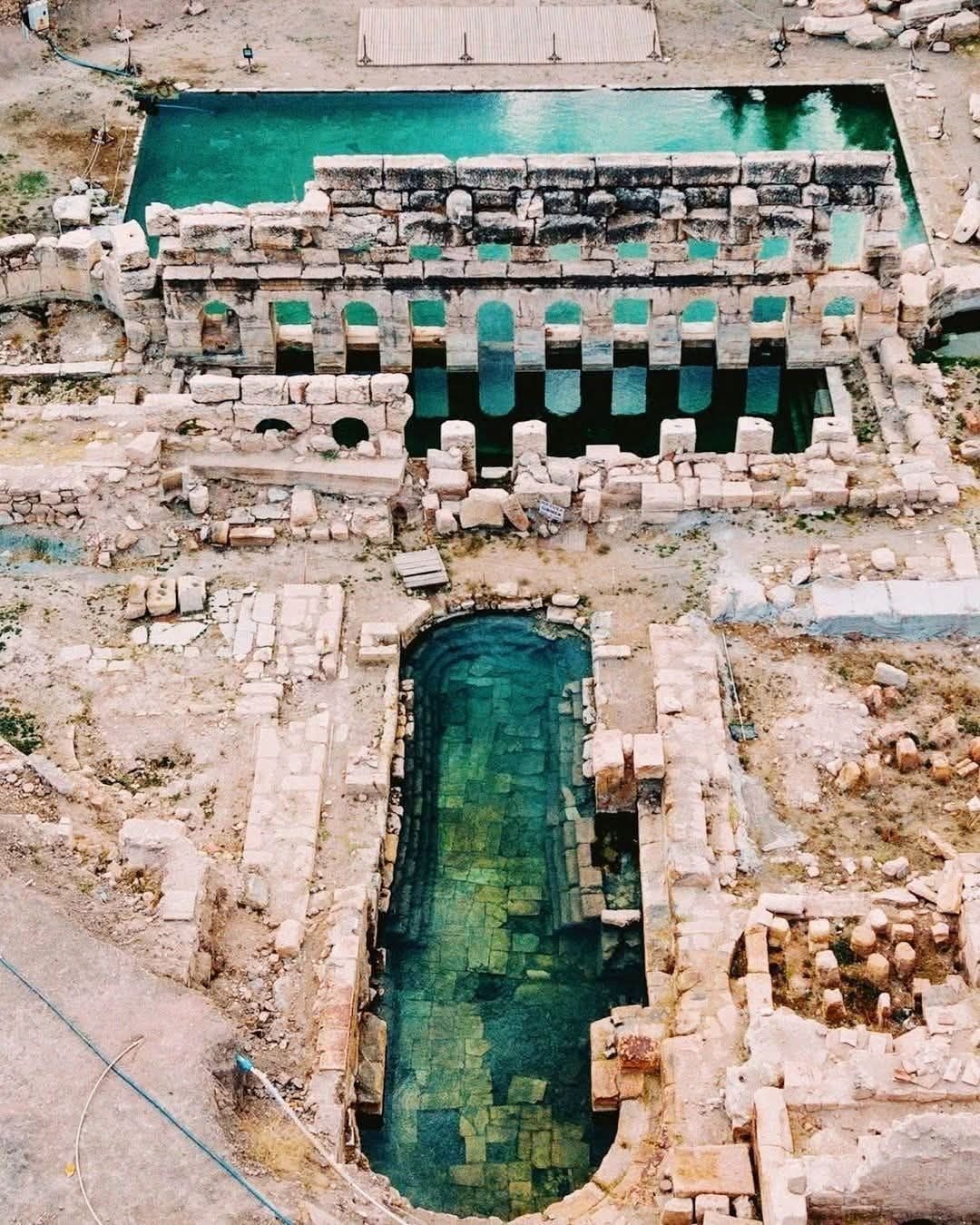
This is the Roman bath of Sarıkaya in Yozgat province, a thermal complex dating back roughly 2,200 years. Built in the late Hellenistic or early Roman period, it kept working through the Byzantine, Seljuk, and Ottoman eras. The spring never cooled, and people never really stopped coming.
A 2,200‑year‑old Roman bath in Sarıkaya is a monumental thermal complex built around a natural hot spring that has flowed at about 45°C since antiquity. It is one of the rare ancient baths where both the water and the bathing tradition have continued almost without interruption.
To understand why this place matters, you have to see it not just as a pretty ruin with warm water, but as a piece of infrastructure that outlived empires.
What was the Sarıkaya Roman bath, exactly?
At its core, Sarıkaya is a balneum, a Roman-style bath complex built around a natural thermal spring. Archaeologists date the main monumental phase to roughly the 2nd century BCE to 2nd century CE, during the transition from Hellenistic kingdoms to Roman provincial rule in central Anatolia.
The complex is built of stone and brick, with a grand façade of arches and columns facing a large rectangular pool. Behind it, smaller rooms and channels managed the flow of hot water. Visitors today see a long pool, about the size of a small swimming pool, framed by a two-story façade with niches and columns, very much in line with Roman public architecture.
Unlike many Roman baths that heated water with hypocaust systems (underfloor furnaces), Sarıkaya did not need much artificial heating. The spring emerges at about 45°C, hot enough for soaking but not scalding. Roman engineers simply captured and channeled that heat.
So when people talk about a “2,200‑year‑old Roman bath that has never stopped flowing,” they are talking about a purpose-built complex that harnessed a natural hot spring and kept it usable for public bathing for more than two millennia.
That matters because it is a rare example of ancient architecture and natural geology working together so well that the original function survives into the present.
Why did the Romans build a bath here in the first place?
Hot springs were not a Roman invention. Long before Roman soldiers or administrators reached central Anatolia, local peoples of ancient Anatolia and the Hellenistic kingdoms valued thermal waters for healing and ritual. Wherever hot water came out of the ground, people tended to gather, pray, and soak.
By the 2nd century BCE, this part of central Anatolia was passing from Hellenistic control into the Roman orbit. Rome had a habit: when it absorbed a region, it invested in public works that both pleased locals and projected Roman order. Roads, aqueducts, and baths were part of that toolkit.
Thermal springs were especially attractive. They were already sacred or socially important sites. Building a monumental bath around a spring was a way to tie Roman authority to something people already respected. In other parts of the empire, like Bath in Britain (Aquae Sulis) or Baiae in Italy, Rome did the same thing.
There was also a medical logic. Roman and Greek physicians, following Hippocratic ideas, believed mineral waters could treat skin diseases, joint pain, and various internal ailments. A spring that held steady at a comfortable hot temperature was an obvious candidate for a healing center.
So the bath at Sarıkaya likely grew from a combination of local tradition, Roman public policy, and practical health concerns, all anchored by a very reliable hot spring.
That matters because it shows the bath was not a random luxury project but a deliberate investment at the intersection of religion, medicine, and imperial politics.
How did this bath keep working through so many empires?
Most ancient baths ended the same way: the empire that built them declined, maintenance stopped, pipes clogged, roofs collapsed, and the site either silted up or was quarried for stone. Sarıkaya’s story is different.
After the Roman imperial period, central Anatolia became part of the Eastern Roman, or Byzantine, Empire. The Byzantines inherited Roman bathing culture and Christianized some of its meanings. Thermal springs could be associated with saints instead of pagan gods, but people still came to soak and seek healing.
Archaeological work at Sarıkaya has found evidence of continued use in late antiquity and the medieval period. The architecture shows repairs and modifications, not a clean break. That suggests that local communities kept the bath functional even as political control changed.
From the 11th century onward, Turkic groups and then the Seljuk Sultanate of Rum took control of much of Anatolia. They brought their own bathing tradition: the hammam. Ottoman culture later refined this into the classic Turkish bath, with hot, warm, and cool rooms and a strong social role.
Thermal waters fit neatly into this new tradition. Seljuk and Ottoman authorities often built hammams at or near hot springs. At Sarıkaya, instead of abandoning the Roman structure, they adapted it. The pool and spring kept their purpose, even if the rituals and languages around them changed.
Local oral history and historical references suggest that people in the Ottoman period continued to use Sarıkaya’s waters for rheumatism, skin diseases, and general relaxation. The architecture may have looked “Roman,” but to users it was simply the local hot bath that had always been there.
That matters because it shows continuity at ground level. Empires came and went, religions shifted, but the daily act of walking to the hot spring and stepping into the water stayed the same.
Who kept this 45°C spring flowing and usable?
The real star here is not a single emperor or architect. It is a chain of anonymous engineers, masons, and local caretakers who kept the system working.
First, there were the original planners, likely under Roman provincial authority. They had to survey the spring, decide where to place the pool, and design channels that would let hot water in and out without flooding or cooling too fast. They also had to consider mineral deposits, which can clog pipes over time.
We do not have a surviving inscription naming the original patron with certainty, though some Roman baths elsewhere proudly record the names of governors or local notables who paid for them. At Sarıkaya, the lack of a clear dedicatory inscription leaves the founding figure in the shadows.
Then came the maintainers. Thermal waters often carry dissolved minerals like calcium carbonate. Over years, these minerals build up as travertine. That is beautiful in nature but a headache in plumbing. Someone had to scrape, clear, and occasionally rebuild channels and pool edges.
In the Byzantine and Ottoman periods, this work probably fell to local communities or religious endowments. In Ottoman towns, hammams were often run as waqf institutions, whose income supported mosques or schools. While we do not have a complete waqf record for Sarıkaya’s bath, the pattern fits: a bath that brought in small fees could fund its own upkeep.
In the modern era, Turkish authorities recognized the historical value of the site. Excavations and conservation work in the 20th and 21st centuries stabilized the ruins and formalized access. The bath is now known as the Basilica Therma or Sarıkaya Roman Bath and has been proposed for UNESCO World Heritage status.
That matters because it reminds us that long-lived monuments are not immortal. They survive because generations of mostly invisible people decide, again and again, that they are worth repairing.
What made this bath different from other Roman baths?
Roman baths were everywhere in the empire, from Britain to North Africa. So what makes Sarıkaya stand out?
First, the water itself. Many Roman baths depended on furnaces to heat water. When the fuel supply or maintenance budget failed, the bath went cold. At Sarıkaya, the spring does the heating. As long as the geology holds, the water stays at roughly 45°C. That removes one major point of failure.
Second, the temperature is unusually stable. Some hot springs fluctuate or are so hot they need heavy mixing with cold water. Sarıkaya’s spring emerges at a temperature that is directly usable for soaking. That simplicity made long-term use easier.
Third, the location. Central Anatolia is seismically active but also rich in mineral springs. Earthquakes can destroy buildings, yet they can also create or alter springs. Sarıkaya’s spring has clearly survived any seismic shifts in the last two millennia without drying up or moving far from its original outlet.
Fourth, the cultural fit. In some regions, Christian or later Islamic authorities frowned on mixed-gender public bathing or certain forms of nudity, which could lead to the closure of older baths. In Anatolia, the hammam tradition kept public bathing socially acceptable, though with gender segregation and different customs. A thermal bath could be adapted rather than suppressed.
So when people online ask, “How can a Roman bath still be working after 2,200 years?” the answer is: the geology was kind, the design took advantage of it, and later cultures found the bath useful enough to keep it going.
That matters because it shows that Sarıkaya is not just an old building with water. It is a rare case where nature, engineering, and social habits lined up to keep a single piece of infrastructure alive across very different worlds.
How did Sarıkaya’s bath change local life and why does it still matter?
For ancient and medieval communities, a thermal bath was more than a spa. It was a social and economic hub.
People traveled to hot springs seeking cures. That meant visitors, which meant trade. Inns, food sellers, and small markets often clustered near such sites. A steady spring could anchor a settlement. Sarıkaya today is a small town, but its identity is tightly linked to its thermal waters.
The bath also shaped daily routines. In Roman times, public bathing was tied to ideas of citizenship and urban life. In Ottoman times, the hammam was where people prepared for Friday prayers, weddings, and major holidays. Across these periods, the hot spring gave structure to social life, from gossip to business deals.
There is a health angle too. Whether or not the waters had the cures people claimed, the idea of a place where the community could wash, warm up, and relax had real effects on hygiene and mental health. In pre-modern winters, a reliably hot pool in a cold plateau region was no small thing.
Today, Sarıkaya’s bath matters for different reasons. It is a case study in sustainable use of natural resources. The Romans did not over-engineer the spring. They built around its natural flow and temperature. Later users respected that basic setup rather than trying to replace it.
It also matters for how we think about “ancient” and “modern.” Sarıkaya is not a frozen ruin. It is part of a living town and a bathing culture that never really broke. When visitors step into the water now, they are not re-enacting a dead ritual. They are joining a 2,200‑year queue.
That matters because it reminds us that some of the most durable legacies of ancient civilizations are not marble statues or lost epics, but working systems that still quietly do their job.
Frequently Asked Questions
What is special about the Roman bath in Sarıkaya, Yozgat?
The Roman bath in Sarıkaya is built around a natural hot spring that has flowed at about 45°C for roughly 2,200 years. Unlike many ancient baths that fell out of use, this one kept functioning through Roman, Byzantine, Seljuk, and Ottoman periods, with people using the same thermal waters across multiple empires.
How old is the Sarıkaya Roman bath in Türkiye?
Archaeologists date the main monumental phase of the Sarıkaya Roman bath to around the 2nd century BCE to 2nd century CE. That makes the complex roughly 2,000 to 2,200 years old, with continuous or near-continuous use as a thermal bath since antiquity.
How has the Sarıkaya hot spring stayed at 45°C for so long?
The spring’s steady 45°C temperature comes from local geology. Groundwater circulates deep enough to be heated by the Earth’s interior, then rises along fractures to the surface. The depth and flow path have remained stable for at least two millennia, so the temperature and mineral content have stayed remarkably consistent.
Can you still bathe in the Sarıkaya Roman bath today?
The ancient pool and façade at Sarıkaya are preserved as a heritage site, and the thermal waters are still used in the area. Modern spa and bathing facilities nearby tap into the same hot spring, allowing visitors to experience the same 45°C waters that Romans, Byzantines, Seljuks, and Ottomans once used.