At street level in Segovia, Spain, the stone arches feel almost too clean to be ancient. Two tiers of granite, 167 arches in all, rising to nearly 29 meters, no mortar in sight. Cars pass underneath, tourists crane their necks, and the thing just sits there, quiet and indifferent, as it has for about 1,900 years.
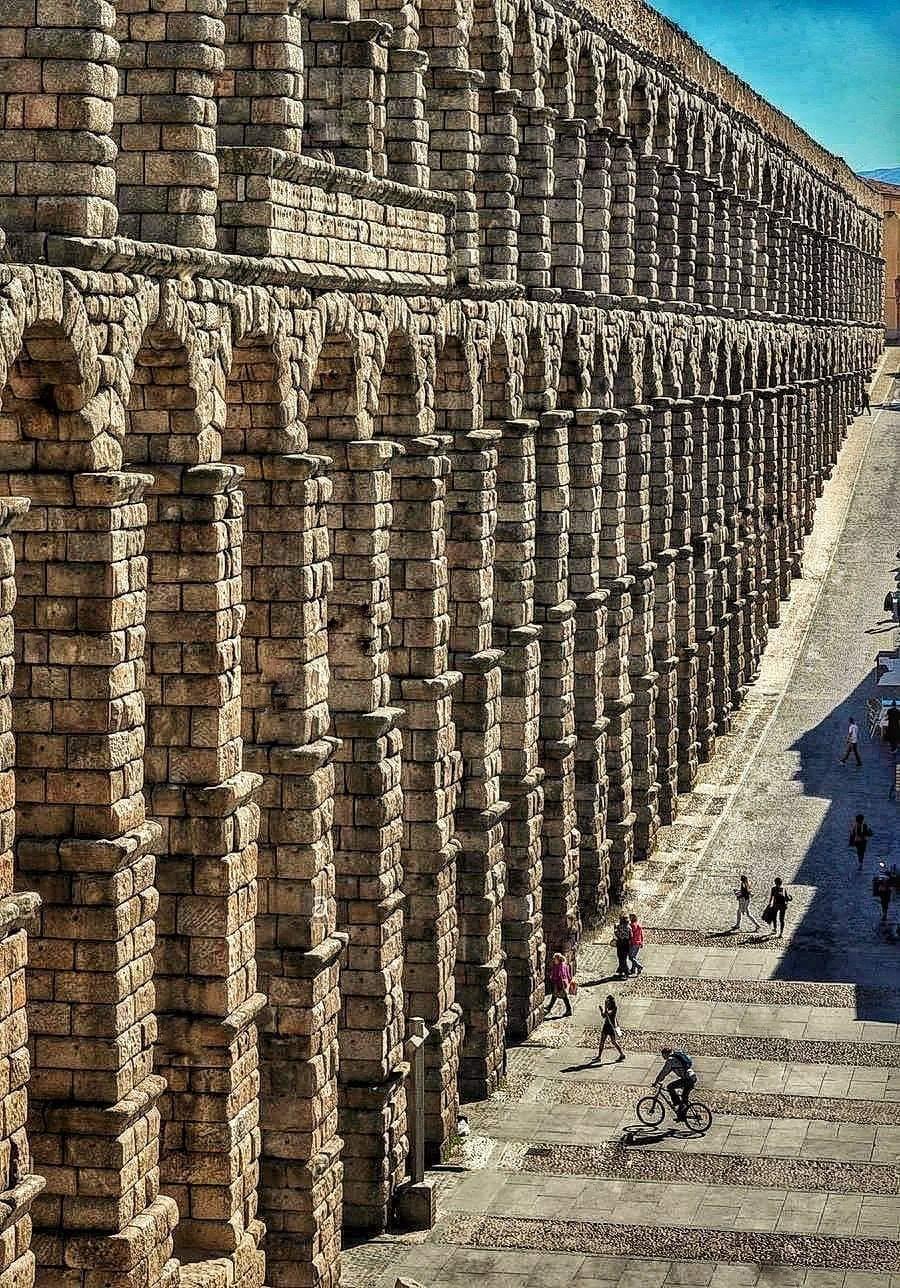
People see photos of the Roman aqueduct of Segovia and ask the same question: how is this different from what we do now? After all, a concrete highway overpass or a modern water main is trying to solve the same problem. Move water from where it is to where people are.
They look similar because both Roman aqueducts and modern water systems are long-distance plumbing with public money behind them. But they were born in different worlds, built with different tools, and aimed at slightly different ideas of what a city should be. By the end of this comparison, the arches of Segovia and the pipes under your feet will feel like cousins, not twins.
Why the Romans built Segovia’s aqueduct vs why we build modern systems
The Segovia aqueduct probably went up in the late 1st or early 2nd century CE, under emperors like Domitian, Nerva, or Trajan. The exact date is debated because the original inscription naming the emperor was lost in the Middle Ages. What is clear is the motive: Segovia was a growing Roman town that needed reliable water.
The source lay about 17 kilometers away in the Sierra de Guadarrama, at springs near the Río Frío. Local wells and rainwater could not match the demands of baths, fountains, workshops, and a growing population. For Roman administrators, water was not just about survival. It was about Roman identity. A proper Roman city had baths, fountains, and public basins. If you brought in water, you brought in Rome.
Roman aqueducts were political statements as much as engineering projects. They said: the empire can command nature. The Segovia aqueduct, with its long arcade cutting across the city, made that message impossible to miss. It was infrastructure and propaganda in one structure.
Modern water systems, especially from the 19th century onward, come from a different kind of crisis. In London, Paris, New York, and Madrid, the trigger was disease. Cholera, typhoid, and other waterborne killers tore through crowded industrial cities. Wells and local streams had become open sewers.
So modern municipal water systems grew out of public health disasters. Cities began to build long-distance supply lines, reservoirs, and treatment plants not to show off, but to stop people from dying in large numbers. The goal shifted from “more water for baths and fountains” to “safe water for everyone, every day.”
That difference in origin matters. Segovia’s aqueduct was built to project Roman order and support a Roman-style urban life. Modern systems were built to stop epidemics and support massive, dense populations. So what?
How the Segovia aqueduct was built vs how we build today
The Reddit post that kicked this off hits the detail that fascinates people: 20,400 granite blocks, no mortar. To modern eyes, that sounds like a magic trick.
The Romans were not magicians. They were very good masons. The Segovia aqueduct’s visible arcade is just the most photogenic part of a longer system. Most of the 17 kilometers from spring to city ran in covered channels at a gentle, controlled slope. Only where the ground dropped sharply, near the city, did they need that soaring double-tier of arches.
Each granite block was quarried nearby, cut to shape, and lifted into place with cranes and scaffolding. The blocks were laid dry, without mortar, relying on precise cutting and gravity. The arches distribute weight down into the piers. As long as the geometry holds, the structure holds.
Above the arches ran the specus, the water channel, lined with waterproof mortar (opus signinum) and covered to keep out debris. The gradient was incredibly shallow, often just a few centimeters per kilometer. Too steep, and the water would erode the channel. Too flat, and it would stagnate.
Modern systems flip the script. The visible structures, like bridges or elevated pipes, are usually a tiny part of the whole. Most of the system is invisible: buried pipes, pumping stations, treatment plants, and storage tanks.
Instead of gravity alone, modern systems rely on pumps to push water through steel, ductile iron, PVC, or concrete pipes. We still use gravity where we can, especially from reservoirs on higher ground, but we are no longer limited to gentle slopes and careful surveying over long distances.
We also treat water extensively. Filtration, chlorination, ozonation, and other methods strip out pathogens and many contaminants. The Romans sometimes tried to avoid obviously dirty sources, but they did not disinfect water in any modern sense. Their engineering genius lay in moving water, not purifying it.
So you get a strange contrast. The Segovia aqueduct looks like a giant, exposed machine, all structure and no secrets. Modern systems are mostly hidden, but far more complex internally. So what?
What the Segovia aqueduct delivered vs what modern systems deliver
At its peak, the Segovia aqueduct probably carried on the order of tens of thousands of cubic meters of water per day. Exact figures vary by estimate, but it was enough to supply public fountains, baths, some private houses, and industrial uses like tanneries and mills.
The water arrived by gravity alone. It flowed into settling tanks, then into distribution channels. Wealthier homes might tap into the system. Poorer residents fetched water from public fountains. There were no individual household meters. No pressure regulators in the modern sense. The system was designed for flow, not fine-grained control.
Romans did pay attention to quality in a rough way. Writers like Frontinus, who managed Rome’s aqueducts in the late 1st century CE, ranked sources by taste and clarity. But there was no germ theory. Lead pipes were common. Sediment and contamination were routine problems.
Modern systems, by contrast, aim for universal, pressurized, metered supply. If you live in a city today, you expect water to come out of a tap on demand, at pressure, 24 hours a day. You expect that water to be safe to drink, at least by local standards.
Behind that expectation lies a chain: protected catchment areas, reservoirs, treatment plants, high-capacity mains, neighborhood distribution pipes, and household connections. Sensors monitor pressure and quality. Valves isolate leaks. Meters track individual use.
Modern systems also handle wastewater separately. Sewers collect used water and send it to treatment plants before it returns to rivers or the sea. Roman cities did have sewers, but the separation between clean water supply and dirty water removal was far less systematic.
So while both Segovia’s aqueduct and a modern network move water over distance, they serve different patterns of life. The Roman system fed public spaces and some private luxury. The modern system feeds private taps and industrial-scale demand. So what?
How long they lasted: durability and maintenance from Rome to now
The Segovia aqueduct carried water to the city until 1973. That date surprises people. They assume the arches became a fossil in late antiquity. In reality, the structure kept doing its job, with interruptions and repairs, for about 18 or 19 centuries.
That longevity came with work. After the fall of the Western Roman Empire, local authorities and later the Church took over maintenance. In the Middle Ages, parts of the channel were damaged, and some blocks were replaced. In the 15th century, the Catholic Monarchs, Ferdinand and Isabella, ordered major repairs, using granite and adding the coat of arms that you can still see today.
The aqueduct survived not because it was indestructible, but because generations kept patching it. Its dry-stone construction helped. Individual blocks could be replaced without tearing down the whole structure. The absence of mortar in the arches meant less material to crack and fail over time.
Modern systems have a different relationship with time. Steel and iron pipes corrode. Concrete spalls. Plastic degrades under certain conditions. The expected lifespan of a water main might be 50 to 100 years, depending on material and environment. After that, it is replaced, not left as a monument.
We do not usually build visible aqueducts any more, partly because pipes are cheaper and easier to protect underground, and partly because we can cross valleys with pressurized pipes instead of long arcades. When a modern bridge or water tower outlives its use, it is often demolished, not preserved.
So Segovia’s arches have outlived most modern infrastructure not because Romans had mystical engineering, but because this particular structure was overbuilt, repairable, and visually important enough that people kept saving it. So what?
What they meant to people: prestige, politics, and public life
To a Roman walking under the Segovia aqueduct in the 2nd century, the message was clear. This town was plugged into imperial power. Someone with access to tax revenue and imperial approval had ordered thousands of tons of stone to be cut, hauled, and stacked, just so water could flow in a controlled line above their heads.
Aqueducts were prestige projects. Emperors and local elites used them to win favor. In Rome itself, emperors bragged about how many aqueducts they had repaired or added. In the provinces, a grand aqueduct could lift a town’s status. It was a physical argument that this place mattered.
The arches also shaped daily life. Public fountains became social hubs. Baths were where business, politics, and gossip mixed. Reliable water changed how people cooked, cleaned, and worked. The aqueduct was not just a backdrop. It structured how the city functioned.
Modern water systems rarely inspire that kind of awe. Politicians cut ribbons at treatment plants, but no one writes poetry about buried mains. The prestige now lies in reliability, not spectacle. If the system works, you do not think about it. If it fails, you notice fast.
There are exceptions. Massive dams, like Hoover Dam in the United States or the reservoirs feeding big cities, have taken over some of the old aqueduct’s symbolic role. They are framed as national achievements, proof of technical and organizational capacity.
Still, the emotional connection is different. We rarely see the pipes that keep us alive. Romans could look up and watch their water glide into town in a stone channel. That visibility made the state’s role in daily comfort impossible to ignore. So what?
Legacy: what Segovia’s arches and modern pipes tell us about power
Today, the Segovia aqueduct is a UNESCO World Heritage Site and the city’s emblem. The water stopped flowing in 1973, when modern pipes took over, but the arches stayed. Conservation work in the late 20th century cleaned and stabilized the structure, and traffic under the main arcade has been restricted to protect it.
Engineers still study Roman aqueducts, including Segovia, for their use of gravity, surveying accuracy, and structural design. The basic principle of keeping a steady gradient and using arches to cross low ground has not gone out of style. What changed is our toolkit: pumps, pressure, and buried pipes let us do the same job with far less visible stone.
Modern water systems, in turn, have reshaped human settlement on a scale the Romans could not match. Megacities of 10 or 20 million people are only possible because water can be moved, treated, and reused at industrial scales. When those systems fail, as in the Flint water crisis in the United States or Cape Town’s near “Day Zero,” the political fallout is immediate.
So the comparison runs both ways. The Segovia aqueduct looks like a beautiful relic, but it was once as practical and political as any modern water main. Our pipes look dull, but they are the quiet backbone of modern life.
They look similar because they answer the same old question: how do you move water to people? The differences, in stone and steel, in arches and buried mains, tell you how ideas of power, health, and public life have changed over two thousand years.
Frequently Asked Questions
How did the Roman aqueduct of Segovia work without mortar?
The visible arches of the Segovia aqueduct are built from about 20,400 carefully cut granite blocks laid without mortar. The stones are shaped so they lock together, and the arches distribute weight down into the piers. Above the arches, the water channel was lined with waterproof mortar and covered. Gravity carried water along a gentle slope from mountain springs about 17 km away into the city.
Did the Segovia aqueduct really carry water until 1973?
Yes. Although it was built in the 1st or early 2nd century CE, the Segovia aqueduct, with repairs over the centuries, continued to supply water to the city until 1973. After modern piped systems took over, the aqueduct was preserved as a historic monument rather than an active part of the water network.
How are Roman aqueducts different from modern water systems?
Roman aqueducts like Segovia relied almost entirely on gravity and visible stone structures to move water from distant springs to cities. They focused on providing flow for public fountains, baths, and some private homes, with minimal treatment. Modern systems use pumps, buried pipes, and treatment plants to deliver pressurized, disinfected water directly into most homes and to remove wastewater through separate sewers.
Why did the Romans build such large aqueducts instead of using pipes?
The Romans did use pipes, often made of lead or ceramic, but they were limited in pressure and scale. To move large volumes of water over long distances without pumps, they relied on gravity and open or covered channels. Where valleys or low ground interrupted the route, they built large arcades like the Segovia aqueduct to keep the channel at the right height and slope.