They look similar because in both images a single human body faces a machine built to crush resistance. One is a young American in a fluorescent vest in Gaza. The other is an anonymous man in a white shirt on a Beijing boulevard. Both are frozen in that same impossible posture: small, upright, in the path of enormous armored vehicles.
But Rachel Corrie in Rafah in 2003 and the “Tank Man” of Tiananmen Square in 1989 came from different worlds, different movements, and met very different fates. By the end of this comparison, the similarities of the photographs will feel obvious, but the differences in origins, methods, outcomes, and legacy will be just as stark.
Rachel Corrie was a 23‑year‑old American peace activist killed by an Israeli army bulldozer in Rafah, Gaza, on 16 March 2003 while trying to stop the demolition of a Palestinian home. Tank Man was a lone Chinese citizen who blocked a column of tanks on Chang’an Avenue in Beijing on 5 June 1989, the morning after the Tiananmen Square massacre. Both acts are often described as symbols of nonviolent resistance against state power.
Nonviolent resistance is the deliberate use of unarmed, usually symbolic physical presence or civil disobedience to oppose authority without using violence. Iconic protest images like these shape how the world understands distant conflicts, even when the details are messy, disputed, or censored.
Origins: Why did Rachel Corrie and Tank Man take that risk?
Start with Rachel Corrie. She grew up in Olympia, Washington, in a middle‑class family. By her early twenties she was involved in local activism and global justice issues. In January 2003 she traveled to the Gaza Strip as part of the International Solidarity Movement (ISM), a Palestinian‑led group that brought foreign volunteers to act as “human shields” and witnesses in the occupied territories.
Gaza in 2003 was in the middle of the Second Intifada. Israeli forces were carrying out frequent incursions, house demolitions, and targeted killings. Rafah, at the southern edge of Gaza near the Egyptian border, was a particular flashpoint. The Israeli military said it was destroying houses used for weapons smuggling and attacks. Palestinians and human rights groups said thousands of civilians were being made homeless as a form of collective punishment.
Corrie’s stated goal, in emails that later became public, was to stand with Palestinian civilians and use her American passport and foreign status as a kind of shield. She believed that the presence of Western activists and their cameras might deter the Israeli army from demolishing homes or firing on civilians, or at least document abuses for the outside world.
Tank Man’s origins are murkier. We still do not know his name for certain. Various theories have floated around, but none have been confirmed. What we do know is the context. In April 1989, after the death of reformist leader Hu Yaobang, students and workers gathered in Tiananmen Square to demand political reform, an end to corruption, and more freedom of expression.
For weeks, the protests grew. By late May, hundreds of thousands were in the streets. On the night of 3–4 June, the Chinese government sent in the People’s Liberation Army. Soldiers fired on demonstrators and bystanders. The death toll is still disputed, with estimates ranging from several hundred to several thousand.
The next morning, 5 June, tanks rolled down Chang’an Avenue to reassert control. That is when a man carrying shopping bags stepped into the road and blocked the lead tank. He was not part of a foreign solidarity group. He was not, as far as we know, a famous dissident. He was an ordinary citizen reacting to the violence of the previous night.
So what? The origins matter because they show two very different protest traditions: Corrie as a foreign solidarity activist deliberately inserting herself into someone else’s conflict, Tank Man as a local citizen confronting his own government in the aftermath of a massacre.
Methods: How did each try to stop the machines?
On 16 March 2003 in Rafah, Corrie and other ISM activists were trying to prevent the demolition of Palestinian homes near the Egyptian border. They wore fluorescent vests and used megaphones. The Israeli army was using armored Caterpillar D9 bulldozers, massive vehicles with reinforced armor used in military engineering operations.
Witnesses from ISM said Corrie climbed onto a dirt mound in front of a bulldozer approaching a Palestinian physician’s house. They say the driver could see her, pushed forward, knocked her down, and then drove over her twice. The Israeli military said the driver’s visibility was limited, that the area was a combat zone, and that the bulldozer was clearing debris, not demolishing a house at that moment.
What is not in dispute is that Corrie placed her body in the path of the machine, that she was struck, suffered severe injuries, and died shortly afterward. Her method was classic nonviolent direct action: physically occupying the space that the state wanted to clear, betting that the authorities would not be willing to kill an unarmed, clearly marked civilian in front of witnesses.
Tank Man’s method was even simpler. He walked into the road, stood in front of the lead tank, and refused to move. When the tank tried to go around him, he sidestepped to stay in front. At one point he climbed onto the tank and appeared to speak to the crew through a hatch. Then he climbed down and resumed his position blocking the column.
Unlike Corrie, he was not part of an organized group. He had no safety vest, no megaphone, no press credentials. He carried shopping bags. His body language was calm but firm. The tank crews, fresh from a night of killing, did not run him over. They idled, tried to maneuver, then stopped. Eventually, bystanders pulled him away and he disappeared into the crowd. His fate remains unknown.
So what? The methods show two different calculations about power and risk: Corrie relied on visibility, foreignness, and organized presence to restrain a military that often used overwhelming force, while Tank Man relied on the hesitation of soldiers in front of cameras in their own capital, and on the moral shock of a lone citizen confronting an armored column.
Outcomes: Death, disappearance, and what the states said happened
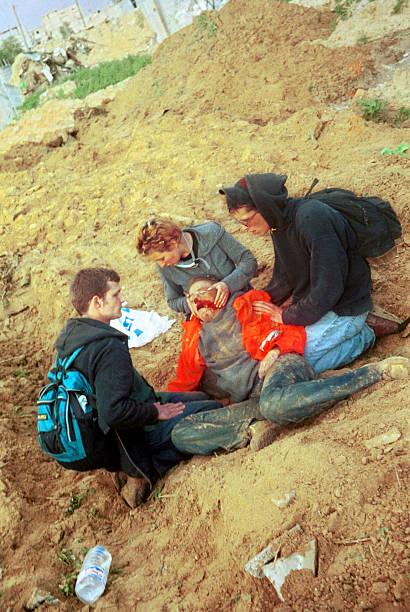
Rachel Corrie died shortly after being run over. Photos show her colleagues trying to stop the bleeding as she lies in the dirt, which is the image that surfaces on Reddit and elsewhere. Her death triggered immediate outrage among activists and drew media coverage in Europe and the United States.
The Israeli military conducted an internal investigation and concluded that the driver had not seen her and that her death was an accident in a combat zone. The U.S. government called the investigation not satisfactory but did not press the matter hard. Corrie’s parents later filed a civil lawsuit in Israel against the state and the bulldozer driver’s unit. In 2012, an Israeli court rejected the suit, ruling that her death occurred during a war‑time activity and that the state bore no liability.
Human rights groups, ISM, and Corrie’s family argued that the investigation was flawed and that the army had created conditions where civilian deaths were predictable. To them, her killing was not an isolated accident but part of a pattern of using heavy machinery and live fire in densely populated civilian areas.
Tank Man’s immediate outcome was different. He was not killed on camera. The tanks did not move forward over his body. The standoff lasted only a few minutes. Then two or more men, likely civilians, rushed in and pulled him away. After that, the trail goes cold.
Western journalists and intelligence agencies have floated stories over the years: that he was executed, that he is alive and in hiding, that he was a worker named Wang Weilin. None of these claims have been confirmed. Chinese authorities have consistently refused to discuss him and have censored the image and any mention of him inside China.
In the short term, neither protest stopped the larger machinery. In Rafah, demolitions and military incursions continued. In China, the crackdown on dissent deepened, and the Communist Party reasserted control. The individual acts did not reverse policy.
So what? The outcomes show how states manage dissent: Israel framed Corrie’s death as an unfortunate accident in wartime and legally insulated itself, while China erased Tank Man from the public record, turning him into a ghost known mainly outside the country.
Media and imagery: How did the photos travel the world?
Both stories are, in large part, stories of images.
Rachel Corrie’s death was photographed by fellow activists and local journalists. Images of her standing in front of bulldozers earlier that day, and then of her bleeding on the ground, circulated among activist networks and news outlets. They became part of the visual archive of the Second Intifada and the Israeli–Palestinian conflict.
Her American identity made the story more newsworthy in the United States than many Palestinian deaths in similar circumstances. Activists used her image to argue that if this could happen to a white American student in a fluorescent vest, it said something about how Israeli forces treated Palestinian civilians with far less visibility.
Tank Man’s image was captured by several photographers and cameramen who had remained in Beijing after the crackdown. The most famous shots were taken from a hotel balcony by photographers like Jeff Widener of the Associated Press. The footage and photos were smuggled out and broadcast worldwide.
Inside China, the image was quickly banned. Outside, it became one of the defining photographs of the late twentieth century. A lone man versus a column of tanks became a shorthand for individual courage against authoritarian power.
There is an important difference in how the two images function. Corrie’s photo is often used inside a polarized debate about Israel and Palestine. People argue about what exactly happened, who was at fault, whether ISM was reckless, whether the bulldozer driver could see her. The image is contested.
Tank Man’s photo is less contested in meaning. Almost everyone outside China reads it as a symbol of bravery and state repression. The argument is not about what happened in the frame, but about what happened to him afterward and what it says about the Chinese state.
So what? The media afterlives of these images show how context shapes meaning: Corrie’s photo feeds into an ongoing, bitter political argument, while Tank Man’s image has become a near‑universal symbol of defiance, even as the country where it happened tries to erase it.
Legacy: How did these acts change activism and memory?
Rachel Corrie’s legacy is specific and contested. Her family created the Rachel Corrie Foundation for Peace & Justice in Olympia. Her writings from Gaza were turned into a play, “My Name Is Rachel Corrie,” which has been staged in multiple countries. A ship in the 2010 Gaza flotilla was named after her.
In Palestinian and pro‑Palestinian circles, she is remembered as a martyr, a foreigner who chose to share the risks faced by Palestinians under occupation. In many Israeli and pro‑Israeli narratives, she is seen as naive or manipulated, part of a group that, in their view, interfered in dangerous military operations and ignored the context of terrorism and armed conflict.
Her case also influenced debates about the role of international activists in conflict zones. ISM’s tactics, especially putting unarmed foreigners in front of military hardware, drew criticism even from some sympathetic observers who saw them as too risky and unpredictable.
Tank Man’s legacy is broader but more abstract. He has no foundation, no known family speaking in his name, no published writings. His power lies almost entirely in the image. That photograph is used in textbooks, documentaries, and protest posters around the world.
For many outside China, Tank Man is the reference point for nonviolent civil courage. When people talk about standing up to tanks in Ukraine, Syria, or elsewhere, they often invoke him. Inside China, his absence from official history is part of a larger erasure of the Tiananmen protests. Younger Chinese who grow up behind the Great Firewall may never see the image unless they seek it out.
Both legacies show the limits and possibilities of symbolic acts. Neither Corrie nor Tank Man changed their governments’ policies in the short term. Yet both became reference points. Corrie is a case study in the ethics and dangers of solidarity activism in asymmetric conflicts. Tank Man is a global symbol of the moment when one person decides not to move.
So what? The legacies show that while individual acts of nonviolent resistance rarely stop tanks or bulldozers, they can reshape how conflicts are remembered, debated, and taught, long after the machines have moved on.
Why do Rachel Corrie and Tank Man still get compared?
So why do people keep putting these two images side by side on places like Reddit?
They look similar because both show a human body confronting a machine of state power. Both involve nonviolent resistance in front of armored vehicles. Both ended with the individual being removed, one by death, one by disappearance.
But the comparison also shows the differences. Corrie was a foreign activist in someone else’s war, part of an organized campaign, killed in a long, grinding conflict. Tank Man was a local citizen in a sudden political crisis, alone, whose fate is unknown. Corrie’s story is wrapped up in a highly polarized argument about Israel and Palestine. Tank Man’s story is wrapped up in a state‑enforced silence inside China and near‑universal admiration outside it.
There are common misconceptions that swirl around both. Some people assume Corrie was trying to stop a tank, like Tank Man, when in fact it was a bulldozer in a demolition operation. Others think Tank Man was definitely executed or definitely survived, when the evidence is thin and contradictory. In both cases, the power of the image encourages simple stories, while the real histories are messier.
So what? Putting Rachel Corrie and Tank Man side by side forces us to think harder about what nonviolent resistance can and cannot do, how images shape memory, and how different states respond when a single person decides to stand in front of a machine and say no.
Frequently Asked Questions
Who was Rachel Corrie and what happened to her in Gaza?
Rachel Corrie was a 23‑year‑old American peace activist from Olympia, Washington. In March 2003, while working with the International Solidarity Movement in Rafah, Gaza, she tried to block an Israeli army armored bulldozer that was operating near Palestinian homes. She was struck and fatally injured. The Israeli military called it an accident in a combat zone, while her supporters argue she was killed during a nonviolent protest against house demolitions.
Who was the Tank Man from Tiananmen Square and what happened to him?
The Tank Man was an unidentified Chinese man who blocked a column of tanks on Chang’an Avenue in Beijing on 5 June 1989, the day after the Tiananmen Square massacre. He stood in front of the lead tank, preventing it from moving forward, and at one point climbed onto it. After a brief standoff, bystanders pulled him away. His identity and fate remain unknown, and Chinese authorities have censored discussion of him inside China.
How are Rachel Corrie and Tiananmen’s Tank Man similar?
Both Rachel Corrie and Tank Man are known for nonviolent acts of resistance in front of armored vehicles. Their images capture a lone, unarmed person confronting state power. In each case, the protest was symbolic rather than militarily effective, but the photographs became powerful icons of defiance and helped shape how the wider world viewed the conflicts in Gaza and Beijing.
Did Rachel Corrie and Tank Man change government policy?
Neither protest led to an immediate change in government policy. In Gaza, Israeli military operations and house demolitions continued after Rachel Corrie’s death. In China, the Communist Party tightened its control after the Tiananmen crackdown. Their impact has been more symbolic and long‑term: they influenced global perceptions, inspired later activists, and became enduring images in discussions of nonviolent resistance and state power.