Picture this: a group of U.S. Marines belly-laughing as they somersault across a field, shuffle forward inside a cardboard box, and crawl like a shrub come to life. Somewhere nearby, an expensive AI-powered camera is doing nothing at all. No alarm. No red box around a target. Just silence.
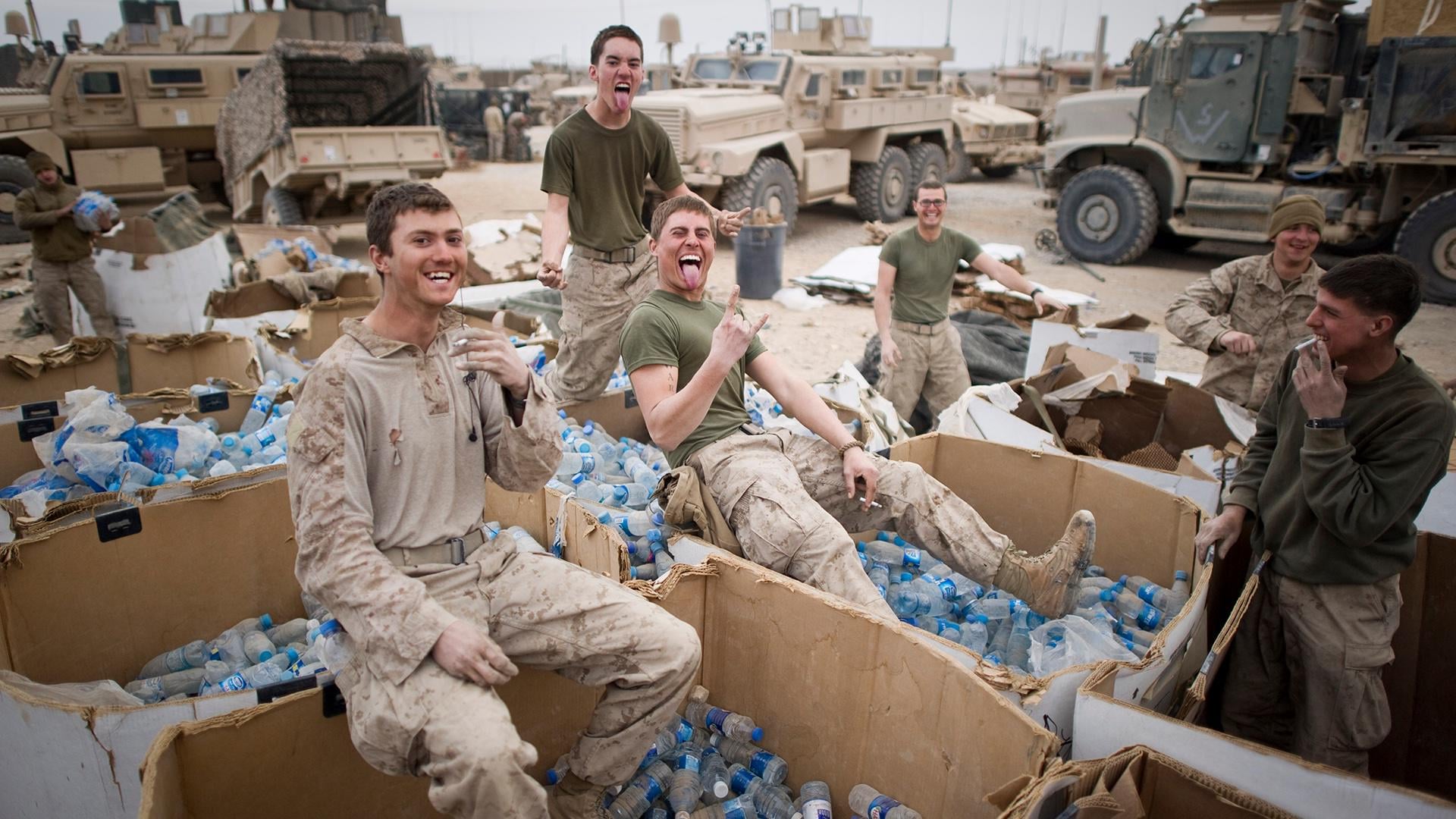
This was not a prank. It was a formal test of a military artificial intelligence system, and the humans won by acting ridiculous.
The story that blew up on Reddit comes from a real experiment run under DARPA’s Squad X program. An AI system trained to spot humans in video failed to detect a single Marine who used creative movement and disguise. By the end of this, you will know what actually happened in that test, why the AI failed, and what it tells us about the future of AI on the battlefield.
What was this Marine vs AI experiment really about?
The viral version of the story sounds like a cartoon: Marines roll, box-walk, and bush-crawl past a robot eye. The real story is a bit more technical, but no less strange.
The account comes from Paul Scharre, a former U.S. Army Ranger and Pentagon official who worked on autonomy and AI policy. He describes the incident in his 2018 book Army of None, which looks at autonomous weapons and AI in war. The test took place during DARPA’s Squad X program, which began around 2015 to give small infantry units better sensing and targeting tools.
In one exercise, DARPA contractors built an AI-powered sensor system that used computer vision to detect humans approaching a guarded area. Think of it as a smart security camera trained on lots of examples of people walking, running, and moving like, well, normal people.
Then they brought in a squad of Marines and gave them a simple task: get from one end of a field to the other without the AI flagging them as humans. They had time to experiment, no one was shooting at them, and the goal was to break the system.
AI object detection systems work by learning patterns from training data. If the training data mostly shows upright humans walking or running, the AI learns that “human = upright torso + head + limbs in certain positions.” It does not “understand” what a human is. It recognizes patterns of pixels that usually correlate with humans.
That is the core of what this test was about. Not a sci-fi showdown between man and machine, but a practical question: how does a pattern-recognition system behave when the patterns change?
So what? Because the whole exercise was designed to probe the limits of military AI, the Marines’ success was not a fluke prank. It was a data point about how brittle these systems can be when reality does not match their training.
How did the Marines actually beat the AI camera?
The Marines tried a bunch of things. The ones that made it into internet legend are the most theatrical.
According to Scharre’s account, eight Marines spent days experimenting with ways to avoid detection. They were not given instructions on how the AI worked, only that it was looking for humans. Their job was to use whatever tactics they could imagine.
Some of them simply somersaulted across the test area. They rolled, tumbled, and moved in ways that did not look like normal walking or running. To the human eye, it was obviously a person doing something weird. To the AI, which had been trained on standard human poses and gaits, the pattern did not match “person.” So it ignored them.
Two others moved together under a cardboard box, inching forward like a low-budget Metal Gear Solid cosplay. The AI system, trained to look for human shapes, saw a box. No torso, no legs, no human outline. No alert.
Another Marine covered himself with foliage and crawled slowly, mimicking a bush. Again, a human observer would have spotted the ruse in seconds. The AI, which classified objects based on visual patterns it had seen before, did not label the moving bush as a person.
According to Scharre, “not a single one” of the Marines was detected when they used these unorthodox movements and disguises. The system simply failed to recognize them as human targets.
AI person detectors learn from examples. If you only feed them images of upright people in typical poses, they will be very good at spotting upright people in typical poses. They will be bad at recognizing a person who is upside down, inside a box, or shaped like a shrub. The Marines were not exploiting some mystical AI weakness. They were exploiting the fact that the AI’s world was only as broad as its training data.
So what? Because the Marines beat the system without hacking it or jamming it, just by changing their behavior, the test showed that you can “attack” AI with creativity and weirdness, not just with code.
Why did the AI fail so badly at something humans find obvious?
To a human, the idea that a somersaulting Marine is “not a person” is absurd. To an AI, it is perfectly logical given what it has seen.
Most modern computer vision systems use deep learning. They are trained on huge datasets of labeled images. Show the network millions of pictures labeled “person” and “not person,” and it learns to associate certain patterns of pixels with the label “person.”
But this learning is narrow. The model does not know the concept of “a human body can move in many ways.” It knows that in its training set, humans usually appear upright, with heads on top, legs below, arms at the sides or swinging in a walk. It builds internal features that detect those patterns.
When a Marine somersaults, the pattern of limbs and torso is scrambled. When a Marine is inside a box, the visible pattern is “box.” When a Marine is covered in foliage, the visible pattern is “bush.” The system has no reason to override its own training and say, “That bush is suspiciously bush-like.”
There is a broader point here. AI systems are brittle. They can be extremely accurate in the conditions they were trained on and surprisingly bad outside them. In AI research, this is called poor generalization and vulnerability to adversarial examples.
An adversarial example is any input designed to trick a model into making a mistake. In lab settings, researchers have fooled image classifiers by adding tiny, almost invisible changes to pictures. In the field, adversarial examples can be as simple as wearing unusual patterns on a shirt or moving in a nonstandard way.
Humans, by contrast, are very good at generalizing. If you see someone crawling, rolling, or wearing a costume, you still recognize “person.” Your brain uses context, physics, and a lifetime of experience. AI does not. It uses patterns in data.
So what? Because the AI failed on something so obvious to humans, the test hammered home a hard limit: pattern-recognition systems can be powerful tools, but they are not general intelligence. Relying on them as if they “see like humans” is asking for trouble.
Was this proof that AI is useless in war?
The Reddit version of the story often gets twisted into “AI is dumb, humans win.” That is not what DARPA or the Marines took away from it.
First, this was a controlled experiment. The Marines had time, safety, and a clear goal: break the system. In a real combat zone, you are not going to somersault 300 meters under fire. You are not going to carry a giant cardboard box across open ground while artillery lands nearby. The tactics that fooled the AI were effective in that context, not magic tricks for every battlefield.
Second, the point of DARPA tests is to find failure modes. The contractors who built the system were not humiliated. They were handed valuable data. Now they knew that their training set was too narrow, their model too brittle, and their assumptions about human movement too simplistic.
Third, AI systems are already useful in military settings where speed and volume matter more than perfect understanding. They scan drone footage for vehicles, flag unusual patterns in radio traffic, and help prioritize which satellite images a human analyst should look at first. They are not replacing human judgment. They are filtering and triaging.
The Marines’ success did not “prove AI is useless.” It proved that AI must be treated like any other fallible sensor. You test it, you stress it, you find where it breaks, and you design around that.
So what? Because this story is often used as a punchline about dumb AI, it is easy to miss the real lesson: the experiment actually strengthened the case for cautious, well-tested use of AI rather than blind faith in its abilities.
How did this incident shape thinking about AI and soldiers?
Inside defense circles, Scharre’s story landed at an interesting moment. Around the mid-2010s, the U.S. military was wrestling with how far to go with autonomous systems.
On one side were advocates who saw AI as a way to process data faster than any human staff could. On the other were skeptics worried about overreliance on black-box systems that could fail in strange ways. The Marines vs AI anecdote became a neat illustration for the skeptics.
Scharre himself used the story to argue for “centaur” models of warfare, where humans and machines work together, each covering the other’s weaknesses. Let AI scan thousands of frames of video. Let humans make the call when something looks odd, or when the AI is operating outside its comfort zone.
The incident also fed into debates about “adversarial thinking” in AI. Soldiers, insurgents, and criminals will not politely behave like the training data. They will probe and exploit weaknesses. That means military AI cannot be evaluated only on standard benchmarks. It has to be tested against creative opponents whose job is to break it.
For infantry training, the story is a reminder that low-tech deception still matters. Camouflage, unusual movement, and misdirection are not relics of World War I. They are tools that can confuse not just human observers but also machine ones.
So what? Because this one weird test neatly illustrated how human creativity can outmaneuver rigid pattern-recognition, it nudged doctrine and policy toward keeping humans in the loop and training troops to think about AI as something they can fight, not just something that fights for them.
What does this tell us about the future of AI surveillance and evasion?
Strip away the military setting and you get a broader question: if AI is watching, can people still hide?
Researchers and activists have already shown that you can confuse face recognition systems with makeup, patterned glasses, or specially designed clothing. Some designs break up the patterns the AI expects in a human face. Others create false “faces” in places where there are none, overwhelming the system.
The Marines’ experiment is the same idea, applied to full-body detection. If a surveillance system is trained on people walking down sidewalks, it might be vulnerable to people who move or dress in ways it has not seen. As AI surveillance spreads in cities and borders, the arms race between detection and evasion will grow.
On the other side, AI systems will get better. Engineers can train models on more varied data: people crawling, rolling, carrying objects, wearing camouflage. They can fuse multiple sensors, like thermal cameras and radar, so that a cardboard box with a warm body inside looks different from an empty box.
There is a cat-and-mouse dynamic here. As AI gets better at recognizing unusual human patterns, humans will look for new ways to confuse it. That is not new. Radar led to stealth aircraft. Night vision led to better camouflage. AI detection will lead to AI deception.
One clear takeaway is that AI surveillance is not omniscient. It has blind spots, and those blind spots are shaped by the data and assumptions that go into the system. That is good news for privacy advocates and bad news for anyone who wants to outsource security to machines.
So what? Because the Marines showed that a supposedly smart camera could be beaten with cardboard and foliage, the story reminds us that AI surveillance is powerful but not all-seeing, and that ordinary human ingenuity will always be part of the equation.
Why this weird little story still matters
The image of Marines somersaulting past an AI camera sticks because it flips the usual script. We are used to stories of AI beating humans at chess, Go, or image recognition. Here, the humans win by being absurd.
Underneath the humor is a serious point about how these systems work. AI is not magic. It is pattern recognition at scale. When the patterns change, it can fail in ways that are obvious to us and invisible to it.
For militaries, that means AI has to be tested against clever, motivated opponents, not just lab benchmarks. For civilians, it means AI surveillance is neither useless nor unstoppable. It is a tool with limits that can be probed and, sometimes, exploited.
The Marines in that DARPA test were not just goofing off. They were doing what soldiers have always done: figuring out how to beat the latest sensor with whatever they had on hand. Cardboard boxes. Shrubs. Somersaults.
So what? Because this story keeps resurfacing, it shapes how people imagine AI in war and in daily life, reminding us that as long as systems are built on patterns, there will be room for people who refuse to move the way the system expects.
Frequently Asked Questions
Did U.S. Marines really fool an AI camera with a cardboard box and a bush?
Yes. In a DARPA test described by former Army Ranger and Pentagon official Paul Scharre in his book “Army of None,” a group of Marines experimented with ways to avoid detection by an AI-powered human-detection system. Some somersaulted, some moved under a cardboard box, and one disguised himself as a bush. The AI, trained mainly on images of upright humans moving normally, failed to detect any of them.
What was the purpose of the DARPA Squad X experiment with Marines and AI?
The experiment was part of DARPA’s Squad X program, which aimed to give small infantry units better sensing and targeting tools using AI and advanced sensors. The specific test with Marines trying to sneak past an AI camera was designed to probe the system’s weaknesses and see how it performed against creative, adversarial behavior, not just standard walking or running.
Why did the AI fail to recognize the Marines as humans?
The AI system used deep learning and had been trained mostly on images and video of typical human movement, such as people walking or running upright. It learned to associate certain visual patterns with the label “person.” When the Marines moved in unusual ways, hid in a box, or disguised themselves as a bush, the visual patterns no longer matched its learned concept of a human. Since the system lacked true understanding and relied on pattern recognition, it simply did not flag them.
Does this mean AI is unreliable for military use?
It means AI must be used with caution and tested rigorously. The Marines’ success showed that AI systems can be brittle and vulnerable to creative tactics, especially outside the conditions they were trained on. However, AI is still useful for tasks like scanning large amounts of sensor data and flagging likely targets. The lesson from the test is that AI should be treated as a fallible sensor that supports human judgment, not as an infallible replacement for it.