In 1977, on a parade field in Delaware, a young Black woman in a stiff new officer’s uniform walked toward the governor.
Her name was Linda. She had just completed the Delaware Army National Guard’s Officer Candidate School, and Governor Pierre S. “Pete” du Pont IV was there to shake her hand. Cameras clicked. The official line was simple: another class of new lieutenants. The unofficial story was bigger. Linda was the first Black woman to finish Delaware’s Army National Guard OCS.
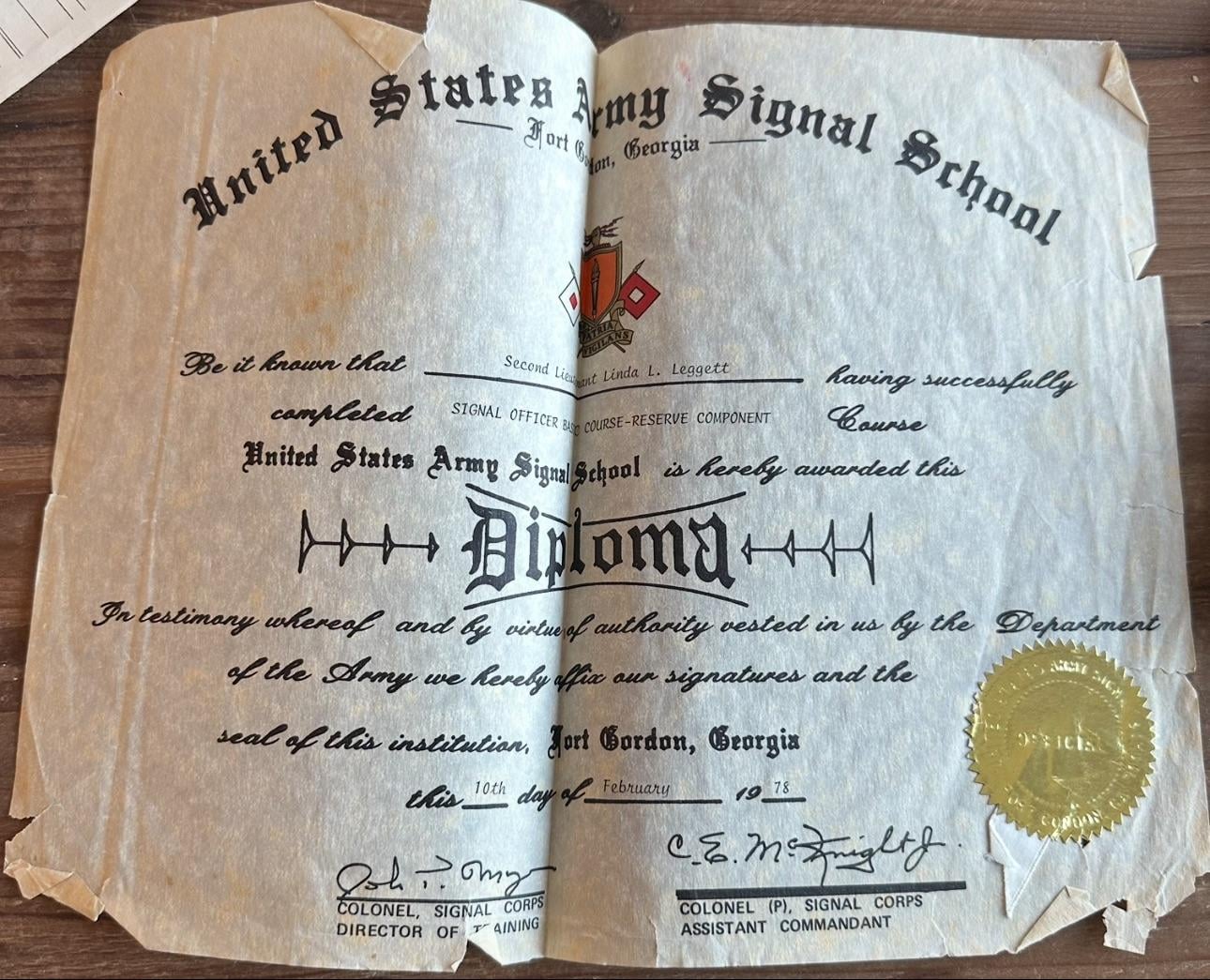
That short caption from a Reddit post – a daughter sharing an old photo of her mother with the governor, plus a Signal Officer diploma dated 1978 – opened a window into a story most people never heard. It raises a lot of questions. How did a Black woman end up in a white, male officer pipeline only a few years after Vietnam and the end of formal segregation in the military? What did a Signal officer actually do? And why did this quiet milestone matter beyond one proud family photo?
To answer that, you have to back up to the 1960s, when the military was changing faster than most of the country, and then zoom in on a small state Guard where those national policies met local habits.
How did Black women end up in the officer pipeline by the 1970s?
The U.S. military officially desegregated in 1948, when President Harry Truman signed Executive Order 9981. On paper, that ended racial segregation in the armed forces. In practice, it took years, and the National Guard lagged behind the active-duty Army.
For most of the 1950s and early 1960s, the National Guard was still heavily white, especially in the officer corps. Guard units were state-controlled, part-time, and often reflected local power structures. Governors and adjutants general had wide latitude. If the local political class was white and male, the Guard usually was too.
Women had an even narrower path. During World War II, women served in separate organizations like the Women’s Army Corps (WAC). They were auxiliaries, not integrated peers. After the war, the WAC continued, but women’s numbers were capped and their roles limited. Black women faced both racial and gender barriers at every step.
The Vietnam era shook that system. The draft, the civil rights movement, and the women’s movement all pushed the military to rethink who could serve and in what roles. In 1967, Congress passed Public Law 90-130, lifting the 2 percent cap on women in the armed forces and allowing them to be promoted to higher ranks. In 1972, the Equal Rights Amendment passed Congress (though it never got enough states to be ratified), and the broader debate about women’s equality seeped into military policy.
Then came a key shift: the end of the draft. The U.S. moved to an all-volunteer force in 1973. That meant the Army and the National Guard needed more volunteers, and they could not afford to casually exclude half the population or keep large groups in dead-end roles.
By the mid-1970s, women were entering ROTC programs, attending service academies, and enrolling in Officer Candidate Schools that had been male-only just a few years earlier. Black service members, who had long been overrepresented in the enlisted ranks, were slowly pushing into the officer corps.
So by the time Linda applied to Delaware’s Army National Guard OCS, national policy said she could be there. The question was whether the local institution would actually let her succeed. That tension between policy and practice is what made her presence in that 1977 class such a big step.
So what? Because without the civil rights and women’s rights changes of the 1960s and early 1970s, a state Guard like Delaware’s would never have had to open its officer pipeline to someone like Linda at all.
What was Delaware’s Army National Guard like in the 1970s?
Delaware is small. Its National Guard is, too. That matters. In a small Guard, everyone knows everyone, and change is personal, not abstract.
In the 1970s, the Delaware Army National Guard mirrored many other state Guards: white, male, with a leadership tier that often overlapped with local business and political networks. The Guard’s history stretched back to colonial militias. Tradition was a selling point. Tradition also meant inertia.
Governor Pete du Pont, who appears in the Reddit photo, took office in 1977. He was a Republican from a wealthy, old-line family, but he also had a reform streak. He pushed economic changes in the state and backed modernization in state institutions. The Guard was one of those institutions.
By then, the Department of Defense was pressuring states to align with federal equal opportunity policies. Racial discrimination in promotions and assignments was officially banned. Sex discrimination was under increasing scrutiny. The Guard could not openly bar women or Black candidates from OCS, at least not without risking federal funding and political blowback.
Even so, being “allowed” in the door did not mean you were welcome. Informal networks, old attitudes, and simple unfamiliarity with women and Black officers created a kind of quiet resistance. A first Black woman officer candidate in a state OCS program would have been watched closely, whether anyone said so out loud or not.
That is the context in which Linda entered OCS. She was not just signing up for weekend drills. She was walking into a small, tight-knit institution that had only recently been told it had to change.
So what? Because in a small Guard like Delaware’s, a single barrier-breaking officer was not anonymous; her presence forced colleagues and superiors to confront change face to face.
What did it take to get through Army National Guard OCS in 1977?
Officer Candidate School is where the Army tries to turn civilians or enlisted soldiers into leaders. The Guard version is usually part-time, spread over many months of weekends and extended training periods. In the 1970s, it was physically demanding, academically challenging, and culturally very male.
OCS is designed to weed people out. Candidates are evaluated on leadership, physical fitness, tactical knowledge, and their ability to function under stress. In the 1970s, many instructors had Vietnam experience. Their model of an officer was shaped by that war: tough, decisive, and very much part of an all-male combat culture.
For a Black woman like Linda, that environment came with extra layers. She had to prove she could meet the same standards as the men. She also had to navigate skepticism that she belonged there at all. Some peers might have seen her as a token. Others might have quietly hoped she would fail so they could say the experiment had gone too far.
Women in OCS at that time often reported subtle and not-so-subtle barriers: instructors who doubted their physical ability, classmates who questioned their authority during field exercises, a lack of female role models in the officer corps. Black officers, male and female, described being steered toward certain branches or assignments, or being left out of informal mentoring networks.
So when Linda finished Delaware’s Army National Guard OCS in 1977, she had done more than complete a course. She had passed through a filter that many in the institution still assumed would favor white men.
OCS is the Army’s officer training program that prepares candidates to become commissioned leaders. Completing OCS in the 1970s meant meeting demanding physical, academic, and leadership standards in a culture that was only starting to accept women and minorities as officers.
So what? Because her graduation showed, in one small but undeniable case, that the new policies about race and gender were not just words on paper; they could produce a Black woman lieutenant in a Guard that had never had one before.
Why did Linda become a Signal officer, and what did that mean?
The second photo in the Reddit post shows Linda’s Signal Officer diploma from 1978. That detail matters. It tells us what kind of officer she became and what the Army trusted her to do.
Signal officers are the Army’s communications and information systems experts. They design, manage, and protect the networks that let units talk to each other, share data, and coordinate operations. In the 1970s, that meant radios, switchboards, field telephones, and early digital systems. Today it means satellites and cyber, but the core idea is the same: if Signal fails, everything else starts to fail.
Signal is a technical branch. Officers need to understand equipment, frequencies, encryption, and the practical realities of keeping communications running in bad weather, under stress, and sometimes under fire. It is not glamorous in the way infantry is, but it is vital.
For women and Black officers in the 1970s, technical branches like Signal, Quartermaster, or Ordnance were often more open than combat arms. Officially, women were barred from direct ground combat roles. That restriction shaped where they could branch. Unofficially, some leaders were more comfortable putting women and minorities in support roles rather than in high-visibility command tracks.
So Linda’s path into Signal fits the pattern of the time, but it also shows something else: the Guard was willing to invest in her technical training and give her responsibility for communications, a field that was becoming more central as the Army modernized.
The Signal Officer Basic Course, which she would have attended after OCS, combined classroom instruction with field exercises. She would have learned to plan communications for units, manage Signal soldiers, and troubleshoot problems under pressure. By 1978, with that diploma in hand, she was not just “the first Black woman” in a symbolic sense. She was a trained specialist in a branch the Army relied on.
Signal officers are commissioned leaders who manage the Army’s communications and information systems. In the 1970s, they bridged the gap between traditional field radios and the early stages of digital, networked warfare.
So what? Because by branching into Signal, Linda’s barrier-breaking role intersected with a part of the Army that was quietly becoming more important every year, tying her personal story to the larger shift toward a more technical, networked force.
What did being “the first” actually change on the ground?
It is easy to treat “firsts” as trivia. First Black woman to do X. First woman to do Y. But in an organization like the National Guard, those firsts have ripple effects.
Inside the Guard, Linda’s presence as a Black woman officer would have changed daily routines in small ways. She would have been in officers’ meetings, in training plans, in evaluation chains. Subordinates would have had to take orders from a Black woman lieutenant. Peers would have had to treat her as an equal, at least officially.
For younger soldiers, especially Black enlisted women and men, seeing her in uniform with officer rank would have mattered. It made the path visible. Many people do not pursue roles they never see anyone like them occupy. A single officer can shift what others imagine for themselves.
For the institution, having a successful Black woman officer made it harder to argue, even privately, that “they” could not hack it. If she performed well, it undercut stereotypes. If she stayed, promoted, and took on more responsibility, it normalized the idea that officers did not all look the same.
There is also the political angle. Governors and adjutants general like stories that show progress. A photo of the governor shaking hands with the first Black woman OCS graduate was a useful symbol. It signaled to the public that the Guard was modern, open, and aligned with national values, even if change inside was slower and more uneven than the photo suggested.
Of course, being “the first” can be lonely. Many barrier-breakers describe feeling like they are always on display, always representing more than themselves. Any mistake risks being read as proof that the group they represent does not belong. The Reddit post, shared decades later by her daughter, hints at the pride in that achievement, but it also reminds us that the emotional cost of being first is rarely captured in official records.
So what? Because Linda’s presence did not just change her own life; it nudged the Guard’s culture, gave others a reference point, and provided state leaders with a symbol of progress that, over time, had to be backed up with more than one person.
How does a quiet 1977 milestone connect to the Guard today?
Since Linda’s graduation in 1977, the role of women and Black officers in the Guard has grown dramatically. Women now serve as generals in the National Guard. Black officers command brigades and divisions. Combat exclusions for women were lifted in the 2010s, opening branches that were off-limits in Linda’s era.
The Delaware National Guard, like other states, now recruits women and minorities openly and features them in its public outreach. Diversity and inclusion are formal priorities. That does not mean problems have vanished. Reports of discrimination, harassment, and unequal treatment still surface. But the baseline expectation is different. A Black woman officer in a state Guard is no longer a curiosity.
When a Reddit user posts an old photo of her mother with the caption “My mom, Linda – The first Black woman to complete Delaware’s Army NG OCS (1977) with Gov Du Pont, and her Signal Officer Diploma (1978),” thousands of people respond with interest and respect. They ask questions about what she did, what it felt like, and how rare it was. That reaction tells us something about our current moment.
We are living in a time when the military is one of the more integrated institutions in American life, yet many of the people who helped make it that way are largely unknown. Their stories are in family albums, not history books. Reddit, of all places, has become a kind of informal archive where those personal milestones surface.
The fact that people are curious about Linda’s story also reveals a gap in public understanding. Many assume that once Truman desegregated the military, the problem was solved. Others think women only began entering serious military roles in the 1990s or after 9/11. A 1977 Black woman OCS graduate in a small state Guard cuts through both myths. Change was earlier than some think, slower than others assume, and always carried by individuals who had to live with the friction.
So what? Because when you connect Linda’s 1977 OCS photo to today’s Guard, you can see a straight but bumpy line from token firsts to a force where diversity is routine, and you can recognize that those early, quiet breakthroughs are part of why the current picture looks the way it does.
Why this one family photo still matters
On one level, the Reddit post is simple: a daughter proud of her mother. No long caption, no political speech, just two images and a short explanation. The internet did the rest.
On another level, that photo is a small historical document. It captures a moment when national policy, local politics, and individual determination intersected. The governor’s handshake, the new officer’s uniform, the date on the Signal diploma, all of it anchors a story that might otherwise be lost.
Military history often focuses on battles, generals, and big wars. Social history looks at movements and laws. People like Linda sit at the intersection. She was not a famous general. She did not argue a Supreme Court case. She went to OCS, did the work, earned her commission, and became the first Black woman to do so in her state’s Guard.
That kind of story matters because it shows how change actually happens: one policy, one institution, one person at a time. It also reminds us that behind every “first” is a human being with a full life that extends far beyond the caption.
We do not know from the Reddit post how long she stayed in uniform, what units she served in, or how she felt about her experience decades later. Those details belong to her and her family. What we can see is that in 1977 and 1978, in a small state Guard that had once been closed to people like her, Linda walked across a stage, took a salute, and stepped into a role that had never been held by a Black woman before.
That is why the photo matters. Not because it is dramatic, but because it is ordinary and rare at the same time. It shows the military we inherited being built, one quiet milestone at a time.
So what? Because when we recognize stories like Linda’s, we get a clearer picture of how the modern Guard came to be, and we give overdue credit to the people whose names rarely make it into the official histories but whose presence changed the institution from the inside.
Frequently Asked Questions
Who was the first Black woman to complete Delaware Army National Guard OCS?
According to a widely shared family photo and caption on Reddit, a woman named Linda became the first Black woman to complete Delaware’s Army National Guard Officer Candidate School in 1977. Official Delaware Guard records are not easily searchable online by demographic category, but nothing publicly contradicts that family account, and the timing fits broader patterns of women and Black officers entering OCS in the 1970s.
What is Army Officer Candidate School and what did it involve in the 1970s?
Army Officer Candidate School (OCS) is a training program that prepares selected enlisted soldiers and civilians to become commissioned officers. In the 1970s, National Guard OCS typically ran on weekends and extended training periods over many months. Candidates were evaluated on leadership, physical fitness, tactics, and academic work. Instructors were often Vietnam veterans, and the culture was heavily male, which made it especially challenging for early women and minority candidates.
What does a Signal officer do in the U.S. Army?
Signal officers manage the Army’s communications and information systems. They plan and oversee the use of radios, telephones, data networks, and encryption to keep units connected in training and combat. In the 1970s, that meant mastering field radios, switchboards, and early digital systems. Today it includes satellite communications and cyber networks. Without Signal, units cannot coordinate effectively or share information in real time.
When did women start becoming officers in the National Guard?
Women began entering officer roles in the National Guard in the 1970s, after legal changes in the late 1960s removed caps on women’s service and the U.S. moved to an all-volunteer force in 1973. Early on, women were barred from direct ground combat roles, so they were commissioned mainly in support branches like Signal, Medical, and administrative fields. By the late 1970s and early 1980s, women officers were present in most state Guards, though often in small numbers and rarely in senior leadership positions.