On a bright April afternoon in 1926, Benito Mussolini stepped out into Rome’s Piazza del Campidoglio to greet a cheering crowd. The Duce had just given a speech to a conference of surgeons. He walked bareheaded, enjoying the adoration.
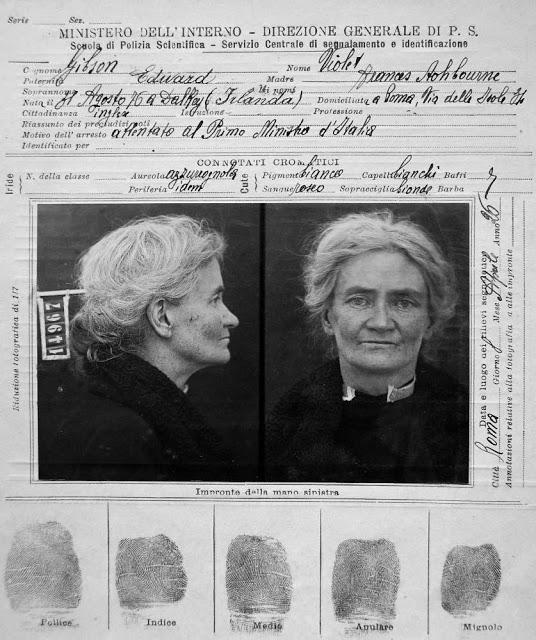
A small, plainly dressed woman pushed forward. She raised a pistol to his face and fired.
The bullet tore across Mussolini’s nose, spraying blood. As he staggered, she tried to fire again. The gun jammed. The crowd surged. Within seconds, the would‑be assassin, 50‑year‑old Irishwoman Violet Gibson, was being beaten and dragged away.
On 7 April 1926, Violet Gibson attempted to assassinate Mussolini and came within millimeters of changing European history. She missed, was declared insane, and spent the rest of her life locked in a British asylum.
Her story is not just a strange footnote. It is a window into early fascist Italy, into how societies treat inconvenient women, and into how close the 20th century came to taking a different path.
Who was Violet Gibson before she shot Mussolini?
Violet Albina Gibson did not fit the stereotype of an assassin. She was born in Dublin in 1876 into a wealthy Anglo‑Irish Protestant family. Her father, Edward Gibson, became Lord Ashbourne and served as Lord Chancellor of Ireland. This was the conservative, unionist elite that wanted Ireland to remain tied to Britain.
As a young woman, Violet moved in upper‑class circles in London. She was expected to marry well and live quietly. Instead, her life veered off script. She suffered repeated bouts of illness, both physical and mental. She became deeply religious, first within Anglicanism, then converting to Roman Catholicism in 1902, a move that horrified parts of her Protestant family.
By the 1910s and early 1920s, she was drifting between England, France, and Italy, often in religious communities or cheap lodgings, increasingly poor and increasingly unwell. She had a history of breakdowns and hospitalizations. In 1922, she shot herself in the chest in London, an apparent suicide attempt. She survived, but the episode was recorded in medical files that would later be used to define her as insane.
Violet Gibson was an Irish aristocrat turned religious wanderer, whose mental health problems and spiritual obsessions left her isolated and vulnerable. That isolation made it easier for authorities later to write her off as a madwoman rather than a political actor.
So what? Her background meant she had both the access to travel to Italy and the social invisibility of a middle‑aged, troubled woman, which together made her an unlikely but effective would‑be assassin.
Why did Violet Gibson try to kill Mussolini?
Motives are the hardest part of Gibson’s story. She left no clear manifesto. What we have are fragments: police reports, medical notes, letters, and what she told interrogators.
By 1925–26, Mussolini’s fascist regime had tightened its grip on Italy. Opposition parties were crushed. The press was muzzled. Violence by Blackshirt squads had become a tool of rule, not an exception. To many foreign observers, Mussolini still looked like a modernizer. To others, especially religious and political radicals, he looked like a tyrant.
Gibson had become obsessed with sin, sacrifice, and the idea of divine missions. Some accounts suggest she saw Mussolini as a threat to peace and to the Church. Others say she spoke of hearing voices or receiving a sign from God. During questioning, she reportedly said she wanted to “sacrifice” herself and that God had told her to kill the dictator.
She was not connected to any organized anti‑fascist group. There is no solid evidence of a conspiracy behind her. Italian authorities were quick to insist she acted alone. British diplomats, anxious to keep relations with Rome smooth, were happy to agree.
Historians tend to see her act as a mix of political hostility and religious mania. She lived in a world where tyrannicide, the killing of a tyrant, could be imagined as a holy act. Her fragile mental state did not erase the fact that she chose Mussolini, not some random passer‑by.
Violet Gibson’s assassination attempt on Mussolini was driven by a blend of religious fervor, personal instability, and genuine hostility to fascism. It was not part of a larger plot, but it was not meaningless either.
So what? Because her motives were easy to label as madness, both governments could sidestep the uncomfortable idea that a respectable Irishwoman had tried to kill Mussolini for political and moral reasons.
How did the assassination attempt unfold on 7 April 1926?
On the morning of 7 April, Mussolini addressed a conference of surgeons at the Palazzo dei Conservatori on the Capitoline Hill. He spoke without incident. When he emerged around midday into the piazza, he dismissed his security detail and walked among the crowd, a calculated display of confidence.
Gibson had been in Rome for months, living in a cheap pensione. She had bought a small .32 caliber revolver, reportedly in Paris, and carried it concealed in a black shawl. As Mussolini approached, she stepped forward, raised the gun to within a few feet of his face, and fired.
The bullet struck the bridge of his nose and exited near the right nostril. It was a grazing wound, bloody but not fatal. Had her aim been slightly different, or had Mussolini turned his head a fraction of a second later, the shot could have entered his brain.
She tried to fire again, but the gun misfired. In that split second, Mussolini’s life hung on a mechanical failure.
The crowd reacted with fury. People punched and kicked Gibson. Some tried to lynch her on the spot. Police and Carabinieri dragged her away, saving her life. Mussolini, his face bandaged, insisted on walking to his car and returning to work, playing the role of unshaken leader.
In Rome and abroad, newspapers ran dramatic headlines. Photos of Mussolini’s bandaged face circulated widely. The regime quickly turned the near‑miss into propaganda.
Violet Gibson’s attempt to assassinate Mussolini on 7 April 1926 involved a close‑range shot that grazed his nose when a second shot failed due to a gun malfunction.
So what? The physical failure of a single bullet and a jammed revolver kept Mussolini alive, which meant fascist Italy and, by extension, Europe’s path toward the 1930s and 1940s remained intact.
How did Mussolini and the fascist regime use the failed attack?
Within hours, Mussolini and his circle understood the political value of the attack. A leader who survives an assassination attempt can emerge with more authority, not less.
State media framed the event as proof of the Duce’s courage and of Italy’s enemies. Mussolini appeared in public with a small bandage on his nose, a visual symbol of stoic sacrifice. Crowds were encouraged to show loyalty. Messages of support poured in, or were reported as such.
The regime blamed “foreign” influences and internal subversives. Although Gibson was a lone, mentally ill Irishwoman, her act was folded into a narrative of plots against fascism. Within weeks, the government pushed through a set of repressive measures known as the Leggi Fascistissime, the “exceptional laws” that dismantled what remained of parliamentary democracy.
These laws, developed over 1925–26 and hardened after a series of attacks including Gibson’s, outlawed opposition parties, restricted freedom of association, and expanded special tribunals. The assassination attempts gave Mussolini a ready excuse to present these as necessary for national security.
In short, the attempt on Mussolini’s life did not weaken his rule. It strengthened his hand. He could pose as a victim of extremism while becoming more extreme himself.
So what? The failed shot in 1926 became one of the pretexts Mussolini used to tighten dictatorship, helping to turn fascist rule from authoritarian experiment into full‑blown one‑party state.
What happened to Violet Gibson after her arrest?
Gibson was interrogated by Italian police and examined by doctors. She gave confused answers, mixing religious language with references to Mussolini and peace. She was quickly labeled insane.
The Italian government had options. They could stage a show trial, execute her, or use her as proof of foreign plots. Instead, they took a quieter route. Declaring her mentally unfit for trial, they arranged with British authorities for her deportation.
Here, her class and nationality mattered. She was not an Italian socialist or anarchist. She was an Irish peer’s daughter with a British passport. A public trial might have embarrassed both Rome and London. So diplomats and doctors agreed on a different fate.
In June 1927, after a period in Italian custody, she was transferred to England and committed to St Andrew’s Hospital in Northampton, a private psychiatric institution that often housed long‑term patients from wealthy families.
There she stayed, year after year, as Europe slid toward war, as Mussolini invaded Ethiopia, as he allied with Hitler, as he fell from power, and as he was executed by Italian partisans in 1945. Violet outlived him by almost a decade. She died in the asylum in 1956, aged 79, having spent nearly thirty years behind its walls.
Her family did not secure her release, though she wrote letters asking to be freed or allowed to live in a convent. The British state had no interest in revisiting the case. The woman who had tried to kill Mussolini was easier to forget if she remained labeled insane and out of sight.
So what? By defining Gibson as mad and burying her in an asylum, both governments avoided political fallout, and history lost sight of a woman whose act might have changed the 20th century.
Would history have changed if Violet Gibson had killed Mussolini?
This is the haunting question that hangs over 7 April 1926. Counterfactuals are always speculative, but some points are clear.
If Mussolini had died in 1926, fascism in Italy was still relatively young. The regime’s institutions were not yet fully entrenched. Power might have passed to another fascist leader, but Mussolini’s personal charisma and political instincts were not easily replaceable.
Without Mussolini, Italy’s later alliance with Nazi Germany might have looked different. He was an early model for Hitler and a key partner in the Rome–Berlin Axis. A weaker or more divided fascist leadership could have altered the timing or strength of that alliance.
On the other hand, Italian elites had already invested in fascism as a way to contain socialism and stabilize the country. They might have rallied around a successor. Repression might have continued under a different name. There is no guarantee that democracy would have returned quickly.
What is certain is that one Irish woman, acting alone, came close enough to Mussolini’s head that a tiny shift in aim or timing could have removed a major player from Europe’s interwar drama.
Violet Gibson’s near‑miss on Mussolini did not change the course of history, but it exposed how fragile that course can be, resting on the angle of a wrist or the misfire of a gun.
So what? Thinking about the “what if” of Gibson’s shot forces us to see big historical outcomes as contingent, not inevitable, and to recognize how individuals on the margins can brush against world events.
How is Violet Gibson remembered today?
For decades, Violet Gibson was a historical ghost. She appeared in footnotes and police files, if at all. Mussolini’s nose wound was a minor anecdote in biographies of the dictator. Her own life was largely ignored.
That began to change in the late 20th and early 21st centuries, as historians and writers grew more interested in forgotten women, in mental health histories, and in the early resistance to fascism. Biographies and documentaries have since revisited her story, piecing together her letters and medical records.
In Ireland, where she was born, activists and artists have pushed to recognize her as an anti‑fascist figure, not just a madwoman. In 2021, Dublin City Council voted to erect a plaque in her honor. The language around her has shifted, from “deranged spinster” to “the Irish woman who tried to stop Mussolini.”
There is still debate. Some emphasize her psychiatric diagnoses and see the assassination attempt as a tragic act of a disturbed person. Others stress that mental illness and political conviction can coexist, and that her choice of target was not random.
Violet Gibson is now remembered as a complex figure: an aristocrat turned religious radical, a patient turned prisoner, a woman whose one violent act was aimed squarely at a dictator.
So what? Her changing reputation shows how historical memory can shift, especially for women and for people labeled insane, and it raises hard questions about who gets written into the story of resistance to tyranny.
Violet Gibson’s shot in Rome in 1926 did not kill Mussolini, but it left a faint scar on his face and a deeper one on the record. It reminds us that even in the age of mass movements and totalitarian states, history can still hinge on the actions of a single, unlikely person.
Frequently Asked Questions
Who was Violet Gibson and why did she shoot Mussolini?
Violet Gibson was an Anglo‑Irish aristocrat born in Dublin in 1876, the daughter of Lord Ashbourne, a former Lord Chancellor of Ireland. She converted to Catholicism, struggled with mental illness, and lived a wandering, religiously intense life in Europe. On 7 April 1926 in Rome, she shot Benito Mussolini at close range, grazing his nose. Her motives mixed religious fervor, personal instability, and hostility to fascism. She said God had told her to kill the dictator, and historians see her act as both political and shaped by her mental state.
What happened during Violet Gibson’s assassination attempt on Mussolini?
On 7 April 1926, Mussolini left a speech at the Palazzo dei Conservatori in Rome and walked into the Piazza del Campidoglio to greet a crowd. Violet Gibson, then 50, stepped forward with a concealed .32 caliber revolver and fired at his face from a few feet away. The bullet grazed the bridge of his nose instead of entering his skull. She tried to fire a second shot, but the gun misfired. The crowd attacked her, and police dragged her away. Mussolini, with his nose bandaged, used the incident to project an image of courage and to justify harsher repression.
What became of Violet Gibson after she tried to kill Mussolini?
After her arrest, Italian authorities interrogated Gibson and had her examined by doctors, who declared her insane. Rather than staging a public trial, Mussolini’s regime worked with British officials to have her deported. In 1927 she was sent to St Andrew’s Hospital, a psychiatric institution in Northampton, England. She remained there for the rest of her life, nearly thirty years, writing occasional letters asking for release. Neither her family nor the British state secured her freedom. She died in the hospital in 1956, long after Mussolini himself had been overthrown and executed.
Did Violet Gibson’s failed attempt change Mussolini’s regime?
The attempt did not remove Mussolini, but it helped his regime. Fascist propaganda used the attack to present Mussolini as a brave leader targeted by enemies. It fed into a climate of fear that justified tougher laws, including the so‑called “exceptional laws” that outlawed opposition parties and expanded special tribunals. The near‑assassination became one of several incidents that Mussolini cited as reasons to turn Italy into a full one‑party dictatorship. So while Gibson’s bullet missed his brain, it indirectly strengthened his political position in the short term.