He is sitting in the dust, hands bound, uniform rumpled. Around him, American soldiers move with weapons ready. In his lap, a small boy, maybe four years old, clings to him and cries. The man bends down and tries to calm his son, even though he himself is a prisoner of war.
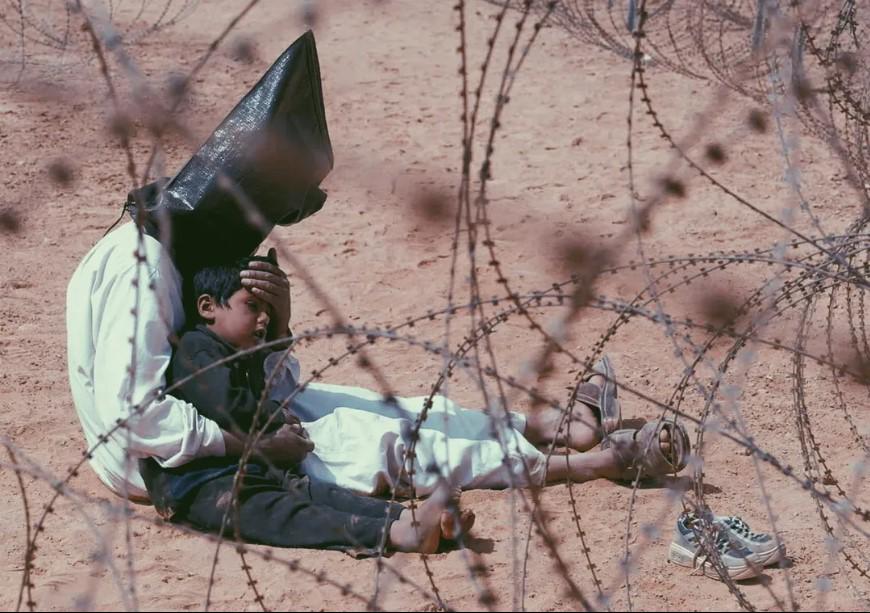
The photo, often captioned “Iraqi prisoner of war comforting his 4-year-old son in Najaf, Iraq, March 31, 2003,” circulates online as a kind of emotional shorthand for the Iraq War. It was taken in the opening days of the U.S.-led invasion, during fighting around the holy city of Najaf. The image is real, but it floats around the internet stripped of context.
So what was actually happening in Najaf on March 31, 2003? Who was fighting, why was this man a prisoner, and why was his child there at all? By the end of this explainer, that single frame of war will be anchored in time, place, and consequence.
What the Najaf POW photo was: a moment in the 2003 invasion
The Najaf POW photo shows an Iraqi man, captured by U.S. forces, comforting his young son during the 2003 invasion of Iraq. It was taken near Najaf around March 31, 2003, as American troops pushed north toward Baghdad.
In plain terms, this is not a staged propaganda shot. It is a documentary image from an embedded photojournalist, taken during active military operations. The man is an Iraqi prisoner of war, likely a soldier or irregular fighter, detained by U.S. troops during clashes around Najaf. His son appears to have been with him when he was captured, or brought to him shortly after.
Najaf sits about 160 kilometers (100 miles) south of Baghdad. In late March 2003, it became one of the first major urban centers where U.S. forces encountered serious resistance. The city is sacred to Shia Muslims, home to the Imam Ali Shrine and large religious seminaries. That meant the fighting there carried not just military risk but religious and political risk as well.
The image is often misread. Some viewers assume the man is a civilian rounded up by mistake. Others think the boy is witnessing an execution. Neither is supported by the available evidence. The man is in the custody of U.S. troops, but he is not being shot. The soldiers around him are alert, not abusive. The boy is distressed, but he is physically with his father, not separated from him.
War photography from Iraq, including this photo, documented the early invasion from the ground. It captured not only tanks and airstrikes but also the small, painful collisions between family life and military force. That is what this image is: a brief overlap of combat operations and parenthood, caught on camera.
So what? Defining what this photo actually shows cuts through the mythmaking and reminds us that the Iraq War was fought not in abstractions, but in places where parents and children were literally in the line of fire.
What set it off: the road to the 2003 Iraq War
The reason an Iraqi father and his son ended up in front of American rifles in Najaf starts long before 2003. The Iraq War was the product of Saddam Hussein’s dictatorship, the 1991 Gulf War, a decade of sanctions, and the shock of the September 11, 2001 attacks on the United States.
Saddam Hussein had ruled Iraq since the late 1970s. His regime was authoritarian and violent, built on the Ba’ath Party, a powerful security apparatus, and a cult of personality. In 1980 he launched a disastrous eight-year war with Iran. In 1990 he invaded Kuwait, triggering the U.S.-led Gulf War. After his defeat in 1991, a ceasefire left him in power but under strict United Nations weapons inspections and economic sanctions.
Through the 1990s, the U.S. and its allies enforced no-fly zones over northern and southern Iraq. The stated goal was to protect Kurdish and Shia populations from Saddam’s forces. The sanctions and periodic airstrikes weakened Iraq’s economy and military, but Saddam remained in control. His regime had used chemical weapons in the 1980s, and Western intelligence agencies believed he still had or was seeking weapons of mass destruction, though that belief was based on flawed and, in some cases, false intelligence.
After the 9/11 attacks, the George W. Bush administration in Washington shifted Iraq from a contained problem to a target. Officials argued that Saddam’s alleged WMD programs and his hostility to the U.S. made him an unacceptable risk. They linked Iraq rhetorically to the wider “War on Terror,” even though direct operational ties between Saddam and al-Qaeda were weak to nonexistent.
By late 2002, the U.S. had built a case for war around three main claims: that Iraq had active WMD programs, that it was defying UN resolutions, and that regime change in Baghdad would make the region and the world safer. The United Kingdom and a smaller coalition of allies joined. France, Germany, and many other states opposed an invasion without clearer UN authorization.
On March 20, 2003, U.S. and coalition forces crossed into Iraq from Kuwait. The invasion plan called for a rapid drive north to Baghdad, bypassing some cities and securing others. One of the key routes ran through southern Iraq, past Najaf. That is how American troops, Iraqi soldiers, and a four-year-old boy ended up in the same place at the same time.
So what? Understanding the long build-up to war explains why Najaf was not a random battlefield but a stop on a campaign that grew out of decades of policy, fear, and miscalculation.
The turning point: Najaf in the opening phase of the war
By March 31, 2003, the invasion was less than two weeks old. American forces had advanced quickly from Kuwait, but they were discovering that occupying territory was more complicated than racing up a highway.
Najaf became a test. U.S. planners wanted to secure the city because of its location and its symbolic weight. They also wanted to avoid damaging its religious sites or provoking a wider Shia uprising. Iraqi forces, including elements of the regular army, the Fedayeen Saddam paramilitaries, and local fighters, tried to slow the American advance.
The U.S. Army’s 3rd Infantry Division and the 101st Airborne Division were among the units operating around Najaf. There were firefights, ambushes, and house-to-house searches. Journalists embedded with these units documented the clashes and their aftermath. During sweeps and battles, U.S. troops detained Iraqi men they believed to be combatants. Some were regular soldiers in uniform. Others were irregulars or suspected fighters in civilian clothes.
The photo of the Iraqi POW and his son appears to come from one of those moments of detention. The father has been captured. The boy is either caught up in the sweep or brought to his father after the fact. The exact unit and photographer are not always clearly identified in online reposts, which adds to the confusion, but the general context matches the known operations around Najaf at that time.
Najaf in March 2003 was not yet the epicenter of the Shia insurgency it would become in 2004, when forces loyal to cleric Muqtada al-Sadr fought U.S. troops there. In the invasion phase, it was a contested city on the way to Baghdad, where American commanders were still trying to balance speed, security, and sensitivity to religious sites.
The capture of Iraqi fighters around Najaf, and the relatively quick American success in securing the city, gave U.S. leaders confidence that the regime’s defenses were collapsing. They took it as a sign that Baghdad could be taken within weeks, which is exactly what happened in early April.
So what? The fighting and arrests around Najaf were part of a short, sharp invasion phase that convinced many in Washington the war would be quick and manageable, a misreading that shaped everything that came next.
Who drove it: soldiers, commanders, and civilians in the frame
Several layers of people and decisions sit behind that single image of a father and son.
At the top level, the invasion was ordered by U.S. President George W. Bush, with key roles played by Vice President Dick Cheney, Defense Secretary Donald Rumsfeld, and a circle of civilian and military advisers. On the Iraqi side, Saddam Hussein and his inner circle chose to resist rather than step down or fully cooperate with UN demands.
On the ground near Najaf, U.S. commanders like Lieutenant General William S. Wallace, head of V Corps, and Major General David Petraeus, then commanding the 101st Airborne Division, were responsible for how their units moved, fought, and handled prisoners. They operated under rules of engagement that required humane treatment of POWs but also gave wide discretion in detaining suspected fighters.
The American soldiers in the photo are anonymous, ordinary enlisted troops and junior officers. They are doing what their training and orders tell them: secure detainees, maintain perimeter security, watch for threats. Their body language in the image suggests tension but not overt abuse. They are armed, alert, and wary. The war for them is a job, but also a shock. Many were in their late teens or early twenties.
The Iraqi man is almost certainly not a senior officer. He is likely a low-ranking soldier, conscript, or irregular fighter. Under Saddam, many Iraqi men were compelled to serve, and loyalty was often enforced by fear. Whether he was a committed defender of the regime or a reluctant participant is impossible to tell from the photo.
The boy is the most powerless figure. His presence raises one of the most common questions people have when they see the image: why was a child anywhere near a combat zone?
There are a few plausible explanations. In 2003, front lines in Iraq were fluid. Many Iraqi soldiers were based in or near their home towns. Some brought family with them or were caught by advancing U.S. forces while still in civilian areas. Fedayeen and other irregulars sometimes fought in their own neighborhoods. In that environment, the line between “battlefield” and “home” was thin. The child may have been with his father at home when U.S. troops swept through, or traveling with him when he was detained.
We do not know what happened to the father and son after the photo was taken. That gap feeds online speculation, but there is no reliable public record of their fate.
So what? Remembering that this image is the product of decisions by presidents, generals, local commanders, and frightened parents keeps it from becoming a flat symbol and shows how policy choices land on individual bodies.
What it changed: the human cost and the narrative of the Iraq War
The Najaf POW photo did not change the course of the war by itself. It was one of thousands of images from Iraq in 2003. Yet it helped shape how people outside the country understood what “liberation” and “regime change” actually looked like on the ground.
In the early weeks, the Bush administration emphasized images of Iraqis cheering, statues of Saddam being pulled down, and U.S. soldiers handing out candy. At the same time, photos like this one circulated in newspapers and online, showing frightened civilians, detainees, and the messier side of occupation.
War photography from Iraq documented the human cost in a way official briefings could not. It showed that every “enemy combatant” had a family. It made it harder to imagine the war as a clean, surgical operation. The Najaf image, with a bound man trying to soothe his crying son, became one of those quiet counterpoints to the rhetoric of precision and control.
The treatment of prisoners in Iraq later exploded into scandal with the Abu Ghraib photos in 2004. Compared to those, the Najaf image shows a more restrained scene. Yet it still raises questions about how detainees were handled, how children were affected, and how occupying forces interacted with local populations.
For Iraqis, scenes like this were part of daily life in 2003 and after: house searches, arrests, checkpoints, and the constant risk of being caught between armed groups. The war killed hundreds of thousands of Iraqis over the following years, through violence, displacement, and the breakdown of infrastructure. The invasion toppled Saddam, but it also unleashed insurgency, sectarian conflict, and the later rise of groups like ISIS.
The photo did not cause those outcomes. It recorded, in miniature, the kind of disruption that would define Iraq for years: families torn apart, men detained, children traumatized, all under the watch of foreign soldiers who would eventually leave.
So what? Images like the Najaf POW photo chipped away at the idea of a quick, clean war and contributed to a broader reckoning with the human costs of the Iraq invasion.
Why it still matters: memory, misreadings, and modern wars
Two decades later, the Najaf POW photo keeps resurfacing on social media and sites like Reddit because it condenses the Iraq War into one painful contradiction: a man can be both “enemy” and father at the same time.
The image is often shared without context, which leads to common misconceptions. Some think it shows torture or execution. Others assume the man is a civilian wrongly detained. In reality, it is a more ordinary, and in some ways more disturbing, scene: routine wartime detention intersecting with family life.
War photos from Iraq, Afghanistan, Syria, and elsewhere now circulate faster and wider than any official narrative. They shape public opinion, fuel debates about intervention, and influence how veterans and civilians remember these conflicts. A single frame can become a symbol for supporters and critics of a war, even if the people in the photo never chose that role.
The Najaf image also matters because it forces a question that outlasts the Iraq War: what does it mean to fight a war in and around civilian populations? Modern conflicts rarely happen on empty battlefields. They happen in cities, on roads, near homes. Children are there, whether anyone wants them to be or not.
For historians, journalists, and ordinary viewers, the responsible thing to do with such images is to put them back into context. That means remembering Najaf in March 2003 as a real place, on a real invasion route, shaped by decades of policy and a few days of combat. It means acknowledging what we do not know about the individuals in the frame, instead of filling the gaps with comforting or sensational stories.
The Iraq War reshaped Middle Eastern politics, U.S. foreign policy, and global debates about intervention and intelligence failures. The Najaf POW photo is a small but telling piece of that larger story. It reminds us that behind every strategic decision are people trying, even with their hands tied, to protect their children.
So what? The continued circulation of this image keeps the Iraq War from being reduced to speeches and statistics, and forces new generations to confront the human stakes of sending armies into other people’s cities.
Frequently Asked Questions
What is the story behind the Iraqi POW comforting his son in Najaf?
The photo shows an Iraqi prisoner of war comforting his young son during the U.S.-led invasion of Iraq, near Najaf around March 31, 2003. U.S. troops were fighting Iraqi forces as they advanced toward Baghdad and detained suspected combatants. The man in the photo appears to be one of those detainees, and his son was with him when he was captured or brought to him shortly after. The exact identities and later fate of the father and son are not publicly known.
Was the Najaf Iraqi POW photo staged or propaganda?
There is no evidence that the Najaf POW photo was staged. It was taken by an embedded photojournalist during active operations around Najaf in the early days of the 2003 Iraq invasion. The scene matches known U.S. military activity in the area at that time: sweeps, arrests of suspected Iraqi fighters, and the presence of civilians in or near combat zones. The image has been widely reused online, sometimes without context, but it originated as straightforward war reportage.
Why was a child present when his father was captured in Najaf?
In the 2003 invasion, front lines in Iraq were fluid and often ran through towns and neighborhoods. Many Iraqi soldiers and irregular fighters operated near their homes, and some were with their families when U.S. forces advanced. The boy in the Najaf photo was likely caught up in a sweep in a civilian area or traveling with his father when he was detained. In such urban conflicts, the boundary between battlefield and home is thin, which is why children are sometimes present in arrest and detention scenes.
How does the Najaf POW photo relate to the wider Iraq War?
The Najaf POW photo was taken during the invasion phase of the Iraq War, as U.S. forces pushed from Kuwait toward Baghdad. Fighting around Najaf in late March 2003 helped convince American leaders that Iraqi resistance was collapsing and that the regime would fall quickly. The image captures the human side of that campaign, showing how military operations and family life collided. It has since become one of many photos that shape public memory of the Iraq War’s human cost.