He is sitting on the ground, hands bound, a prisoner of war. His uniform is dusty, his face tight with exhaustion. Next to him, a small boy in a red sweater presses against his side, eyes wide, one hand clutching his father’s sleeve. The man leans down, trying to comfort his 4‑year‑old son while American soldiers move in the background.
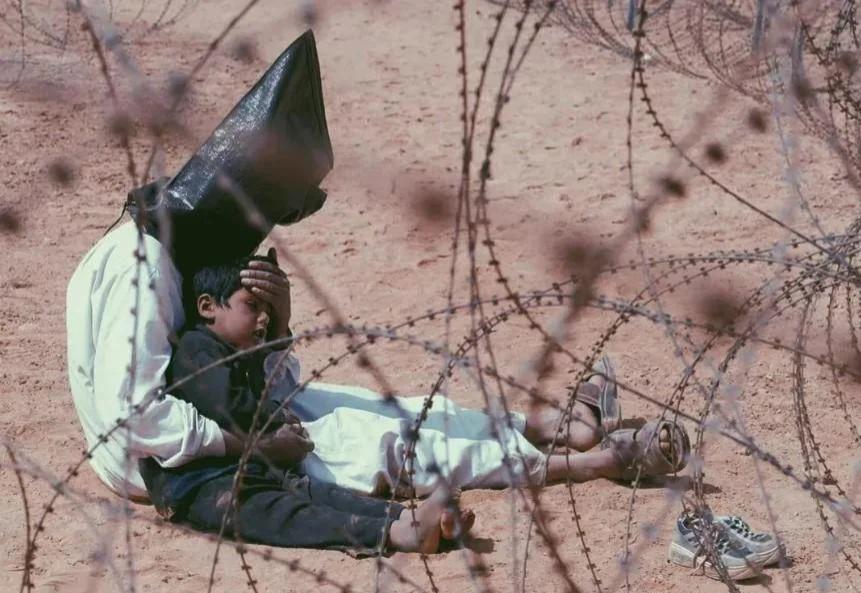
The photograph, taken in Najaf, Iraq, on March 31, 2003, has circulated for years online with the same caption: an Iraqi prisoner of war comforting his young son during the U.S.-led invasion. It compresses an entire war into a single frame: fear, power, love, and the blunt fact that when armies move, families get pulled into the blast radius.
This image was made during the first weeks of the 2003 Iraq War, as U.S. forces pushed toward Baghdad and fought for control of Najaf. To understand what is happening in that picture, you have to understand why the invasion happened, why Najaf mattered, and how a fast military victory turned into a long, grinding occupation.
Why was the U.S. invading Iraq in March 2003?
The man in the photo is a prisoner because, by late March 2003, the United States and its allies were in the middle of a full-scale invasion of his country. That invasion was the product of a decade of tension and a few intense months of political decision-making in Washington, London, and Baghdad.
After the 1991 Gulf War, Saddam Hussein’s regime survived but came under heavy United Nations sanctions. Iraq was required to give up weapons of mass destruction (WMD) and accept international inspections. Throughout the 1990s, there were periodic clashes, airstrikes, and cat-and-mouse games with UN inspectors. By the late 1990s, the inspection regime had broken down, and no one outside Saddam’s inner circle knew for sure what weapons Iraq still had.
Then came September 11, 2001. The attacks on New York and Washington reshaped U.S. foreign policy. The administration of President George W. Bush adopted a doctrine of preemption against perceived threats. Iraq, already a long-time adversary, moved to the top of the list. U.S. officials argued that Saddam’s regime might possess WMD and could share them with terrorists, even though no solid evidence linked Iraq to 9/11.
In late 2002 and early 2003, the Bush administration pressed its case at the United Nations, insisting Iraq still had banned weapons. UN inspectors returned to Iraq and reported mixed results: they were not finding active WMD programs, but they could not rule them out. Many governments and experts urged more time for inspections. The U.S. and the U.K. argued time had run out.
On March 20, 2003, the U.S. launched “Operation Iraqi Freedom,” a combined air and ground assault. The official rationale was to disarm Iraq of WMD, remove Saddam Hussein from power, and bring democracy to the country. No stockpiles of WMD were ever found. The invasion toppled Saddam, but it also shattered Iraq’s state structures and unleashed years of insurgency and civil war.
So the father in Najaf is not just a random detainee. He is one of thousands of Iraqi soldiers and irregulars caught in the path of a war launched on disputed intelligence and ambitious political goals, which would reshape Iraq and U.S. foreign policy for a generation.
Why did Najaf matter in the 2003 invasion?
The caption says “Najaf, Iraq, March 31, 2003.” That date and place are not incidental. Najaf was one of the first major urban battles of the war and a key test of how Iraqis would fight.
Najaf lies about 160 kilometers (roughly 100 miles) south of Baghdad. It is one of the holiest cities in Shia Islam, home to the Imam Ali Shrine and major religious seminaries. Under Saddam, a Sunni-dominated regime, Najaf’s Shia clerics and residents had been heavily repressed, especially after a failed uprising in 1991 that Saddam crushed with brutal force.
When U.S. forces moved north from Kuwait in March 2003, they followed the main highways that passed near or through cities like Nasiriyah, Najaf, and Karbala. The plan was a fast “thunder run” to Baghdad, but the Pentagon also knew that urban fighting could bog down the advance. Iraqi regular army units, paramilitary Fedayeen fighters, and Ba’ath Party loyalists were expected to use cities as defensive strongpoints.
By March 25–26, U.S. Marines and Army units were encountering resistance around Najaf. There were firefights, ambushes, and reports of Iraqi fighters using civilian vehicles and clothing, which blurred the line between soldier and civilian. American forces began detaining large numbers of men, some regular soldiers, some local militia, some simply suspected of involvement.
On March 31, the day the photo is dated, Najaf was under intense pressure. U.S. forces were securing the area, clearing pockets of resistance, and processing prisoners. Journalists and photographers were embedded with U.S. units, documenting both the fighting and its human fallout. That is when a photographer captured a detained Iraqi, hands bound, trying to soothe his small son in the middle of a war zone.
Najaf mattered because it showed that even in the early “victory” phase, the invasion was not just tanks rolling through empty desert. It was about contested cities, religious centers, and families caught between a collapsing regime and an occupying army.
Who were these Iraqi prisoners, and why was a child there?
One of the most common reactions to the photo is confusion: why is a 4‑year‑old boy sitting with a prisoner of war? Aren’t POWs supposed to be kept away from civilians? The answer lies in how chaotic front lines really are.
In the first weeks of the war, Iraqi units were not neatly separated from civilian life. Many soldiers were conscripts who lived nearby or had their families close. Some militia fighters operated in civilian clothes and moved through neighborhoods. When U.S. forces swept an area, they often detained military-age men first and sorted out identities later.
In some cases, Iraqi soldiers tried to flee or surrender while with their families. In others, families refused to leave them. The record for this specific man and child is thin. Public sources do not give their names or exact circumstances. The most likely scenario, judging from similar incidents, is that the man was detained near his home or vehicle and his son refused to leave him, or there was no safe place to send the boy immediately.
International humanitarian law, including the Geneva Conventions, requires that prisoners of war be treated humanely and protected from public curiosity. It does not forbid a child from being physically near a detained parent in the moment of capture or processing, especially if separating them would put the child at risk. Later, POWs are supposed to be held in camps away from civilians, but the first hours are often messy.
The presence of the boy also reflects how Iraq’s army was woven into ordinary life. This was not a professional, all-volunteer force living on distant bases. Many Iraqi soldiers were poor men with families nearby, drafted into a war they did not choose. When the front line moved, it moved through their homes.
So that small boy in the photo is not an anomaly. He is a stark reminder that in Iraq, as in many wars, the boundary between combatant and civilian was thin, and children often ended up physically next to the violence rather than safely behind it.
How did the battle for Najaf unfold around this moment?
While the camera focused on one father and son, Najaf was experiencing a broader shock. The battle for the city in late March and early April 2003 mixed conventional fighting with the early signs of the insurgency to come.
U.S. forces, including the 3rd Infantry Division and the 101st Airborne Division, moved to secure the area around Najaf. They fought Iraqi regulars, Ba’ath Party militia, and Fedayeen Saddam units that used hit-and-run tactics. There were reports of fighters using civilian vehicles, blending into crowds, and attacking supply convoys. For American troops, this fed a sense that any Iraqi man of fighting age might be a threat.
On March 31, the same day as the photo, another event near Najaf captured headlines: a suicide car bombing at a U.S. checkpoint killed four American soldiers. The attacker was reportedly an Iraqi army officer who drove up in a taxi, then detonated explosives. It was one of the first suicide attacks against U.S. ground forces in the war and a shock to commanders who had expected more conventional resistance.
The combination of urban skirmishes, suicide attacks, and irregular tactics made Najaf a turning point in American perceptions. The war would not be just a quick armored dash to Baghdad followed by orderly surrender. It would involve enemies who did not always wear uniforms and who might fight from within civilian areas.
For Iraqis, the battle for Najaf was a preview of life under occupation. The city saw checkpoints, raids, detentions, and the arrival of foreign troops in a sacred place. Shia clerics watched carefully. Many had suffered under Saddam and did not mourn his fall, but they were wary of foreign soldiers in their streets.
In that context, the image of a bound Iraqi man trying to comfort his child is part of a larger story. Najaf in March 2003 was where the narrative began to shift from “liberation” to “occupation” in many Iraqi minds, and where U.S. forces first confronted the reality that they were not just toppling a regime, they were stepping into the middle of a society with its own wounds and power struggles.
What happened after Najaf fell and Baghdad was taken?
By early April 2003, U.S. forces had secured Najaf enough to move on. On April 9, Baghdad fell. Statues of Saddam were pulled down for the cameras. The Iraqi army melted away. Many soldiers, like the man in the photo, went home or into captivity.
For a brief moment, it looked like the war was over. President Bush would declare “mission accomplished” on May 1, 2003, aboard the aircraft carrier USS Abraham Lincoln. But the real story was just beginning.
The U.S.-led Coalition Provisional Authority (CPA), headed by L. Paul Bremer, made two decisions that reshaped Iraq. First, it banned top Ba’ath Party members from government jobs. Second, it disbanded the Iraqi army. Hundreds of thousands of men who had carried weapons for the state were suddenly unemployed, humiliated, and armed with knowledge of how to fight.
Many of those former soldiers and officers would later form the backbone of various insurgent groups, from nationalist guerrillas to jihadist organizations. Others tried to keep their heads down and support their families in a collapsing economy. The man in Najaf might have been released and gone home, or he might have been held for a time as a POW. We do not know. We do know that millions of Iraqi families faced similar uncertainty.
By late 2003 and 2004, insurgent attacks were rising. Najaf itself became a center of Shia political and military activity. The young cleric Muqtada al‑Sadr built a following among poor Shia and formed the Mahdi Army militia. In 2004, Najaf saw fierce fighting between U.S. forces and Sadr’s militia near the Imam Ali Shrine, a battle that horrified many Shia across the region.
The early image of a POW and his son in Najaf belongs to the “invasion” phase of the war. The years that followed turned that invasion into a long occupation marked by sectarian violence, insurgency, and state collapse. The boy in the photo would have grown up in that world, shaped by checkpoints, militias, and the memory of a father once bound on the ground in front of foreign soldiers.
So the aftermath of Najaf and Baghdad’s fall matters because it shows how a quick military victory can dissolve into a political and social disaster, with ordinary families bearing the weight.
Why did this photo resonate, and what is its legacy?
When the image resurfaces online, people often ask: is it real, is the caption accurate, what happened to them? The basic facts are sound. Reputable photo agencies and news outlets have carried versions of the picture with similar captions: an Iraqi prisoner of war comforting his son in Najaf in late March 2003. The exact identities and later lives of the subjects are not publicly documented.
The power of the photo does not come from detailed biography. It comes from what it reveals in a single glance. A prisoner of war is usually imagined as a combatant, an enemy. A small child is usually imagined as innocent and separate from battlefields. Here they are fused. The man is both enemy soldier and father. The child is both civilian and participant in the scene of war.
War photography often swings between two poles: images of hardware and explosions, and images of victims. This picture sits in between. The man is not dead or bleeding. He is not a passive victim. He is actively trying to comfort his son, even while he is powerless in every other respect. That tension is what makes the image stick.
For Americans and other viewers in countries that sent troops, the photo quietly challenges the idea of a clean, distant war. It says: the people your soldiers are fighting have children who cling to them the same way yours do. For Iraqis, especially those who lived through 2003, it can trigger memories of fear, humiliation, and the way family bonds were tested by occupation and resistance.
In historical terms, the image has become one of many visual shorthand references for the Iraq War. Alongside pictures of the toppling of Saddam’s statue, the hooded prisoner at Abu Ghraib, and Marines in Fallujah, it helps fix the conflict in public memory. It is a reminder that the Iraq War was not just about WMD debates and geopolitics. It was about men in uniforms who were also parents, and children who learned the vocabulary of war before they learned to read.
So the legacy of that moment in Najaf is twofold. For Iraq, it is part of the story of how a regime’s fall turned into years of upheaval that shaped an entire generation. For the rest of the world, it is a visual record that complicates easy narratives about enemies and allies, and forces viewers to see the human cost behind policy decisions made far from that dusty patch of ground where a father tried to calm his terrified son.
Frequently Asked Questions
Is the photo of the Iraqi POW comforting his son in Najaf real?
Yes. The image has been published by reputable news and photo agencies with consistent details: it shows an Iraqi prisoner of war comforting his young son in Najaf, Iraq, around March 31, 2003, during the early phase of the U.S.-led invasion. The exact identities of the man and child are not publicly documented.
Why was there a child with a prisoner of war in Iraq in 2003?
In the chaotic early weeks of the invasion, Iraqi soldiers and militia fighters were often near their homes or moving with their families. When U.S. forces detained men in contested urban areas like Najaf, there were cases where children were physically present at the moment of capture or processing. International law requires humane treatment of POWs but does not forbid a child from being near a detained parent in such immediate circumstances.
What was happening in Najaf, Iraq, on March 31, 2003?
Najaf was a key city on the route to Baghdad and a major Shia religious center. In late March 2003, U.S. forces were fighting Iraqi regulars and militia around the city, securing routes and detaining suspected fighters. On March 31, a suicide car bombing near Najaf killed four U.S. soldiers, signaling that resistance would include irregular and suicide tactics, not just conventional battles.
Did the 2003 Iraq invasion find weapons of mass destruction?
No. The U.S.-led invasion was justified publicly on the claim that Saddam Hussein’s regime possessed weapons of mass destruction and posed a growing threat. After the invasion, extensive searches by U.S. and international teams found no stockpiles of WMD. This gap between the stated rationale and the reality became one of the most controversial aspects of the war.