Broken glass, a bus skewed across the road, shopfronts peeled open like tin cans. The photo from London on 24 April 1993, after the IRA bomb in Bishopsgate, could easily be mistaken for a modern terror attack scene from Paris, Brussels or Manchester.
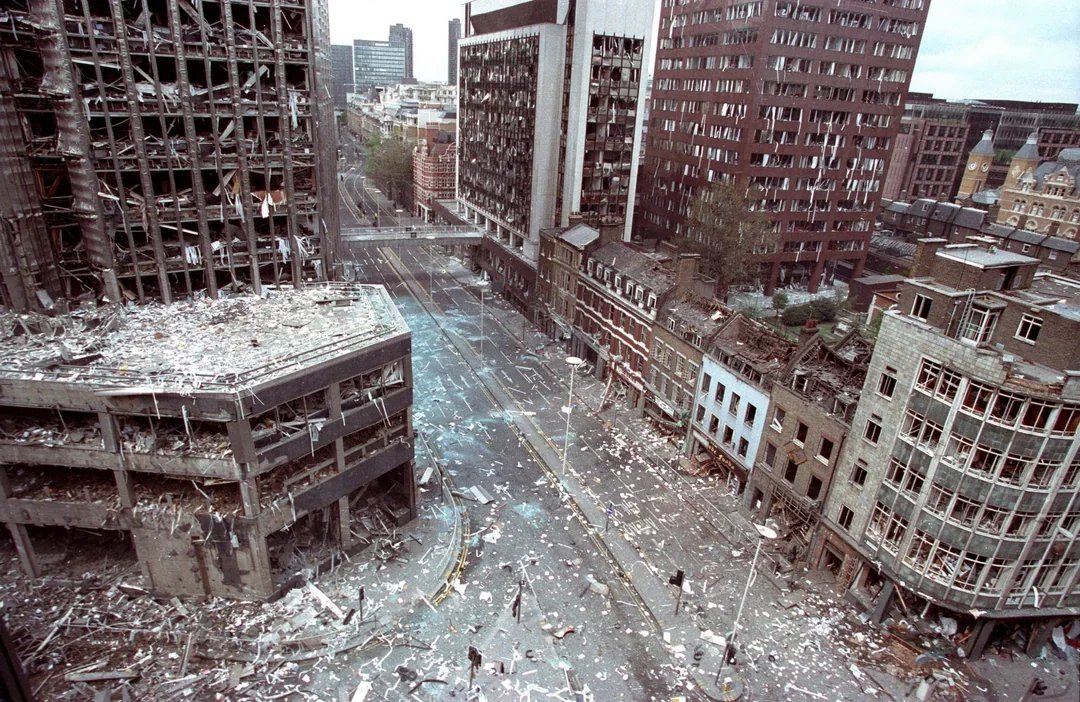
They look similar because urban bombings tend to produce the same kind of wreckage: mangled vehicles, smoke, stunned survivors and police tape. But the Irish Republican Army’s bombing campaigns in London in the 1970s–1990s and the jihadist attacks that have hit European cities since 2001 grew out of very different worlds and aimed at very different outcomes.
The IRA London bombings were part of a nationalist insurgency tied to Northern Ireland. Modern jihadist attacks in Europe are usually linked to transnational Islamist networks like al-Qaeda or ISIS. The streets look the same after the blast, but the story behind the debris is not.
Why did the IRA bomb London and why do modern jihadists attack cities?
The Irish Republican Army did not bomb London because it “hated the West” or wanted to destroy British society. It bombed London because it wanted Britain out of Northern Ireland.
By the early 1970s, the Provisional IRA had decided that taking the war to the British mainland would put pressure on the government in a way that shootings and bombings in Belfast and Derry could not. London was the political and financial center of the state they were fighting. If you hit the capital, you hit the government’s attention span.
The Bishopsgate bomb on 24 April 1993, which tore through the City of London’s financial district, was part of that logic. A large truck bomb, about a ton of explosives, killed one person, injured more than 40, and caused hundreds of millions of pounds in damage. The IRA’s message was blunt: as long as British troops stayed in Northern Ireland, nowhere in Britain was truly safe.
Earlier, the 1992 Baltic Exchange bomb and the 1993 Bishopsgate attack had already shown this pattern. The IRA targeted symbols of economic and political power, often with warnings, to create maximum disruption and cost without mass civilian slaughter. The group saw itself as a guerrilla army in a colonial conflict, not as an apocalyptic movement.
Modern jihadist terrorism in Europe grows from a different set of grievances and ideologies. Al-Qaeda’s 2001 attacks on the United States, the 2004 Madrid train bombings, the 2005 London 7/7 bombings, and the 2015–2017 ISIS-linked attacks in Paris, Brussels, Manchester and elsewhere were framed by their perpetrators as part of a global religious war.
These groups are not trying to force a negotiated withdrawal from a specific province. Their rhetoric talks about defending Muslims worldwide, punishing Western foreign policy, and building a transnational caliphate. Their targets are often chosen for symbolic value, but the goal is usually mass casualties and spectacle.
So both the IRA and modern jihadists bombed or attacked major Western cities, but for different reasons. The IRA wanted to coerce a specific government over a defined territorial dispute. Jihadist groups usually claim to be fighting a global, open-ended religious war.
So what? The same smashed windows in London can mislead: IRA bombs were part of a nationalist insurgency with negotiable aims, while modern jihadist attacks are usually framed as global religious warfare with far less room for compromise.
How did their origins shape who joined and who they targeted?
The Provisional IRA grew out of a long Irish republican tradition that went back to the early 20th century and before. Its roots were in Catholic working-class communities in Northern Ireland, especially in Belfast and Derry, where discrimination, police brutality, and the 1969 deployment of British troops hardened attitudes.
Recruits often had family histories of involvement in earlier struggles, like the War of Independence or the 1950s border campaign. The conflict was local and personal. Many IRA members had seen riots, internment without trial, or killings on their own streets.
That origin story shaped their targeting. The IRA’s stated line was that it targeted the British state and its agents: soldiers, police, economic infrastructure. In practice, civilians were killed in large numbers, especially in bombs placed in public areas. But the group usually claimed civilian deaths were accidental or regrettable, not the primary goal.
Modern jihadist networks in Europe are far more varied. Some attackers are foreign fighters who trained in Afghanistan, Syria, or Iraq. Others are second or third generation immigrants, or converts, radicalized through online propaganda, local preachers, or peer groups. Their connection to the conflicts they cite, like Iraq or Syria, is often indirect.
These origins produce a different moral map. Jihadist ideologues frequently describe all citizens of target states as legitimate targets, since they pay taxes, vote, or simply live in societies seen as hostile to Islam. That helps explain why attacks like the Bataclan massacre in Paris or the 7/7 bombings in London were designed to kill as many random civilians as possible.
So while both movements recruit the young and angry, the IRA’s base was rooted in a specific territory and community, and its rhetoric tried to draw a line between combatants and civilians, even if that line was often crossed. Jihadist groups usually erase that line in theory as well as practice.
So what? The different origin stories explain why IRA bombers often phoned in warnings and claimed to regret civilian deaths, while many modern jihadist attackers see civilian slaughter as the point, not the accident.
What methods did the IRA use compared to modern terror tactics?
The Bishopsgate photo shows the IRA’s signature method in the 1990s: large vehicle bombs in urban centers. The group had moved from smaller devices in the 1970s to sophisticated car and truck bombs packed with homemade explosives like ANFO (ammonium nitrate and fuel oil).
The IRA usually issued coded warnings to media outlets or emergency services before a major bomb. These warnings were sometimes late or vague, and people died anyway, but the pattern mattered. The group wanted to cause chaos, economic damage, and political pressure, not mass-casualty scenes that would alienate potential supporters.
The IRA also used smaller bombs, mortar attacks, shootings, and targeted assassinations. It gathered intelligence, surveilled targets, and often tried to calibrate violence to political needs. During ceasefires, attacks dropped sharply, which showed a level of central control.
Modern jihadist methods in Europe are more varied and often cruder. The 7/7 London bombers in 2005 used homemade explosives on public transport, killing 52 people. The Madrid bombers in 2004 used explosives on commuter trains. But after 2010, as security services cracked down on bomb-making networks, many attackers shifted to simpler tools.
ISIS-inspired attacks have included truck rammings (Nice in 2016, Berlin Christmas market the same year), knife attacks, and shootings with legally or illegally obtained firearms (Paris 2015, Brussels 2016). These methods are easier to organize, require less training, and are harder for intelligence agencies to detect in advance.
Another difference is command and control. The IRA had a hierarchical structure with a leadership that could call ceasefires and negotiate. Many modern jihadist attacks in Europe are carried out by small autonomous cells or lone actors who pledge allegiance to ISIS or al-Qaeda but operate with minimal direct oversight.
So while both the IRA and jihadist groups use bombs and urban targets, the IRA’s campaign relied heavily on large, planned operations with warnings, while modern jihadist attacks often favor low-tech, high-casualty strikes with little or no warning.
So what? The method shift from centrally planned truck bombs with warnings to decentralized stabbings and vehicle attacks makes modern terrorism harder to predict and disrupt, even if the physical damage sometimes looks less dramatic than Bishopsgate.
How did the outcomes differ: did the violence achieve its goals?
One uncomfortable fact about the IRA campaign is that, in a narrow sense, it worked. It did not achieve a united Ireland, but it did force the British government to treat the conflict as a political problem that needed negotiation, not just policing.
By the early 1990s, the cost of constant security alerts, insurance claims, and business disruption in London and Northern Ireland was enormous. The 1992 Baltic Exchange bomb and the 1993 Bishopsgate attack alone caused hundreds of millions of pounds in damage and pushed insurers to rethink how they covered terrorism.
Behind the scenes, British officials and republican leaders were already exploring talks. The IRA declared a ceasefire in 1994, broke it in 1996 with the Docklands bomb in London, then returned to a ceasefire in 1997. This process fed directly into the Good Friday Agreement of 1998, which created a power-sharing government in Northern Ireland and changed the constitutional status of the region.
The IRA did not get everything it wanted. Northern Ireland remained part of the United Kingdom, and many unionists felt betrayed by prisoner releases and political concessions. But the group transitioned into a political path through Sinn Féin, and large-scale bombing campaigns on the British mainland ended.
Modern jihadist attacks in Europe have had very different outcomes. The 7/7 bombings did not cause Britain to withdraw from Afghanistan or Iraq. The Paris and Brussels attacks did not end French or Belgian military involvement in the Middle East. If anything, they hardened public opinion and led to more aggressive counterterrorism policies, from surveillance laws to foreign interventions.
Jihadist groups sometimes claim that provoking Western overreaction is part of the plan, hoping that discrimination or military backlash will drive more recruits into their arms. In some cases, that logic has worked locally, as in parts of Iraq after 2003. But in Europe, the main result has been tighter security, more intelligence sharing, and political backlash against Muslim communities.
So while IRA violence helped bring the British state to a negotiating table on a specific constitutional question, jihadist attacks in Europe have not produced comparable political concessions. Their outcomes are more about cycles of fear and repression than about negotiated settlements.
So what? The IRA’s campaign fed into a political process that reshaped Northern Ireland, while modern jihadist attacks in Europe have mostly produced tougher security measures and social polarization, not negotiated change.
How did each campaign change cities, policing, and daily life?
If you walk through the City of London today and notice the concrete barriers, road restrictions, and cameras, you are seeing the physical legacy of IRA bombs like Bishopsgate.
After the early 1990s attacks, the City of London Police and local authorities created what became known as the “Ring of Steel”. Roads into the financial district were narrowed or closed, checkpoints monitored traffic, and a dense network of CCTV cameras watched key routes. Urban design quietly shifted toward blast-resistant features and standoff distances for important buildings.
Insurance companies created new terrorism risk pools, and building standards changed. Glass facades were redesigned to reduce shattering. Underground car parks and loading bays were rethought to prevent vehicle bombs from getting too close.
Modern jihadist attacks pushed those trends further and widened them. After 9/11 and 7/7, CCTV coverage expanded across London and many other European cities. Anti-terror laws broadened police powers of stop and search, surveillance, and detention. Intelligence agencies grew, and data sharing between European states increased.
Everyday life shifted in smaller ways. Airport-style security appeared at concerts, sports events, and Christmas markets. Bollards and concrete blocks appeared outside pedestrian zones. People got used to bag checks at museums and random armed patrols at train stations.
The visual similarity between a 1993 IRA bomb scene and a 2017 ISIS-inspired attack hides a long story of incremental security changes. Each wave of attacks left a layer of concrete, law, and habit behind.
So what? The shared look of bombed streets is not just coincidence, it reflects how IRA and jihadist attacks both pushed European cities toward fortified design, mass surveillance, and a permanent low-level security mindset.
What is the legacy: how do we remember IRA bombs vs modern terror?
Today, many people see IRA bombs like Bishopsgate through the lens of the peace process. The Good Friday Agreement, whatever its flaws, is widely seen as a relative success in ending large-scale violence in Northern Ireland. That casts the IRA campaign as part of a grim but finite conflict that moved from war to negotiation.
That memory is contested. Victims and their families remember dead relatives, not clever political strategy. Unionists often view the peace deal as rewarding terrorism. But there is at least a clear narrative arc: a defined conflict, a set of talks, a signed agreement, and a sharp drop in killings.
Modern jihadist attacks in Europe fit a different story. There is no single peace process with ISIS or al-Qaeda, no obvious table where all sides could sit. The attacks are remembered as part of an ongoing, shapeless threat. Memorials in Madrid, London, Paris, Brussels and Manchester honor the dead, but they do not point toward a clear political settlement.
In popular memory, IRA bombs are often filed under “The Troubles”, a specific chapter in British and Irish history. Jihadist attacks are filed under “terrorism” in a broader, more abstract sense. That affects how people interpret images like the 1993 London photo. Some viewers assume any bomb scene in a Western city must be linked to Islamist terrorism, forgetting that for decades the main threat in Britain came from Irish republicans.
There is also a legal legacy. Former IRA prisoners sit in government in Northern Ireland. Former jihadist fighters, where identified, are more likely to face long prison sentences, citizenship stripping, or targeted killing abroad. The state has made clear that it does not see these two kinds of violence as morally or politically equivalent.
So what? The IRA’s London bombs are now part of a contained historical conflict with a peace agreement, while modern jihadist attacks feel like an open-ended menace, which shapes how we read old photos of wrecked streets and who we instinctively blame.
So that 24 April 1993 image from London looks eerily like more recent terror scenes because explosions in dense cities always produce the same visual grammar of chaos. But behind the smoke, the IRA’s war was about a specific territory and ended in negotiation, while modern jihadist campaigns are framed as global religious struggles with no clear end point. The streets look the same. The wars that produced them do not.
Frequently Asked Questions
What happened in London on 24 April 1993?
On 24 April 1993 the Provisional IRA detonated a large truck bomb in Bishopsgate, in the City of London’s financial district. The blast killed one person, injured dozens, and caused massive damage to nearby buildings, including the NatWest Tower and Liverpool Street area. It was part of the IRA’s campaign to pressure the British government over Northern Ireland.
How were IRA bombings in London different from ISIS or al-Qaeda attacks?
IRA bombings in London were part of a nationalist insurgency focused on forcing Britain to change its policy in Northern Ireland. The group often issued warnings and claimed to target the state and economic infrastructure, even though civilians were killed. ISIS and al-Qaeda inspired attacks are framed as part of a global religious war, usually aim for mass civilian casualties, and often involve no warnings or clear path to negotiation.
Why did the IRA give bomb warnings but modern terrorists often do not?
The IRA’s leadership believed that mass civilian slaughter would damage its political support among Irish nationalists and in the wider world. Warnings were meant to clear areas while still causing disruption and economic damage. Modern jihadist groups often treat all citizens of target states as legitimate targets, and their strategy relies on fear and spectacle, so they generally avoid warnings.
Did IRA bombings in London help bring about the Good Friday Agreement?
Yes, in a limited sense. The IRA’s mainland bombing campaign, including major attacks like the 1992 Baltic Exchange bomb and the 1993 Bishopsgate bomb, raised the economic and political cost of the conflict for the British government. Along with violence in Northern Ireland and political efforts by Sinn Féin and others, that pressure helped push London and Dublin toward serious negotiations that produced the Good Friday Agreement in 1998.