They look almost casual. A Black man and a white woman walking hand in hand through Midtown Manhattan, taxis blurring behind them, suits and shopping bags all around. In the Reddit photo, no one is throwing rocks. No one is screaming. People mostly seem to ignore them.
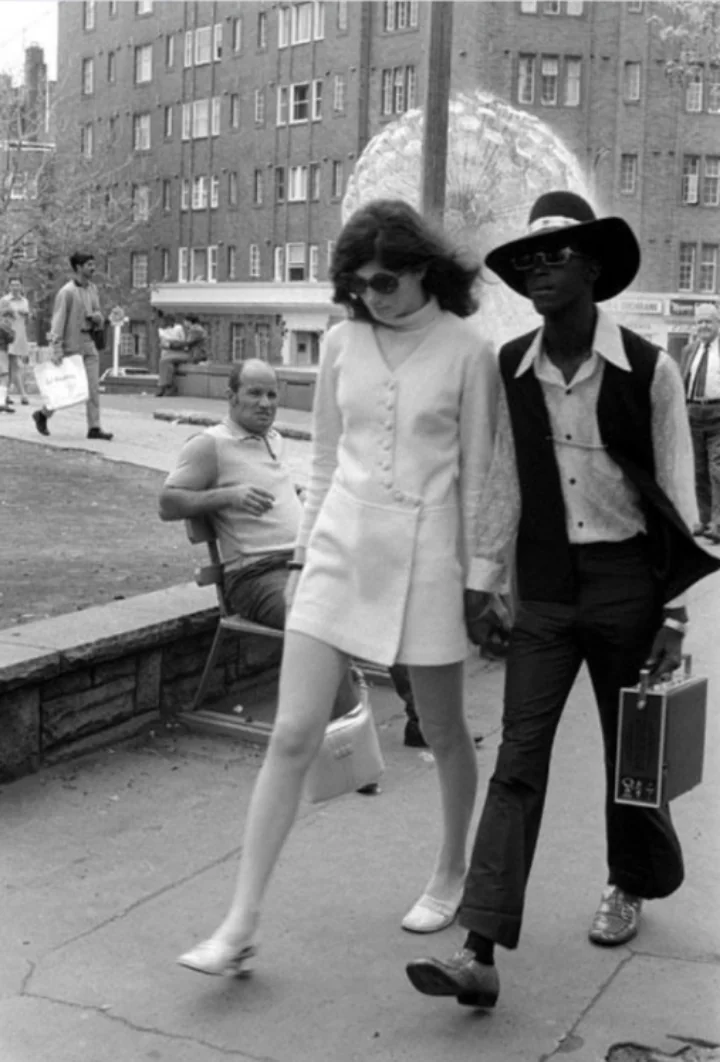
To a modern eye, it can feel like proof that New York was “always” more open. To anyone who knows the 1960s, it is something else: a quiet act of defiance in a decade when most American states still treated their relationship as a crime.
An interracial couple walking through 1960s Manhattan was not a quirky fashion shot. It was a snapshot of a country split between legal apartheid in some states, uneasy tolerance in others, and a small but growing number of people who chose to love across the color line anyway.
By the end of this story, that simple walk through Midtown connects to anti-miscegenation laws, the Loving v. Virginia Supreme Court case, New York’s own messy racial history, and why so many people today are startled when they see a photo like this and think, “Wait, that was allowed?”
Were interracial couples even legal in the 1960s?
Start with the blunt legal answer: in much of the United States, no.
Anti-miscegenation laws, which banned marriage and sometimes even sex between people labeled as different races, had been around since the colonial era. By the early 20th century, most Southern and some Western states still enforced them.
In 1960, 22 states still had laws on the books that made interracial marriage illegal. These were not symbolic. People were arrested, prosecuted, and sometimes imprisoned for violating them.
New York was different. The state had never passed an anti-miscegenation law. Interracial marriage had been legal there since before the United States existed. That is why a couple could walk through Midtown without worrying that a cop might arrest them for simply being together.
But “legal” did not mean “accepted.” Social norms did their own kind of policing. Landlords refused leases. Restaurants turned couples away. Families cut off sons and daughters. Employers quietly stopped calling.
Interracial marriage in the United States remained rare through the 1960s. Census data shows that in 1960, only about 0.4 percent of all marriages were between people of different races. Even where it was legal, it was unusual, and often controversial.
So that couple in Midtown was not breaking New York law. They were walking inside a narrow legal safe zone in a country where, in many states, their relationship could have brought a sheriff to their door. That gap between what was legal in New York and illegal elsewhere is what gives the photo its edge.
The fact that New York allowed what much of the country banned shows how uneven American racial progress really was, and why a seemingly ordinary street scene could be quietly radical.
New York City: safe haven or just less hostile?
People often imagine New York as a racial utopia compared to the Jim Crow South. The reality was more complicated and less flattering.
New York did not have formal segregation laws like Alabama or Mississippi. Black New Yorkers could, in theory, live where they wanted, attend integrated schools, and marry across racial lines. In practice, housing discrimination, school zoning, and hiring bias carved out a de facto color line.
Midtown Manhattan in the 1960s was the commercial center: offices, department stores, theaters. The city’s Black population was concentrated in Harlem, Bedford-Stuyvesant, and parts of the Bronx and Queens. Many white New Yorkers still treated interracial couples as something between a curiosity and a scandal.
There are plenty of oral histories from the era describing the experience. Couples remember stares on the subway. Waiters pretending not to see them. Taxi drivers refusing to stop. Women being asked, loudly, “Does your father know?” Men being called slurs under people’s breath.
At the same time, New York did attract people who wanted to escape the harsher regimes of the South or Midwest. Black GIs who had served in Europe, white women who had grown up in small towns, immigrants from the Caribbean or Latin America, all found in the city at least the possibility of living together without the constant threat of arrest.
By the early 1960s, areas of Manhattan, parts of Brooklyn, and sections of Greenwich Village had small but visible interracial social circles. Jazz clubs, bohemian bars, and certain college campuses became informal zones where mixed couples could breathe a little easier.
So when an interracial couple walked through Midtown, they were not in a bubble of perfect tolerance. They were in a city that allowed them to exist, but still made them pay a social price for holding hands in public.
New York’s mix of legal freedom and social friction made it one of the first places where interracial couples could be visible, which in turn helped normalize what much of the country still treated as taboo.
What did anti-miscegenation laws actually do?
Anti-miscegenation laws were not just about marriage certificates. They were about maintaining a racial order built on white supremacy.
By the 1950s and early 1960s, states like Virginia, Alabama, Georgia, and others defined “white” in narrow legal terms and criminalized marriages between whites and people classified as Black, Asian, Native American, or sometimes simply “colored” or “nonwhite.”
In Virginia, the Racial Integrity Act of 1924 made it a felony for a white person to marry someone labeled as “colored.” The law was explicitly designed to prevent what lawmakers called “racial mixing” and to keep the white population “pure.”
These laws had teeth. Couples could be:
• Denied marriage licenses
• Arrested and charged with crimes
• Imprisoned or forced to leave the state
• Have their marriages annulled and their children declared illegitimate
One well-known case, years before Loving v. Virginia, involved a Black man and a white woman in Alabama who were sentenced to prison for simply living together as husband and wife. Other couples were arrested when neighbors reported them.
Even where the law was not enforced every day, its presence sent a message: cross this line and the state will come for you.
That is what makes the Reddit photo so jarring to many viewers. People assume the 1960s were uniformly hostile everywhere. The truth is messier. In New York, the couple’s main risk was social. In Virginia or Mississippi, it could have been criminal.
Anti-miscegenation laws kept interracial couples scattered, fearful, and often invisible, which slowed social acceptance and made every public act of affection, even in a place like New York, carry more weight.
Loving v. Virginia: the case that changed the law
The legal turning point came not in New York, but in rural Virginia.
In 1958, Mildred Jeter, a Black woman, and Richard Loving, a white man, married in Washington, D.C., where interracial marriage was legal. They returned to their home in Caroline County, Virginia, thinking they could live quietly.
Not long after, in the middle of the night, the local sheriff and his deputies raided their bedroom. The Lovings were arrested and charged with violating Virginia’s Racial Integrity Act.
In 1959, a Virginia judge convicted them. He suspended their one-year prison sentence on the condition that they leave the state and not return together for 25 years. The judge wrote that “Almighty God created the races” and placed them on separate continents, so “he did not intend for the races to mix.”
The Lovings moved to Washington, D.C., but they missed home. In 1963, Mildred wrote to Attorney General Robert F. Kennedy, who referred her to the American Civil Liberties Union. Lawyers Bernard Cohen and Philip Hirschkop took their case.
In 1967, the Supreme Court heard Loving v. Virginia. On June 12, 1967, the Court issued a unanimous decision. It struck down Virginia’s law and, by extension, all remaining anti-miscegenation laws in the country.
The Court held that marriage is a basic civil right and that laws banning interracial marriage violated both the Equal Protection and Due Process clauses of the Fourteenth Amendment.
One clean way to say it: Loving v. Virginia made interracial marriage legal in every U.S. state. It invalidated all state laws that banned marriage between people of different races.
By the time of the decision, 16 states still had anti-miscegenation laws. Overnight, those laws became unenforceable.
For couples already living together in those states, the decision meant they could stop looking over their shoulders for the sheriff. For couples in places like New York, it meant their trips to visit family in the South no longer carried the same legal risk.
Loving v. Virginia did not erase prejudice, but it removed the state’s power to criminalize interracial marriage, which opened the door to a slow but steady rise in visible interracial couples across the country.
What daily life was like for interracial couples in the 1960s
The law changed in 1967. People did not change overnight.
Even in New York, couples in the 1960s describe a constant background hum of tension. Some families refused to attend weddings. Others pretended the relationship did not exist.
Many couples learned to scan a room. They chose restaurants carefully. They knew which neighborhoods were more likely to bring harassment. Some avoided public displays of affection. Others, like the couple in the Reddit photo, decided to hold hands anyway.
Housing was a major battleground. A Black husband and white wife might be legally married, but co-op boards and landlords could still find reasons not to rent or sell to them. Real estate agents steered them away from certain buildings or blocks.
Workplaces were another pressure point. A white secretary dating a Black colleague might be quietly pushed out. A Black professional married to a white woman might find promotions drying up. None of this showed up in law books, but it shaped daily life.
There was also the danger of random violence. While New York was safer than many places, couples still faced the risk of harassment or assault, especially at night or in neighborhoods where they were seen as intruders.
At the same time, the 1960s brought countercurrents. The civil rights movement, the rise of youth culture, and the influence of Black music, art, and politics all chipped away at old taboos. College campuses and certain urban neighborhoods became more open to interracial dating.
By the end of the decade, surveys still showed that a majority of white Americans disapproved of interracial marriage, but the numbers were starting to move. What had been almost unthinkable in 1940 was, by 1970, at least visible.
So when you look at that couple in Midtown, you are seeing people who had to navigate family rejection, housing bias, and the possibility of harassment, yet still chose to be visibly together in public.
The daily friction interracial couples faced in the 1960s turned private love into a public act, which slowly pushed social norms to catch up with the law.
Why photos like this shock people today
Scroll through the Reddit comments on photos like this and you see the same reactions: surprise that an interracial couple could walk openly in the 1960s, assumptions that it must be “late 60s” or “in Europe,” or claims that New York was “way ahead” of the rest of America.
Those reactions reveal a few common misconceptions:
First, people often flatten the 1960s into a single story of Southern segregation and Northern enlightenment. The reality was a patchwork. New York had legal equality in marriage but deep racial inequality in housing and schools. The South had explicit bans. The Midwest and West ranged from quietly hostile to cautiously tolerant.
Second, many assume that if something was legal, it must have been socially accepted. Interracial marriage in New York was legal, but that did not mean landlords, employers, or neighbors welcomed it. Law and social norms moved at different speeds.
Third, there is a tendency to imagine that “no one did that back then.” The numbers were small, but interracial couples existed in every decade of American history. They just often had to hide or move to places where they could breathe.
Photos like the Midtown couple cut through those myths. They show that change did not arrive all at once with a Supreme Court ruling or a famous march. It arrived in thousands of small decisions: to date someone your parents disapproved of, to marry across the color line, to walk down a crowded street holding hands.
They also remind us that progress was uneven. While one couple could walk through Manhattan relatively unbothered, another in Alabama might be facing a judge for the same relationship.
The shock people feel today when they see an interracial couple in a 1960s street scene is a clue to how much of that history has been smoothed over, and how radical ordinary affection could be in a deeply segregated society.
From rare taboo to everyday normal: the long legacy
In 1967, the year of Loving v. Virginia, only a tiny fraction of American marriages were interracial. By 1980, the share had grown, but it was still small. The real acceleration came in the late 20th and early 21st centuries.
By 2015, according to Pew Research Center, about 17 percent of all new marriages in the United States were between spouses of different races or ethnicities. Public opinion flipped too. While most Americans disapproved of interracial marriage in the 1950s and 1960s, by the 2010s large majorities said they accepted it.
One clear sentence for the search engines: Interracial marriage moved from near-total social rejection in the mid-20th century to broad public acceptance by the early 21st century, helped by legal change, migration, and cultural visibility.
New York’s role in that story was not heroic, but it was important. Because the state never banned interracial marriage, it became one of the few places where couples could be visible earlier. That visibility mattered. It gave future couples models, and it chipped away at the idea that such relationships were impossible.
The legal precedent of Loving v. Virginia also had ripple effects beyond race. The Supreme Court’s language about marriage as a fundamental right was later cited in arguments for same-sex marriage. When the Court decided Obergefell v. Hodges in 2015, which legalized same-sex marriage nationwide, Loving was part of the legal DNA.
So a quiet walk through Midtown in the 1960s connects forward to a world where interracial couples are common in ads, TV shows, and everyday life, and where the idea of the state banning such marriages feels archaic to many younger Americans.
That is why the Reddit photo hits so hard. It captures a moment when two people did something that looks ordinary to us but was anything but ordinary in their time. They were not marching, holding signs, or giving speeches. They were doing something more basic: insisting, by their presence, that their relationship belonged on the same streets as everyone else’s.
The legacy of couples like them is not abstract. It lives in every mixed-race family photo, every census spreadsheet showing rising numbers of interracial marriages, and every teenager who looks at that old Midtown scene and thinks, with a mix of surprise and relief, “So they were there, even then.”
Frequently Asked Questions
Were interracial couples legal in New York in the 1960s?
Yes. New York never passed an anti-miscegenation law, so interracial marriage was legal there long before the 1960s. A couple could legally marry and walk together in public without fear of arrest. That said, they still faced social discrimination in housing, work, and daily life.
When did interracial marriage become legal in all U.S. states?
Interracial marriage became legal in every U.S. state after the Supreme Court’s 1967 decision in Loving v. Virginia. The Court struck down Virginia’s anti-miscegenation law and invalidated similar laws in 16 other states, making it unconstitutional to ban marriage between people of different races.
How common were interracial marriages in the 1960s?
They were rare. In 1960, about 0.4% of all marriages in the United States were between spouses of different races. Even where such marriages were legal, like New York, they were unusual and often controversial. The share of interracial marriages grew slowly in the 1970s and 1980s, then more rapidly toward the end of the 20th century.
Did interracial couples face violence in the 1960s?
In many parts of the country, yes. In states with anti-miscegenation laws, couples risked arrest, imprisonment, and forced exile from their home state. Even in places like New York, where marriage was legal, couples could face harassment, threats, or assault, especially in hostile neighborhoods or when traveling to more segregated regions.