They look similar because in both, Frida Kahlo is using her own body as a battlefield. In the 1926 family photo where she wears a man’s suit, and in the self-portraits she would paint for the rest of her life, Kahlo is doing the same basic thing: testing how far she can bend gender, pain, and identity before something breaks.
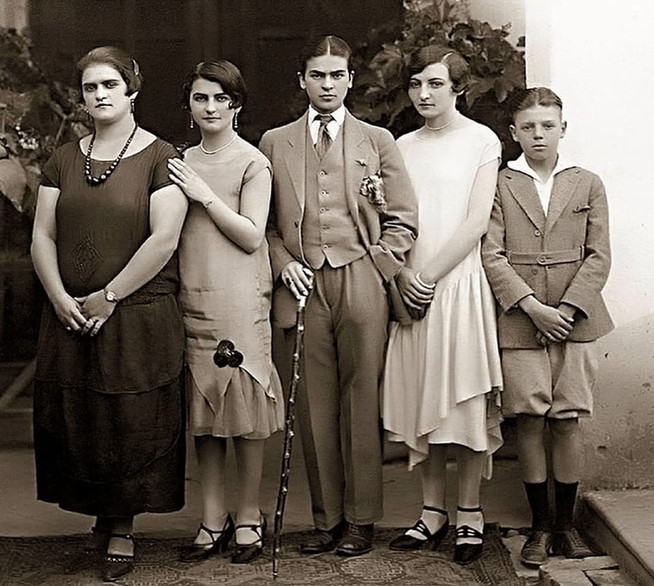
The Reddit post shows a rare photograph from February 7, 1926. Frida, about 18 years old, stands in a suit among her family, photographed by her father, Guillermo Kahlo. People today see it and ask: was this just a joke, a phase, or an early act of rebellion? How does this image connect to the famous paintings that turned her into a global icon of gender nonconformity?
To answer that, you have to compare two Fridas: the one in front of her father’s camera in 1926, and the one she painted again and again on canvas. The origins, methods, outcomes, and legacy of those two Fridas line up more closely than they first appear.
Origins: A family photograph vs a self-made myth
Start with the scene in the Reddit post. It is 1926 in Mexico City. The Mexican Revolution has ended less than a decade earlier. Nationalism and cultural pride are in the air. In the Kahlo family home, Guillermo Kahlo, a German-born photographer who made a living documenting churches and public buildings, points his camera at his family.
His daughter Frida steps into the frame wearing a man’s suit. Short hair. Hands in pockets. She is flanked by relatives in more conventional dress. She is not yet the Frida of the unibrow posters and flower crowns. She is a teenager, still a student at the National Preparatory School, still months away from the bus accident in September 1925 that would nearly kill her and define her physical life.
In that moment, the origin of the image is simple: a family photo session. But the choice of clothing is not. Cross-dressing photographs were not standard family fare in 1920s Mexico. Frida had already been known among her classmates as a prankster and a contrarian. She joined a group of intellectual friends called the Cachuchas, who liked to provoke teachers and mock authority. Putting on a suit for a formal portrait fits that pattern of playful defiance.
Her father’s role matters too. Guillermo was not just a dad with a camera. Photography was his trade. He knew composition, posture, and how to fix an image in time. He also had epilepsy and relied on Frida’s help. Their relationship was close, and several sources suggest he encouraged her independence and education. A daughter wearing a suit in his studio was an experiment he was willing to record.
Compare that to the origin of Frida’s painted self-portraits. Those begin in earnest after the 1925 bus accident, when a steel handrail pierced her abdomen and pelvis. She spent months in casts and corsets, often confined to bed. Her mother had a special easel built so she could paint lying down, and a mirror was placed above her bed. That mirror turned her own face into her most available subject.
So the photograph comes from a relatively healthy, mobile Frida, using her body as a joke and a statement in front of her father’s lens. The paintings come from a wounded, semi-immobile Frida, using her body as her only reliable model and as a record of pain. One is a teenager testing boundaries. The other is an adult building a myth from the wreckage of her body.
The significance is that both origins grow out of constraint: a family structure and a father’s studio in one case, a broken spine and a bed-bound mirror in the other. The limits around her are different, but in both cases Frida responds by turning herself into an image that does not quite obey the rules.
Methods: Camera vs canvas, costume vs surgery
The 1926 photo is a quick performance. Frida’s method is simple: put on a suit, stand still, let the camera do the rest. The technology is mechanical. Light, lens, shutter, plate or film. The photographer is another person, her father, who chooses the frame and the moment.
In that frame, Frida borrows the symbols of masculinity that are easiest to access: tailored jacket, trousers, tie. She does not change her body itself. She changes its wrapping. The photograph freezes that momentary disguise. It is a costume, but the image makes the costume feel permanent.
Her later method as a painter is slower and more invasive. On canvas, Frida does not just put on masculinity. She carves it into her own image. Look at her 1940 painting “Self-Portrait with Cropped Hair.” In it, she sits in a man’s suit, hair shorn, locks of it scattered on the floor. She holds scissors. The lyrics of a Mexican song about a man who loved a woman for her hair appear above her head. Here, she is not borrowing a suit for a family joke. She is painting the aftermath of cutting away a part of herself, likely tied to her separation from Diego Rivera.
In “The Two Fridas” (1939), she paints herself twice, side by side, one in European dress, one in Tehuana costume. Their hearts are exposed, connected by a blood vessel. She uses anatomy, clothing, and blood to talk about identity and fracture. No camera could have done that without props and surgery. On canvas, she can open her own chest and still live.
There is another method at work that people often miss: medical intervention as self-fashioning. Over her life, Frida endured dozens of operations. Some were necessary. Some were questionable. Steel corsets, plaster casts, orthopedic shoes, and later amputations all changed how her body looked and moved. She painted many of these devices onto herself. In “The Broken Column” (1944), she shows her torso split open, a column of stone where her spine should be, nails piercing her skin. That is not costume. That is surgery and pain turned into visual language.
So the method in the 1926 photo is external and collaborative. Clothing plus camera plus father. The method in the paintings is internal and solitary. Surgery plus mirror plus brush. The first relies on a quick visual joke. The second builds a dense personal iconography of hair, blood, corsets, and clothing.
The so what is that the photograph hints at what the paintings will do more aggressively. Both use visual codes of gender and body to send a message, but painting lets Frida control every detail, from the cut of the suit to the cut of her own flesh.
Outcomes: A private family image vs a public cultural symbol
When Guillermo Kahlo clicked the shutter in 1926, the photo’s audience was tiny. It likely lived in a family album or among his negatives. There is no sign that it circulated widely in her own lifetime. It was not a manifesto. It was a moment.
For the family, the outcome might have been a mix of amusement, annoyance, or quiet pride. Sources do not give us a transcript of that day. What we do know is that Frida continued to wear men’s clothing at times, and that she had romantic relationships with both men and women. The suit photo is consistent with that pattern, but it did not launch a movement.
Her painted self-portraits had a different trajectory. In the 1930s and 1940s, she exhibited in Mexico and the United States. She was often framed as “Diego Rivera’s wife” who also painted. Her work was admired by some Surrealists, though she rejected the label, saying she painted her own reality, not dreams.
During her lifetime, her audience was real but limited. After her death in 1954, interest in her work faded for a while. The big outcome shift comes in the 1970s and 1980s, when feminist scholars and artists began to champion her. They saw in her self-portraits a rare, unflinching female gaze on the female body, including menstruation, miscarriage, disability, and aging. Her face, once a subject among many, became a global emblem.
That is when images like the 1926 suit photo start to be re-read. What had been a family oddity becomes evidence. People look at it and say: here is Frida as a gender rebel from the start. The photo’s meaning changes because the world around it has changed. A private moment becomes a public symbol.
There is a risk here of flattening her. Online, the suit photo often circulates with captions that make it sound like a planned act of queer activism. We do not have Frida’s own words about that specific day. We do have her life, which shows consistent disregard for strict gender roles. The safest claim is that the photo fits her character, but we should be careful not to turn an 18-year-old’s pose into a manifesto she never wrote.
The outcome difference matters because it shows how context creates meaning. The photograph did little to shape Frida’s world in 1926. The paintings, especially after her death, reshaped how millions of people think about gender, pain, and Mexican identity. The suit photo only becomes powerful because the painted Frida made people care who she was.
Legacy: From family album to queer and feminist icon
Today, if you search for Frida Kahlo, you will find two main kinds of images. The first are her paintings, especially self-portraits. The second are photographs of her, including the 1926 suit photo. Both sets of images feed into her legacy, but they do it in different ways.
Her painted self-portraits created the core of that legacy. They made her a symbol of Mexicanidad, of indigenous and mestizo pride, of female creativity, and of an unglamorous approach to suffering. They are the reason museums mount exhibitions, scholars write books, and tourists visit the Casa Azul.
The photographs, including the one on Reddit, give texture to that legacy. They show her joking, posing, smoking, loving, and aging. The suit photo, in particular, has become popular in queer history and gender studies circles. It is used as a visual shorthand for early 20th century gender nonconformity in Latin America.
Here is a clean way to put it: Frida Kahlo’s 1926 suit photo is an early visual record of her playing with gender presentation. Her later self-portraits are a sustained artistic investigation of identity, pain, and selfhood. The two are connected, but they are not the same thing.
There is also a political legacy. In Mexico and abroad, Frida has been adopted by leftist movements, by disability activists, and by LGBTQ+ communities. Her affairs with women, her refusal to hide her disability, and her use of indigenous dress all feed into that. The suit photo is now often read through that lens. It has become part of a larger archive that people use to argue that queer and nonbinary histories did not begin in the late 20th century.
At the same time, her image has been heavily commercialized. Frida’s face appears on mugs, socks, and makeup lines. The suit photo is less common in that commercial wave than the flower-crown portraits, but it circulates widely online. Some critics argue that this turns a complex, politically engaged artist into a brand. Others counter that such visibility keeps her story alive for new generations.
The so what is that the 1926 photo and the paintings now work together. The photo gives a sharp, early snapshot of a young woman refusing to sit quietly in her assigned role. The paintings give decades of evidence that she kept refusing. Together, they have made Frida Kahlo one of the most recognizable faces of 20th century art and of gender nonconformity.
Why the 1926 photo and the paintings look so similar
Put the Reddit image side by side with “Self-Portrait with Cropped Hair” or “The Two Fridas” and the continuity is obvious. In both, Frida is using visual codes of gender, dress, and body to send a message about who she is and who she refuses to be.
They look similar because in both, Frida is staging herself. The medium changes, the stakes change, but the instinct is the same. She knows that how she appears will be read, judged, and remembered. So she takes control of that appearance, first with a borrowed suit in front of her father’s camera, later with a brush in her own hand.
They also look similar because the same themes run through them: defiance, humor, pain, and a refusal to separate the personal from the political. The teenager in a suit and the adult on a canvas are not two different people. They are the same person at different stages of a long argument with the world.
The lasting significance is that the 1926 photograph is not just a quirky family relic. It is an early chapter in the same story her paintings tell. When people on Reddit stop scrolling for a second to stare at that suited teenager, they are catching Frida Kahlo in the act of becoming the artist who would later paint herself into history.
Frequently Asked Questions
Why did Frida Kahlo dress as a man in the 1926 photo?
We do not have Frida’s own explanation for that specific day, but the context suggests a mix of humor and defiance. As a teenager she was known for pranks and for challenging authority. Wearing a suit for a formal family portrait in 1926 Mexico City would have been a pointed way to play with gender roles. The photo fits her broader life pattern of ignoring strict expectations about how women should look and behave.
Who took the rare 1926 photo of Frida Kahlo in a suit?
The photograph was taken by her father, Guillermo Kahlo, a professional photographer who documented buildings and public works in Mexico. He often photographed his family as well. His technical skill and willingness to record his daughter in a man’s suit helped preserve one of the earliest visual records of Frida playing with gender presentation.
How does the 1926 suit photo relate to Frida Kahlo’s self-portraits?
The 1926 photo and her later self-portraits share a core idea: Frida uses her own body to explore identity and defy expectations. In the photo, she changes her appearance quickly with clothing and poses for her father’s camera. In the paintings, she goes further, depicting herself with cropped hair, exposed hearts, surgical scars, and traditional dress. The methods differ, but both images show her taking control of how she is seen.
Was Frida Kahlo openly queer or nonbinary by modern standards?
Frida Kahlo had relationships with both men and women, and she frequently challenged gender norms in her clothing and self-presentation. She did not use modern labels like “queer” or “nonbinary,” which did not exist in the same way in her time. However, many LGBTQ+ people today see her life and images, including the 1926 suit photo, as part of a longer history of gender and sexual nonconformity.