Picture a conference room at Los Alamos in the mid‑1950s. Chalk dust in the air, cigarette smoke hanging low, and on the board a number that makes even hardened weapons physicists go quiet: 10,000 megatons.
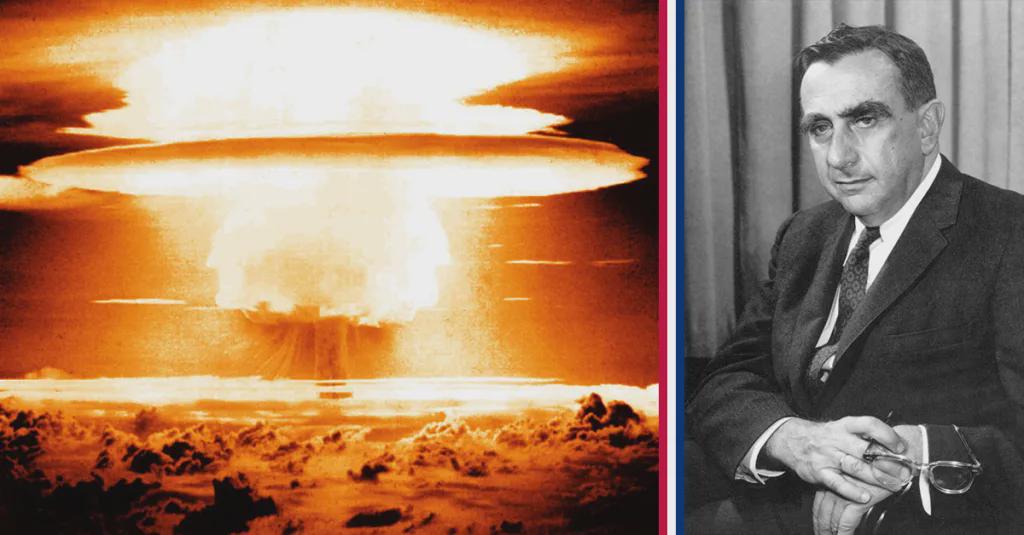
Edward Teller, already known as the “father of the H‑bomb,” was sketching out a new idea. A theoretical hydrogen bomb so large it made every weapon ever built look like a firecracker. The concept got a name that sounded almost whimsical: SUNDIAL.
SUNDIAL was a proposed 10‑gigaton thermonuclear weapon concept, roughly 200 times more powerful than the Soviet Tsar Bomba, the largest bomb ever detonated. It was never built. The U.S. Air Force dropped the idea, and SUNDIAL slipped into the footnotes of Cold War history.
But the idea itself tells us a lot about how far nuclear planners were willing to go, what they feared, and where they finally drew a line. By the end of this, you will know what SUNDIAL was, why it was even considered, and what killed it.
1. SUNDIAL was a 10‑gigaton “thought experiment” in city‑killing power
First, the basic definition. SUNDIAL was a mid‑1950s U.S. thermonuclear weapon concept, pushed by Edward Teller, that aimed for a yield on the order of 10 gigatons of TNT. That is 10,000 megatons. For comparison, the bomb that destroyed Hiroshima was about 15 kilotons. SUNDIAL was roughly 600,000 times more powerful than that.
The concrete point of comparison people know is the Soviet Tsar Bomba, tested in 1961 over Novaya Zemlya. That device yielded about 50 megatons, with a design potential of around 100 megatons. SUNDIAL, on paper, was about 200 times the energy of the actual Tsar Bomba test and 100 times the largest U.S. test, Castle Bravo (15 megatons) in 1954.
What would that mean on the ground? Physicists estimated that a 10‑gigaton airburst could cause third‑degree burns over an area the size of France or Texas, depending on altitude and conditions. Blast damage would flatten cities far beyond any single metropolitan area. Fallout from a groundburst version would contaminate entire regions, not just downwind towns.
Why it mattered: SUNDIAL pushed the logic of nuclear deterrence to its absurd extreme. By sketching a bomb that could scorch a country‑sized area, Teller and his colleagues forced policymakers to confront a question: at what point does “more” yield stop adding any real military value and only add horror?
2. Edward Teller’s obsession with bigger bombs shaped the idea
SUNDIAL did not appear out of nowhere. It came from Edward Teller’s long‑running drive to build ever more powerful thermonuclear weapons. Teller, a Hungarian‑American physicist, had already been central to the first U.S. hydrogen bomb test, Ivy Mike, in 1952. That device yielded about 10.4 megatons and vaporized part of Enewetak Atoll.
By 1954, during the Castle test series at Bikini Atoll, Teller’s ideas were being turned into deliverable weapons. Castle Bravo, based on a Teller‑Ulam design, produced a 15‑megaton blast, far above predictions, and spread radioactive fallout over inhabited islands and a Japanese fishing boat, the Lucky Dragon No. 5. That disaster shook public opinion and some in the scientific community.
Teller, though, kept thinking bigger. SUNDIAL was part of that mindset. While exact internal memos are still patchy in the public record, the general pattern is clear. Teller and like‑minded physicists were exploring multi‑stage hydrogen bomb designs that, in theory, could be scaled almost arbitrarily. Stack enough fusion stages, and you could reach gigaton yields.
One example of Teller’s influence is the way he lobbied politicians. He had already clashed with J. Robert Oppenheimer over the ethics and necessity of the H‑bomb. In the 1954 Oppenheimer security hearing, Teller testified in a way that helped sideline Oppenheimer and clear the path for aggressive thermonuclear development. SUNDIAL grew in that political climate, where Teller’s voice carried weight.
Why it mattered: SUNDIAL was not just a physics problem, it was a personality problem. Teller’s drive for ever larger weapons pulled U.S. planning toward the extreme, and his influence meant that ideas like a 10‑gigaton bomb were taken seriously enough that the Air Force had to formally say no.
3. The physics said “maybe,” the engineering said “you must be kidding”
On paper, SUNDIAL was possible. Thermonuclear weapons use a fission primary to ignite a fusion secondary. That basic Teller‑Ulam design can be repeated in stages. In theory, you can chain multiple fusion stages and keep scaling the yield. SUNDIAL was an exercise in asking how far that chain could go.
But theory and hardware are not the same thing. A 10‑gigaton bomb would have been enormous. Tsar Bomba, at 50 megatons, already weighed about 27 tons and was so big the Soviets had to strip a Tu‑95 bomber to carry it. A SUNDIAL‑class device might have been larger than any practical aircraft payload and likely would have required a custom delivery system or a fixed installation.
Engineers also had to worry about structural integrity. Multi‑stage thermonuclear devices are not just piles of fuel. They are precise arrangements of fission and fusion materials, tamper layers, reflectors, and explosives that must survive launch, flight, and the first microseconds of detonation. Scaling that up by orders of magnitude multiplies the chances of failure.
There was also the question of fallout. To reach 10 gigatons, you would probably use a lot of fissionable material in the outer stages. That means a huge fraction of the yield would come from fission, not “clean” fusion. Castle Bravo showed what a 15‑megaton fallout accident looked like. SUNDIAL would be that, magnified beyond easy comprehension.
One concrete engineering comparison: the U.S. Mk 41 bomb, deployed in the early 1960s, was the most powerful American nuclear weapon in service, with a maximum yield around 25 megatons. It was already at the edge of what could be carried and handled. SUNDIAL was hundreds of times that, which gives a sense of how far beyond practical weapons it really was.
Why it mattered: The gap between “theoretically possible” and “militarily usable” helped kill SUNDIAL. It showed that nuclear weapons had hit a ceiling where physics allowed more power but engineering, delivery systems, and basic sanity did not.
4. The Air Force decided super‑super bombs were bad strategy
The U.S. Air Force had the final say, and it said no. By the mid‑1950s, Strategic Air Command under Curtis LeMay was planning for massive nuclear strikes, but it wanted many deliverable weapons, not one doomsday device. A SUNDIAL‑class bomb did not fit the emerging logic of nuclear war planning.
Here is the strategic problem. Deterrence does not require a single apocalyptic bomb. It requires a credible ability to destroy an opponent’s military, industry, and cities. That is better done with dozens or hundreds of smaller (still enormous) weapons that can be targeted separately. A 10‑gigaton blast wastes much of its energy on empty space and already‑destroyed areas.
Concrete example: by the late 1950s, U.S. war plans like the Single Integrated Operational Plan (SIOP) envisioned thousands of warheads in a first strike, many in the 1 to 10 megaton range. The logic was to hit airfields, missile sites, command centers, and cities across the Soviet Union and its allies. A SUNDIAL bomb could not replace that targeting network.
The Air Force also had to think about delivery platforms. Bombers like the B‑52 had payload limits. Early ICBMs had strict weight and size constraints. A weapon that needed a custom aircraft or some kind of giant rocket was a logistical nightmare. Worse, it was a single point of failure. If the one SUNDIAL delivery system was shot down or malfunctioned, you lost a huge chunk of your deterrent.
There was a political angle too. After Castle Bravo, fallout and global opinion were real concerns. A weapon that could contaminate half a continent was not just a military tool, it was a diplomatic disaster waiting to happen. The Air Force, which had to defend its budget and public image, was not eager to be associated with a project that looked like a doomsday machine.
Why it mattered: By rejecting SUNDIAL, the Air Force signaled that nuclear strategy was shifting from “biggest possible bang” to “usable, targetable arsenals.” That decision helped steer the arms race toward many smaller warheads and away from cartoonishly large single bombs.
5. SUNDIAL exposed the moral and political limits of the arms race
Even if SUNDIAL never left the drawing board, the idea landed in a world already anxious about nuclear weapons. The 1950s saw the rise of scientists’ petitions, church statements, and early anti‑nuclear activism. Concepts like a 10‑gigaton bomb fed the sense that the arms race was out of control.
One telling example is the reaction to Tsar Bomba in 1961. When the Soviets detonated their 50‑megaton device, the world press called it a “doomsday bomb.” Western analysts knew that U.S. scientists had considered even larger yields on paper. The comparison made clear that both superpowers had flirted with weapons that could, in practical terms, destroy entire countries in a single shot.
Inside the scientific community, ideas like SUNDIAL sharpened ethical debates. Physicists such as Hans Bethe and Isidor Rabi, who had already expressed misgivings about the hydrogen bomb, saw the drive for ever larger yields as a moral slide. If 10 megatons was acceptable, why not 100? If 100, why not 10,000? At some point, the line had to be drawn.
Politically, the fear of runaway testing and fallout helped push the 1963 Partial Test Ban Treaty, which banned atmospheric nuclear tests. While SUNDIAL itself was not a public talking point, the mindset that produced it was. People were reacting to the idea that nuclear planners were willing to contemplate almost anything if it could be written on a chalkboard.
Why it mattered: SUNDIAL became part of the unspoken boundary line. It showed that there were weapons so destructive that even Cold War hawks and military planners saw no point in building them, and that realization fed into the slow move toward arms control.
SUNDIAL never flew, never detonated, and probably never got beyond conceptual studies. Yet its ghost lingers in every conversation about nuclear limits. It is a reminder that, for a few years, some of the smartest people on Earth calmly considered a bomb that could burn a country in a single flash.
The fact that SUNDIAL was canceled tells its own story. The Cold War did not lack for apocalyptic imagination. What it eventually found, under pressure from engineers, strategists, and a worried public, were boundaries. SUNDIAL marks one of those boundaries, where the arms race looked over the edge and quietly stepped back.
Frequently Asked Questions
What was the SUNDIAL nuclear weapon concept?
SUNDIAL was a mid‑1950s U.S. thermonuclear weapon concept associated with Edward Teller. It aimed for a yield of about 10 gigatons of TNT, or 10,000 megatons, making it roughly 200 times more powerful than the Soviet Tsar Bomba test. It remained a theoretical design and was never built or tested.
How did SUNDIAL compare to Tsar Bomba?
Tsar Bomba, detonated by the Soviet Union in 1961, yielded about 50 megatons, with a design potential around 100 megatons. SUNDIAL was conceived at roughly 10,000 megatons, so about 200 times the energy of the actual Tsar Bomba test. While Tsar Bomba was a real, flown device, SUNDIAL stayed on paper because it was militarily impractical and strategically unattractive.
Why did the U.S. Air Force cancel the SUNDIAL idea?
The Air Force rejected SUNDIAL because it did not fit real nuclear strategy. A single 10‑gigaton bomb would have been enormous, hard to deliver, and wasteful compared to many smaller warheads that could be targeted separately. It would also have produced extreme radioactive fallout and a political backlash. Strategists preferred multiple megaton‑class weapons over one doomsday‑scale device.
Could a 10‑gigaton nuclear bomb actually be built?
In theory, thermonuclear designs can be scaled by adding more fusion stages, so physicists considered a 10‑gigaton device possible on paper. In practice, the engineering, delivery, and safety challenges would be enormous. The bomb would likely be too large and heavy for existing aircraft or missiles, structurally complex, and produce catastrophic fallout. These practical and strategic problems are why no such weapon was ever built.