They are barefoot, thin, and roped together with iron around their necks. In the famous photograph from Wyndham, Western Australia, around 1901, a line of Aboriginal men sit on the red dirt, chained to a central pole. A white policeman stands nearby, rifle in hand. No one is smiling. No one is meant to.
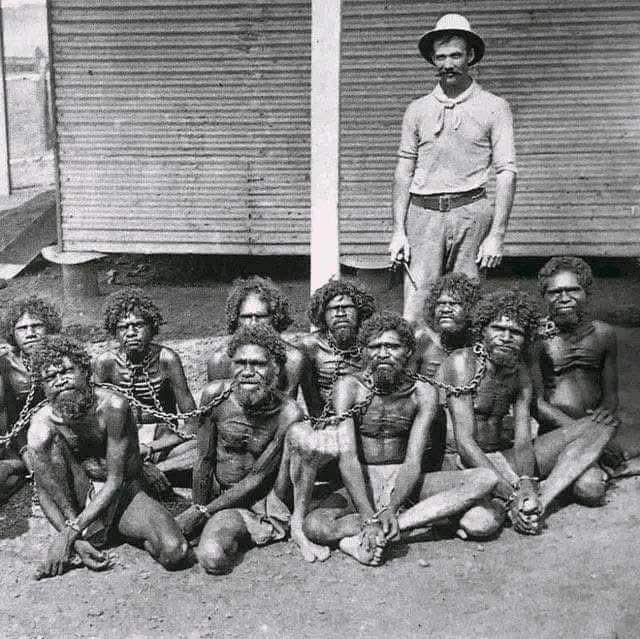
This is not a chain gang in the American South. It is a group of Aboriginal prisoners in colonial Australia, held under laws that made it easy to arrest, shackle and move Indigenous people across vast distances. The image from Wyndham is one of many similar scenes from the late 19th and early 20th centuries, when police and pastoralists used chains as routine tools of control on the Australian frontier.
Chained Aboriginal prisoners in colonial Australia were Indigenous men, and sometimes women and children, restrained with neck or leg chains while being arrested, transported or forced to work under colonial law. The practice was widespread in northern and western Australia into the early 20th century, and it grew out of frontier conflict, racial ideology and a hunger for cheap labour.
To understand that single photo, you have to understand how a continent was taken, how law was bent to that purpose, and how long those chains, literal and legal, lasted.
What were chained Aboriginal prisoners in colonial Australia?
In plain terms, chained Aboriginal prisoners were Indigenous people arrested under colonial laws and restrained with iron neck chains, handcuffs or leg irons, often linked together on a single chain. They were used for transport, punishment and control, especially in remote regions where police were few and distances were huge.
In Western Australia, where Wyndham is located, this system was formalised by the late 19th century. Police manuals and government reports from the 1880s and 1890s refer openly to the use of neck chains on Aboriginal prisoners. The chains were usually heavy iron collars locked around the neck, joined by short lengths of chain to a central line. Prisoners might be marched for days or weeks between stations, depots and courts.
Aboriginal people could be arrested for a wide range of offences. Some were accused of spearing cattle or sheep on land that had been theirs for thousands of years. Others were charged with theft, trespass, or breaching work contracts that were often unfair to begin with. Many were arrested under vagrancy or “protection” laws that criminalised simply existing outside the control of a station or government reserve.
In the Kimberley and Pilbara regions, police also used chained prisoners as labour. They cut wood, built roads, worked in police stables and sometimes on private pastoral stations. Payment, if any, was minimal. Food and clothing were basic. Disease and injury were common.
So a photo like the Wyndham image is not an anomaly. It is a visual record of a system in which Aboriginal people were made prisoners in their own country, with iron on their bodies and almost no say in the laws that bound them. That basic definition matters because it turns an arrest photo into evidence of a wider regime, not just a single bad day.
What set it off: frontier invasion, law and cheap labour
The roots of those chains go back to 1788, when the British declared Australia terra nullius, “land belonging to no one.” That legal fiction erased existing Aboriginal law and ownership in one stroke. From then on, British law claimed the continent, but British law did not protect Aboriginal people in any consistent way.
In the early decades, frontier conflict was intense. Aboriginal groups resisted invasion, attacked stock, and defended waterholes and hunting grounds. Settlers and police replied with shootings, poisonings and organised massacres. The violence was especially fierce in northern and western Australia, where pastoral expansion surged in the late 19th century.
By the 1860s and 1870s, colonial governments wanted two things: order on the frontier and a supply of cheap labour. Aboriginal people were the obvious workforce for cattle and sheep stations, pearling fleets and domestic service. But they were also seen as a threat to property and to white authority.
So lawmakers wrote statutes that criminalised Aboriginal survival strategies. Killing a sheep to eat became “stock theft.” Moving through country without permission became “trespass.” Refusing to work or leaving a station could be treated as breach of contract or vagrancy. In Western Australia, the 1892 Aboriginal Offenders Act and related regulations made it easier to arrest and imprison Aboriginal people for minor offences and to use them as prison labour.
At the same time, racial ideology hardened. Many white Australians in the late 19th century believed Aboriginal people were a “dying race” who needed firm control. Newspapers and officials described them as childlike, lazy or dangerous. That made it easier to justify harsh treatment, including chaining.
Economic motives sharpened the chains. In the north, Aboriginal men were forced into the pearling industry, often through “blackbirding” style recruitment, where coercion and kidnapping blurred with contract work. Women and children were taken as domestic servants or sexual partners. Police who arrested Aboriginal people for “offences” could then hire them out as labour or use them on public works.
So the chains were not just about punishment. They were a tool for turning dispossessed people into a controlled workforce. That cause-and-effect matters because it links the image of prisoners in Wyndham to the broader story of how colonisation and capitalism worked together on the Australian frontier.
The turning point: scandals, inquiries and slow retreat
By 1901, the year usually given for the Wyndham photograph, Australia had just federated. The new Commonwealth of Australia was born with a constitution that mentioned Aboriginal people only to exclude them from the national census and from federal lawmaking. Control over Aboriginal affairs stayed with the states, including Western Australia.
Yet the turn of the century also brought more scrutiny. Missionaries, some politicians and a few journalists began to criticise the treatment of Aboriginal people, especially in the north. Reports of chained prisoners, floggings and deaths in custody filtered south to Perth, Melbourne and London.
In Western Australia, one flashpoint was the 1905 Royal Commission into the condition of Aboriginal people, chaired by Dr Walter Roth. The commission heard evidence about neck chains, unpaid labour and sexual exploitation. Roth’s report acknowledged abuses but stopped short of calling for a complete end to chaining. He argued it should be restricted, not banned.
The same year, the Western Australian government passed the Aborigines Act 1905. It created a Chief Protector of Aborigines, who became the legal guardian of all Aboriginal children and controlled where Aboriginal people could live, work and travel. The act did not outlaw chains. It extended state power under the banner of “protection.”
Public criticism grew slowly. Some church groups and humanitarians in Britain and Australia campaigned against what they saw as slavery-like conditions. International pressure, especially from the British Anti-Slavery Society, embarrassed Australian governments that liked to present themselves as progressive and democratic.
By the 1920s and 1930s, the open use of neck chains was less common in some regions, though leg irons and handcuffs remained. In Western Australia, neck chaining of Aboriginal prisoners reportedly continued in remote areas into the 1940s, and some historians argue it lingered even later. The record is patchy, partly because officials knew it was controversial and avoided detailed reporting.
The turning point was not a single law or protest. It was a slow shift in what governments were willing to admit, what the public was willing to tolerate, and how much international criticism they could ignore. That matters because it shows that the chains fell out of sight before they fully fell out of use, which helps explain why many Australians grew up never hearing about them.
Who drove it: police, pastoralists, officials and resisters
There was no single mastermind behind the system that put chains on Aboriginal prisoners. It was held together by many hands, some local and some far away.
On the ground were the police. In Western Australia these included the Native Police and later the regular police force, often mounted and operating from small bush stations. Men like Constable William O’Grady or Inspector Ernest Mitchell (names that appear in Kimberley records) had wide discretion. They chose when to arrest, how to transport, and when to use chains. Many saw them as practical tools in rough country. Some also used them to terrorise communities into compliance.
Pastoralists, the owners and managers of cattle and sheep stations, were another driving force. They pressed governments for tougher laws against “cattle killing” and demanded police support to control local Aboriginal groups. Some station owners lent horses, rations or information to police patrols. Others directly requested that “troublesome” Aboriginal people be arrested and removed.
Colonial and state officials wrote the laws that made this possible. In Western Australia, figures like Sir John Forrest, the first Premier, and later ministers for lands and Aboriginal affairs, balanced pressure from settlers with criticism from humanitarian groups. They rarely ordered chains to be used, but they created a legal environment where chaining was normal and rarely punished.
Missionaries and protectors of Aborigines played a double role. Some, like the Benedictine monks at New Norcia or various Protestant missions in the north, criticised chaining and tried to shield Aboriginal people by bringing them onto missions. Others cooperated with police, handed over runaways or accepted chained prisoners into mission lockups.
On the other side were Aboriginal leaders and communities who resisted. Men like Jandamarra in the Kimberley in the 1890s led armed resistance against police and pastoralists. Others used quieter tactics: moving camps, hiding children, sabotaging work, or using the courts where possible. Oral histories from many language groups recall ancestors who broke chains, escaped custody or negotiated with sympathetic officers.
These human choices matter because they show the system was not automatic. It was built and maintained by specific people with power, and it was challenged by specific people with far less power but deep knowledge of country and strong will to survive.
What it changed: prisons, labour and Aboriginal communities
The use of chained Aboriginal prisoners reshaped both the justice system and Aboriginal life across large parts of Australia.
In legal terms, it blurred the line between punishment and labour. Aboriginal prisoners built roads, police stations and public works that helped open the north to further settlement. Their unpaid or underpaid work subsidised colonial budgets. The idea that prison could be a source of cheap labour took root, especially when the prisoners were Indigenous.
For Aboriginal communities, the impact was devastating. Frequent police raids and arrests tore families apart. Men taken in chains might be gone for months or years. Some died in custody from disease, malnutrition or violence. Women and children left behind were more vulnerable to exploitation on stations or in towns.
The constant threat of arrest changed how people moved across their own country. Some avoided traditional hunting grounds near stations or roads. Others shifted camp more often or retreated to more remote areas. Ceremonies and trade routes were disrupted. Knowledge of certain places faded as access became too dangerous.
Psychologically, the image of Aboriginal people in chains fed racist stereotypes. Photographs like the Wyndham image were sometimes circulated as curiosities, proof to white audiences that Aboriginal people were criminals or needed firm control. That visual record helped justify further restrictions, such as curfews, reserves and pass systems.
The effects carried into the 20th century. Children who saw their parents or relatives chained grew up under protection and assimilation policies that tried to control every part of their lives. Many ended up in missions, reserves or as part of the Stolen Generations. The memory of chains, passed down in stories, shaped how later generations viewed police, courts and government.
So the practice of chaining did more than restrain individual bodies. It helped lock in a wider system of inequality, with long shadows over law, labour and identity in Australia.
Why it still matters: memory, justice and that Wyndham photo
Today, the image of chained Aboriginal prisoners in Wyndham circulates on sites like Reddit, often with shock and disbelief in the comments. Many viewers ask: Was this legal? Was it common? How could this happen as late as 1901?
The short answers: yes, it was legal under colonial and state law. Yes, it was common in parts of Australia, especially Western Australia and the Northern Territory, well into the 20th century. It happened because a settler society built its wealth on land and labour taken from Indigenous people, and wrote laws that made that process look orderly.
These photos matter because they puncture the myth of a gentle, peaceful colonisation. They show that Australia’s story of democracy and progress sits alongside a story of chains, camps and coerced work. Both are true at the same time.
They also connect to present debates. Aboriginal people are still imprisoned at far higher rates than non-Indigenous Australians. Deaths in custody, over-policing and the legacy of protection laws are constant topics in inquiries and protests. When elders talk about a “long history” with the justice system, they are not speaking in metaphors. They are remembering chains on their grandparents’ necks.
Finally, the Wyndham photograph and others like it raise questions about how history is remembered. For decades, these images were tucked away in archives or used without context. Now they circulate widely online, often without explanation. Pairing them with the story behind the iron turns shock into understanding, and understanding into a clearer sense of what still needs repair.
The men in that 1901 line at Wyndham are unnamed in most captions. We may never know their individual stories. But we can know why they were there, who put them there, and how long the marks of those chains have lasted. That is why this piece of colonial history still matters every time the photo resurfaces on a screen.
Frequently Asked Questions
Why were Aboriginal prisoners chained in colonial Australia?
Aboriginal prisoners were chained in colonial Australia because police and officials saw iron neck and leg chains as a practical way to control and transport groups of Indigenous prisoners across long distances. Laws in places like Western Australia made it easy to arrest Aboriginal people for minor offences such as stock killing, trespass or vagrancy. Once arrested, they could be moved in chains and used as prison labour on roads, public works and sometimes pastoral stations.
Was it legal to use neck chains on Aboriginal people in Australia?
Yes. In the 19th and early 20th centuries, colonial and state laws in Australia allowed police to restrain prisoners, and in practice this included the use of neck chains on Aboriginal people. Regulations and police manuals in Western Australia openly referred to neck chaining Aboriginal prisoners. While some officials objected and inquiries criticised abuses, there was no blanket legal ban for many decades, especially in remote regions.
How common was the chaining of Aboriginal prisoners?
The chaining of Aboriginal prisoners was common in northern and western Australia from the late 1800s into the early 1900s, particularly in Western Australia and the Northern Territory. It was most frequent in remote areas where police had to move prisoners on foot over long distances. In southern cities it was less visible, which is one reason many Australians later grew up unaware that neck chaining had been routine practice on the frontier.
When did Australia stop using chains on Aboriginal prisoners?
There is no single clear end date, but the open use of neck chains on Aboriginal prisoners declined from the 1910s and 1920s as public criticism grew. In Western Australia, reports suggest neck chaining continued in some remote districts into the 1940s, and possibly later, though the record is incomplete. Handcuffs and leg irons remained in use for longer. The practice faded gradually rather than being stopped by one specific national law.