Picture a Neanderthal sitting by a fire 60,000 years ago, carefully striking a flint core to knock off a razor-thin blade. Each strike has to land at just the right angle. Too hard and the stone shatters. Too soft and nothing happens. Around the fire, kids watch, learning a skill that took adults years to master.
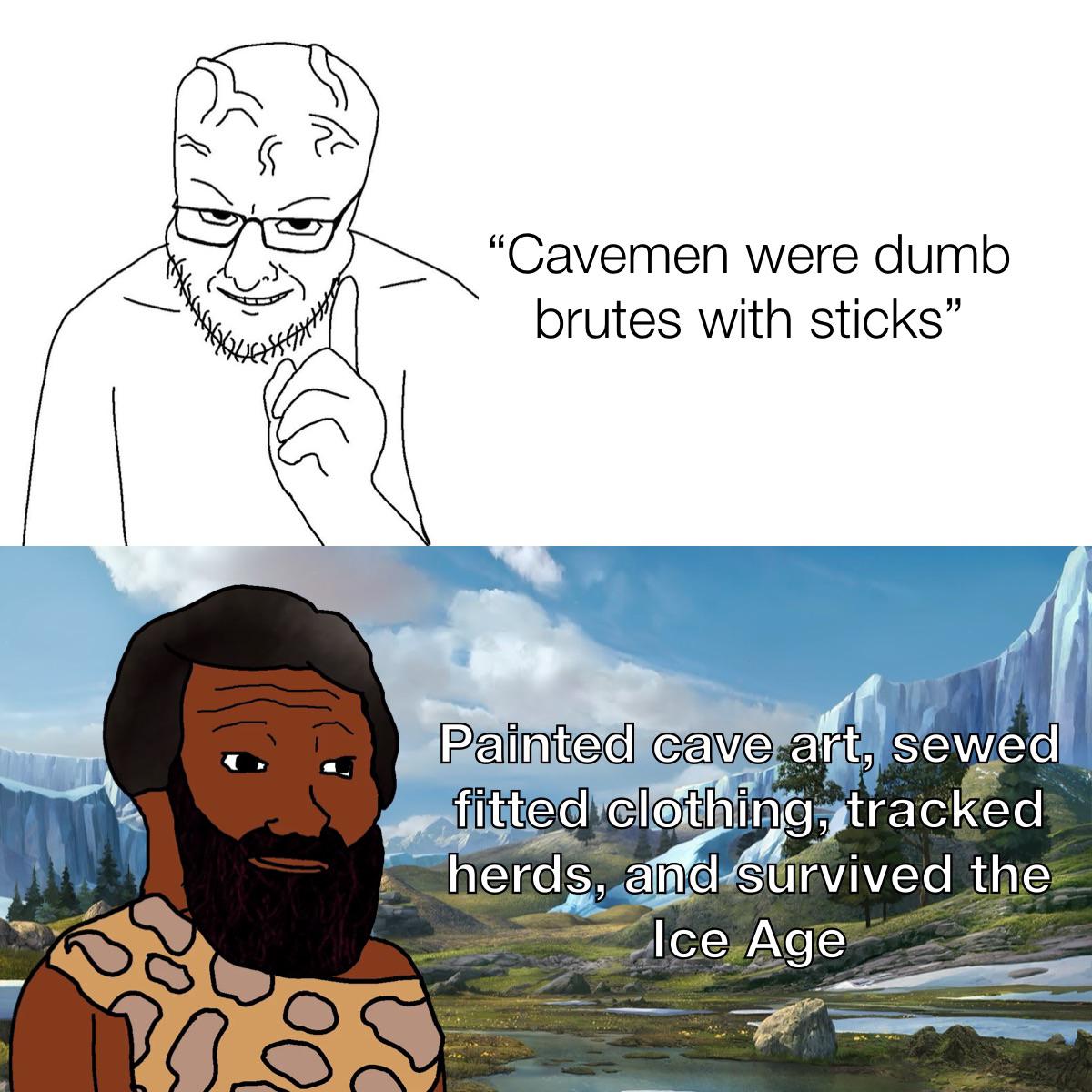
This is not the life of a dumb brute. This is a technical apprenticeship.
When people joke about “cavemen” as stupid, they are talking about real humans who survived ice ages, crossed seas, invented glue, planned hunts, and buried their dead. Prehistoric people were versatile, not stupid, and modern archaeology has spent the past few decades proving it.
By the end of this explainer, you will know what “cavemen” actually were, what pushed them to innovate, who the main prehistoric players were, and how their brains and skills compare to ours today.
What were “cavemen,” really?
“Cavemen” is a pop culture label, not a scientific one. It usually mashes together several different prehistoric humans and ways of life.
In reality, we are talking about:
1. Early Homo sapiens
That is us. Anatomically modern humans first appear in Africa at least 200,000–300,000 years ago. By about 60,000–70,000 years ago, some groups began spreading into Eurasia and beyond.
2. Neanderthals (Homo neanderthalensis)
Living mostly in Europe and western Asia from at least 400,000 years ago until about 40,000 years ago. Stockier bodies, big brains (on average as large or larger than ours), adapted to cold climates.
3. Other archaic humans
Such as Denisovans in Asia (known mainly from DNA and a few bones), Homo heidelbergensis, and others. These groups overlap in time and space with both Neanderthals and early Homo sapiens.
Most of these people did not actually live in caves full time. Caves preserve material well, so archaeologists find a lot of evidence there. But prehistoric humans also built shelters, used rock overhangs, and camped in open-air sites.
“Cavemen” were not a separate species of idiots. They were early humans and close cousins who used tools, language, fire, and social cooperation to survive in harsh environments. That matters because it shifts the story from “we used to be dumb and got smart” to “we have been smart for a long time.”
What set off their inventions and skills?
Prehistoric people did not wake up one day and decide to “advance.” Their versatility came from pressure. Survival pressure.
1. Climate whiplash
During the Pleistocene (about 2.6 million to 11,700 years ago), Earth’s climate swung between glacial and warmer periods. Ice sheets advanced and retreated. Environments shifted from forest to grassland and back again.
That meant food sources moved or disappeared. Groups that could adapt their hunting, gathering, and tool-making survived. Those that could not, vanished.
2. Moving into new environments
As Homo sapiens left Africa, they walked into deserts, mountains, dense forests, and frozen steppes. Each new place demanded new tricks.
In the Levant, people hunted gazelle and used stone tools suited to butchering small game. In Ice Age Europe, they targeted mammoths and reindeer and built tailored clothing and shelters. In Australia, early arrivals had to deal with strange megafauna and fire-prone landscapes.
New environments forced innovation. You do not cross open water to reach islands or survive Arctic winters by being slow-witted.
3. Competition and contact
Homo sapiens did not move into an empty world. They met Neanderthals, Denisovans, and perhaps other groups. Sometimes they interbred, sometimes they competed for the same resources.
Contact brought new genes and probably new ideas. It also raised the stakes. Groups that could organize better, share knowledge, and adapt quickly had an edge.
4. Social learning
Humans are especially good at copying, teaching, and improving on what others do. Prehistoric life depended on this. A child did not reinvent spear-making from scratch. They watched, practiced, and were corrected.
Archaeologists can see this in stone tools. Over thousands of years, specific styles and techniques spread across regions. That is cultural transmission, not random banging of rocks.
Climate stress, migration, competition, and social learning pushed “cavemen” to become highly versatile problem-solvers. So what? Because those same pressures are what made human intelligence useful in the first place.
What was the turning point in prehistoric human behavior?
If you zoom out, human history before farming is not just a flat gray blur. There are turning points where behavior becomes more complex and more recognizably “modern.”
Archaeologists often point to what they call the “behavioral modernity” package. It does not arrive in one place at one time, but several changes stand out.
1. Symbolic thinking and art
By at least 100,000 years ago in Africa, people at sites like Blombos Cave were using red ochre, engraving patterns on pieces of ochre, and making shell beads. These are not survival tools. They are symbols, probably linked to identity or ritual.
Later, from about 40,000 years ago in Europe and parts of Asia, we see spectacular cave paintings, carved figurines, and musical instruments. Neanderthals also used pigments and may have made simple art, though the record is debated.
Once humans start spending time on symbols, they are thinking in abstractions. That is a turning point in how brains are being used.
2. Complex tools and materials
Early stone tools, like Oldowan choppers (about 2.6 million years ago), are relatively simple. By the time of Neanderthals and later Homo sapiens, toolkits are much more varied and specialized.
We see:
• Carefully shaped handaxes and spear points
• Composite tools, like stone blades hafted onto wooden shafts with plant or birch tar glue
• Bone, antler, and ivory tools for sewing, fishing, and hunting
• Heat treatment of stone to improve flaking
Making birch tar, for example, requires heating bark in low-oxygen conditions. That is controlled chemistry, not guesswork.
3. Long-distance networks
Some stone tools and ornaments are made from materials that came from tens or even hundreds of kilometers away. That means either long-range travel or trade between groups.
These networks spread ideas and reduce risk. If your group has a bad hunting season, allies or trading partners can help. That is a social safety net.
4. Planning and storage
Evidence from sites with large animal kills and storage pits suggests people were planning hunts seasonally and preserving food. You do not organize a coordinated mammoth hunt without forward planning and communication.
The turning point is not a single invention like “fire” or “the wheel.” It is the gradual build-up of symbolic thought, complex tools, social networks, and planning. So what? Because by the Late Pleistocene, “cavemen” were operating with minds and cultures that look a lot like ours, not like cartoon stereotypes.
Who were the key prehistoric humans behind this?
Prehistory does not give us named inventors. There is no “Steve Jobs of the Stone Age.” But we can talk about key groups and what they contributed.
Neanderthals: the skilled cousins
Neanderthals have long been cast as the dumb relatives who lost out to Homo sapiens. That picture is collapsing.
They:
• Made sophisticated stone tools (Mousterian technology)
• Hunted large game in coordinated groups
• Used fire and built shelters
• Cared for injured and elderly individuals
• Buried some of their dead, possibly with ritual
Genetic studies show that most people outside Africa today carry a small percentage of Neanderthal DNA. That means interbreeding. They were close enough to us biologically and behaviorally that mixing happened.
Early Homo sapiens in Africa: the innovators
Sites like Blombos Cave and Pinnacle Point in South Africa show some of the earliest known evidence of symbolic behavior, complex tools, and coastal resource use.
These groups:
• Used ochre, beads, and engravings
• Collected shellfish and fish
• Developed advanced stone tool technologies like blade production
They were experimenting with new food sources and new ways of marking identity. That innovation base in Africa set the stage for later expansions.
Homo sapiens in Ice Age Eurasia: the adapters
When modern humans reached Europe and northern Asia, they faced cold, seasonal environments. They responded with:
• Tailored clothing made with bone needles
• Dwellings built from mammoth bones and hides
• New hunting strategies for reindeer, horses, and mammoths
• Rich art traditions in caves and portable objects
These people show how flexible Homo sapiens could be. They turned extreme environments into habitable spaces.
Denisovans and others: the genetic ghosts
Denisovans are known mainly from DNA in a few bones from Denisova Cave in Siberia. Yet their genetic legacy is wide. People in parts of Asia and Oceania carry Denisovan DNA, including variants that help with high-altitude living in Tibet.
That suggests Denisovans were well adapted to certain regions and that knowledge and genes moved between groups.
Neanderthals, early African Homo sapiens, Ice Age Eurasians, and Denisovans all contributed to the pool of skills and genes that shaped later humans. So what? Because “cavemen” were not one group marching in a straight line to us, but a network of related populations solving problems in different ways.
What did their versatility actually change?
Calling prehistoric people “versatile” is not just a compliment. It had real consequences for the world that came after.
1. Global colonization
By about 50,000 years ago, Homo sapiens were moving rapidly into new territories. By roughly 45,000 years ago they were in Europe and Australia. By at least 14,000–16,000 years ago (and possibly earlier), humans were in the Americas.
Reaching Australia required some kind of water crossing. Reaching the Americas required adapting to cold northern routes or coastal paths. This was not accidental wandering. It was exploration, even if nobody drew maps.
Human versatility turned a few African populations into a global species.
2. Extinctions and ecosystem changes
Where humans went, large animals often disappeared. The causes are still debated and climate change played a role, but in many regions the arrival of skilled human hunters coincides with the decline of megafauna like mammoths, giant kangaroos, and giant ground sloths.
Prehistoric people were not passive parts of nature. They reshaped ecosystems through hunting, fire use, and habitat change.
3. The groundwork for farming
For tens of thousands of years, humans lived as hunter-gatherers. Yet late Ice Age groups were already:
• Managing wild plant stands
• Storing food
• Building more permanent or seasonal settlements
• Developing social networks that could support larger groups
After the last Ice Age, around 12,000 years ago, some of these practices tipped into agriculture in places like the Fertile Crescent, China, and Mesoamerica. Farming did not come out of nowhere. It built on the knowledge and social habits of “cavemen.”
4. Cognitive continuity with us
Genetic and archaeological evidence suggest that the basic brain wiring of Homo sapiens has not changed dramatically in the past 50,000 years. A child born 40,000 years ago and raised in a modern city could probably handle school, smartphones, and social media. The hardware was there.
That means the people painting caves, knapping flint, or sewing hides had minds capable of language, planning, and creativity on our level. The difference is culture and technology, not raw brainpower.
Versatile “cavemen” turned a small African primate into a global ecological force and laid the foundations for farming, cities, and modern society. So what? Because when we talk about human progress, we are really talking about cultural accumulation, not a sudden jump in intelligence.
Why it still matters that cavemen were not stupid
The meme version of history likes simple hierarchies. Ancient people were dumb. Medieval people were slightly less dumb. Modern people are smart. Prehistory blows that story up.
1. It changes how we see intelligence
Once you accept that Neanderthals and early Homo sapiens were smart, the question shifts from “when did we become intelligent?” to “how do cultures use the same basic intelligence differently?”
That matters for how we think about education, inequality, and even AI. The human brain has been powerful for a long time. What changes is the information and tools around it.
2. It corrects lazy stereotypes
Calling someone a “caveman” as an insult is not just historically wrong. It feeds a broader habit of assuming that people in other times or places were simple-minded.
Archaeology keeps finding evidence of planning, care, and creativity: healed injuries that show long-term support, complex burial practices, shared hunting strategies. These are not the behaviors of idiots.
3. It gives depth to human problems
Climate stress, migration, resource competition, and cultural contact are not new. Prehistoric people dealt with all of them, with far fewer tools.
Seeing how they adapted, cooperated, and sometimes failed gives context to our own crises. We are not the first humans to face a changing world. We are just the first with satellites and nuclear weapons.
4. It restores a missing chapter of our story
Most of human history happened before writing. If we treat that entire span as a joke about clubs and grunts, we erase the experiences of billions of people who lived, loved, raised children, told stories, and tried to make sense of their world.
Recognizing “cavemen” as versatile, intelligent humans reconnects us to that deep past. So what? Because it reminds us that our species has been clever and complicated for far longer than our textbooks usually admit, and that the line between “them” and “us” is much thinner than the memes suggest.
Frequently Asked Questions
Were cavemen actually intelligent?
Yes. Archaeological evidence shows that prehistoric humans used complex tools, controlled fire, planned hunts, made art, and maintained social networks. Their brains were as capable as ours. The main difference is technology and accumulated culture, not raw intelligence.
Did cavemen really live in caves all the time?
Not usually. Caves preserve artifacts well, so archaeologists find many sites there, but prehistoric people also built shelters, used rock overhangs, and camped in open areas. Caves were one type of dwelling, not the only one.
How advanced were Neanderthals compared to modern humans?
Neanderthals made sophisticated stone tools, hunted in coordinated groups, used fire, built shelters, and cared for injured individuals. They may have used pigments and simple ornaments. Their behavior overlaps strongly with early Homo sapiens, and most non-African people today carry some Neanderthal DNA.
Could a caveman survive in the modern world?
A prehistoric Homo sapiens infant raised today would likely function much like any modern person. The brain hardware is similar. An adult transported directly from 40,000 years ago would struggle with modern technology and social rules, but that is a cultural gap, not a lack of intelligence.