In the dust of northern Iraq, a crane groans, straps tighten, and a stone giant rises slowly from the earth. Its body is a bull, its wings belong to an eagle, and its face is calm, human, and eerily self-assured. Archaeologists brush at the carved beard as if greeting an old acquaintance. The lamassu has been underground for more than 2,700 years. It once guarded the gates of an Assyrian king’s new capital, Dur‑Sharrukin. Then the empire collapsed, the city was abandoned, and the guardian went blind in the dark.
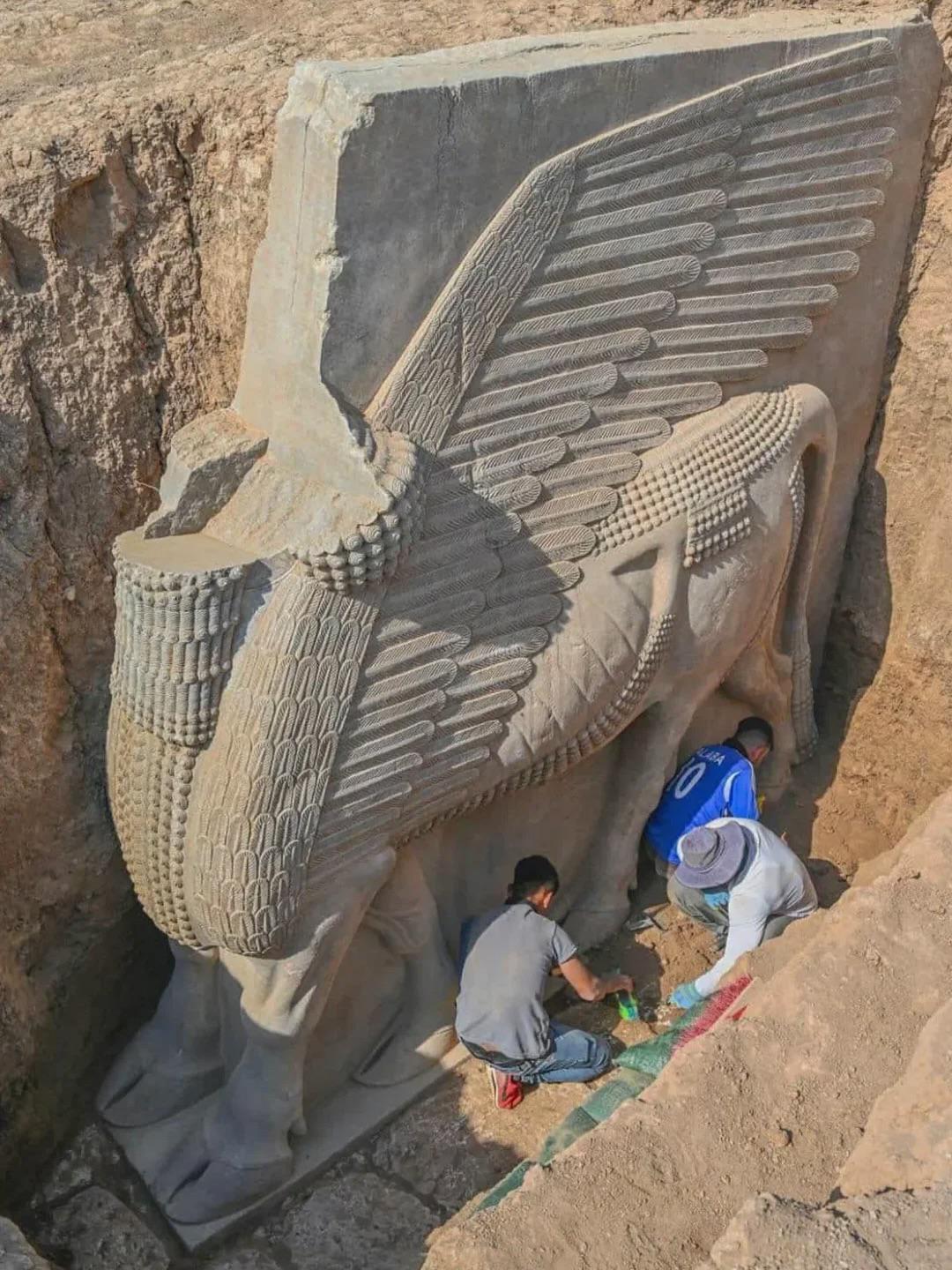
That is what you are looking at in that Reddit photo: not just a cool statue, but a fragment of a vanished superpower. By the time this lamassu was buried, Assyria had gone from unstoppable war machine to smoking ruin. The story of how it was created, forgotten, dug up, and even smashed again in the 21st century says a lot about how empires imagine themselves, and how fragile that imagination really is.
A lamassu is an Assyrian protective spirit, carved as a winged bull or lion with a human head, usually placed at palace or city gates. These colossal figures were meant to terrify enemies and reassure subjects that the king’s power was backed by the gods. They are propaganda in stone.
Why did the Assyrians build Dur‑Sharrukin in the first place?
The lamassu in the photo comes from Dur‑Sharrukin, “Fortress of Sargon,” a city that did not exist before one man decided he needed a fresh start. Around 722 BCE, Sargon II seized the Assyrian throne in circumstances that ancient sources politely gloss over. He was probably a usurper. That meant he had a legitimacy problem.
Assyria at this point was the bully of the Near East. Its armies smashed cities from the Mediterranean to the Persian Gulf. But its kings still had to convince their own elites and priests that the gods approved of them. Sargon’s answer was to build a brand‑new capital from scratch, away from the old power bases at Ashur and Nimrud.
Dur‑Sharrukin rose on a plain northeast of modern Mosul, near today’s village of Khorsabad. Archaeologists estimate its walls ran about 5 kilometers in circumference, enclosing palaces, temples, administrative buildings, and planned streets. Sargon ordered entire populations deported from conquered regions to provide labor. Royal inscriptions brag that people from across the empire helped build his dream city.
From the start, the place was designed as a stage set for power. The main palace complex had courtyards, reception halls, and gateways that forced visitors along a choreographed path. At each turn, they would confront carved stone slabs showing the king hunting lions, crushing enemies, and receiving tribute. The lamassu guarded the thresholds, announcing that you were entering the king’s domain and the gods were watching.
Dur‑Sharrukin was Sargon II’s attempt to rewrite the story of his own rise by rewriting the map of his empire. The city existed as a physical argument that he was chosen by the gods and secure enough to start from zero.
What exactly is a lamassu and why did Assyrians care so much?
To modern eyes, a lamassu looks like a fantasy creature out of a video game. To an Assyrian walking through the gate of Dur‑Sharrukin around 710 BCE, it was a very real guardian spirit. The word “lamassu” refers to a protective deity, usually female in earlier Mesopotamian tradition, but in Neo‑Assyrian art the form we know best is male, bearded, and royal.
Each lamassu is a composite. The bull’s body suggests strength and stability. The wings signal divine speed and reach. The human head carries intelligence and the familiar features of the ruling elite. The whole thing is wrapped in detailed carving: ringlets of hair, patterned feathers, stylized muscles. Many have five legs, a trick of ancient perspective so the figure looks stable from the front and striding from the side.
Lamassu were usually carved from single blocks of gypsum or limestone and could weigh 10 to 30 tons or more. They flanked gateways in pairs, sometimes with a third figure set between them. Inscriptions on their sides or beneath their feet often invoke blessings for the king and curses on anyone who would damage the monument.
In simple terms, a lamassu is an Assyrian guardian statue, meant both to protect a space spiritually and to project royal authority physically. They are security systems, propaganda posters, and religious icons carved into one body.
By lining his palace and city gates with lamassu, Sargon II turned Dur‑Sharrukin into a kind of stone prayer and stone threat. Anyone entering the city had to pass under the gaze of these hybrid beings, reminded that the king’s power was not just military but cosmic.
Inside Dur‑Sharrukin: how did these guardians shape the city?
Dur‑Sharrukin was not just a collection of buildings. It was a controlled experience. The lamassu were the bouncers at every important threshold.
Visitors approaching the city would first see the massive mudbrick walls and towers. At the gates, lamassu flanked the entrances. Passing them meant crossing from the messy world of fields and villages into a realm ordered by the king. Inside, processional ways led toward the royal palace, where more lamassu guarded inner courtyards and throne rooms.
Archaeologists working at Khorsabad since the 19th century have mapped out this choreography. Reliefs show Sargon II receiving foreign envoys in halls whose doorways were framed by these winged bulls. The message was not subtle. If you were a minor king from some small Levantine city, you walked under stone creatures that said: you are small, this empire is large, and the gods approve of this arrangement.
Even the palace’s private areas used lamassu. They guarded doorways to residential quarters and storerooms. The king and his household lived with these figures as constant company. In a world where the line between religion and politics barely existed, that made sense.
By building Dur‑Sharrukin as a city of gates and guardians, Sargon II turned architecture into a political weapon. The lamassu did not just decorate the city, they controlled how people moved, what they saw, and how they understood the king’s place in the universe.
The sudden end of Dur‑Sharrukin: why was it abandoned so quickly?
Here is the twist that surprises a lot of people when they first read about that Reddit lamassu. Dur‑Sharrukin was barely finished when it was abandoned.
Sargon II died in battle around 705 BCE, fighting against enemies in Anatolia. For an Assyrian king, dying in war was not just bad luck. It was a bad omen. He died far from home, his body apparently not recovered. In Mesopotamian thought, that raised questions about his relationship with the gods and his ability to rest properly in the afterlife.
His son and successor, Sennacherib, did not want to inherit that baggage. He moved the capital to Nineveh, a more established city on the Tigris. Construction at Dur‑Sharrukin stopped. Some buildings were probably never fully completed or occupied. The grand experiment in starting fresh ended almost as soon as it began.
Dur‑Sharrukin did not vanish overnight. People likely lived and worked there for some time. But as the political center shifted, the city slipped into the background. When the Assyrian Empire itself collapsed around 612 BCE, crushed by a coalition of Babylonians and Medes, Dur‑Sharrukin’s lamassu were left to the elements and to looters.
Within a few centuries, the mudbrick walls eroded into low mounds. The stone guardians, too heavy to move easily, slowly sank under windblown soil. The city that was supposed to rewrite Assyria’s story became a short, strange chapter instead.
The abandonment of Dur‑Sharrukin turned its lamassu into accidental time capsules. Because the city was used for such a short period, its art and architecture give a sharp snapshot of one king’s vision, frozen almost at the moment of completion.
How were the lamassu of Dur‑Sharrukin rediscovered and moved?
Fast forward more than 2,500 years. In the 1840s, European archaeologists began poking around the mounds of northern Iraq, hunting for the cities mentioned in the Bible and classical texts. Paul‑Émile Botta, the French consul at Mosul, started excavating at a site called Khorsabad in 1843. He hit stone walls, reliefs, and then the first lamassu of Dur‑Sharrukin.
These finds caused a sensation in Europe. Newspapers printed engravings of the winged bulls. The French government funded more work. Huge stone figures were cut from the palace gateways, dragged on rollers, and floated down the Tigris on rafts. Several lamassu from Dur‑Sharrukin ended up in the Louvre in Paris, where they still flank museum doorways today.
Later, American and Iraqi teams also excavated at Khorsabad. Some lamassu went to the Oriental Institute in Chicago. Others remained in Iraq, in museums or still half‑buried on site. The lamassu in the Reddit photo is likely one of these later finds, uncovered by modern Iraqi or international teams using cranes and careful recording rather than 19th‑century brute force.
People often ask why so many lamassu are in Western museums. The short answer is: early archaeology was tied to imperial politics. European powers treated ancient Near Eastern sites as quarries for art and prestige. Local authorities had little power to stop them. Today, that history fuels debates about repatriation and who should own objects like these.
The rediscovery and removal of the Dur‑Sharrukin lamassu turned them from buried guardians of a dead empire into ambassadors of Assyrian culture in faraway capitals, while also stripping Iraq of some of its most important ancient monuments.
Destruction and survival: what happened to lamassu in modern Iraq?
The story does not stop with 19th‑century exports. In the 20th and 21st centuries, the lamassu of Iraq were caught in new storms.
During the Iran‑Iraq War and the 2003 invasion of Iraq, archaeological sites suffered from neglect, looting, and damage. Then, in 2014, the extremist group ISIS captured Mosul and large parts of northern Iraq. They targeted ancient sites and museums, including those with Assyrian monuments.
In 2015, ISIS released videos of militants smashing lamassu and other sculptures at the Mosul Museum and at the site of ancient Nineveh. They used sledgehammers and drills. They claimed these were idols, forbidden by their interpretation of Islam, and symbols of pre‑Islamic empires they wanted to erase.
Some of the objects in those videos were plaster casts, but others were genuine ancient pieces. The destruction horrified Iraqis and people worldwide. It also made the surviving lamassu, both in Iraq and abroad, feel newly fragile.
At Khorsabad itself, reports suggest that parts of the site were damaged during ISIS’s occupation of the region, though the full extent is still being studied. Iraqi archaeologists and international teams have since worked to document, conserve, and, where possible, restore what remains.
The modern attacks on lamassu showed that these 2,700‑year‑old guardians are still politically charged. They are not just art. They are symbols of identity, power, and history, which makes them targets in times of conflict.
Why does this 2,700‑year‑old lamassu matter today?
So you have a half‑buried stone bull with wings and a human face. Why should anyone outside a small circle of archaeologists care?
First, lamassu like the one at Dur‑Sharrukin are some of the clearest visual records we have of the Assyrian Empire at its height. They show how the Assyrians imagined power: hybrid, overwhelming, backed by gods and armies. They turn abstract history about “empires” into something you can stand next to and feel small.
Second, their story ties together a long chain of human choices. A king with shaky legitimacy builds a new capital. He fills it with guardian spirits to project confidence. His son abandons the project. The empire falls. Farmers plow over the ruins. Foreign archaeologists dig them up. Museums claim them. Extremists smash some. Others are carefully lifted by cranes in the Iraqi sun, watched by a global audience on Reddit.
Third, lamassu have become symbols in contemporary Iraq and in the Assyrian diaspora. Modern Assyrians, a Christian minority whose roots trace back to ancient Mesopotamia, often use the lamassu as an emblem of identity. For them, these are not just ancient sculptures but proof of deep historical roots in a region where they have faced persecution and displacement.
When archaeologists unearth a lamassu at Dur‑Sharrukin today, they are not just rescuing a piece of art. They are reopening a conversation about who owns the past, how we protect it, and how stories of empire and collapse echo into the present.
The lamassu in that photo is doing the job it was carved to do, just in a different way. It still guards a threshold. On one side is a forgotten Assyrian capital. On the other is our world, trying to decide what to remember, what to repair, and what to learn from a stone guardian that has seen empires rise and fall.
Frequently Asked Questions
What is an Assyrian lamassu and what was its purpose?
A lamassu is a protective deity from ancient Assyria, usually carved as a winged bull or lion with a human head. These colossal statues were placed at palace and city gates to guard against evil, project royal authority, and visually link the king’s power to the gods.
Where was Dur-Sharrukin and why was it built?
Dur-Sharrukin, meaning “Fortress of Sargon,” was a planned capital city built by the Assyrian king Sargon II around the late 8th century BCE. Located near modern Khorsabad in northern Iraq, it was created as a new political and ceremonial center to legitimize his rule and display imperial power.
Why was the Assyrian city of Dur-Sharrukin abandoned so quickly?
Dur-Sharrukin was largely abandoned after Sargon II died in battle around 705 BCE. His son Sennacherib viewed that death as a bad omen and moved the capital to Nineveh. As a result, construction stopped and the city never became the long-term capital its founder intended.
How did Assyrian lamassu end up in European and American museums?
In the 19th century, French, British, and later American archaeologists excavated Assyrian sites like Khorsabad and Nineveh. Working under imperial-era agreements that favored foreign powers, they shipped many lamassu and reliefs to museums in Paris, London, and Chicago. This history fuels current debates about repatriation and cultural ownership.