Picture this. You are a merchant in Britain around the year 380. You can walk on paved roads from Londinium to Verulamium, pay your taxes in coin, hire a lawyer if someone cheats you, and send a letter that might actually arrive.
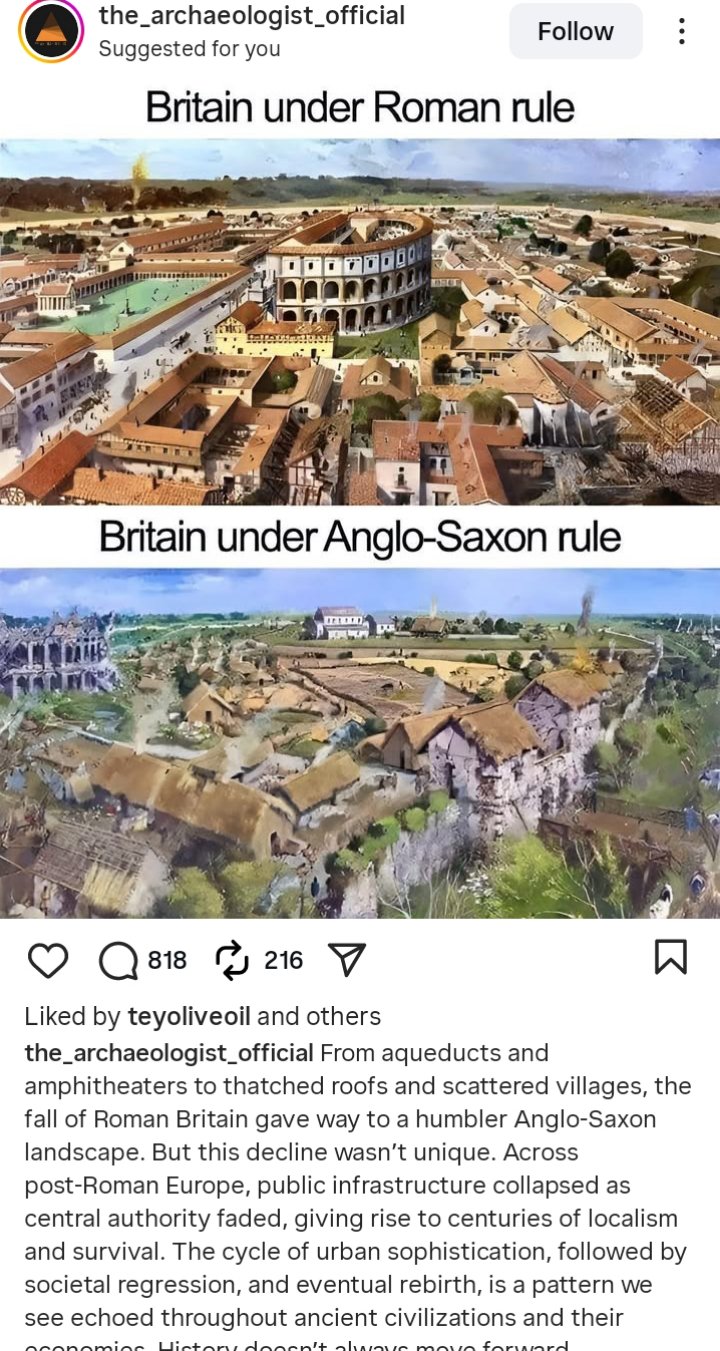
Now jump two hundred years. The roads are broken, the town walls are crumbling, the coins have mostly vanished, and the man who settles your dispute is not a magistrate but a warlord and his followers.
That is the gap people feel when they ask why Anglo‑Saxon Britain was “so much worse” than Roman Britain. The short answer: Roman Britain was plugged into a wealthy imperial system. Anglo‑Saxon Britain grew out of its ruins as a poorer, more local, more violent society. The long answer needs five big changes.
Here are five concrete ways life in Anglo‑Saxon Britain differed from Roman Britain, with real places, people, and why each change mattered.
1. From paved highways to muddy tracks: the road and town collapse
What it is: Roman Britain had a dense network of paved roads and planned towns tied into a tax and military system. By the early Anglo‑Saxon period, many roads decayed and most Roman towns shrank or were abandoned, leaving a far more rural, fragmented society.
Roman Britain was webbed with stone roads: Watling Street from Dover to Wroxeter, Ermine Street from London to York, the Fosse Way cutting diagonally across the island. These were not just lines on a map. They were the arteries of tax collection, troop movement, and trade.
Along them sat planned towns and cities. Londinium with its bridge and forum. Verulamium (near modern St Albans) with its basilica. Corinium (Cirencester), one of the largest cities in Roman Britain. Archaeologists find stone buildings, bathhouses, mosaics, and street grids. This was an urbanized province by Roman standards.
By the 5th and 6th centuries, that world had cracked. The imperial army left around 410. Central tax collection collapsed. Without a state to maintain them, many roads fell into disrepair. People still used the routes, but the paving broke up, bridges failed, and drainage went bad.
The towns suffered even more. Excavations at places like Wroxeter and Silchester show public buildings abandoned, reused as workshops or animal pens, then left to rot. Londinium’s population shrank so much that by the 6th century the main settlement had shifted to the area of Lundenwic, a smaller trading site to the west.
There were exceptions. Canterbury and York kept some life, partly because they became early church centers. But compared to Roman Britain, Anglo‑Saxon England before about 800 was far less urban. Most people lived in small villages or isolated farmsteads like the one excavated at West Stow in Suffolk: timber halls, sunken huts, no paved streets.
Concrete example: Verulamium is a clear case. Once a thriving Roman town with stone public buildings, it was largely abandoned by the early Anglo‑Saxon era. The nearby early English settlement grew up outside the old walls, using Roman ruins as a quarry for building stone.
Why it mattered: Fewer functioning roads and towns meant slower travel, weaker markets, and less political coordination. It was harder to move grain in a famine or troops in a crisis. Power became local because the infrastructure that supported a province‑wide system had fallen apart.
2. From coin and tax to tribute and gift: the economy shrinks and localizes
What it is: Roman Britain ran on a cash economy tied to imperial tax, long‑distance trade, and standardized goods. Early Anglo‑Saxon Britain shifted to a more local, in‑kind economy, where wealth was measured in land, livestock, and war booty, not regular coin.
Under Rome, Britain paid taxes in money and kind. Soldiers on Hadrian’s Wall were paid in coin. Merchants used Roman currency to buy imported wine, oil, and fine pottery. Hoards of Roman coins turn up across the province, especially from the 3rd and 4th centuries.
That system depended on imperial bureaucracy and army payrolls. Once those vanished, the cash economy withered. Archaeologists see a sharp drop in coin finds after the early 5th century. For long stretches of the 5th and 6th centuries, there is little to no new coinage in circulation in what became England.
Instead, wealth became more personal and physical. Kings and warlords rewarded followers with land, slaves, and loot. The famous Sutton Hoo burial in Suffolk, probably early 7th century, is a snapshot of that world: a ship packed with gold, silver, weapons, and feasting gear, but no sign of tax documents or coin chests.
Trade did not vanish. There were still imported goods. Pottery from Gaul and the eastern Mediterranean shows up at high‑status sites like Tintagel in Cornwall and some Kentish cemeteries. But this was elite exchange, not the broad, taxed market of a Roman province.
Only in the 7th and 8th centuries do we see a new money economy emerging, with small silver coins (sceattas) and trading towns like Hamwic (Southampton) and Ipswich. For about two centuries before that, everyday economic life was narrower and more local.
Concrete example: Compare a 4th‑century Roman villa like Chedworth in Gloucestershire, with its mosaics and bathhouse, to an early Anglo‑Saxon hall site such as Yeavering in Northumbria. Chedworth is tied into a money and goods economy. Yeavering is a royal site where power is expressed in feasts, gifts, and warbands.
Why it mattered: A weaker cash economy meant fewer specialists, less surplus, and more vulnerability. Without regular tax and markets, kings had less stable revenue and ordinary people had fewer ways to buffer bad harvests or buy imported necessities.
3. From Roman law to feud and wergild: how violence was handled
What it is: Roman Britain had formal courts, written law, and imperial officials. Early Anglo‑Saxon England relied more on personal lordship, feud, and compensation payments, with written law codes only emerging slowly and unevenly.
Under Rome, Britain was part of a legal machine. Governors, magistrates, and local councils applied Roman law. There were written statutes, legal procedures, and appeals. We know from inscriptions and documents elsewhere in the empire how this worked. Britain would have followed the same pattern.
After Rome, that framework vanished. There was no imperial governor in York or London. No standardized courts. Instead, disputes were settled in assemblies and halls, backed by the threat of private violence.
Early Anglo‑Saxon law codes, like those of King Æthelberht of Kent (early 7th century) and Ine of Wessex (late 7th century), show a world where compensation was central. If you killed a man, you paid his kin a wergild, literally “man‑price.” The amount depended on his status. If you refused, feud and bloodshed followed.
These codes are impressive in their own right. Æthelberht’s law is one of the earliest Germanic law codes we have. But they are short, focused on fines and status, and limited in scope compared to Roman law. They were also regional. Kent’s rules were not Northumbria’s rules.
Violence was common enough that kings had to legislate against fighting in churches or at royal courts. The fact those laws exist tells you the problem was real.
Concrete example: Æthelberht’s law code, probably written down around 600–620, sets a wergild of 50 shillings for killing a free Kentishman, but 300 shillings for a nobleman. In Roman law, by contrast, citizens were notionally equal before the law, even if reality was messier.
Why it mattered: Weaker central law and reliance on feud made life more precarious. Justice depended on your kin group and your lord, not an impersonal state. That raised the stakes of every insult, injury, and land dispute.
4. From Latin literacy to oral tradition: who could read and write
What it is: Roman Britain had a literate elite using Latin for administration, trade, and religion. Early Anglo‑Saxon England saw a sharp drop in literacy, with writing largely confined to the church until the 8th century.
In Roman Britain, literacy was not universal, but it was present and practical. We have the Vindolanda tablets from a fort near Hadrian’s Wall, written around 100–120. They include shopping lists, birthday party invitations, and duty rosters. That is everyday writing, not just high literature.
Latin inscriptions on altars, tombstones, and public buildings show that local elites used writing to record names, titles, and dedications. Bureaucrats kept tax records and military reports, even if those have mostly rotted away.
After the Roman withdrawal, that written culture thinned out. For the 5th and 6th centuries in what became England, we have almost no written documents produced locally. The incoming Anglo‑Saxon elites were not Latin‑educated. Their culture was oral: poems, genealogies, and law remembered by specialists, not written down.
Writing returned with Christianity, first in the Celtic church in places like Iona and then with Roman missionaries such as Augustine of Canterbury in 597. Monasteries at Wearmouth‑Jarrow, Canterbury, and elsewhere became scriptoria. By the time of Bede in the early 8th century, Northumbria could produce a scholar who wrote a detailed Latin history of the English people.
But that took centuries. For a long stretch after Rome, written records are thin. Even kings like Penda of Mercia (died 655) left no charters in their own words. We know them only from later writers.
Concrete example: Compare the Vindolanda tablets with the Sutton Hoo burial. Vindolanda gives us named individuals writing about socks and beer. Sutton Hoo gives us dazzling objects but no texts. The silence is telling.
Why it mattered: Less literacy meant less formal record‑keeping, weaker memory of contracts and boundaries, and fewer ways for ordinary people to access distant authority. History itself became hazier, which is why the 5th and 6th centuries in Britain are so hard to reconstruct.
5. From provincial backwater to frontier war zone: security and identity
What it is: Roman Britain, especially in the 4th century, was a defended but integrated province. Early Anglo‑Saxon Britain was a patchwork of competing kingdoms, frequent warfare, and shifting ethnic identities, with no single authority until much later.
Under Rome, Britain was a frontier, but it was a managed one. Hadrian’s Wall and later the Antonine Wall marked the northern limits. Legions and auxiliary units garrisoned forts. Rebellions and raids happened, but there was a professional army to respond.
By the early 5th century, that system was fraying. Saxon raiders hit the coasts. Picts and Scots raided from the north and west. Roman troops were pulled back to fight on the continent. Around 410, the emperor Honorius reportedly told the British cities to look to their own defense.
What followed was not instant collapse but a long, messy transition. Local Romano‑British leaders tried to hold on. Figures like Ambrosius Aurelianus, mentioned by later writers, may have led resistance against Anglo‑Saxon groups. The legendary Battle of Mount Badon, probably late 5th or early 6th century, was remembered as a major British victory, though details are murky.
By the 7th century, the map looked very different. Anglo‑Saxon kingdoms such as Northumbria, Mercia, Wessex, Kent, and East Anglia dominated much of what is now England. Warfare between them was common. Bede’s history reads like a grim scoreboard of battles and assassinations.
Identity shifted too. Under Rome, “Briton” was a provincial label inside a larger Roman identity. In the early medieval period, people began to think of themselves as “Englisc,” “Westseaxe” (West Saxons), or “Mierce” (Mercians), while the descendants of the Romano‑British in Wales and Cornwall became the “Wealas,” foreigners in their own land.
Concrete example: The Battle of Maserfield in 642, where Penda of Mercia killed Oswald of Northumbria, shows the new order. Two regional kings fought for dominance, with religious overtones, and the result reshaped power in central England. There was no imperial governor to step in, only the sword.
Why it mattered: Life in a patchwork of warring kingdoms was less predictable than life in a distant but stable empire. Security depended on your local ruler’s strength. Ethnic and political identities hardened along new lines, setting up the later story of England, Wales, and Scotland.
So was Anglo‑Saxon Britain “worse”? In some ways, yes. Roman Britain had better roads, more cities, a stronger cash economy, more formal law, and broader literacy. For many people, especially in towns and villas, daily life probably felt safer and more connected under Rome.
But the story is not a straight fall from light to darkness. Anglo‑Saxon England created its own achievements: rich art like the Lindisfarne Gospels, legal codes that tried to tame feud, and eventually a unified kingdom that could resist Viking armies. It was not Roman. It was something new, built on the rubble.
The contrast matters because it reminds us how much of “civilization” depends on invisible systems: roads, coins, courts, schools. When those go, life can change fast. Britain between Rome and the Anglo‑Saxons is one of the clearest case studies of what happens when an imperial world ends and a very different one grows in its place.
Frequently Asked Questions
Was life better in Roman Britain or Anglo-Saxon England?
For many people, especially urban elites, life in Roman Britain was better in terms of infrastructure, trade, and legal protection. Roman Britain had paved roads, functioning towns, a cash economy, and formal courts. Early Anglo-Saxon England was poorer, more rural, and more violent. That said, by the 8th and 9th centuries some Anglo-Saxon regions had regained significant wealth and cultural life, though on different terms than under Rome.
Did Roman towns in Britain completely disappear after 410?
Most Roman towns in Britain declined sharply or were abandoned between the 5th and 7th centuries, but not all vanished overnight. Places like London, York, and Canterbury kept some form of settlement, often shifting location or function. Many Roman sites, such as Verulamium and Silchester, lost their urban character and became quarries for building stone or small rural centers rather than true cities.
Did the Anglo-Saxons destroy Roman civilization in Britain?
The change was less a single act of destruction and more a long, uneven transition. Roman institutions in Britain were already weakening in the late 4th and early 5th centuries. Incoming Anglo-Saxon groups settled in a province whose tax system, army, and urban life were collapsing. There was violence and displacement, but also continuity in farming, some trade routes, and the use of Roman sites. The result was a new, mixed society rather than a simple wipeout.
Why did literacy decline after the Romans left Britain?
Literacy in Roman Britain depended on imperial administration, the army, and Latin education for local elites. When those institutions disappeared, there was little incentive or infrastructure to maintain widespread writing. The incoming Anglo-Saxon elites were not Latin-trained, and their culture was mainly oral. Only with the spread of Christianity and the growth of monasteries from the 6th century onward did Latin literacy return, first for church use and then for royal documents.