Somewhere around 1650 BCE, a tired Egyptian scribe sat with a reed brush, a sheet of papyrus, and a list of math problems.
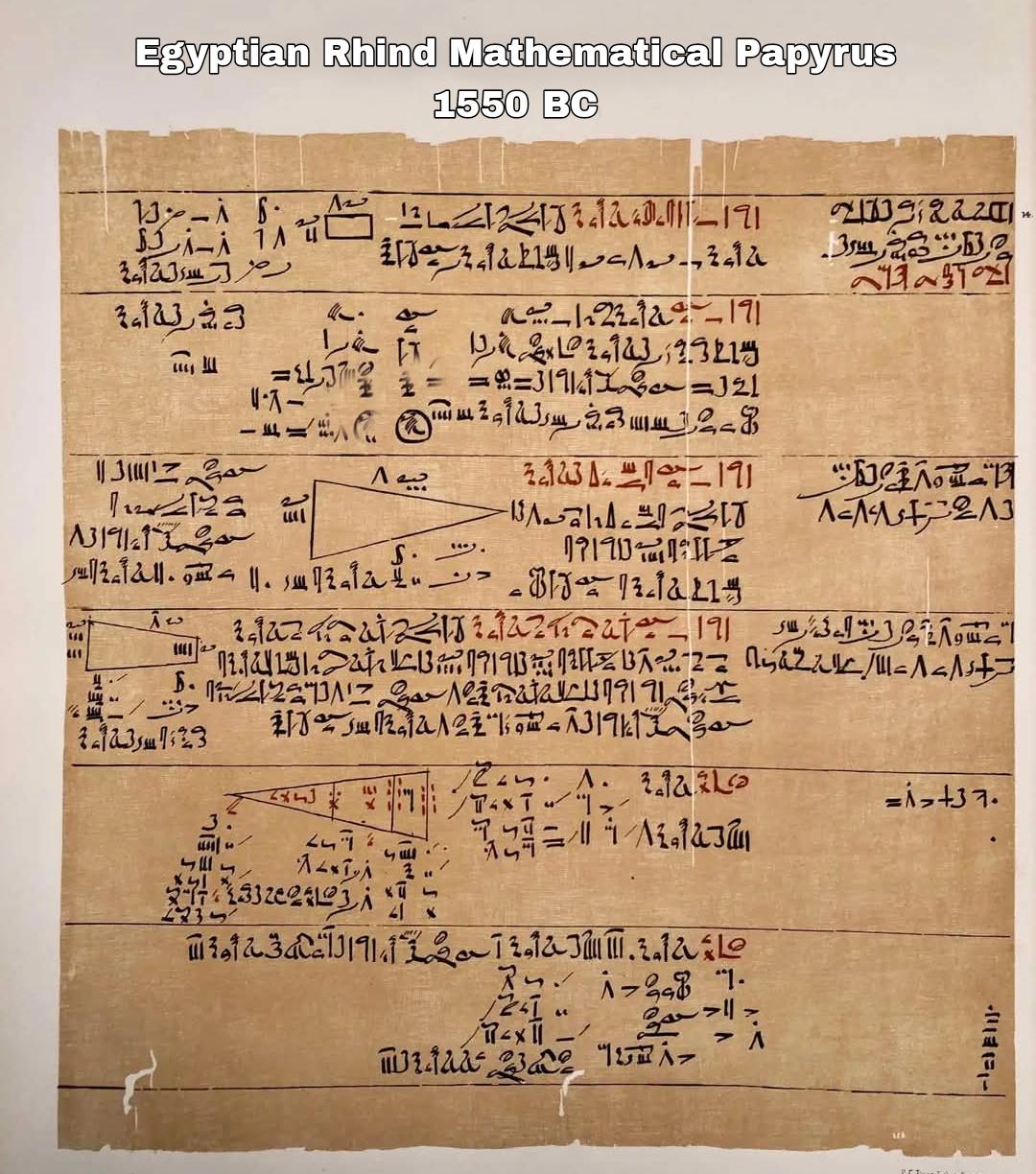
His world was not stable. Egypt was split between native rulers in the south and foreign Hyksos kings in the north. Armies moved. Trade shifted. Yet on this narrow strip of papyrus, the scribe calmly worked through how to find the area of a circle, how to divide loaves of bread, and how to calculate the volume of a granary.
That is the strange power of the so‑called “geometry papyri” from ancient Egypt. Written in hieratic, the quick cursive script of everyday scribes, they look like school worksheets. In fact, they are one of our best windows into how people 3,500 years ago thought about numbers, shapes, and the practical problems of running a kingdom.
This is the story of those papyri, the world that produced them, and why a sheet of brown, fraying plant fiber can still change how we think about the history of mathematics.
What is this 3,500‑year‑old Egyptian geometry papyrus?
When people online talk about a 3,500‑year‑old Egyptian geometry papyrus, they are usually circling around a small group of related documents: the Rhind Mathematical Papyrus, the Moscow Mathematical Papyrus, and a few lesser fragments. All were written in hieratic script and date to Egypt’s Middle Kingdom or Second Intermediate Period, roughly 2000–1550 BCE.
The Rhind Papyrus, for example, was copied around 1550 BCE by a scribe named Ahmose, who says he is copying an older Middle Kingdom text. It contains 84 problems. Some are simple arithmetic. Others are geometry and what we would now call algebra: finding unknown quantities, working with series, calculating areas and volumes.
Ancient Egyptian mathematical papyri are handwritten exercise books that mix worked examples, rules of thumb, and word problems. They were not abstract treatises. They were tools for training scribes to solve real administrative tasks.
So when you hear “geometry papyrus,” think of a scribal workbook. It is less like Euclid’s Elements and more like a well‑used exam prep book, complete with worked solutions.
This matters because it tells us not just what Egyptians could calculate in theory, but what they actually cared to teach and use.
Why did Egyptians need geometry and algebra in the Second Intermediate Period?
The Second Intermediate Period (about 1650–1550 BCE) was a time of fragmentation. The Hyksos, a dynasty of foreign rulers, controlled the Nile Delta in the north. Native Egyptian dynasties held the south from Thebes. Between them lay shifting borders, tribute, and uneasy coexistence.
Yet the Nile kept flooding. Fields still had to be measured. Grain had to be taxed, stored, and rationed. Temples and palaces needed to track labor, rations, and materials. None of that worked without people who could calculate with some precision.
Egyptian math grew out of three pressures:
First, agriculture. Every year the Nile flood erased field boundaries. Surveyors, called “rope‑stretchers,” used cords knotted at regular intervals to re‑measure plots. They needed methods to compute areas of rectangles, triangles, and approximated circles. Geometry was literally about land.
Second, storage and taxation. Grain was wealth. It sat in tall, rounded silos. To know how much tax had been collected or how much food was available for workers, scribes needed to estimate volumes. That meant formulas for cylinders and other shapes, even if expressed in their own terms.
Third, bureaucracy. Wages, rations, and supplies were all recorded in units and fractions. Dividing loaves among workers or splitting a quantity of beer required comfort with fractions and proportional reasoning. That is where the “algebra” problems come in: finding unknown shares from known totals.
Egyptian mathematics was a tool of statecraft. In a fractured era like the Second Intermediate Period, the ability to keep the books straight and the fields measured was part of how any regime kept control.
So what? The very existence of a geometry papyrus from this era shows that even in political crisis, Egypt kept investing in scribal education, because without math the state could not function.
How did hieratic script shape Egyptian math on papyrus?
The Reddit post notes that the papyrus is written in hieratic, a “simplified ancient Egyptian script.” That is exactly right, and it matters for how math was written and taught.
Hieroglyphs were the formal, pictorial script carved on temple walls and monuments. Hieratic was the everyday handwriting of scribes. Written with a brush on papyrus, it used flowing, abstracted signs that could be written quickly in horizontal lines.
Numbers in hieratic had their own shorthand symbols. There were separate signs for 1, 10, 100, 1,000, and so on, which could be repeated to build up any number. Fractions had special notations, especially the unit fractions like 1/2, 1/3, 1/5 that Egyptians loved.
Equations as we know them did not exist. There was no equal sign, no x or y. Instead, problems were written as short word stories. For example, a typical algebra‑type problem might say something like: “A quantity and its seventh make 19. What is the quantity?” The scribe then showed a method called “false position,” guessing a value, seeing how far off it was, and scaling the guess.
Geometry problems were written the same way. “A circular field has a diameter of 9 khet. What is its area?” The scribe then applied a rule: take 8/9 of the diameter, square it, and you have the area. That rule gives π ≈ 3.16, a decent approximation.
Hieratic made this kind of step‑by‑step reasoning easier to write quickly. It turned math into a running narrative that a student could follow and copy. The script and the math grew together.
So what? Because math was written in hieratic as worked stories, we can see not only Egyptian results but Egyptian methods, which lets us reconstruct how they thought about problems rather than just what answers they got.
What kinds of geometry and algebra problems did the papyri include?
The phrase “it has geometric and algebra problems” sounds almost casual, but the content is surprisingly rich.
On the geometry side, Egyptian papyri include problems for:
• Area of rectangles and squares, often for fields or building plots.
• Area of triangles and trapezoids.
• Area of a circle, using that 8/9‑of‑the‑diameter rule.
• Volume of cylindrical granaries and other storage shapes.
One famous problem from the Moscow Mathematical Papyrus asks for the volume of a truncated pyramid. The scribe gives a rule that, translated into modern notation, matches the correct formula. That is not just rule‑of‑thumb guessing. It shows a consistent way of handling three‑dimensional shapes.
On the algebra side, the papyri feature:
• Linear equations in one unknown, framed as word problems about shares, wages, or mixtures.
• Arithmetic and geometric series, especially for distributing goods over time.
• Problems about ratios, like mixing different grades of bread or beer.
Egyptian algebra was procedural. A typical solution might read: assume a value, calculate its result, compare to the target, then scale up or down. It is not symbolic algebra, but it is systematic problem solving with unknowns.
Ancient Egyptian mathematical papyri show that by 1800–1600 BCE, scribes could solve linear equations, work with series, and approximate π through practical rules. They did this without symbols, relying on verbal algorithms and unit fractions.
So what? The range of problems shows that Egyptian math was not just rote arithmetic. It was a toolkit for modeling real‑world situations, centuries before Greek geometry or Babylonian algebra were written down in the forms we usually learn about.
Were Egyptians “doing real math” or just practical tricks?
This is where modern expectations get in the way. People often assume that “real” mathematics starts with Greek proofs or with abstract algebra. By that standard, Egyptian math can look like a bag of tricks.
But that is a bad way to read these papyri.
First, Egyptians clearly generalized. The Rhind Papyrus opens with a kind of preface where the scribe Ahmose says he is explaining “methods of reckoning” and “the entering into things.” He is not just listing answers. He is teaching procedures that can be reused on new numbers.
Second, the methods are consistent. The same fraction decompositions, the same area rules, the same false‑position approach to unknowns appear across multiple papyri and inscriptions. That suggests a shared curriculum, not random hacks.
Third, the approximations are often quite good. The circle area rule that implies π ≈ 3.16 is not an accident. Someone tested and refined that rule enough that it became standard.
What Egyptian math lacks is explicit proof. Scribes did not argue that a rule was true in all cases. They showed that it worked in examples and passed it on. That is a different mathematical culture, not an absence of thought.
So what? Reading the geometry papyrus as “primitive” misses the point. It shows a mature, coherent style of mathematics aimed at solving administrative and engineering problems, which is a different but legitimate branch of the story of math.
How did these math papyri fit into scribal training and social power?
Every line of hieratic math on papyrus came from a very specific social world: the scribal school.
Scribes were the white‑collar class of ancient Egypt. They wrote letters, kept accounts, recorded taxes, copied religious texts, and drafted legal documents. Training to be a scribe took years. Boys, usually from elite or semi‑elite families, learned hieratic writing, copied classic texts, and practiced arithmetic and geometry.
Mathematical papyri like the Rhind or Moscow examples were part of that training. They gave students standard problems with worked solutions. A teacher could dictate a problem, have students copy it, then walk them through the steps.
Math knowledge was not neutral. It was tied to access to jobs in the temple, palace, or local administration. Knowing how to compute the volume of a granary or the area of a field meant you could be the one who decided how much tax someone owed or how much grain a work crew received.
So the geometry papyrus is not just a record of ancient curiosity. It is a tool of social reproduction. It helped turn sons of scribes into the next generation of bureaucrats who would keep the state running.
So what? The papyrus reminds us that mathematics has always been entangled with power. In Second Intermediate Egypt, as in many societies, math education was a gatekeeper to influence and security.
What happened after: did this Egyptian math go anywhere?
The Second Intermediate Period ended when Theban kings drove out the Hyksos and founded the New Kingdom around 1550 BCE. Egypt became a territorial empire stretching into the Levant and Nubia. Bureaucracy expanded. So did the need for trained scribes.
Mathematical practice continued. New Kingdom ostraca (pottery sherds used for notes) and papyri show similar fraction work and area calculations. The old Middle Kingdom problems kept being copied. Ahmose’s claim that he was copying an older text was not a one‑off. Egyptian scribal culture loved tradition.
Did this math influence Greece? Direct links are hard to prove. Greek writers like Herodotus and later authors claimed that Greek thinkers learned from Egyptian priests. There were certainly contacts, especially after Greek mercenaries and traders entered Egypt in the Late Period.
What we can say is this: by the time Greek mathematicians like Thales and later Euclid were active, Egypt had already been doing practical geometry and arithmetic for more than a thousand years. The idea that land, storage, and trade could be handled with consistent numerical rules was very old along the Nile.
So what? The geometry papyrus is part of a long Egyptian tradition that formed the mathematical background of the eastern Mediterranean, even if the exact lines of influence are hard to trace.
Why does a 3,500‑year‑old geometry papyrus still matter?
On its face, a Second Intermediate Period math papyrus is a quiet object. Brown. Fragile. Covered in tight, slanting hieratic signs. No famous pharaoh. No dramatic battle.
Yet it forces several adjustments in how we tell the story of human thought.
First, it pushes back the timeline of organized mathematical education. By 1800–1600 BCE, Egypt had not just arithmetic but a stable curriculum of geometry and algebra‑like reasoning taught to professional scribes.
Second, it reminds us that math history is not only about abstract proof. For centuries, the most important mathematics on earth was the kind that let officials measure fields, tax grain, and plan building projects. The Egyptian geometry papyrus is one of the clearest surviving records of that world.
Third, it gives ancient Egyptians their due as thinkers. They did not write like Greeks or calculate like Babylonians. They used unit fractions, word problems, and procedural rules. But they were solving the same kind of questions that still show up in schoolbooks: how to share fairly, how to scale quantities, how to approximate curved shapes with straight rules.
When a Reddit thread marvels at a 3,500‑year‑old geometry papyrus, it is catching a glimpse of that continuity. A student in Thebes, puzzling over the area of a circular field, is closer to a modern teenager wrestling with math homework than the distance in years suggests.
So what? Because of papyri like this, the history of mathematics is not just a line of famous names. It is also the story of anonymous scribes whose careful hieratic notes kept a fragile kingdom running and left us a record of how ordinary minds wrestled with numbers long before algebra had a name.
Frequently Asked Questions
What is the Rhind Mathematical Papyrus and why is it important?
The Rhind Mathematical Papyrus is an ancient Egyptian math text copied around 1550 BCE by a scribe named Ahmose, based on older material. Written in hieratic script, it contains 84 worked problems in arithmetic, geometry, and algebra‑like reasoning. It is important because it shows how Egyptian scribes were trained to solve real administrative problems, such as measuring fields and calculating grain rations, and it preserves their actual methods rather than just final answers.
Did ancient Egyptians really know geometry and algebra?
Yes. Egyptian mathematical papyri from around 2000–1600 BCE include problems on areas of rectangles, triangles, and circles, volumes of granaries and truncated pyramids, and linear equations in one unknown. Egyptians did not use symbolic algebra or formal proofs, but they used consistent verbal procedures to solve unknowns and approximate values like π. Their math was practical and procedural, but it was systematic and taught in scribal schools.
What is hieratic script and how was it used in math papyri?
Hieratic is a cursive form of ancient Egyptian writing used for everyday documents, written with a brush on papyrus. Unlike the pictorial hieroglyphs carved on monuments, hieratic signs are more abstract and faster to write. In math papyri, hieratic was used to write numbers, fractions, and word problems as running text. This allowed scribes to record step‑by‑step solutions, giving modern historians insight into Egyptian calculation methods.
How accurate were ancient Egyptian mathematical methods?
Egyptian methods were often quite accurate for their purposes. For example, their rule for the area of a circle, which takes 8/9 of the diameter and squares it, implies a value of π around 3.16, close to the true value of 3.14159. Their formula for the volume of a truncated pyramid matches the modern formula. While they relied on approximations and unit fractions, their results were good enough for surveying land, managing grain storage, and planning construction.